Airport Ground Handling Workwear: Sourcing Hi-Vis Safety Jackets & Polo Uniforms for Middle East Aviation Ramp Operations
Middle East airports are among the world's busiest aviation hubs — Dubai International handles over 90 million passengers annually, Hamad International in Doha is a global transit gateway, King Abdulaziz International in Jeddah serves millions of Hajj pilgrims, and Abu Dhabi and Riyadh airports are expanding for Vision 2030 tourism targets. Behind every departure and arrival is a ramp workforce — baggage handlers, aircraft marshals, fuel operators, ground support equipment drivers, cargo loaders, and ramp supervisors — who work in one of the most visibility-critical and vehicle-dense industrial environments on earth. This sourcing guide for Middle East B2B buyers covers EN ISO 20471 hi-vis safety jackets and logistics polo uniforms for airport ground handling, fabric specifications for tarmac conditions, compliance considerations, and volume procurement from a Chinese workwear manufacturer.

Buyer context
What procurement teams run into
The Middle East's aviation sector is one of the fastest-growing in the world. Dubai International Airport (DXB) is the world's busiest international airport, handling over 90 million passengers in 2024 and targeting 120 million in its expansion phase. Hamad International Airport (DOH) in Doha handles over 50 million passengers as the hub for Qatar Airways' global network. King Abdulaziz International Airport (JED) in Jeddah serves over 80 million passengers annually, peaking during Hajj season when pilgrim traffic exceeds 2.5 million in a two-week window. Abu Dhabi's Zayed International Airport, Riyadh's King Khalid International, and new airports in NEOM and the Red Sea Project are all expanding capacity. Every one of these airports operates 24/7, 365 days a year. Aircraft don't wait for comfortable temperatures. The ramp area — the apron, taxiways, and aircraft stands — is one of the most dangerous industrial work environments on earth, and it presents a unique combination of hazards that demand specific workwear solutions. For B2B buyers procuring workwear for airport ground handling workforces, the challenge is specific: **1. The airport ramp environment is uniquely visibility-critical and vehicle-dense** An airport ramp presents a combination of hazards that few other industrial environments match: - **Extreme vehicle density and speed.** Tug tractors, belt loaders, cargo dollies, fuel tankers, aircraft pushback tractors, aerobridge drivers, and de-icing vehicles operate in close proximity to workers on foot. Aircraft taxi at 10–30 km/h on the apron with jet blast behind them. A worker in standard clothing is nearly invisible against aircraft fuselage colours, tarmac surfaces, and terminal lighting — especially at night, in dawn/dusk transition, or during sandstorm-reduced visibility. - **Jet blast and propeller wash.** Workers near running engines face wind speeds exceeding 100 km/h from jet blast. Loose clothing, unsecured pockets, and inadequate garment fastening become safety hazards. Garments must stay secure in high-wind conditions. - **Extreme tarmac temperatures.** Airport tarmac surfaces in Gulf summers reach 65–75°C. Radiant heat from tarmac raises effective working temperature well above ambient. Workers face heat stress risk during 8–12 hour shifts. Garments must be lightweight and breathable while maintaining visibility and durability. - **Fuel and chemical exposure.** Fuel operators handle Jet A-1 aviation fuel. De-icing crews handle glycol-based fluids. Cargo handlers may encounter dangerous goods spills. Garments must resist fuel and chemical degradation and be easily laundered to remove hydrocarbon residues. - **Shift work across all lighting conditions.** Airport operations run 24/7. Workers transition between full daylight (extreme UV on open tarmac), dawn and dusk (low-angle sun creating glare and shadows), night operations under high-mast apron lighting, and sandstorm-reduced visibility. Hi-vis clothing must perform in all conditions. - **Passenger-facing areas.** Ground handling staff work not only on the ramp but also at aircraft doors, at check-in counters, and in terminal areas where passengers observe them. Appearance matters for airline brand representation. **2. Hi-vis safety jackets for ramp workers, baggage handlers, and ground support equipment operators** For every worker who spends time on the apron, near aircraft stands, or in ground support equipment operating zones, the hi-vis safety jacket is a life-saving garment. Airport ramps have dense vehicle traffic — tug tractors, fuel tankers, and cargo loaders operate in tight spaces around aircraft with limited visibility. A worker in standard clothing is extremely difficult to see against aircraft surfaces, especially at night. Key specifications when sourcing hi-vis jackets for airport ground handling from a Chinese manufacturer: **Fabric weight and composition.** Specify lightweight polyester 210–240gsm with mesh lining for Gulf conditions. Heavy hi-vis jackets are unbearable in 50°C+ tarmac heat (ambient plus radiant) — workers will remove them, defeating the safety purpose. A mesh-lined jacket allows air flow while keeping retroreflective tape visible. **EN ISO 20471 Class 3.** Class 3 offers the highest retroreflective coverage and is the right call for all workers who spend significant time on the apron — baggage handlers, aircraft marshals, fuel operators, cargo loaders, and ground support equipment drivers. Confirm the jacket meets EN ISO 20471 minimum retroreflective intensity (typically 330 cd/lx/m² for Class 3). **Fluorescent background and retroreflective tape.** Specify fluorescent yellow-green or orange fabric with retroreflective tape positioned to EN ISO 20471 geometry. The tape must be on the torso, arms, and around the shoulders for full-class coverage. For airport environments, specify tape with excellent adhesion that resists peeling from jet blast, fuel contact, and frequent washing. **Fuel and chemical resistance.** Airport hi-vis jackets face Jet A-1 fuel splashes, glycol de-icing fluid contact, hydraulic fluid, and lubricant exposure. Specify fabric and tape that maintain retroreflective performance after contact with aviation fuels and fluids. Confirm the fluorescent background fabric resists hydrocarbon-induced colour degradation. **Practical details for ramp work.** Two-way front zip (workers bend, crouch, and climb into cargo holds constantly). Zipped side pockets that close securely — dropped items on the ramp are FOD (foreign object debris) hazards that can damage aircraft engines. Adjustable cuffs that seal tight against jet blast. DWR finish with 5,000mm+ hydrostatic head for fuel and fluid splash resistance. **Durability.** Airport hi-vis jackets face constant abrasion from cargo dolly edges, aircraft fuselage contact, and ground support equipment. Specify reinforced shoulders and elbows, and confirm the retroreflective tape maintains performance after 50+ industrial wash cycles. **FOD-safe design.** No loose buttons, snaps, or trim that can detach and become foreign object debris. All closures must be secure. Zippers preferred over snaps. No external hanging labels or loose tags. **3. Logistics polo uniforms for supervisors, passenger-facing staff, and operations coordinators** Airport ground handling operations employ ramp supervisors, operations coordinators, customer service agents, check-in staff, and airline liaison officers who work both on the ramp and in terminal areas. These roles need a professional, brandable garment that represents the airline or ground handling company brand while providing comfort in extreme heat. Key specifications when sourcing polo uniforms for airport ground handling from a Chinese manufacturer: **Fabric.** 180–220gsm pique knit in 65% polyester / 35% cotton with moisture-wicking treatment and UPF 30+ sun protection. Ramp supervisors and operations coordinators spend significant time outdoors on the apron — sun protection is essential. **Collar and trim.** Ribbed collar with contrast piping in airline brand colours; tonal buttons; clean placket. The collar must hold its shape after repeated industrial washing and outdoor UV exposure. **Branding.** Embroidered chest logos with Pantone colour matching for airline or ground handler branding. Woven name tapes and role patches ("RAMP SUPERVISOR," "OPERATIONS," "CUSTOMER SERVICE," "LOAD CONTROLLER"). Airport branding is highly visible — passengers see ground staff at aircraft doors, at check-in, and in terminal areas. **Sizing.** Full size range (2XS–4XL+) with Middle East / South Asian body proportions for the multinational ground handling workforce. Gulf airports employ workers from South Asia, Southeast Asia, the Arab world, and Africa — sizing must accommodate diverse body types. **Colour fastness.** ISO 105 certified for Gulf sun and industrial laundering. Airport polo uniforms face 8–10 hours of direct UV daily on the tarmac plus frequent washing. Colours must not fade to an inconsistent patchwork appearance. **Moisture management.** Ramp supervisors and operations coordinators transition between outdoor apron work (extreme heat) and indoor operations rooms (air-conditioned). Garments must wick moisture efficiently in both environments to maintain comfort and professional appearance. **4. The hi-vis-and-polo system for complete airport ground handling uniform** The smartest procurement approach treats hi-vis jackets and polo uniforms as a unified uniform system: **Ramp workers (baggage handlers, cargo loaders, fuel operators, GSE drivers):** Logistics polo as base garment. Hi-vis jacket over the polo at all times when on the apron. The polo provides comfort and brand representation; the hi-vis jacket provides life-saving visibility. **Aircraft marshals and wing walkers:** Hi-vis jacket mandatory at all times on the apron. Polo underneath for comfort and branding. Additional reflective accessories (armbands, helmet tape) for maximum visibility during aircraft pushback operations. **Ramp supervisors and operations coordinators:** Polo uniform with company branding as daily garment. Hi-vis jacket when on the apron. Distinctive polo colour (e.g., white or light blue vs. dark colours for ramp workers) for instant recognition by ramp crews and airline operations staff. **Customer service agents and check-in staff:** Polo uniform as primary garment for terminal areas. No hi-vis jacket needed in passenger-facing terminal zones, but supervisors who walk between terminal and ramp need hi-vis jacket accessible. **Load controllers and operations room staff:** Polo uniform for indoor operations room work. Hi-vis jacket for occasional ramp visits and aircraft loading inspections. This system means one colour palette for polos (aligned with airline or ground handler brand colours), one hi-vis standard, one manufacturer, and one procurement process covering the full ground handling operation. **5. Compliance and testing for airport ground handling workwear** Relevant standards for Middle East airport operations: - **EN ISO 20471** — high-visibility clothing. Class 3 for all workers on the apron and in vehicle zones. Insist on third-party test reports from accredited labs (SGS, TÜV, Intertek, Bureau Veritas) covering retroreflective performance after washing and fabric colour fastness. - **EN ISO 13688** — general requirements for protective clothing (ergonomics, sizing, ageing, marking). Applies to both hi-vis jackets and polo uniforms. - **ISO 105-B02** — colour fastness to light (xenon arc). Critical for Gulf airport sites where garments face 8–10 hours of direct UV daily on open tarmac. - **ISO 15797** — industrial laundering durability. Airport workwear is washed at 60–75°C in industrial machines. Specify dimensional change ≤ 3% after 50+ wash cycles. - **OEKO-TEX Standard 100** — restricted substances. Workers in extreme heat sweat heavily; skin contact with harmful chemicals is a real concern. - **Airport-specific HSE requirements.** Major airports (DXB, DOH, JED) have internal HSE standards for ramp PPE that exceed national regulations for hi-vis performance, FOD-safe garment design, and fuel-resistant specifications. Confirm the manufacturer can meet airport-specific requirements. - **IATA Ground Operations Manual (IGOM)** — industry guidelines for ground handling safety, including PPE requirements for ramp workers. While not legally binding, many airports and airlines require IGOM compliance from ground handling contractors. **6. Procurement strategy for airport ground handling buyers** Airport ground handling operations have distinctive procurement patterns: **Volume and frequency.** A mid-size Gulf airport employs 500–3,000 ground handling staff (depending on whether services are operated by the airport authority, a dedicated ground handling company, or airline subsidiaries). Order hi-vis jackets in bulk (500–3,000 units) for initial fleet outfitting, then reorder quarterly for replacements (hi-vis jackets wear quickly on the ramp due to constant abrasion and fuel contact). Order polo uniforms in similar volumes with semi-annual reorders. **Consolidate orders.** Order hi-vis jackets and polo uniforms in one shipment to reduce freight costs and simplify customs clearance at Dubai, Doha, Jeddah, or Abu Dhabi airports. A Chinese manufacturer with in-house capability for both garment types can produce and ship them together. **Plan for seasonal timing.** Order hi-vis jackets year-round based on consumption rates — these are high-turnover items on the ramp. Order polo uniforms 3–4 months before peak seasons (Hajj season for Jeddah, winter tourism season for Dubai and Doha, summer holiday peaks). Avoid ordering for delivery during Ramadan production slowdowns. **Stock buffer.** Order 25–30% buffer stock above annual requirements. Airport hi-vis jackets wear out quickly — fuel contact, abrasion from cargo equipment, and jet blast damage shorten garment life. Reordering small batches of custom-branded garments costs far more per unit than including buffer in the original production run. **Pilot before full volume.** Order 50–100 hi-vis jackets and 50–100 polo uniforms for a trial fitting before committing to the full airport order. Adjust sizing, fabric weight, pocket placement, and branding specifications based on field feedback from baggage handlers, ramp supervisors, and operations coordinators. **Standardise across airlines and ground handlers.** Whether your airport serves full-service carriers, low-cost airlines, or cargo operators, the same hi-vis-and-polo system works. Standardise on one hi-vis class across all ground handling companies operating at your airport — this ensures consistent safety standards and makes all ramp workers instantly identifiable.
Sourcing approach
How a factory partner can respond
The solution for Middle East airport ground handling operations is a two-garment workwear system — EN ISO 20471 Class 3 hi-vis safety jackets for all ramp workers, baggage handlers, fuel operators, cargo loaders, and ground support equipment drivers who work on the apron, paired with logistics polo uniforms for ramp supervisors, operations coordinators, customer service agents, and passenger-facing staff — sourced from a single Chinese workwear manufacturer for consistent quality, consolidated shipping, and volume pricing. **For hi-vis safety jackets (all ramp workers):** - Lightweight polyester 210–240gsm with mesh lining for Gulf tarmac heat (ambient plus radiant) - EN ISO 20471 Class 3 with fluorescent yellow-green or orange fabric - Retroreflective tape on torso, arms, and shoulders (330 cd/lx/m² minimum) - Fuel and chemical resistant — fabric and tape maintain performance after contact with Jet A-1 fuel, glycol de-icing fluid, and hydraulic fluid - Two-way front zip, zipped side pockets (FOD-safe — no loose items on ramp), adjustable cuffs sealing against jet blast, DWR finish (5,000mm+ hydrostatic head) - FOD-safe design: no loose buttons or trim, secure closures only, no external hanging labels - Reinforced shoulders and elbows for abrasion against cargo equipment and aircraft fuselage - Third-party test reports from SGS, TÜV, Intertek, or Bureau Veritas **For logistics polo uniforms (supervisors, passenger-facing staff, operations coordinators):** - 180–220gsm pique knit in 65% polyester / 35% cotton with moisture-wicking and UPF 30+ sun protection - Ribbed collar with contrast piping in airline brand colours; tonal buttons; clean placket - Embroidered chest logos with Pantone colour matching; woven name tapes and role patches - Full size range (2XS–4XL+) with Middle East / South Asian body proportions for multinational workforce - ISO 105 colour-fastness certified for Gulf tarmac sun and industrial laundering - Moisture management for transition between outdoor apron and indoor operations areas **Procurement strategy:** - Treat hi-vis jackets and polo uniforms as a unified uniform system across all ground handling functions - Consolidate both garments into one shipment to reduce freight and simplify customs - Order hi-vis jackets year-round based on consumption (high-turnover items); order polos 3–4 months before peak seasons - Stock 25–30% buffer for replacement cycles (ramp hi-vis jackets face accelerated wear from fuel, abrasion, and jet blast) - Pilot 50–100 units per garment type before full fleet commitment - Standardise on one hi-vis class across all ground handling companies at the airport for consistent safety
Recommended Products
Products that fit this use case
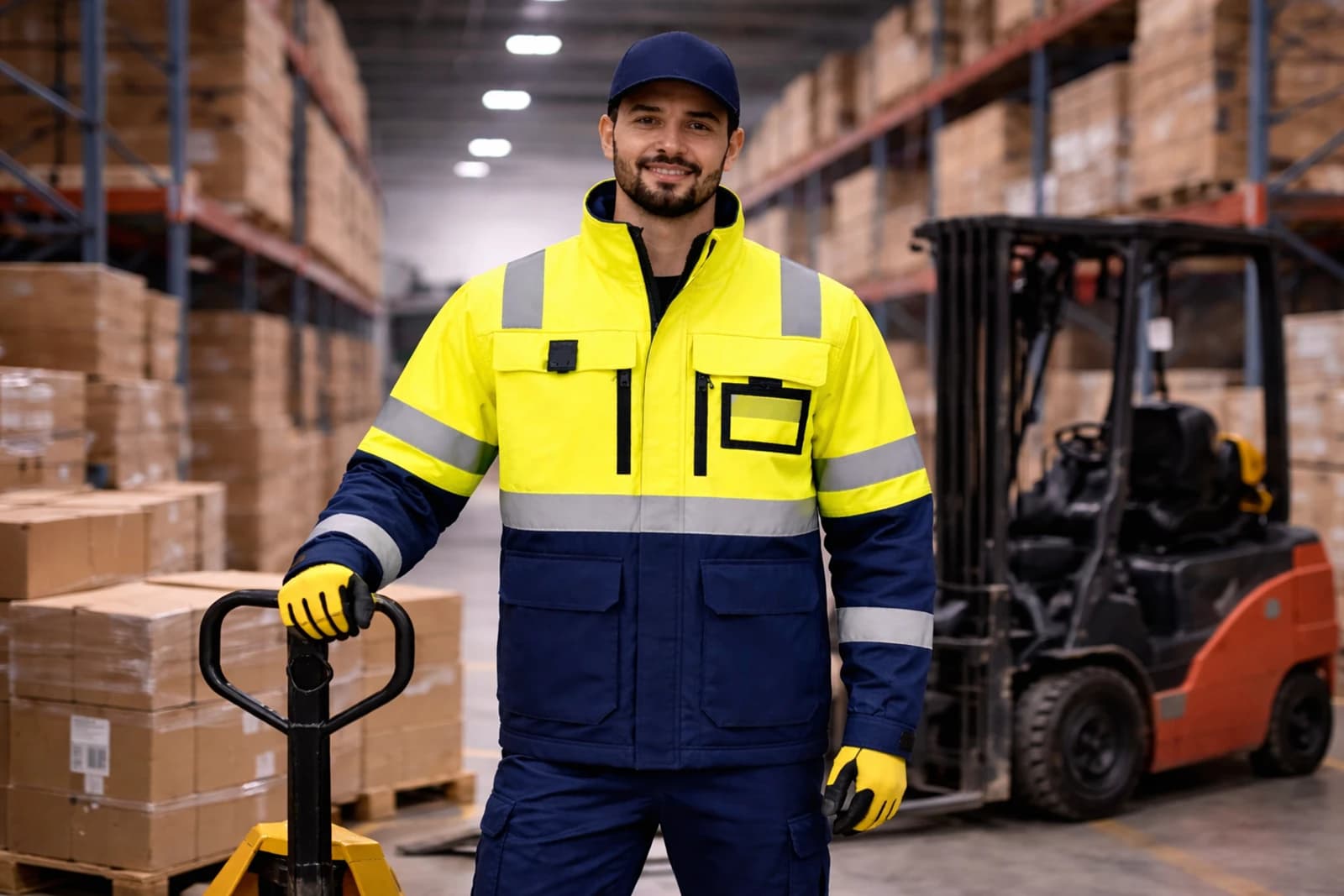
Safety Uniform
Hi-Vis Safety Jacket
Reflective safety jacket for high-visibility site operations and road work crews.

Logistics Uniform
Logistics Polo Uniform
Breathable uniform polo for warehouse, delivery, and last-mile teams.