Bakery Workwear Must Handle Flour Dust and Oven Heat in the Same Shift
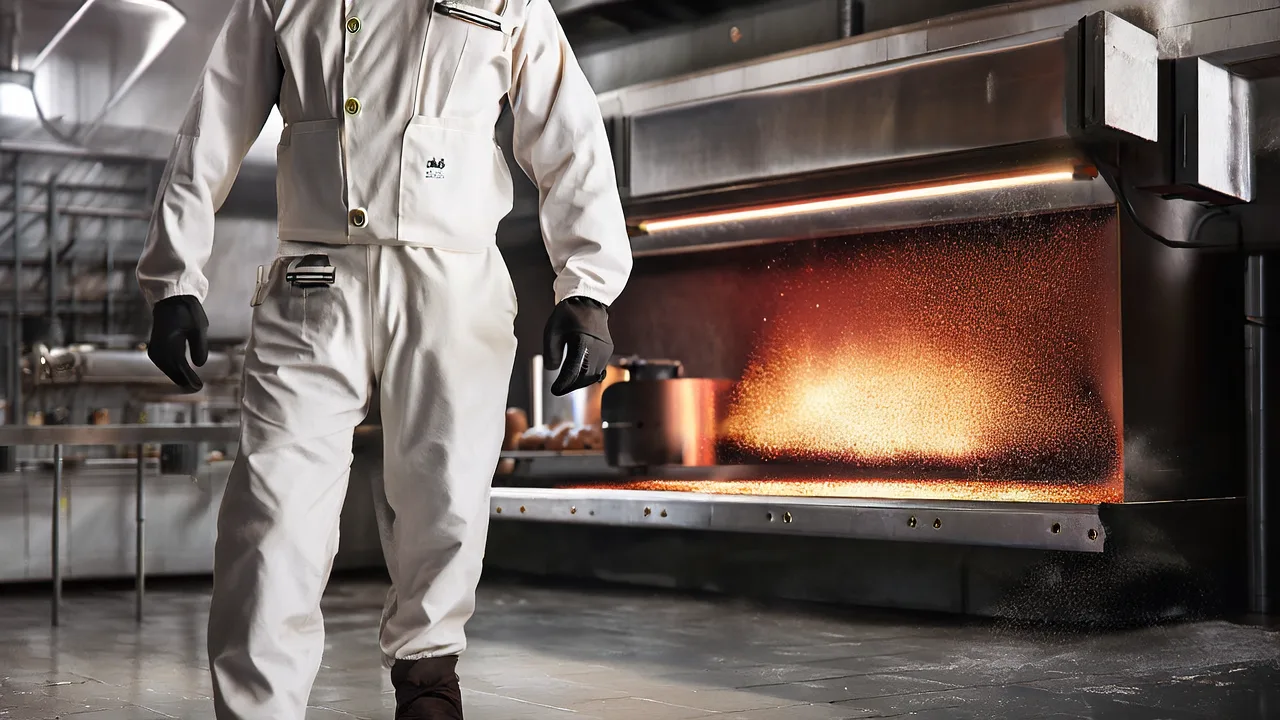
Commercial bakery workers rotate between flour-dust areas (mixing, make-up, dough handling) and high-radiant-heat areas (deck ovens at 230–300°C, rack ovens, tunnel ovens) wearing the same garment all shift. Standard food-safe workwear — smooth, lightweight polyester designed to release flour dust and pass hygiene audits — provides no thermal protection during oven loading and unloading. Standard thermal-protective workwear — heavier, textured fabric — traps flour dust in its surface texture, fails food safety audits, and creates cross-contamination risk between raw dough and baked product zones. The root cause: food safety and thermal protection are specified as separate requirements, but the worker performs both tasks in the same garment. This article covers the dual-constraint specification gap in bakery workwear, the fabric criteria that address flour dust release and oven radiant heat simultaneously, and the zone-based allocation protocol that separates garment types by exposure profile.
Buyer context
What procurement teams run into
Commercial bakery workers perform two distinct tasks in every shift: flour-dust operations (mixing, dividing, make-up, proofing, and dough handling in areas with airborne flour concentrations of 5–20 mg/m³) and oven operations (loading and unloading deck ovens at 230–300°C, rack ovens at 200–260°C, and tunnel ovens where radiant heat at the worker's position reaches 2–4 kW/m²). The worker wears the same garment for both tasks — and the garment must address both flour dust release and oven radiant heat protection. But standard workwear fails at one or both tasks. **1. The flour dust environment in commercial baking** Commercial bakeries generate airborne flour dust in multiple areas: - **Mixing areas:** Operators who charge flour into industrial mixers (50–400 kg batches) face airborne flour dust concentrations of 10–20 mg/m³ during flour bag opening, pouring, and mixer loading. Flour dust settles on garment surfaces, sleeves, and chest areas within minutes of exposure. - **Make-up and dividing areas:** Operators who handle divided dough pieces, operate moulders, and shape loaves face flour dust concentrations of 5–15 mg/m³ from dusting flour applied to work surfaces and dough. Flour dust accumulates on garment fronts, sleeves, and apron areas. - **Proofing and baking areas:** Operators who load proofed dough into ovens and unload baked products face minimal flour dust (0–2 mg/m³) but face intense radiant heat from oven openings and hot product surfaces. The critical issue: most bakery workers rotate between flour-dust areas and oven areas in the same shift. A make-up operator may spend 3 hours in flour dust, then rotate to oven unloading for 2 hours, wearing the same garment throughout. The garment must release flour dust easily (for food safety and hygiene) AND protect against radiant heat (for thermal safety during oven operations). **2. Standard food-safe fabric fails on thermal protection** Standard food-safe workwear is made from smooth, lightweight polyester fabric (3–4 oz/yd², 100–135 g/m²) designed to release flour dust and pass hygiene audits. The garment's food-safe performance: - **Smooth surface texture:** The fabric's tight, smooth weave prevents flour dust from embedding in the fabric surface. Flour dust brushes off easily during routine cleaning or between tasks. The garment passes visual hygiene audits and does not carry flour dust from raw dough areas into baked product zones. - **Lightweight construction:** The fabric's light weight provides thermal comfort in warm bakery environments (ambient temperature 25–32°C near ovens, 22–26°C in make-up areas). Workers do not experience heat stress during flour-dust operations. But the garment's thermal protection during oven operations is inadequate: - **No radiant heat barrier:** Lightweight smooth polyester (100–135 g/m²) provides minimal insulation against radiant heat from oven openings. When the operator loads or unloads deck ovens at 230–300°C, radiant heat passes through the thin fabric and reaches the worker's skin. Garment surface temperature rises to 45–55°C during oven loading, causing discomfort and, with repeated exposure, low-grade thermal burns on forearms and chest. - **No thermal mass:** The lightweight fabric has insufficient thermal mass to absorb and dissipate radiant heat energy. Heat transfers through the fabric to the skin within seconds of exposure to oven radiant heat. The operator experiences immediate heat discomfort during each oven loading cycle. The worker wearing standard food-safe fabric in a commercial bakery passes hygiene audits but experiences thermal discomfort and low-grade burn risk during oven operations — the garment addresses flour dust release but not thermal protection. **3. Standard thermal-protective fabric fails on flour dust release** Standard thermal-protective workwear is made from heavier, textured fabric (6–8 oz/yd², 200–270 g/m²) designed to provide a radiant heat barrier. The garment's thermal protection: - **Thermal mass and insulation:** Heavier fabric (200–270 g/m²) provides sufficient thermal mass to absorb radiant heat energy and slow heat transfer to the skin. Garment surface temperature during oven loading reaches 50–60°C, but skin-side temperature remains below 38°C — within comfortable limits. The operator experiences minimal thermal discomfort during oven operations. - **Textured surface:** Many thermal-protective fabrics use a ripstop or twill weave construction that creates a textured surface. The texture provides durability and abrasion resistance but also traps flour dust in the fabric surface. The garment's flour dust performance is poor: - **Flour dust embedding:** The textured fabric surface traps flour dust in the weave valleys and fiber interstices. Flour dust cannot be brushed off easily and accumulates with each exposure. After one shift in flour-dust areas, the garment's chest, sleeve, and front surfaces are coated with a visible flour layer that cannot be removed without washing. - **Cross-contamination risk:** The flour-laden garment carries raw flour dust from mixing and make-up areas into baked product zones (cooling, packaging, slicing). This creates a cross-contamination pathway: raw flour (which may contain pathogenic bacteria such as E. coli or Salmonella — both documented in raw flour recalls) contacts baked product surfaces, packaging equipment, or cooled product. The garment that provides thermal protection becomes a food safety hazard. - **Hygiene audit failure:** The flour-embedded garment fails visual hygiene audits. Auditors identify flour accumulation on garment surfaces as a contamination risk and issue non-conformance findings. The bakery faces corrective action requirements despite having specified thermal-protective workwear for oven operations. The worker wearing standard thermal-protective fabric in a commercial bakery is protected from oven radiant heat but creates cross-contamination risk and fails hygiene audits — the garment addresses thermal protection but not flour dust release. **4. The procurement mistake: specifying food safety OR thermal protection, not both** The most common procurement error is to specify food-safe garments for all bakery workers OR thermal-protective garments for oven-area workers, without addressing the dual-task reality. The logic: "If the garment releases flour dust, it meets food safety requirements" or "If the garment provides a thermal barrier, it protects oven operators." But this logic addresses only one task and ignores the other. The buyer who specifies food-safe fabric for all workers faces thermal discomfort and burn risk during oven operations. The buyer who specifies thermal-protective fabric for oven operators faces flour dust embedding, cross-contamination, and hygiene audit failure. The buyer often procures two separate garments — one for flour areas, one for oven areas — and expects workers to change garments between tasks. But workers do not change garments between tasks: the changeover burden is too high, the changeover facility is not available in the bakery production area, and the worker performs both tasks in continuous sequence during a shift. The result: workers wear the food-safe garment for both tasks and accept thermal risk, or wear the thermal-protective garment for both tasks and accept food safety risk. **5. The dual-performance specification for bakery workwear** The procurement specification for bakery workwear must address both flour dust release and thermal protection simultaneously: - **Moderate-weight smooth fabric:** Specify polyester or polyester-cotton blend fabric of 5–6 oz/yd² (170–200 g/m²) with a smooth, tight weave construction. The fabric must be heavy enough to provide a moderate radiant heat barrier (reducing skin-side temperature to below 40°C during brief oven exposure of 30–60 seconds per loading cycle) while maintaining a smooth surface that releases flour dust easily. Specify fabric with air permeability of 30–50 CFM per square foot for thermal comfort in warm bakery environments. - **Flour dust release testing:** Require the supplier to provide flour dust release testing data. The test method: expose fabric samples to airborne flour dust (15 mg/m³ concentration) for 30 minutes, then measure the percentage of flour dust removed by a single brushing motion. Specify minimum flour dust release of 85% after one brushing — confirming that the fabric surface does not trap flour dust. - **Radiant heat testing:** Require the supplier to provide radiant heat protective performance testing data (ISO 11612 Method B or equivalent). Specify a minimum radiant heat attenuation that limits skin-side temperature rise to less than 10°C during 60 seconds of exposure to 3 kW/m² radiant heat (simulating oven loading at 250°C). This confirms that the moderate-weight fabric provides meaningful thermal protection during brief oven exposure. - **Food-safe components:** Specify food-safe components for all garment elements: smooth polyester thread (no fuzzy or textured thread that traps flour dust), covered elastic cuffs (elastic encased in smooth fabric), fabric labels (not paper or textured labels), and smooth snap fasteners or concealed zippers (no exposed metal snaps above waistline that can fall into product or trap flour dust). No buttons above waistline, no exposed hook-and-loop closures (which trap flour dust), and no pocket openings above waistline (which collect flour dust and create contamination risk). **6. The zone-based allocation protocol** For bakeries where workers cannot perform both tasks adequately in a single garment (large deck ovens with extended loading times, or high-flour-dust mixing areas with very fine airborne flour), implement a zone-based allocation protocol: - **Zone A (flour-dust areas):** Workers who spend more than 70% of their shift in mixing, make-up, and dividing areas wear lightweight food-safe garments (3–4 oz/yd², smooth polyester) optimized for flour dust release. These workers have minimal oven exposure (less than 30 minutes per shift) and do not require thermal protection. - **Zone B (oven areas):** Workers who spend more than 50% of their shift in oven loading and unloading wear moderate-weight dual-performance garments (5–6 oz/yd², smooth tight-weave polyester) that provide both flour dust release and moderate thermal protection. These workers rotate between oven areas and brief flour-dust area exposure (less than 30% of shift) and require dual performance. - **Zone C (baked product areas):** Workers in cooling, slicing, and packaging areas wear lightweight food-safe garments (3–4 oz/yd²) optimized for hygiene and flour dust release. These workers have no flour-dust or oven exposure and require only food-safe hygiene performance. The zone-based allocation ensures that each worker receives a garment matched to their actual exposure profile — avoiding both the thermal risk of under-protected garments and the food safety risk of over-protected garments that trap flour dust. **7. The pilot protocol for bakery workwear** Before committing to full fleet orders, pilot dual-performance garments with 10–15 workers in the highest-exposure tasks (make-up operators who rotate to oven unloading, oven loaders who handle both tasks) for 8–12 weeks: - **Flour dust release monitoring:** Monitor garment flour dust accumulation during the pilot period. Record whether dual-performance garments release flour dust as effectively as standard food-safe garments. If flour dust accumulates on dual-performance garments, investigate whether the fabric surface texture is trapping dust. Specify a smoother fabric construction — but re-test for thermal protection to confirm that the adjustment does not compromise thermal performance. - **Thermal comfort monitoring:** Monitor thermal discomfort and heat stress incidents during oven operations. Record whether dual-performance garments reduce thermal discomfort compared to standard food-safe garments. If thermal discomfort persists, investigate whether the fabric weight is insufficient for the radiant heat exposure. Specify a heavier fabric construction — but re-test for flour dust release to confirm that the adjustment does not compromise food safety performance. - **Hygiene audit performance:** Monitor hygiene audit results during the pilot period. Record whether dual-performance garments pass visual hygiene audits at the same rate as standard food-safe garments. If audit findings increase, investigate whether the fabric is trapping flour dust or whether workers are not performing between-task garment brushing. - **Wash-cycle tracking:** Track wash cycles for each garment during the pilot. Confirm that dual-performance garments maintain both flour dust release and thermal protection after 25, 50, and 75 wash cycles (bakery workwear is washed daily — 300+ cycles per year). Require the supplier to provide flour dust release and thermal protection testing data for garment samples after 25, 50, and 75 wash cycles. **8. Adjusting the specification based on pilot data** After the pilot, adjust the garment specification: - **If flour dust accumulates:** Specify a smoother fabric construction or a fabric with anti-static treatment that repels flour dust. Confirm that the adjusted fabric still meets thermal protection requirements. - **If thermal discomfort persists:** Specify a heavier fabric (6–7 oz/yd²) or add a radiant heat-reflective lining on the garment's front panel (facing the oven). Confirm that the adjusted fabric still releases flour dust effectively. - **If flour dust release degrades after washing:** Investigate whether the fabric surface is degrading with wash cycles (pilling, fiber fuzzing). Specify a more durable fabric construction with anti-pilling treatment. Require flour dust release testing after 50 and 75 wash cycles. - **If workers do not perform between-task brushing:** Simplify the between-task cleaning protocol. Specify a garment color that shows flour dust clearly (dark blue or black) so that workers and supervisors can identify flour accumulation visually. Provide garment brushing stations at zone transition points.
Sourcing approach
How a factory partner can respond
The solution for commercial bakery workwear is to specify dual-performance garments that address both flour dust release and oven radiant heat protection simultaneously, implement a zone-based allocation protocol that matches garment type to worker exposure profile, and pilot the specification before full fleet commitment. **Step 1: Specify dual performance in the procurement specification** Include the following requirements: - **Moderate-weight smooth fabric:** 5–6 oz/yd² (170–200 g/m²) polyester or polyester-cotton blend with smooth, tight weave construction. Air permeability 30–50 CFM per square foot. - **Flour dust release testing:** Minimum 85% flour dust removal after one brushing motion (tested at 15 mg/m³ flour dust concentration for 30 minutes exposure). - **Radiant heat testing:** Skin-side temperature rise less than 10°C during 60 seconds of exposure to 3 kW/m² radiant heat (ISO 11612 Method B or equivalent). - **Food-safe components:** Smooth polyester thread, covered elastic cuffs, fabric labels, concealed closures. No buttons above waistline, no exposed hook-and-loop, no pocket openings above waistline. **Step 2: Implement zone-based allocation** Allocate garments by worker exposure profile: - Zone A (flour-dust areas, >70% of shift): Lightweight food-safe garments (3–4 oz/yd²). - Zone B (oven areas, >50% of shift): Moderate-weight dual-performance garments (5–6 oz/yd²). - Zone C (baked product areas): Lightweight food-safe garments (3–4 oz/yd²). **Step 3: Pilot dual-performance garments before full fleet commitment** Pilot with 10–15 workers in highest-exposure tasks for 8–12 weeks. Monitor flour dust release, thermal comfort, hygiene audit performance, and wash-cycle durability. Require supplier testing data for flour dust release and thermal protection after 25, 50, and 75 wash cycles. **Step 4: Adjust specification based on pilot data** Specify smoother fabric if flour dust accumulates. Specify heavier fabric or radiant heat-reflective lining if thermal discomfort persists. Specify anti-pilling treatment if flour dust release degrades after washing. **Recommended garments for commercial bakery workwear:** - **Industrial coverall-pro** — specify the coverall in moderate-weight smooth polyester fabric (5–6 oz/yd², 170–200 g/m², tight weave construction) for Zone B workers (oven loaders, make-up operators who rotate to oven unloading) who need both flour dust release and radiant heat protection. The coverall provides full-body coverage with smooth surface that releases flour dust, moderate thermal mass that reduces skin-side temperature during oven loading, and food-safe components (concealed zipper, covered elastic cuffs, no pockets above waistline) that meet bakery hygiene requirements. Specify the coverall with flour dust release testing data and radiant heat attenuation testing data. - **Logistics polo-uniform** — specify the polo shirt in lightweight smooth polyester fabric (3–4 oz/yd², 100–135 g/m²) for Zone A workers (mixers, make-up operators, dividers) and Zone C workers (cooling, slicing, packaging) who need flour dust release and food-safe hygiene without thermal protection. The polo shirt provides smooth surface that releases flour dust easily, lightweight construction for thermal comfort in warm bakery areas, and food-safe components (smooth fabric, covered seams, no buttons above waistline) that meet bakery hygiene requirements. Specify the polo shirt with flour dust release testing data.
Recommended Products
Products that fit this use case

Industrial Workwear
Industrial Coverall Pro
Hard-wearing one-piece coverall for plant, maintenance, and heavy-duty operations.

Logistics Uniform
Logistics Polo Uniform
Breathable uniform polo for warehouse, delivery, and last-mile teams.