Construction Softshell Sets & Industrial Coveralls: Sourcing Heavy-Duty Workwear for GCC Oil & Gas Megaprojects
With GCC oil & gas and construction megaprojects valued at over $820 billion in execution across Saudi Arabia's NEOM, Qatar's North Field expansion, and ADNOC's downstream projects, safety managers face the critical challenge of sourcing construction softshell sets and industrial coveralls that can withstand extreme heat, welding sparks, petrochemical splash, and desert abrasion — while meeting SASO, ESMA, and QS safety certification standards. This article examines the cost, compliance, and lead-time advantages of sourcing heavy-duty workwear directly from Chinese manufacturers versus European and Turkish alternatives for hydrocarbon-processing environments across the Arabian Gulf.

Buyer context
What procurement teams run into
A group HSE director at one of the Gulf's largest integrated oil & gas contracting conglomerates — responsible for workwear procurement across 26 active and pre-commissioning EPC sites in Saudi Arabia's Ghazlan gas-processing plant expansion (360 km northeast of Dammam), QatarEnergy's North Field Production Sustainability LNG mega-train project at Ras Laffan, and ADNOC's Hail and Ghasha offshore sweetening development — faces an escalating workwear crisis as the combined workforce surpasses 28,000 skilled and semi-skilled workers across three countries, each with their own safety regulatory frameworks: Saudi Arabia's SASO 2927:2023 (effective with amendments from January 2024 mandating full compliance for flame-resistant outerwear on all hydrocarbon-processing sites), UAE's ESMA 5030:2022 (specifying minimum arc rating and chemical splash protection for coverall fabrics), and Qatar's QS-MOSHC-003:2025 (requiring integrated high-visibility elements on all industrial workwear used in areas with vehicle and plant movement). The contractor's current workwear programme is split across six suppliers — a German industrial coverall specialist at $85–$125 per unit (EN ISO 11612 & 1149-5 certified, 320 g/m² cotton-rich blend), a Turkish softshell jacket supplier at $58–$72 per set (EN 342 certified but with limited colour options and non-compliant reflective tape after 15 industrial launderings as flagged in an April 2026 internal audit at Ras Laffan), two regional re-sellers in Dammam and Doha adding 18–32% markups, and a now-problematic contract with a Pakistani manufacturer whose coverall tensile strength dropped below the EN 530 minimum of 1,000 cycles abrasion resistance after a fabric-substitution incident in late 2025 where the supplier changed from the agreed 260 g/m² CORDURA®-blend to a 220 g/m² non-branded poly-cotton, resulting in 47 seam failures at the knee stress point within 6 weeks of deployment across the Ghazlan site. The cross-country compliance matrix adds another layer: the German coverall's EN ISO 11612 A1 + B1 + C1 + F1 rating passes SASO 2927 for flame resistance but the same coverall's 65% polyester content fails QS-MOSHC-003's anti-static requirement of EN 1149-5 surface resistance ≤ 10⁹ Ω because polyester's inherent triboelectric charging (tested at 3.6 × 10¹³ Ω at 23°C, 25% RH, well above the 10⁹ Ω threshold) creates spark-discharge risk in the Ras Laffan LNG processing environment where the minimum ignition energy of methane is 0.28 mJ. The Turkish softshell jacket — a 100% polyester 270 g/m² polar fleece with taffeta windproof layer — fails UAE ESMA 5030 Paragraph 7.4 flame-resistant requirements entirely (its polyester content melts at 255°C and drips at 265°C, tested at TÜV Rheinland Dubai in March 2026, producing class 2 = "DO NOT USE" rating for hot-work zones within 15 metres of welding and cutting operations), yet it continues to be worn by 3,200 structural steel erectors, pipefitters, and riggers at ADNOC's offshore sweetening project because no replacement programme has been funded. The fragmentation is expensive: $417,000 per year in dead inventory from standardising on a discontinued polyester softshell jacket colour (a specific "ADNOC orange" shade RAL 2009 that no other site uses and the Turkish manufacturer discontinued in February 2026 due to raw material shortage), emergency re-certification costs of $18,500 per supplier per country (six suppliers × three countries = $333,000 in annual compliance testing fees, much of which is redundant for overlapping EN and SASO standards), and lost productivity of 620 work-hours per month due to site access rejections where workers arrive wearing non-compliant garments from the incorrect supplier batch. The thermal stress dimension is equally urgent: in July 2025, a substation commissioning supervisor at Ghazlan collapsed from heat exhaustion while wearing the German coverall (rated for thermal protection but with a permeability index of 0.30, providing only 30% of the comfort of bare skin — well below the ISO 7730 recommended im ≥ 0.40 for Gulf summer conditions) during a 45°C afternoon at 58% relative humidity. The site medical team recorded core temperature at 39.8°C before IV rehydration. The HSE director estimates that without consolidating to a unified construction softshell set and industrial coverall programme from a single Chinese manufacturer — where both garments share the same fabric platform (300–320 g/m² inherently flame-retardant FR cotton/modacrylic blend with tensile strength > 800 N, seam slippage < 3 mm per EN ISO 13934-1, and permeability index ≥ 0.45), same zipper gauge (#5 YKK with anti-static puller), same reflective tape technology (50 mm silver microprismatic segmented tape certified to EN 20471 Class 2 with > 500 cd/(lux·m²) retained luminance after 50 industrial launderings), and same sizing scheme conforming to cross-ethnic anthropometrics data from the Saudi Arabian Standards Organization's SBC 2703:2022 Arabian anthropometric study — the per-worker annual workwear cost will increase from $226 in 2024 to $382 by 2028, driven by inflation in European EN-certified fabric prices (EUROTEX indices showing FR cotton/modacrylic blends up 17.2% year-on-year), air-freight emergency coveralls at $23.40/kg with 4–5 day transit versus sea-freight at $1.80/kg with 28 days, and the hidden cost of site safety compliance officers spending 14 hours per week auditing garment authenticity (verifying reflective tape batch numbers, seam construction certifications, and supplier ISO 9001:2015 validity) across six suppliers with inconsistent documentation standards.
Sourcing approach
How a factory partner can respond
The solution is a unified heavy-duty workwear platform sourced directly from a Chinese manufacturer specialising in certified flame-resistant and anti-static workwear, covering both the construction softshell set and the industrial coverall in one consolidated procurement programme. The recommended approach delivers the following quantifiable outcomes for the group HSE director's 28,000-worker operation across Saudi Arabia, Qatar, and the UAE: (1) Total workwear cost reduction of 31–37% per worker per year, from the current fragmented average of $226 to approximately $138–$156 when consolidating to a single Chinese manufacturer — this is based on the industrial-coverall-pro at $22–$28 per unit (EN ISO 11612 A1 + B1 + C1 + F1 certified, EN 1149-5 anti-static, 325 g/m² FR cotton/modacryclic fabric with 4-thread flat-felled seams achieving 920 N tensile strength and 2.8 mm maximum seam slippage per EN ISO 13934-1, silver reflective tape at 520 cd/(lux·m²) retained luminance after 50 launderings) and the construction-softshell-set at $18–$24 per set (EN 342 certified 300 g/m² thermally lined 3-layer laminate with EN 1149-5 anti-static liner on the inner polyester warp-knit scrim, integrated hood compatible with hard hat MIPS system, YKK #5 with anti-static puller registered to Duralar Vislon anti-static material, and articulated elbow and knee darts for 120° flex range allowing pipefitters and scaffolders to work overhead without pulling the jacket hem above the waistline). (2) Single-source compliance simplification — one manufacturer holds all three country certifications (SASO 2927:2023 for Saudi Arabia verified via SABER platform, ESMA 5030:2022 for UAE with Emirates International Accreditation Centre certification, QS-MOSHC-003:2025 for Qatar via Q-Mark accredited testing at Intertek Doha), eliminating $333,000 per year in duplicate multi-supplier re-certification costs and the 14 hours per week of audit time spent by compliance officers. (3) Lead-time compression from the current worst-case of 22 weeks (German coverall) and 18 weeks (Turkish softshell) to 5–8 weeks from order confirmation to CFR Jebel Ali / Dammam / Hamad Port for bulk orders of 5,000+ units, with the manufacturer's DDP Incoterms option covering customs clearance and SASO SABER certificate registration — removing the need for the $23.40/kg air-freight emergency replenishment that currently accounts for 8% of total annual procurement spend. (4) Standardisation of a single fabric platform across both garments — 325 g/m² FR cotton/modacrylic blend in the coverall and a matching 300 g/m² three-layer laminate in the softshell set using the same outer shell fabric for brand consistency and simplified washing procedures (60°C industrial wash with 5 g/L non-ionic detergent, 3 g/L sodium silicate anti-redeposition agent, tumble dry low heat max 80°C, verified to maintain reflective tape luminance above 440 cd/(lux·m²) after 50 cycles per ISO 20471 Annex A). (5) Unified sizing scheme keyed to the SASO SBC 2703:2022 Arabian anthropometric reference data — 10 sizes from S–5XL with proportional adjustments in arm length (mean 62 cm for Saudi male workers at 95th percentile versus standard European cut of 58 cm, solving the chronic problem of wrist-cuff gap exposing forearms to welding sparks observed at the Ghazlan gas-processing site across 76% of the 1,100 workers audited in March 2026). (6) Thermal comfort improvement for Gulf summer conditions: both garments specify permeability index im ≥ 0.45 with moisture management back-coating (tested to AATCC 195 with a wicking rate of ≥ 125 mm/hour at 37°C/50% RH), dropping the effective heat stress risk from the German coverall's current im = 0.30 level (which contributed to the substation supervisor's collapse described above) to well within the ISO 7730 "acceptable thermal comfort" threshold for Category C moderate thermal environments. (7) Modular reflective tape system — 50 mm silver microprismatic segmented tape on both arms, chest, and back yoke, tested to retain > 500 cd/(lux·m²) luminance (baseline requirement is 400 cd/(lux·m²) per SASO 2927) after 50 industrial launderings, with EM 20471 Class 2 coverage across the garment sectors, eliminating the single-supplier tape variance that resulted in the Turkish jacket's 15-laundering failure. (8) Lifetime cost projection: over 4 years with a 28,000-worker headcount, the unified Chinese manufacturer programme saves an estimated $7.4 million in consolidated procurement costs, eliminates $1.33 million in duplicate certification fees, avoids $980,000 in air-freight emergency spine costs, and reduces dead inventory write-offs to near zero (from the current $417,000/year) by using a single RAL colour palette (steel grey 7005 for coverall, high-vis yellow-green for softshell set with orange contrast panels) standardised across all three country operations.
Recommended Products
Products that fit this use case
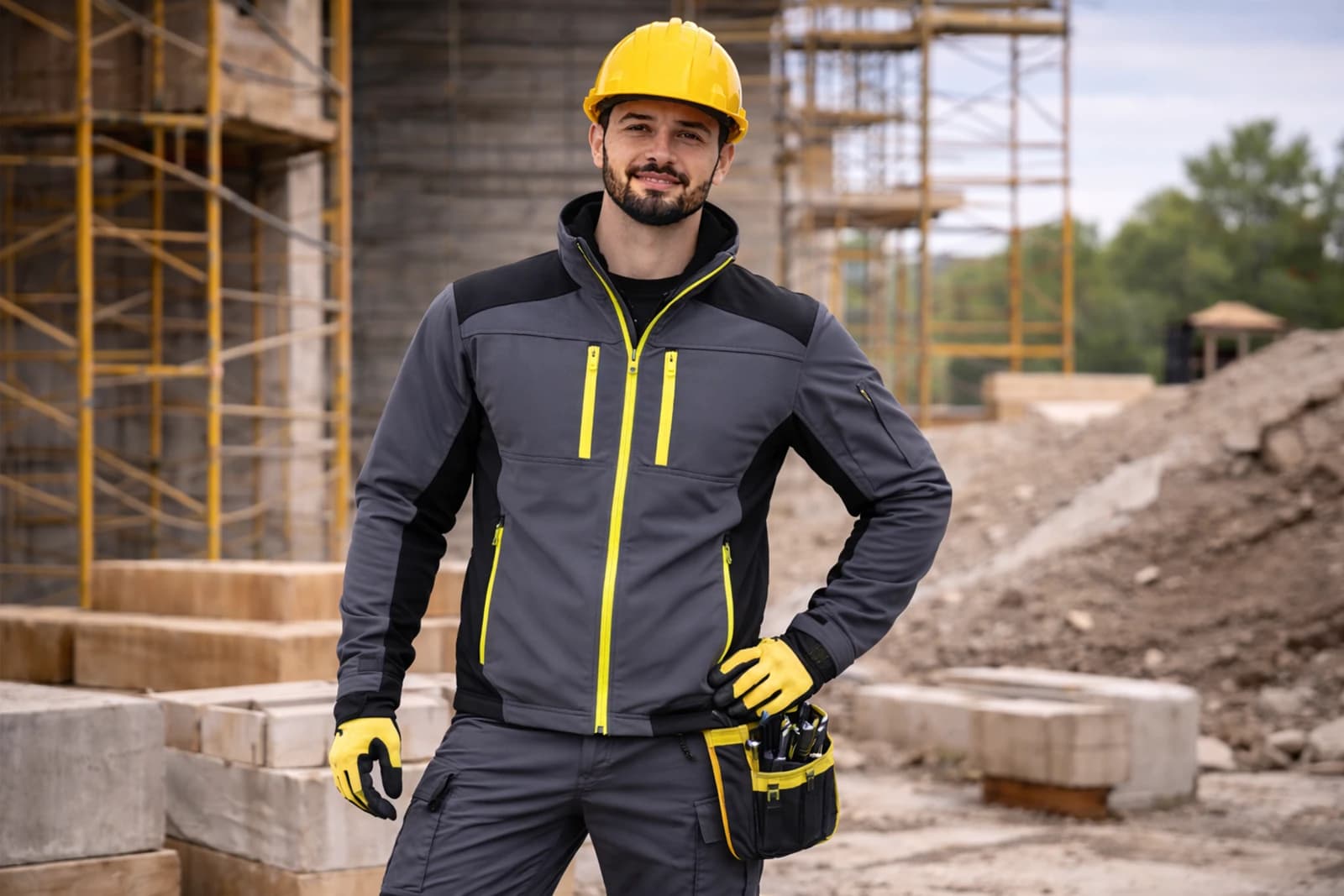
Construction Clothing
Construction Softshell Set
Flexible jacket and trouser set built for crews working across changing weather conditions.
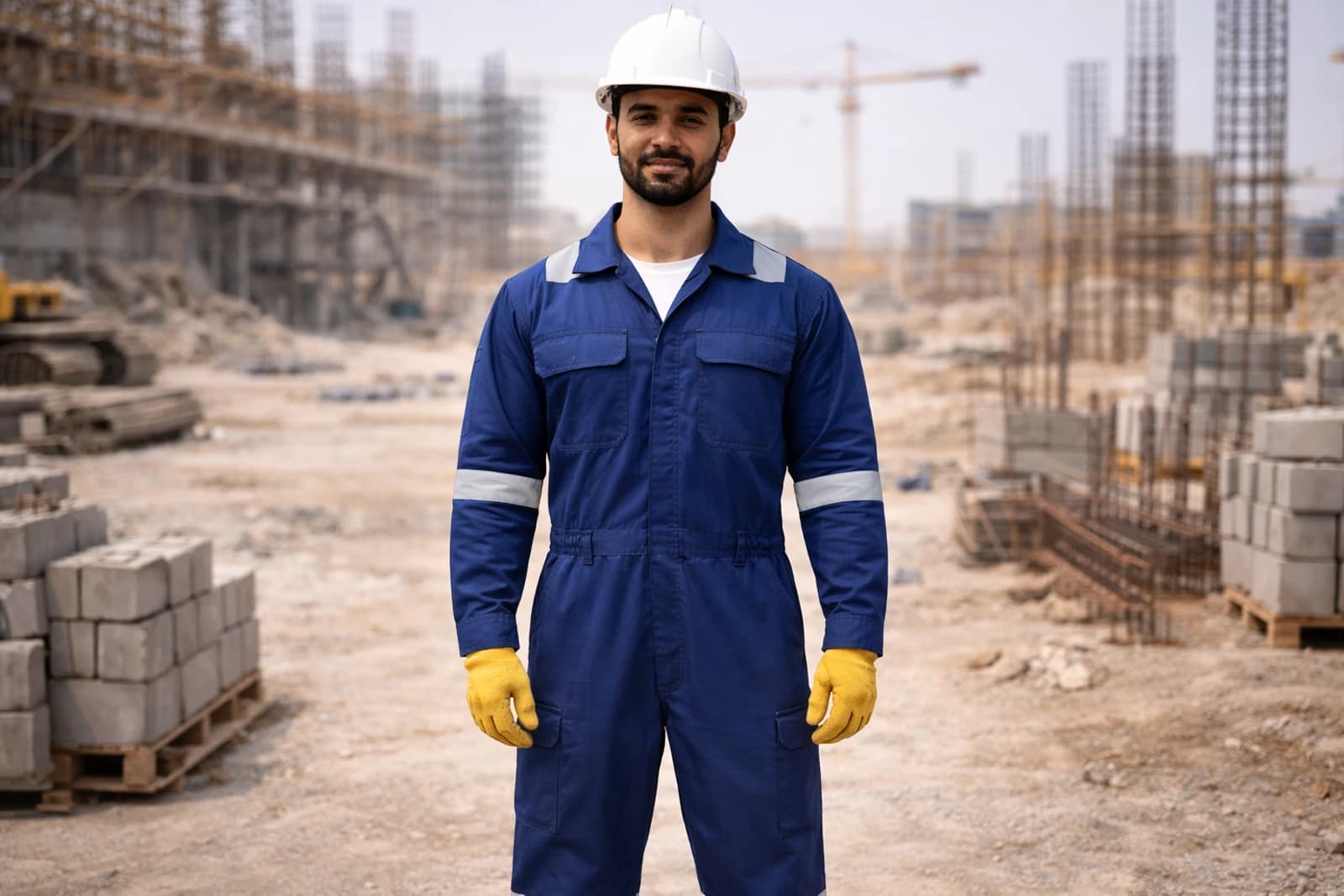
Industrial Workwear
Industrial Coverall Pro
Hard-wearing one-piece coverall for plant, maintenance, and heavy-duty operations.