Construction Softshell Sets & Industrial Coveralls for Middle East: B2B Sourcing Guide from a Chinese Workwear Manufacturer
From NEOM's The Line and Saudi Arabia's $1.5 trillion giga-projects to Dubai's Expo City legacy sites and Doha's Lusail development, the Middle East construction sector is the world's most demanding testbed for workwear. Workers face 50°C summer heat, sudden dust storms, abrasive rebar, welding sparks, and the region's aggressive UV index. Construction softshell sets and industrial coveralls must survive conditions that would degrade most temperate-climate garments within weeks. This guide for Middle East B2B buyers sourcing from a Chinese workwear manufacturer covers fabric weight and weave selection, EN ISO 13688 and EN 14404 compliance, tear-resistance ratings, welding and flame-resistant options for oil & gas-adjacent sites, ventilation design for extreme heat, and bulk procurement strategies for project workforces of 500-50,000+.

Buyer context
What procurement teams run into
The Middle East is executing the largest construction program in modern history. Saudi Arabia's Vision 2030 alone includes NEOM ($500 billion), the Red Sea Project, Qiddiya, and Diriyah Gate — with the Kingdom spending roughly $1.5 trillion on giga-projects through 2030. The UAE continues large-scale development across Dubai South, the Abu Dhabi industrial corridor, and new free zones. Qatar, following its 2022 World Cup infrastructure build-out, is sustaining investment in Lusail and smart-city projects. Construction employment across the GCC exceeds 12 million workers, and it is growing. For Middle East B2B procurement managers, safety officers, and uniform distributors sourcing from a Chinese workwear manufacturer, two garment categories dominate every construction tender: **construction softshell sets** (wind-resistant, water-repellent jackets and trousers for site supervisors, engineers, and general laborers) and **industrial coveralls** (for welders, mechanics, equipment operators, and oil & gas-adjacent construction crews). Getting these specifications right determines bid success, worker safety, and garment lifespan on sites that punish poor materials. **1. Softshell vs. traditional jacket — why GCC sites are switching** The softshell construction set has displaced traditional canvas or nylon work jackets across most Gulf construction sites for good reason: - **Climate fit:** Softshell fabric (typically a 3-layer bonded laminate of outer woven face, breathable membrane, and insulating fleece or mesh backer) provides wind resistance and light water repellency without the bulky insulation of a padded jacket. In the Gulf, where daytime temperatures swing from 45°C to 18°C within a single shift (especially during November-March), a softshell's layered breathability beats both heavy padded jackets and thin windbreakers. - **Weight and mobility:** A quality softshell jacket weighs 500-700 g versus 1.2-2 kg for a traditional work jacket. For workers climbing scaffolding, operating equipment, and moving across rough terrain, the weight difference translates directly into reduced fatigue and better site safety compliance (workers actually wear what is comfortable). - **Abrasion resistance:** The outer face of a good softshell is a tightly woven nylon or polyester (typically 250-320 gsm) that resists snagging on rebar and rough concrete. A brushed microfibre fleece backer adds warmth without bulk. For Middle East sites, specify a minimum abrasion resistance of 25,000 rubs on the Martindale test (EN ISO 12947-2) for jacket elbows, forearms, and shoulder areas. **2. Fabric weight and weave selection for GCC conditions** The critical specification decision for Middle East construction workwear is fabric weight and weave: - **Softshell outer face:** 250-320 gsm, 100% polyester with a durable water-repellent (DWR) finish rated 80/20 (water repellency × oil repellency per ISO 4920). For sites near the coast (Jeddah, Dubai, Doha), specify salt-resistant DWR chemistry that won't degrade after 10-15 industrial washes. - **Coverall fabric:** For general construction, a ripstop polyester-cotton twill (65/35 T/C or 50/50) at 245-280 gsm is the GCC default. Ripstop weave (reinforced with a grid of thicker yarns every 5-8 mm) prevents small tears from running the full length of the garment — critical on sites with sharp rebar ends and metal edge trim. - **Tear strength:** Specify minimum tear strength of 40 N warp / 30 N weft (ISO 13937-2) for general construction coveralls, and 60 N+ for oil & gas-aligned work. Many Chinese factories can exceed this at minimal cost uplift — the specification is about preventing brand-damaging failures, not about price. - **Heat management:** Standard dense twill traps heat. For GCC summer months, look for coveralls with a **vented back panel** (a mesh or perforated fabric insert under the shoulder blade area), underarm mesh gussets, and a half-open zip front that allows rapid cooling. A 245 gsm 65/35 T/C twill with these design features is dramatically more wearable in 45°C than a sealed 300 gsm garment. **3. EN ISO 13688 compliance — the baseline every tender requires** Most Middle East construction contracts — especially those from the UAE, Saudi, and Qatari government-linked developers — specify garments meeting **EN ISO 13688** (the general requirements standard for protective clothing). Key elements: - **Ergonomic design testing:** EN ISO 13688 requires garments to be assessed for comfort, freedom of movement, and proper fit — verified through the standard's ergonomics clause. A garment that restricts movement on scaffolding fails the standard. - **Size range:** Many Chinese manufacturers default to Asian sizing. For Gulf workforces with significant South Asian, Filipino, and Egyptian labour, specify sizes up to 3XL-4XL and provide clear size-mapping between the factory's size chart and the buyer's required dimensions (chest, waist, inseam, sleeve length). This is a top source of delivery-day disputes. - **Marking and documentation:** EN ISO 13688-certified garments must carry the CE pictogram, size, fibre composition, and care instructions. Request the actual third-party test certificate (SGS, TÜV, Intertek) before bulk production — not the supplier's self-declaration. **4. Coveralls for welding, sparks, and oil & gas-adjacent work** Industrial coveralls on Middle East construction sites must frequently handle more than dust and abrasion: - **EN ISO 11611 (welding):** For welders and site fitters, specify coveralls meeting Class 1 or Class 2 of EN ISO 11611. Class 2 provides higher resistance to molten metal splashes and is recommended for heavier MIG/TIG welding work. Key requirements include flame-retardant (FR) treatment, antistatic properties, and limited molten metal splash resistance. - **EN ISO 11612 (heat and flame):** For sites adjacent to oil & gas operations (e.g., pipeline tie-ins near existing facilities), specify coveralls to EN ISO 11612 A1 (limited flame spread) at minimum, with B1 or C1 ratings depending on convective heat exposure. FR-treated 100% cotton or cotton-modacrylic blends (88/12, 70/30) are the common solutions. - **EN 1149-5 (antistatic):** For fuel storage, gas metering stations, and electrical substation work, antistatic treatment is mandatory. The standard requires surface resistance ≤ 2.5 × 10⁹ Ω measured under specified humidity. - **The dual-hazard coverall:** Many Gulf oil & gas EPC contractors now specify a single coverall that meets EN ISO 11611 Class 1 + EN ISO 11612 A1 B1 + EN 1149-5 simultaneously. This "multi-norm" garment costs 15-25% more than a standard twill coverall but avoids the need for workers to change garment layers when moving between zones. **5. Design features that extend garment life on harsh sites** The difference between a coverall that lasts 18 months and one that fails in 6 often comes down to construction details: - **Double-stitched seams:** All major stress seams (crotch, shoulders, back yoke) should be double or triple stitched. Specify a seam strength of ≥ 100 N per 50 mm (EN ISO 13935-2). - **Bar-tacking at stress points:** Belt loops, pocket corners, and zip baselines need bar-tack reinforcement. Cheap garments skip these 4-5 cm stitch reinforcements and fail at exactly the load points workers abuse them. - **YKK or equivalent hardware:** Specify YKK or equivalent-brand zippers (metal for coveralls, coil for softshells) and press-studs rated for 20,000+ open-close cycles. Gulf dust and sand is highly abrasive to non-sealed zippers — look for zippers with a protective tape or flap. - **Knee pad pockets:** EN 14404-compliant knee pad pockets, with a vertical adjustment of at least 100 mm, are increasingly specified for GCC sites. Workers kneel on rebar, aggregate, and hard concrete all day; EN 14404 knee protection rated Type 1 Level 1 is the minimum expected. - **Reflective accent options:** While construction workwear does not always require hi-vis, many GCC sites now mandate Class 2 hi-vis bands on the torso for workers near mobile equipment (telehandlers, cranes, dump trucks). Adding EN ISO 20471 Class 2 taping to a coverall costs marginally more at production stage but can save you a separate hi-vis vest procurement line. **6. Bulk sourcing strategy for project-scale workforces** For construction tenders covering 500-50,000 workers, the sourcing strategy is as important as the specification: - **Phased fulfilment:** GCC mega-projects often require staggered delivery aligned with construction phases. Confirm your Chinese supplier's capacity for split deliveries (e.g., 30% in 45 days, 40% in 90 days, 30% in 135 days) without significant cost penalty. - **Branding and ID integration:** Softshell sets and coveralls for GCC sites typically require chest, back, and sleeve branding plus worker ID panels (name, role, company). Heat-transfer (silicone or PU) is standard for coveralls; embroidery works best on softshell outer faces. Heat-transfer applied before garment construction (in-seam application) lasts far longer than surface-applied after assembly. - **Stock vs. custom:** For fast-track projects, ask whether the factory holds blank stock in common GCC sizes and colours (navy, orange, forest green, hi-vis yellow). Blank-stock coveralls are typically deliverable in 3-4 weeks versus 6-10 weeks for fully custom production — a major advantage when a tender deadline is tight. - **AQL inspection:** Specify AQL 1.5/2.5 for construction workwear (critical/visual defects) with pre-shipment inspection at the Chinese factory (e.g., SGS or Bureau Veritas) — this also matches what most GCC importers and end clients will audit at receiving. Confirm the factory accepts third-party inspection before signing.
Sourcing approach
How a factory partner can respond
Sourcing construction softshell sets and industrial coveralls from a Chinese workwear manufacturer for Middle East B2B buyers requires a structured approach. The winning formula combines correct fabric weights (250-320 gsm softshell outer; 245-280 gsm ripstop twill coveralls), full EN ISO 13688 compliance with third-party certification, zone-appropriate add-ons (EN ISO 11611/11612 for welding and oil & gas work, EN 1149-5 antistatic where required), and Gulf-adapted design (vented backs, EN 14404 knee pads, reinforced stress seams, salt-resistant DWR). For most GCC construction tenders, a two-product strategy works best: the **construction softshell set** for site supervisors, engineers, and tradespeople who need wind/water protection with mobility, and the **industrial coverall pro** for welders, mechanics, and operators requiring durability, FR options, and multi-norm compliance. Both should be specified for GCC heat, abrasion, and the region's aggressive UV index, with bulk ordering structured around phased delivery aligned to project milestones. Working with a Chinese manufacturer that understands EN standards certification, offers blank-stock for fast delivery, and accepts third-party pre-shipment inspection reduces the two biggest Middle East procurement risks: non-compliant garments and missed delivery windows. Sample verification, AQL inspection, and documented test certificates — not price alone — should drive supplier selection for any contract of 500+ garments.
Recommended Products
Products that fit this use case
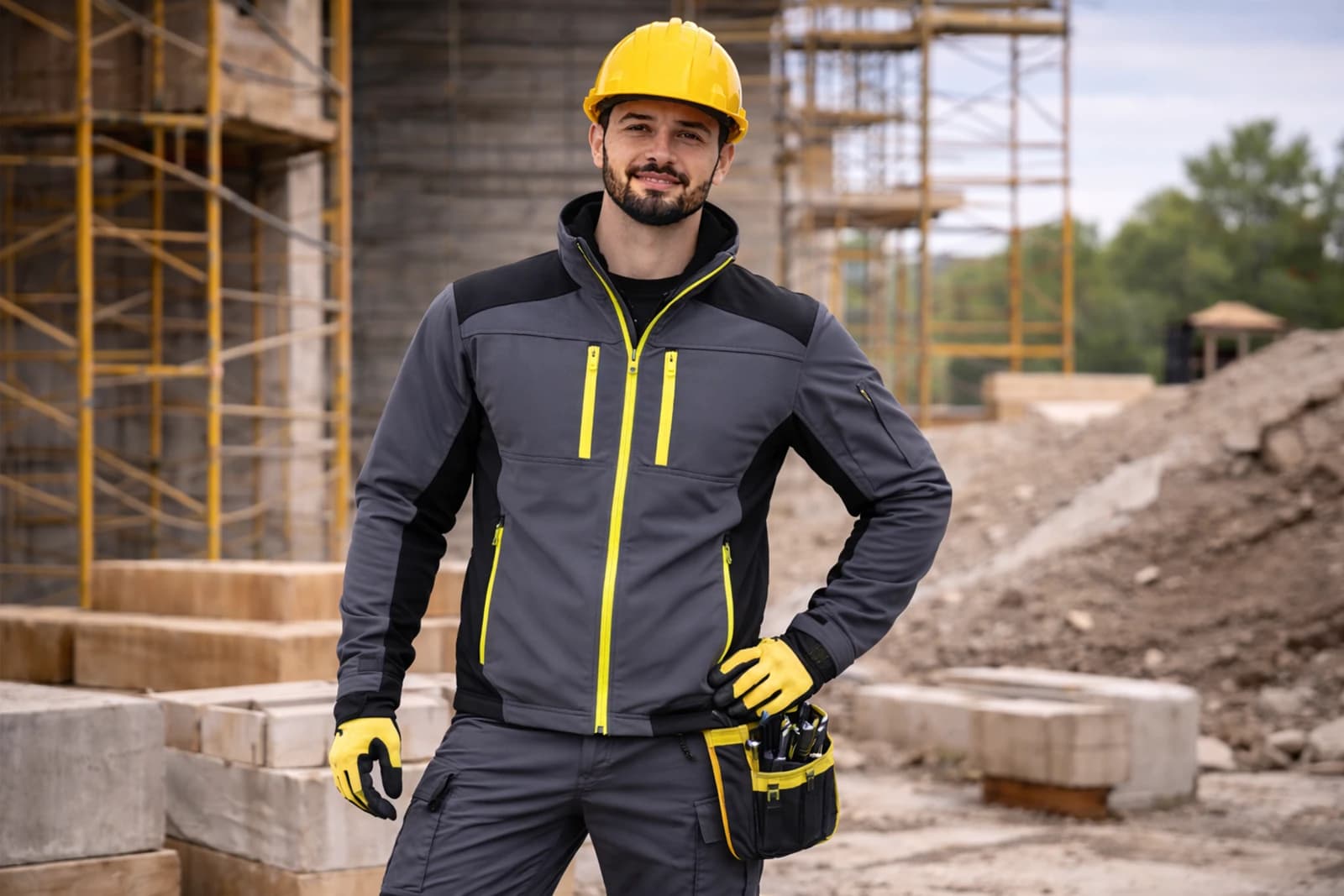
Construction Clothing
Construction Softshell Set
Flexible jacket and trouser set built for crews working across changing weather conditions.
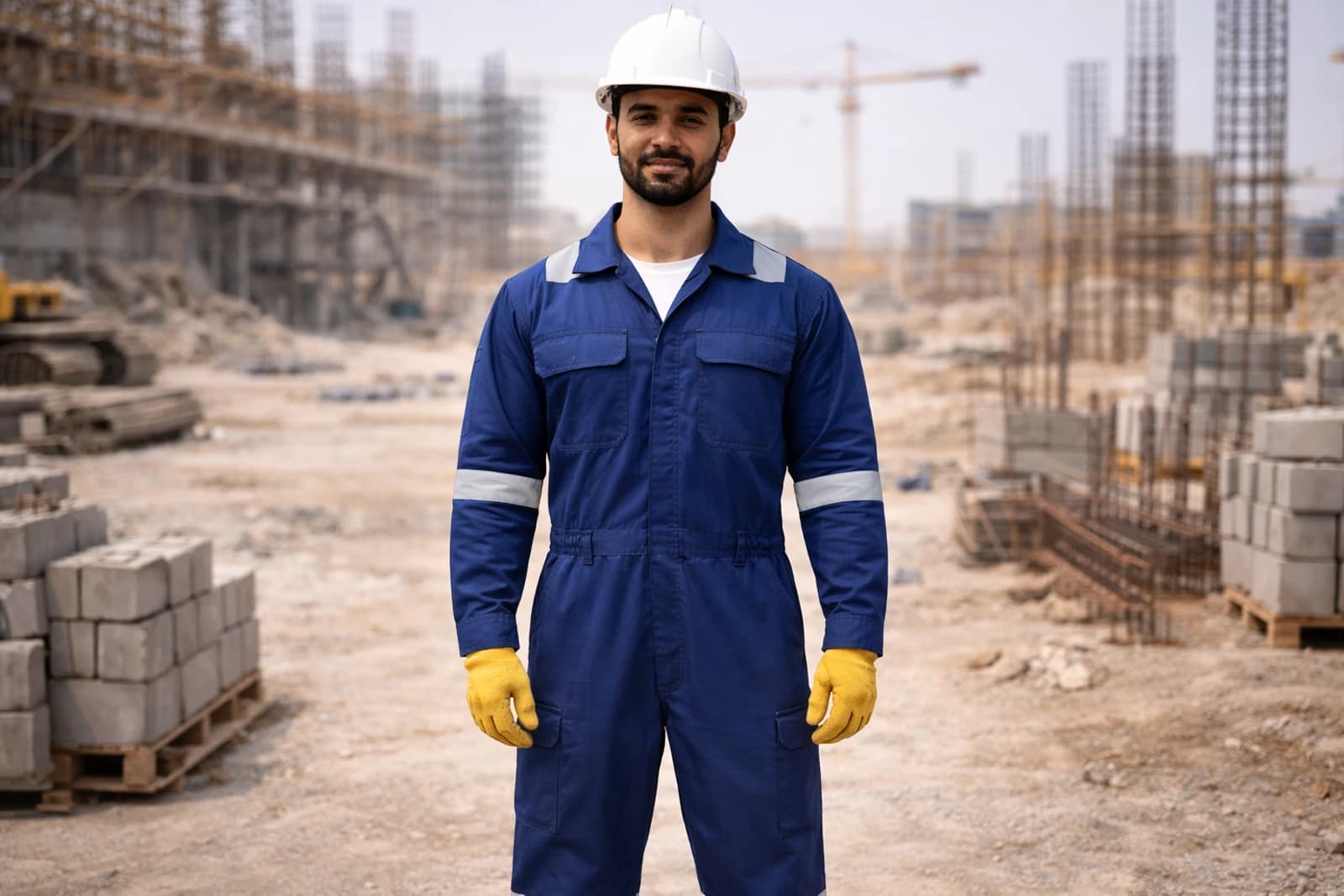
Industrial Workwear
Industrial Coverall Pro
Hard-wearing one-piece coverall for plant, maintenance, and heavy-duty operations.