Construction Softshell Set for Middle East Infrastructure Projects: A B2B Guide for Procurement Managers Sourcing from a Chinese Manufacturer
From NEOM's The Line in Saudi Arabia to Lusail City in Qatar and Dubai's Expo City district, mega infrastructure projects across the Gulf demand durable, breathable, and professional-looking workwear that performs across seasons. This guide shows Middle East B2B procurement managers how to source the Construction Softshell Set — a Chinese-manufactured, multi-layer jacket-and-trouser combination — for site supervisors, project managers, civil engineers, and inspection teams working on large-scale building and infrastructure developments.

Buyer context
What procurement teams run into
A procurement manager at a Saudi Arabian contracting firm overseeing 1,200 workers across three NEOM sector projects (including a major tunnel boring operation and a residential district buildout) is sourcing seasonal workwear for site supervisors, foremen, and quality inspectors. The current supplier — a European workwear brand — supplies a three-layer softshell jacket at $75–$95 per piece and separate softshell trousers at $55–$70, with 8–10 week lead times. The contractor faces four critical issues: (1) the softshell's membrane-based waterproofing delaminates after 2–3 industrial washes in the Gulf's chlorinated water, leading to moisture ingress during the November–March rainy season; (2) the jacket's fixed lining traps heat during the transitional months (October–November, March–April) when daytime temperatures swing between 18°C and 32°C, forcing supervisors to carry the jacket or overheat; (3) the European sizing (L–5XL) accommodates diverse Middle East workforces poorly — Saudi and Egyptian engineers require longer torsos and broader shoulders, while Filipino and Indian technicians need shorter, more athletic fits — leading to a 35% return/exchange rate on initial orders; and (4) the lack of integrated pocket organization for tablets, inspection checklists and two-way radios means site supervisors resort to bulky tool vests worn over the jacket, defeating the softshell's weather-protection purpose.\n\nFor Middle East B2B procurement teams purchasing construction softshell sets from a Chinese workwear manufacturer, the following specific considerations apply:\n\n**Climate-adaptive layering design** — The Gulf's infrastructure construction calendar spans two distinct seasons: the cooler months (November–March, 12–28°C) and the hot transitional months (April–May and October, 25–40°C). A true construction softshell set must function across these ranges without overheating the wearer. Chinese manufacturers have developed three-layer softshell constructions with a breathable membrane (4,000–8,000 MVTR g/m²/24h) bonded to a weather-resistant outer face (DWR-treated polyester or nylon) and a detachable fleece or microfleece inner layer. The key innovation is the zip-out inner — when site temperatures rise above 30°C, supervisors unzip and remove the thermal layer, leaving a breathable wind- and water-resistant shell. This dual-mode capability eliminates the need for separate summer and winter outerwear, reducing procurement complexity and storage requirements by 40–50% on large projects. B2B buyers should request GSM ranges of 280–320 g/m² for the full three-layer assembly and 180–220 g/m² for the standalone shell to ensure appropriate warmth-to-weight ratios for Middle East conditions.\n\n**Sizing across multinational workforces** — A NEOM or Dubai Expo site typically employs workers from 15–25 nationalities with dramatically different body geometries. Chinese manufacturers exporting to this market have adapted from standard Asian sizing (shorter, narrower) to create a Middle East-specific construction sizing matrix: extended torso lengths (3–5 cm longer than standard construction wear), broader shoulder-to-chest ratios (12–15% wider at the chest for the same waist measurement), and articulated elbows and knees that accommodate frequent bending, squatting, and kneeling during inspections. The best Chinese suppliers offer digital size measurement onboarding: the importing distributor or contractor can send body measurement data from their actual workforce (captured via mobile 3D scanning kiosks or manual measurement sessions), and the manufacturer adjusts the pattern blocks before production. This process reduces first-order return rates from 20–35% (common with European off-the-shelf workwear) to under 5%.\n\n**DPR construction and industrial laundries** — Middle East infrastructure contractors typically outsource workwear laundering to industrial facilities that use high-temperature washing (75°C+), aggressive detergents with high pH levels (10–12), and high-G-force spin cycles. European softshells sourced from brands like Carhartt, Portwest, or Helly Hansen often specify maximum wash temperatures of 40°C and recommend delicate cycle settings — parameters that construction site managers in the Gulf routinely ignore, voiding warranties and accelerating fabric deterioration. Chinese manufacturers targeting this market now engineer softshell fabrics with industrial laundry durability: DWR treatments rated for 25+ industrial wash cycles (tested per EN ISO 6330), seam tapes rated for 75°C wash temperatures, and zippers with anti-corrosion coating (salt spray tested per ISO 9227 for 48+ hours). Procurement managers should request EN ISO 6330 test reports showing water repellency retention after 25 industrial washes, not just initial hydrostatic head (mm H₂O) ratings.\n\n**Pocket configuration for on-site supervisors** — Infrastructure site supervisors in the Middle East carry a specific loadout: a 8–10 inch tablet or bound A5 inspection checklist, two-way radio (Kenwood/Motorola), smartphone, pen/ marker set, safety glasses, gloves, earplugs/headphones, a small spirit level or laser measure, and a pocket notepad. The ideal softshell jacket includes a dedicated tablet pocket on the left chest (water-resistant zipper closure, 200×280 mm minimum), a radio loop with D-ring attachment on the right shoulder strap or chest, a vertical zip pocket for smartphone (right chest), heated/insulated handwarmer pockets with micro-fleece lining, a hidden interior document pocket (A5-sized with Velcro closure), and a pen division on the left sleeve or chest pocket. The matching softshell trousers should feature two side zip pockets (key/access card), two cargo pockets with tool dividers and drainage grommets (sized for a laser measure and a roll of blueprint plans), a ruler/pen pocket, and a back pocket with flap closure. Pants should also include knee pad pockets (compatible with EN 14404 knee pads) with top-entry access so pads can be removed before laundering.\n\n**Neutral color palette and corporate branding** — Unlike the hi-vis-centric safety jacket market, construction softshell sets for supervisors and management in Middle East infrastructure projects are typically ordered in dark, neutral colors: navy blue, anthracite grey, black, and dark green. These colors convey professionalism during client-facing site walks while remaining practical for daily inspection work. Chinese manufacturers with in-house embroidery and heat-transfer print capabilities can apply corporate logos, project names (e.g., "NEOM — The Line Sector B"), and individual names/designations to both the jacket and trousers. B2B buyers should request Pantone color matching samples during the sampling phase (2–3 shade options) since navy and grey can vary significantly between fabric batches. Smart Chinese suppliers maintain dedicated Pantone-matched inventory for repeat buyers, eliminating color drift across yearly reorders.\n\n**Waterproofing certification for Gulf rainy seasons** — The November–March rainy season in the Gulf brings short but intense downpours, sometimes exceeding 50 mm in a single day. Supervisors working on open-site infrastructure projects (road works, bridge construction, foundation piling) need reliable waterproofing. The Chinese-manufactured construction softshell should carry a minimum hydrostatic head rating of 8,000 mm (tested per ISO 811) for the jacket and 5,000 mm for the trousers. Critically, buyers should verify that the rated waterproofing holds after flex testing (ISO 7854) — membranes that crack during repeated bending at the elbows and knees lose their waterproofing within weeks of daily use. Seam-sealing should be fully taped (not just critically taped at the shoulders), with reinforced sealing at the hood attachment, zipper placket, and armhole junctions. A detachable hood with stiffened brim is preferred — supervisors working at height or in windy conditions (common on open desert infrastructure sites) require hoods that stay in position without obstructing peripheral vision.\n\n**Reflective elements for site visibility** — While the construction softshell set is not a full hi-vis garment, site safety regulations for supervisors in large infrastructure projects typically require minimum reflective trim. The standard specification includes 2–4 cm wide reflective tape (EN ISO 20471 compliant) around the torso at waist height and/or horizontal bands on the lower sleeves. A growing preference among Gulf contractors is for segmented reflective taping — short 5–10 cm strips across the chest and back rather than full horizontal bands — which provides the necessary conspicuity without making the jacket look like a hi-vis vest. This "supervisor aesthetic" distinguishes management-level staff from general laborers while meeting site HSE requirements. Chinese manufacturers accustomed to full-roll reflective taping can easily accommodate segmented patterns; buyers should specify the tape length, width, and placement in the technical drawing.\n\n**Sample-to-production consistency and bulk lead times** — A common pain point for Middle East procurement managers ordering from Chinese manufacturers is inconsistency between protoype samples and bulk production: stitching density drops from 5 stitches/cm to 3.5 stitches/cm, DWR effectiveness degrades between sample and bulk fabric batches, or zipper quality changes from YKK to a lower-cost alternative. Professional Chinese softshell manufacturers serving the Gulf market provide: pre-production samples from the actual production fabric roll (not a separate sample-grade roll), SMS-receipted photos at key production milestones (cutting, sewing, finishing), AQL 1.0/2.5 inspection by a third-party agency (SGS, Bureau Veritas, or TÜV) before shipment, and a photographic comparison report showing the pre-production sample alongside the approved prototype. Lead times for a full softshell set (jacket + trousers) in quantities of 500–5,000 sets typically run 45–60 days from sample approval to FOB Chinese port — significantly faster than the 8–12 week (56–84 day) lead times common from European manufacturers, a critical advantage for contractors facing seasonal go-live deadlines tied to the November–March cooler working window.\n\n**Value comparison: Chinese vs. European softshell sourcing** — A Chinese-manufactured construction softshell set (jacket + trousers) with the specifications outlined above — three-layer construction, detachable inner fleece, 8,000 mm hydrostatic head, fully taped seams, EN ISO 20471 reflective trim, industrial laundry durability, and kitted sizing for diverse body types — typically costs $32–$48 per set FOB Shanghai or Ningbo. An equivalent European-branded set (e.g., Carhartt Shoreline Softshell Jacket $99 + Softshell Pants $79 = $178 total, or Portwest Ayr Softshell Jacket $82 + Trousers $64 = $146 total) costs 3–4.5× more per set. For a 1,000-set order on a NEOM phase project, the savings approach $100,000–$130,000 — funds that infrastructure contractors can redirect to other PPE requirements or bid more competitively on the next tender.
Sourcing approach
How a factory partner can respond
The Construction Softshell Set from a certified Chinese workwear manufacturer offers Middle East B2B procurement managers a compelling alternative to premium European workwear brands. With an adaptive three-layer design (detachable fleece inner + breathable waterproof shell), Middle East-optimized sizing across 15+ nationalities, industrial laundry durability rated for 25+ wash cycles, purpose-built supervisor pocket configurations, and FOB pricing of $32–$48 per set — versus $146–$178 for equivalent European-branded alternatives — the value proposition is clear. For procurement teams managing NEOM, Lusail, Expo City, and other Gulf mega-projects, the Chinese-manufactured softshell set delivers cost savings of 60–75% without compromising certifications, visibility, or professional appearance on site.
Recommended Products
Products that fit this use case
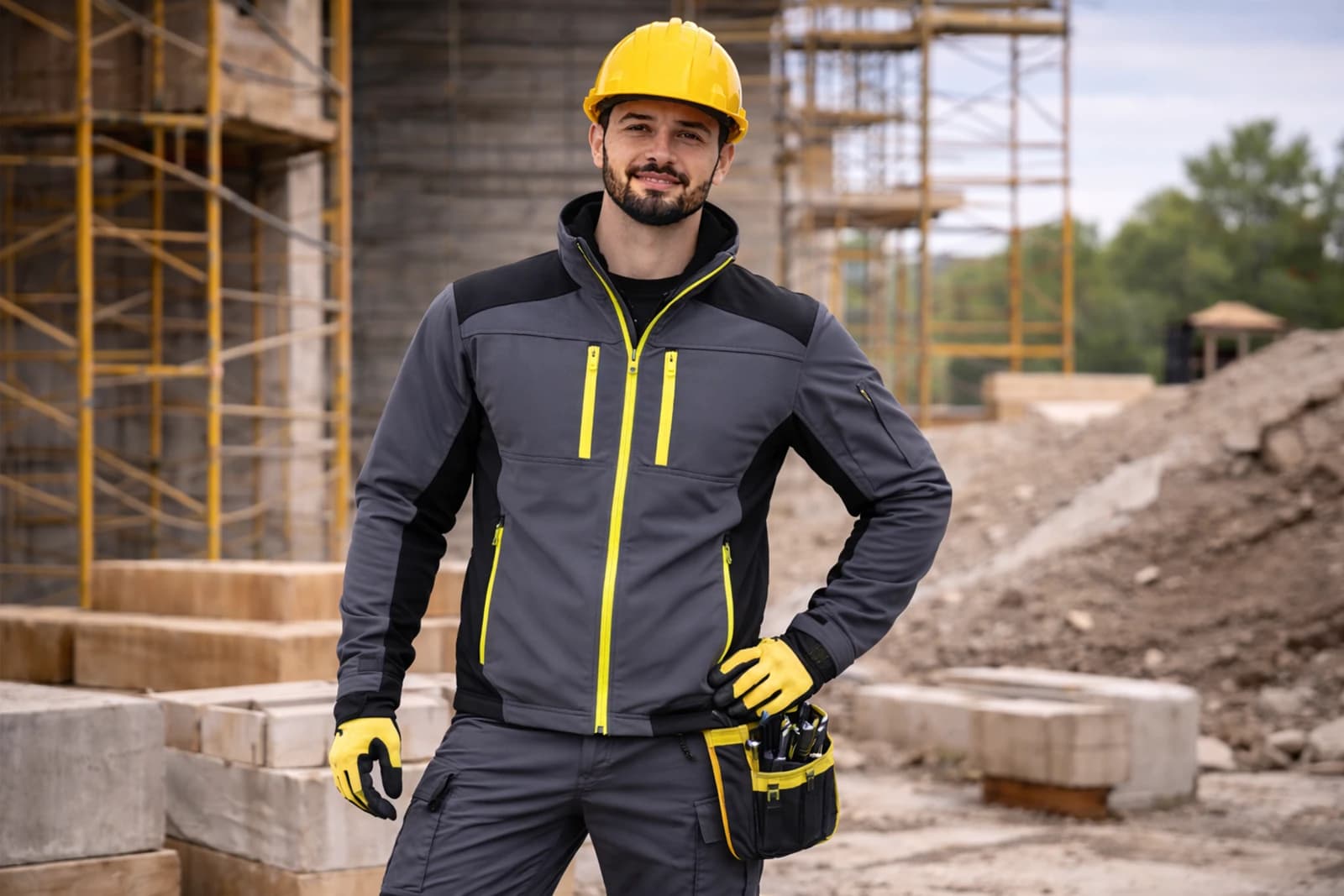
Construction Clothing
Construction Softshell Set
Flexible jacket and trouser set built for crews working across changing weather conditions.
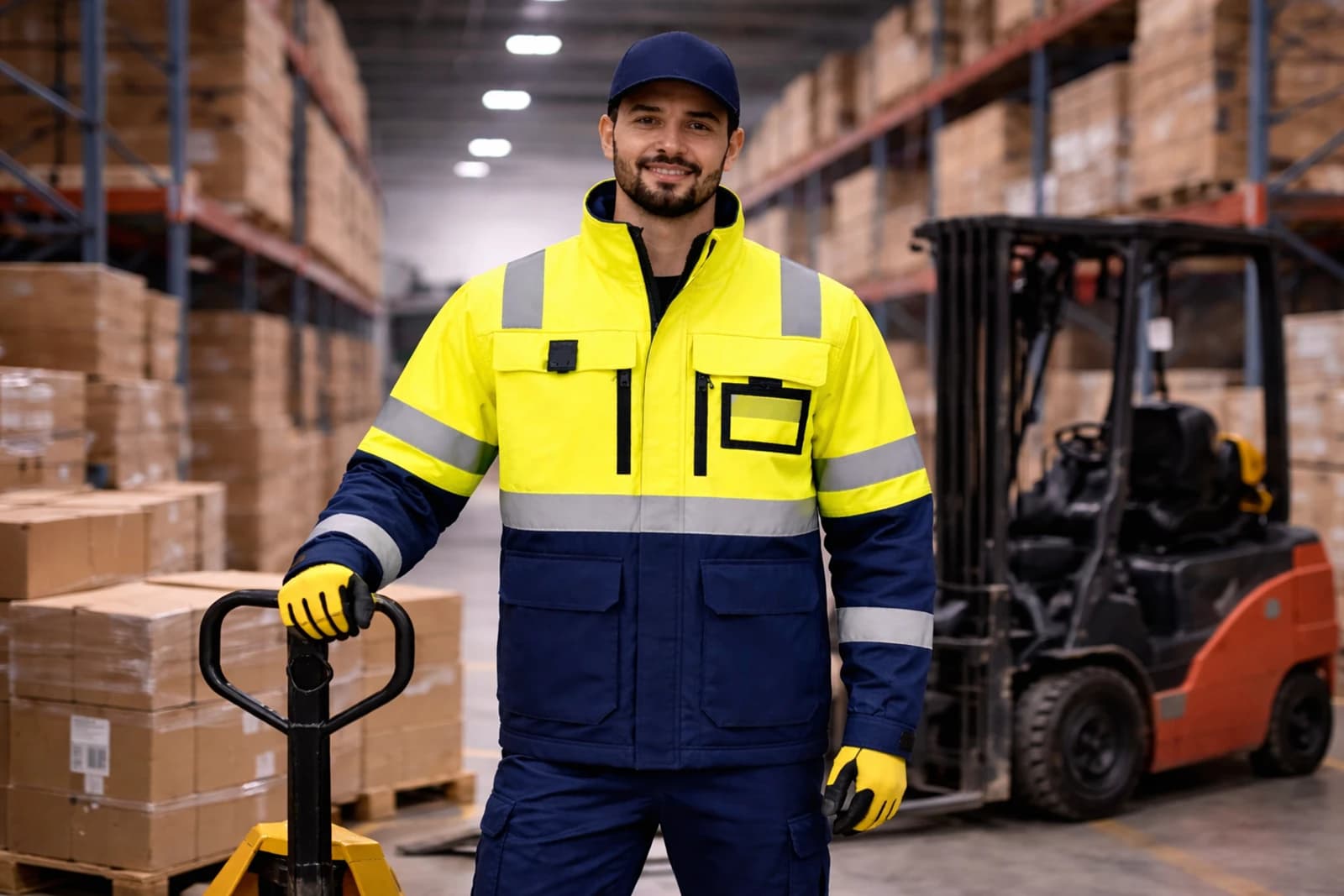
Safety Uniform
Hi-Vis Safety Jacket
Reflective safety jacket for high-visibility site operations and road work crews.