Construction Softshell Set for Middle East Winter Worksites: A B2B Sourcing Guide
From NEOM construction crews and Expo City site teams to QatarEnergy winter-phase projects and Dubai Creek Tower scaffolding crews, the Construction Softshell Set is the preferred mid-layer for cooler months in the Gulf. This guide helps Middle East B2B buyers source windproof, water-resistant, breathable softshell workwear from a Chinese manufacturer — covering fabric technologies for 15°C–25°C Gulf winters, ergonomic design for active workers, brand customisation for fleet identity, and bulk procurement strategies for national contractors and mega-project developers.

Buyer context
What procurement teams run into
The Gulf region's construction sector is the largest outside China, with combined GCC construction output exceeding $140 billion in 2026. Mega-projects such as NEOM (Saudi Arabia), Dubai Creek Tower (UAE), Lusail City (Qatar), and Zayed City (Abu Dhabi) operate year-round, including the November–March winter window when daytime temperatures drop to a comfortable 15°C–25°C range. For B2B buyers sourcing the Construction Softshell Set from a Chinese workwear manufacturer, several specific challenges emerge: **Winter doesn't mean cold — but Gulf winter is windy:** Gulf winters are mild in temperature but characterised by strong winds — shamal winds in Saudi/Qatar and coastal breezes in UAE/Oman can create wind-chill factors dropping effective temperatures by 5–10°C. Standard cotton or fleece mid-layers fail to block wind yet trap moisture, leading to worker discomfort and reduced productivity during outdoor concrete pouring, steel erection, and façade installation. **Day-to-night temperature swings of 10–15°C:** A single work shift (06:00–18:00) in a Riyadh or Kuwait City winter site may start at 8°C and reach 25°C by midday. Workers need a garment that regulates across this range — too warm for midday, too cold for dawn. Traditional thick fleece or padded jackets force workers to constantly remove and carry layers, increasing the risk of lost or damaged PPE. **Durability against construction abrasion:** Softshell fabrics (typically polyester/elastane laminates) are chosen for their stretch and breathability, but on active construction sites — climbing rebar, kneeling on rough screed, brushing against scaffolding — standard 150–200 gsm softshells abrade and delaminate within 4–6 weeks, leading to fabric peeling at high-wear zones (elbows, knees, hips, cuffs). **Branding longevity for fleet identity:** Major contractors like Saudi Binladin Group, Al Habtoor, ACC, and QDVC require durable logo embroidery, reflective tape, and company colour-matching on softshell sets. Heat-transfer or screen-printed logos crack and peel on stretch fabrics within 10–15 washes, while poor colour-matching across batch runs creates inconsistent fleet appearance. **Moisture management for active workers:** Concrete workers, steel fixers, and masons generate significant metabolic heat even in 18°C weather. Without adequate moisture-wicking and ventilation, sweat saturates the inner lining, causing chilling when wind hits — a primary complaint during Gulf winter worksite safety audits.
Sourcing approach
How a factory partner can respond
A well-specified Construction Softshell Set from an experienced Chinese workwear manufacturer solves each of these Gulf-specific challenges: **3-layer bonded softshell for wind resistance without bulk:** Specify a 3-layer bonded softshell fabric (outer: 96% polyester / 4% elastane woven face, 280–320 gsm; middle: waterproof breathable membrane 5,000–10,000 mm H₂O / 3,000–5,000 g/m²/24h MVTR; inner: micro-brushed polyester fleece). This construction blocks wind up to 50 km/h while maintaining stretch (30–40% elongation in warp and weft per ISO 13934-1). Chinese manufacturers offering laminated fabrics from certified mills (e.g., Toray Dermizax or domestic equivalents meeting JIS L 1099 B-1 standards) deliver consistent membrane bonding with less than 5% delamination risk through 50 industrial washes. **Zip-off sleeve system for day-to-night temperature adaptation:** The ideal Construction Softshell Set includes zip-off sleeves at the shoulder seam (YKK #5 reverse coil zippers), transforming the jacket into a lightweight gilet in under 30 seconds. Workers wear the full set at dawn, remove sleeves for midday warmth, and slip them back on as temperature drops. This reduces the "carrying bulky outerwear" problem and ensures the worker always has the appropriate layer. Additional features — underarm laser-cut venting panels (100+ micro-perforations per cm²), a mesh-lined chest map pocket, and a stow-away hood in the collar — further expand the temperature regulation range. **Reinforced wear zones for construction-site durability:** Look for double-layer reinforcement patches at elbows (500D Cordura or equivalent, stitched with bonded nylon thread), internally lined knee pads on trousers with adjustable height positioning, and bartack stitching at all stress points (crotch gusset, pocket corners, zipper base). The trousers should feature a reinforced seat panel and triple-stitched inner leg seam. Specify ASTM D3884 abrasion testing with a minimum of 25,000 cycles (Martindale) before face fabric breakthrough — standard fashion softshells fail at 8,000–12,000 cycles. Reinforced construction adds 15–20% to unit cost but extends garment life from 3 months to 12+ months on active sites. **Heat-transfer reflective and embroidery-ready fabric:** Choose a smooth-face softshell with a tight weave structure (minimum 180 threads per inch) that accepts both silicone-based heat-transfer logos (for reflective tape and complex colour gradients) and high-density chainstitch embroidery (for company crests and worker ID numbering). Request 40°C industrial-laundering colour-fastness samples (ISO 105 C06): Delta E below 2.0 for colour matching across production batches, and reflective tape (EN ISO 20471 Class 2 minimum) retention after 25 washes with less than 20% loss of retroreflective performance. Chinese suppliers offering digital fabric colour-matching (Pantone TPX to fabric within 24 hours) enable fast fleet rebranding cycles. **Moisture-wicking inner face and antimicrobial treatment:** The inner layer should be a brushed micro-polyester (100% polyester, 150–180 gsm) with wicking finish achieving a vertical wicking height above 100 mm per 30 minutes (AATCC 197) and drying rate under 4 hours (JIS L 1096). Add an antimicrobial finish (silver-ion or zinc-pyrithione based, compliant with Oeko-Tex Standard 100 and EU Biocidal Products Regulation) to prevent odour and bacterial buildup through extended wear cycles. For the most demanding Gulf contractors, Chinese manufacturers can also integrate UPF 50+ sun protection and insect-repellent treatment (permethrin or IR3535 based) for remote desert site workers, creating a true multi-hazard winter workwear solution.
Recommended Products
Products that fit this use case
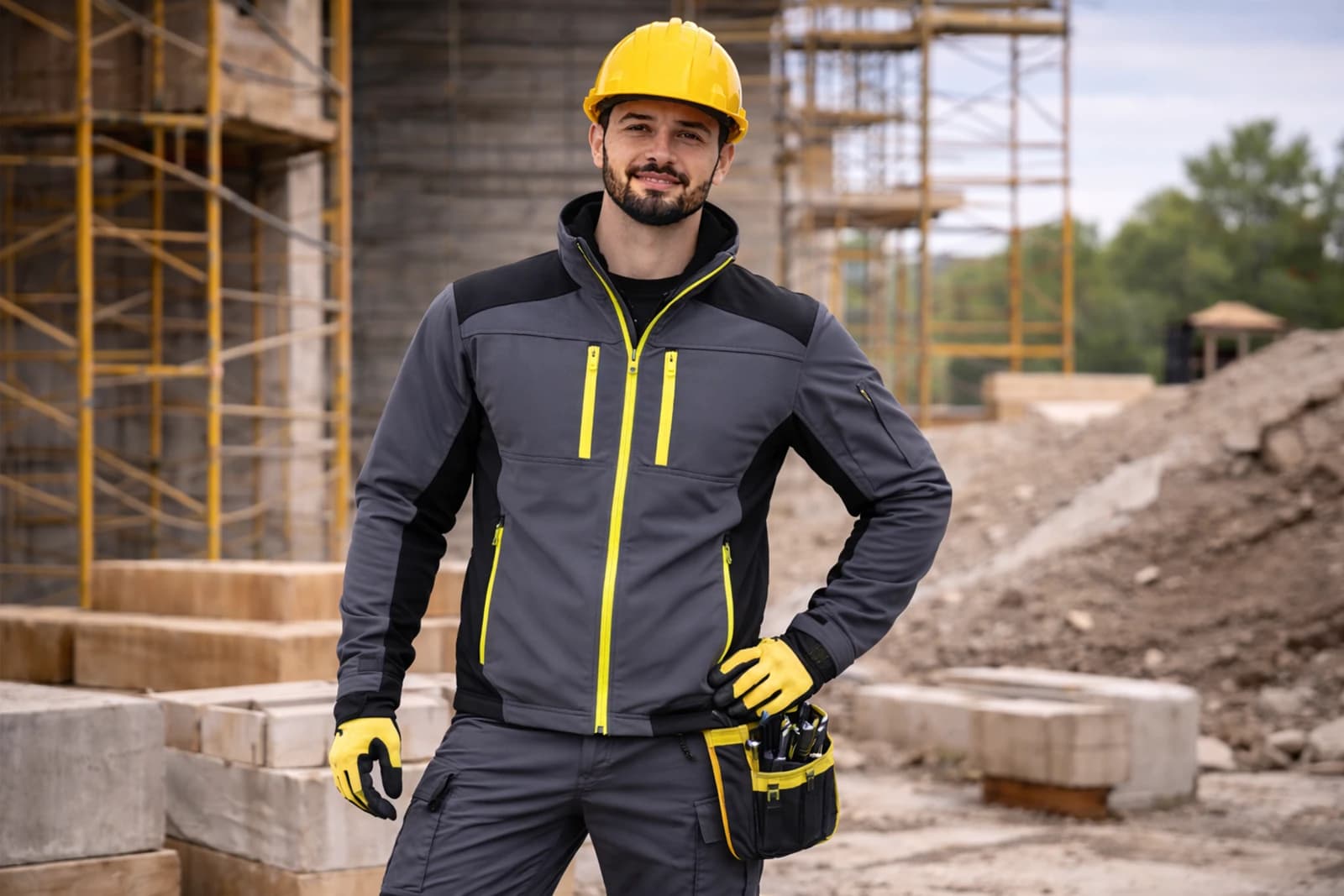
Construction Clothing
Construction Softshell Set
Flexible jacket and trouser set built for crews working across changing weather conditions.
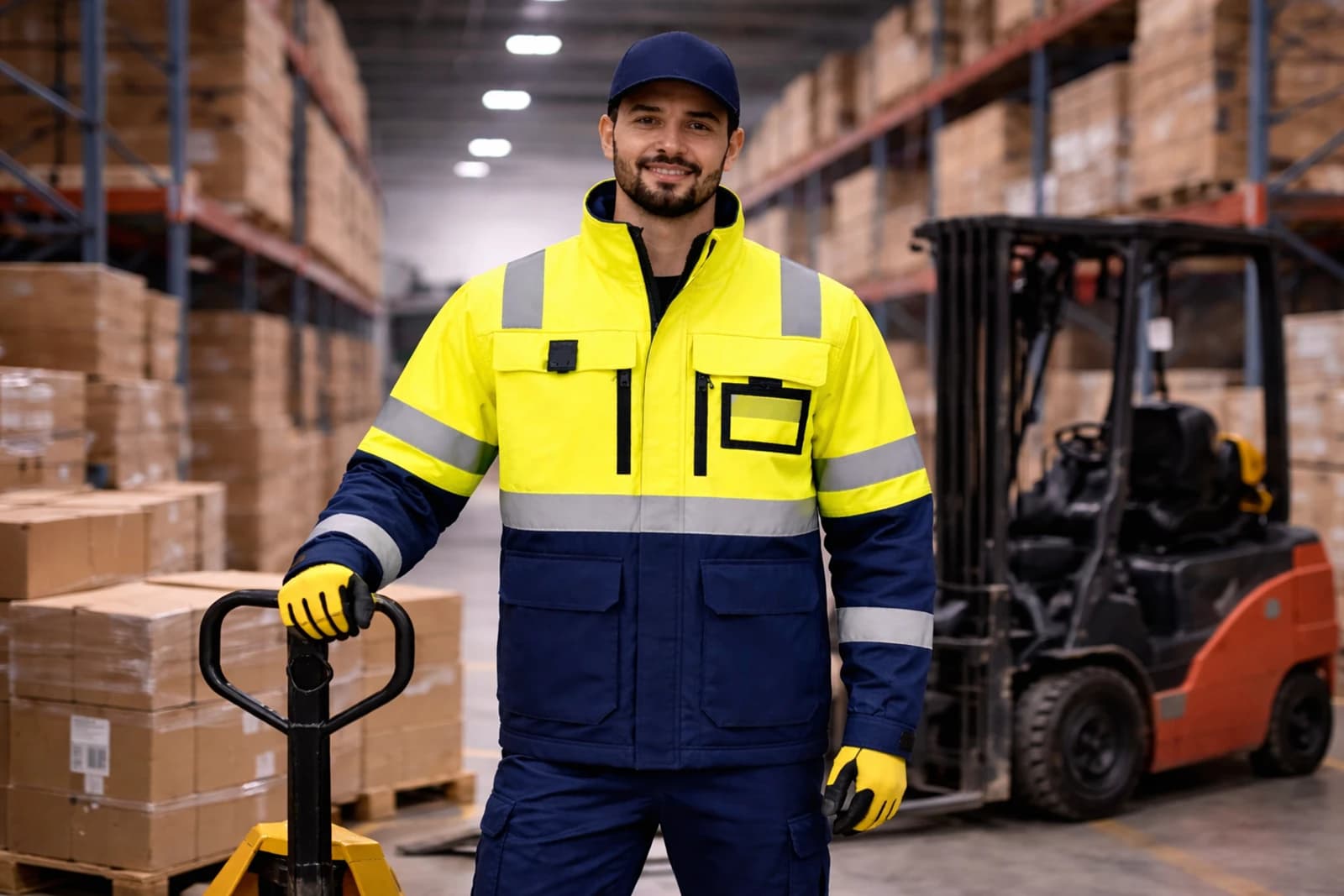
Safety Uniform
Hi-Vis Safety Jacket
Reflective safety jacket for high-visibility site operations and road work crews.