Construction Softshell Set for Middle East Infrastructure Projects: B2B Buyer's Guide for Sourcing from China
Middle East infrastructure and construction megaprojects — from NEOM and the Riyadh Metro to Qatar's World Cup legacy builds and UAE city expansions — require safety workwear that performs in extreme desert conditions. This guide covers what B2B buyers across Saudi Arabia, UAE, Qatar, Kuwait, and Oman should know when sourcing construction softshell sets from a Chinese workwear manufacturer: thermal insulation without bulk, wind and water resistance for dusty and cool-season conditions, abrasion resistance, and the right balance of visibility and professional appearance for crew identification and branding.

Buyer context
What procurement teams run into
The Middle East construction sector is undergoing a transformative boom. Saudi Arabia's Vision 2030 has unleashed a pipeline of giga-projects — NEOM, the Red Sea Project, Diriyah Gate, Roshn communities, the Riyadh Metro and 12 new airports — that together represent over $1 trillion in planned investment. The UAE is building at a frenetic pace across Dubai, Abu Dhabi, and the Northern Emirates. Qatar's post-2022 World Cup legacy construction continues, while Kuwait and Oman are advancing their own national development plans with significant infrastructure and oil & gas related construction. For B2B procurement managers, HSE directors, and workforce outfitting buyers responsible for sourcing workwear at scale, the challenge is finding a construction safety softshell set that addresses the unique environmental conditions of the Gulf: **Temperature extremes:** Gulf construction operates across a punishing seasonal range. Summer daytime temperatures routinely hit 48–52°C — too hot for any softshell. But winter nights and early mornings from November through March drop to 8–14°C, compounded by strong winds and occasional rain. Offshore construction and elevated structures (crane operation, high-rise steelwork) experience even more severe wind chill. The ideal softshell must be comfortably worn in 12–28°C conditions — warm enough for cool mornings yet breathable enough to wear through midday temperature rises without causing heat buildup. **Dust, sand, and wind:** The Gulf's construction sites are dusty environments year-round. On-site visibility can drop to 50–100 metres during shamal wind events. Fine silica dust, cement powder, and sand particles abrade fabric surfaces, clog zippers, and infiltrate pockets and seams. The softshell must resist particle ingress while remaining breathable. **UV radiation:** Gulf UV index values reach 11+ (extreme) for 6–8 months of the year, with peak UV-B intensity 3–4 times higher than Southern Europe. Workers spending 10–12 hour shifts outdoors accumulate dangerous UV exposure. A construction softshell with integrated UV protection (UPF 50+) provides critical daily protection for uncovered arms and upper body during the cooler months when sunscreen application may be inconsistent. **Branding and crew identification requirements:** Middle East megaprojects typically involve 50–200+ subcontractor companies on a single site. Contractor identification, trade classification (scaffolders, steel fixers, formwork, MEP, finishing), and site access level must be clearly visible from colour-coded garments and printed/embroidered branding. A plain softshell won't work — buyers need a garment that accommodates high-visibility contrast panels, reflective tape striping, chest and back print areas, and detachable sleeves for the armband trade-indicator system common in Saudi Aramco and Qatari Diar sites. **Cost-per-wear economics for project-scale sourcing:** Construction contracts in the Middle East typically last 6–24 months. A softshell must survive the contract period with 20–50 industrial launderings at 60–75°C, maintain its shell membrane integrity, keep reflective tape securely bonded, and not lose its colour, fit, or professional appearance. A cheap softshell that delaminates, pills, or loses shape after 10 washes drives hidden replacement costs that destroy the unit economics of a bulk procurement order.
Sourcing approach
How a factory partner can respond
**1. Fabric system: the 3-layer softshell architecture optimised for Gulf construction conditions** The best construction softshell sets for Middle East work are built on a 3-layer bonded fabric architecture that balances protection, breathability, and durability: - **Outer layer (face fabric):** 94–97% polyester / 3–6% elastane woven stretch fabric at 280–320 gsm weight. The elastane content provides 4-way stretch essential for bending, kneeling, climbing ladders, and reaching overhead — movements repeated hundreds of times per shift on a construction site. The face fabric should have a durable water repellent (DWR) finish — Teflon EcoElite or Bionic-Finish Eco (C6/C0 free for global regulatory compliance) — that causes water, mud, and cement slurry to bead off rather than soaking in. - **Mid layer (membrane):** A microporous breathable membrane (ePTFE or TPU-based) laminated to the outer fabric. The critical specification for Gulf conditions is breathability: a minimum MVTR of 5,000 g/m²/24h (ASTM E96), with 8,000–10,000 being ideal. In cooler winter mornings, the membrane blocks wind (maximum 0.02 CFM air permeability per ASTM D737), but as temperatures rise through the day, the microporous structure vents moisture vapour to prevent sweat buildup. For Middle East construction, a waterproof rating of 5,000–8,000 mm (ISO 811) is adequate — Gulf rain is short-lived but intense — while the primary function is wind-blocking and dust resistance. - **Inner layer (backer):** A brushed micro-fleece or interlock knit that provides warmth without bulk. This layer should be antimicrobial-treated to resist odour build-up in the warm, sweaty conditions of day-long wear. The combined fabric weight of 320–400 gsm across all three layers provides warmth equivalent to a mid-weight fleece while remaining packable and non-restrictive. **Key specification questions for your manufacturer:** 1. Ask for the wind permeability test report (ASTM D737 / EN ISO 9237) — the fabric should show less than 5 cfm/ft² air permeability. 2. Ask for the MVTR test report — values below 4,000 g/m²/24h risk condensation buildup inside the garment during active work. 3. Ask for the abrasion resistance per ISO 12947-2 (Martindale) — a minimum of 20,000 cycles for the outer fabric ensures the softshell survives 12+ months of on-site wear. **2. Construction-specific design features that Middle East buyers must not compromise on** A softshell set — jacket and trousers — for Middle East construction differs significantly from a hiking or outdoor sports softshell. The following design elements are non-negotiable for site work: **For the softshell jacket:** - **High-visibility contrast panels:** At minimum, EN ISO 20471 Class 3 requires that the garment provides 360° visibility with 0.80 m² of fluorescent background material and 0.20 m² of retroreflective tape. In Middle East construction practice, most buyers specify fluorescent yellow-green or fluorescent orange-red for the contrast panels, with 50 mm wide retroreflective tape configured as a chest band (horizontal), shoulder stripes (over the shoulder and down to the waist), and a waist band. The microprismatic or glass-bead reflective tape should have a minimum coefficient of retroreflection (RA) of 330 cd/(lux·m²) for new garments. - **Detachable or roll-up sleeves:** Some Middle East sites (particularly Saudi Aramco and ADNOC construction projects) allow or require short sleeves during the hot months, while full-length sleeves are mandatory in winter. A zip-off sleeve system at the bicep converts the jacket to a vest, maximising wear seasons in a single garment. The zipper must be concealed under a flap to maintain reflective tape continuity. - **Radio/communication pocket:** A chest pocket with a headphone exit port and clear window for radio/hands-free communication device. On large construction sites, workers need wireless communication with supervisors, crane operators, and safety officers. A dedicated pocket prevents the radio from dangling from a belt where it snags on rebar and scaffolding. - **Document pocket:** An internal chest pocket with a clear window and secure closure for site access cards, COVID-19 vaccination cards, or trade-qualification cards — items that workers must present at gate checkpoints daily. **For the softshell trousers:** - **Knee pad pockets:** Open-at-the-top internal knee pad pockets with drop-in knee pads (foam, 10–15 mm thick, EVA or PU). These are mandatory for trades that spend long hours kneeling — tile layers, formwork carpenters, MEP fitters, and floor finishers. The pocket design should allow the worker to insert and remove pads without removing the trousers. - **Reinforced bottoms:** Abrasion-resistant hem facing — Cordura or 500 denier nylon overlay on the inner lower leg and hem, protecting against boot abrasion and scuffing from steel toe caps. - **Multiple utility pockets:** A hammer loop on the dominant side, two side cargo pockets with flap and Velcro closure, two back patch pockets (one with button closure), and a ruler/pen pocket. All pocket faces should incorporate a drainage grommet at the lowest point to prevent water and dust accumulation. - **Ankles:** Adjustable ankle tabs with snap closure or elasticated cuffs to seal out dust and sand. For desert construction sites, integrated elasticated gaiters (a stretch fabric tube that hooks under the boot) provide additional dust sealing. **3. Regional certifications and compliance requirements** Middle East construction worksites typically require multiple certifications. Buyers should request the following as minimum documentation from a Chinese workwear manufacturer: - **EN ISO 20471:2013 (High Visibility Clothing):** All contrast panels and reflective tape must meet the Class 3 requirement. The key verification point: retroreflective tape performance after 25 and 50 industrial wash cycles at 60°C. - **EN 343:2019 (Protection against Rain):** Class 3/1 (water penetration resistance / water vapour resistance) for the outer fabric. Class 3 water penetration means minimum 13,000 Pa, while Class 1 vapour resistance is the lowest barrier requirement — important because high vapour resistance causes condensation. - **EN 14058:2017 (Protection against Cool Environments):** Class 1 thermal insulation — the basic requirement for softshells intended for moderate cool conditions. The garment should provide an Iclu value of at least 0.34 m²·K/W (equivalent to approximately 1.0 clo). - **Saudi SASO / Qatari QS compliance:** For Saudi projects, garments must comply with SASO 2593 or equivalent, and for Saudi Aramco contracts specifically, the PPE must be pre-approved on Aramco's approved supplier list (ASL). For Qatar, QCS 2014 Section 11 (Health and Safety) outlines mandatory PPE requirements including high visibility and FR standards — while FR is not required for standard construction, it is mandated for commissioning and tie-in work near live hydrocarbons. **4. Sizing, colour coding, and customisation for multi-national workforces** The Middle East construction workforce is one of the most ethnically diverse in the world. A typical site employs workers from India, Pakistan, Bangladesh, Nepal, Sri Lanka, the Philippines, Egypt, Sudan, Jordan, and sometimes Southeast Asia. Body shapes, height-to-waist ratios, and arm lengths vary dramatically. Chinese workwear manufacturers experienced in Middle East export typically offer expanded sizing tables: - **Standard sizing:** S through 5XL (EU sizing basis) - **Short/Regular/Tall options:** For trousers, inseam lengths of 32, 34, and 36 inches - **Plus sizes specific to Gulf markets:** Many Middle East buyers require 6XL, 7XL, and even 8XL for Arab national supervisors and engineers who often prefer a looser, more comfortable fit **Colour coding systems commonly used in Gulf construction:** | Standard | Common Use | Example Application | |---|---|---| | Yellow-green (Hi-Viz) | General labour, trade workers | Common across all GCC states — Riyadh Metro, Lusail projects | | Orange-red (Hi-Viz) | Supervisors, inspectors, engineers | Differentiates management from general workforce | | Royal blue | Electrical trades, MEP | Site-specific; may carry anti-static requirements | | Grey / anthracite | Site management, office staff | Non-hi-vis for non-operational areas | | White | Project directors, client representatives | Reflects authority; often custom embroidered | **5. Logistics and MOQ considerations for bulk sourcing** When negotiating with a Chinese workwear manufacturer for construction softshell sets: - **MOQ range:** 500–2,000 pieces per style per colour per size. A typical softshell jacket + trouser set for a project with 500 workers across 5 trades (100 workers each) would require a minimum order of approximately 200–500 sets per trade colour. - **Lead times:** 30–45 days for first orders including sample approval (fabric selection → lab dip → size set → final sample → production). Repeat orders typically 20–30 days. - **Fabric stock:** Chinese manufacturers with integrated fabric mills can hold fabric stock in grey state and dye to order in 10–14 days. Ask about "quick response" programs that cut lead time by 15–20 days for rush orders. - **Shipping:** Sea freight from Shanghai or Shenzhen to Jebel Ali (Dubai), Dammam (Saudi Arabia), or Hamad (Qatar) takes 12–18 days. Air freight for urgent top-up orders takes 3–5 days. - **Quality checks:** Require AQL 2.5 (normal severity) pre-shipment inspection with photos, packing list verification, and in-line inspection during production for orders over 2,000 sets.
Recommended Products
Products that fit this use case
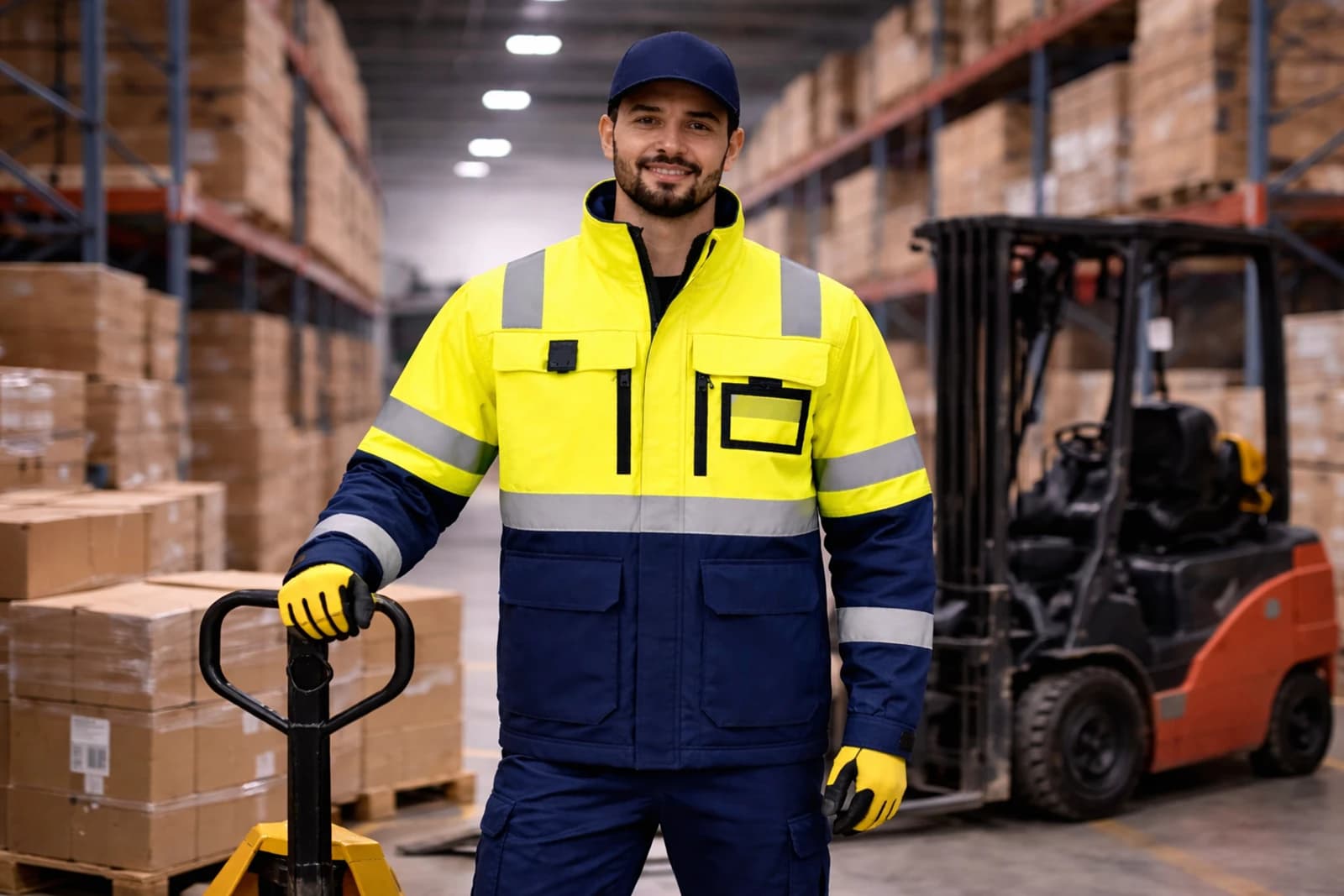
Safety Uniform
Hi-Vis Safety Jacket
Reflective safety jacket for high-visibility site operations and road work crews.
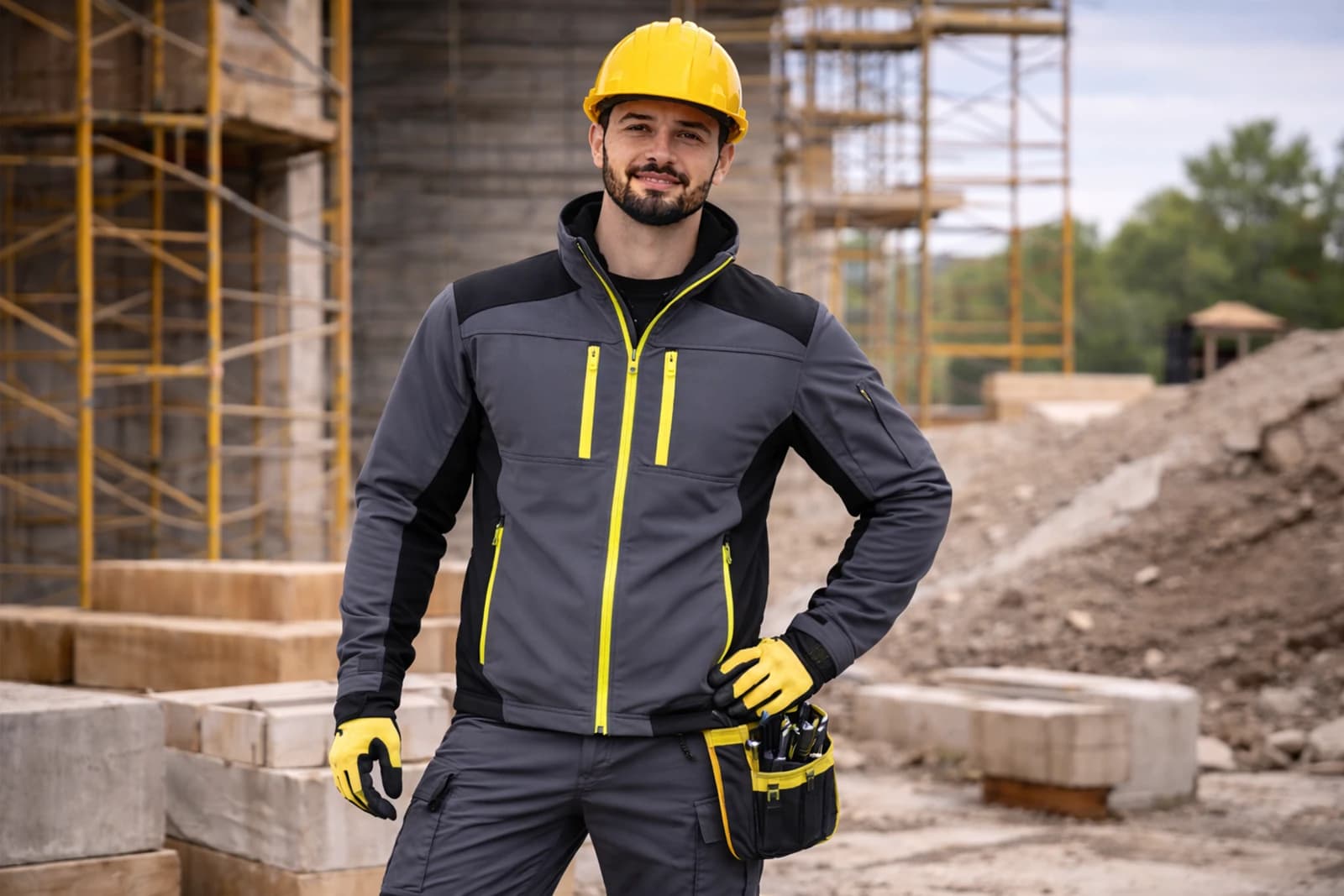
Construction Clothing
Construction Softshell Set
Flexible jacket and trouser set built for crews working across changing weather conditions.