Construction Softshell Sets for Middle East Evening and Cold-Weather Worksites: A B2B Sourcing Guide for Contractors
Middle East construction contractors working night shifts, winter months, and air-conditioned indoor sites need softshell sets that provide warmth without bulk. This sourcing guide covers fabric technology, layering systems, durability standards, and what B2B buyers should know when sourcing construction softshell uniforms from a Chinese manufacturer for Saudi, UAE, Qatar, and Oman worksites.

Buyer context
What procurement teams run into
<p>Middle East construction doesn't stop when the sun goes down — and it doesn't pause in winter. Night shifts on NEOM earthworks, winter months on Dubai high-rise towers, underground metro stations in Doha, and air-conditioned indoor fit-out work across the Gulf all create a challenge: workers need upper-body warmth without the bulk and restriction of a traditional heavy jacket.</p><p>The default solution for many procurement managers is a standard fleece or a lined hi-vis jacket worn over the work shirt. Both have problems. A standalone fleece lacks wind resistance — in open desert construction sites at night, wind cuts straight through, making the worker cold despite the fleece's thermal weight. A lined hi-vis jacket is too warm for workers who are physically active (lifting, climbing, operating tools) because it traps heat and sweat, so workers remove it mid-shift, defeating its purpose.</p><p>Durability is another issue. Many softshell fabrics sold into the Middle East market are designed for casual outdoor use or light industrial settings. On a construction site, these fabrics fail at the seams (especially under the arms where range-of-motion stress is highest), lose water repellency after a few washes, and pill or fray on the cuffs and collar within weeks of daily use. Construction workers also need pockets that work while wearing a harness — most standard softshell jackets place pockets where a harness belt or straps sit, making them inaccessible.</p><p>For B2B buyers managing uniforms for 100 to 5,000 construction workers across multiple sites, the goal is a softshell jacket-and-trouser set that provides warmth and wind resistance for evening and winter conditions, allows full mobility for active construction work (lifting, bending, climbing), resists abrasion from rough surfaces (rebar, concrete, scaffolding), includes practical pocket placement compatible with fall-protection harnesses, and integrates with the contractor's existing hi-vis vest or jacket system for compliance.</p>
Sourcing approach
How a factory partner can respond
<p>The most practical solution for Middle East construction contractors is a three-layer softshell jacket-and-trouser set (the construction softshell set) built from a bonded fabric construction: a durable outer face (94–98% polyester with 2–6% elastane for stretch), a breathable membrane mid-layer for wind resistance, and a micro-brushed inner fleece for warmth. Target a total fabric weight of 280–320 gsm — heavy enough for insulation without the bulk that restricts movement on site.</p><p>Key specifications to request from your Chinese manufacturer:</p><ul><li><strong>Wind-resistant membrane with breathability rating of 5,000+ g/m²/24h:</strong> The membrane must block wind while allowing sweat vapour to escape. Active construction workers generate significant body heat — a non-breathable softshell causes condensation inside the jacket, which then chills the worker when they stop moving. A breathability rating of 5,000 g/m²/24h or higher prevents this. Request an actual MVTR (moisture vapour transmission rate) test report from the fabric supplier.</li><li><strong>DWR (Durable Water Repellent) finish rated C6 or C8 free:</strong> Construction sites in the Gulf don't have frequent rain, but dew, humidity, and occasional winter showers do occur. A DWR finish on the outer face causes water to bead and roll off rather than soak into the fabric. Specify C6 or the newer C8-free DWR formulations — these are more durable than older C6 variants and last 20–30 washes before needing reapplication. Avoid non-DWR softshells for construction use; they absorb moisture quickly and become heavy and uncomfortable.</li><li><strong>Four-way mechanical stretch at 15–20%:</strong> Construction work requires reaching, bending, climbing, and twisting. A softshell without stretch (100% polyester face fabrics) restricts movement, especially in the shoulders and elbows. Request 4-way mechanical stretch — the stretch comes from the fabric weave structure and elastane content, not from a separate stretch layer. Verify with a stretch-and-recovery test: the fabric should return to its original shape after 30% elongation.</li><li><strong>Harness-compatible pocket layout:</strong> This is a commonly overlooked specification. Standard softshell pockets are placed at the waist or hip level — exactly where a fall-protection harness sits. For construction workers wearing harnesses, specify a chest pocket layout: two Napoleon zip pockets (vertical zippered pockets on each side of the chest centre zip) for phone and small tools, and two upper-arm zip pockets for access while wearing a harness. The jacket hem should be drop-tail (longer in back) to prevent it riding up when the worker raises their arms or bends.</li><li><strong>Abrader-resistant fabric at key zones:</strong> The outer face should pass 20,000+ cycles on the Martindale abrasion test (EN ISO 12947). Request reinforcement panels at high-wear zones: the inner forearms (from contact with scaffolding and rebar), the elbows (from kneeling and leaning), and the cuffs (from rubbing against gloves and sleeves). Some manufacturers offer contrast-coloured Cordura or nylon reinforcement at these points — this is worth paying for if your softshell sets are used on rough concrete or steel frame sites.</li><li><strong>Hi-vis tape integration for nighttime and low-light compliance:</strong> The softshell jacket should include reflective tape (50 mm wide, EN 20471-compliant) on the torso bands and sleeves so it functions as a hi-vis garment for evening and night shifts. For contractors who already use hi-vis vests, the softshell jacket can be made without tape and worn under the vest — confirm this with your manufacturer so tape placement doesn't conflict with vest straps. A combination approach — softshell jacket with minimal tape worn under a hi-vis mesh vest — gives the most flexibility for mixed daytime and nighttime workforces.</li></ul><p>For the trousers, a matching softshell trouser with the same bonded fabric construction provides full-body warmth. Key features include: articulated knees (pre-shaped for bending and kneeling), a gusseted crotch for range of motion, two side pockets with zippers (prevents content loss when climbing), two back pockets, and a hem width adjustable for boot compatibility. The trousers should be worn over a standard work trouser or base layer, not as a standalone trouser for active construction — they are insulation layer, not primary work trousers.</p><p><strong>Sizing for Middle East construction workforces:</strong> Request sizing based on actual body measurements of your workforce rather than standard European sizing charts. Middle East construction workforces are diverse — workers from Bangladesh, India, Pakistan, Nepal, the Philippines, Egypt, and Sri Lanka all have different body proportions. Ask your manufacturer for a measured size chart (chest, waist, height, inseam, sleeve length) and order a size-run of 5 jackets and 5 trousers in the sizes you expect to need most. Have workers from different nationalities try them on and provide feedback on fit before placing the full order. Common adjustments include: shorter sleeve-to-cuff length for South Asian workers, wider shoulders for workers who do overhead lifting, and longer back lengths for the jacket to accommodate a stooped-over working posture on ground-level tasks.</p><p><strong>Colour selection for Middle East construction sites:</strong> Choose lighter-coloured softshells (grey, light blue, or high-visibility orange/yellow) for daytime-night-mixed operations — lighter colours reduce heat absorption if the worker wears the softshell during cooler daytime hours. For pure night-shift workforces or winter-only use, darker colours (navy, black, dark grey) are more practical for hiding site dirt and concrete dust.</p><p><strong>Customization and branding:</strong> Construction companies in the Middle East typically want their company name and logo on both the jacket (left chest) and the back of the jacket (full-width between the shoulder blades). Silicone heat-transfer is the best application method for softshell fabric — it bonds permanently, doesn't crack with stretch, and survives 50+ industrial washes. Avoid embroidery on softshell jackets; the needle holes through the membrane layer compromise breathability and can lead to delamination around the logo area over time.</p><p><strong>Lead time and MOQ:</strong> Standard lead time for custom softshell sets from a Chinese manufacturer is 35–50 days from sample approval, depending on fabric availability and order volume. Typical MOQ ranges from 300 to 1,000 sets per colour per design. For contractors with annual uniform programs, consider ordering a 10–15% overrun to cover new hires and replacements during the year — softshell sets to a specific fabric and colour spec are difficult to reorder in small quantities at the same unit price.</p>
Recommended Products
Products that fit this use case
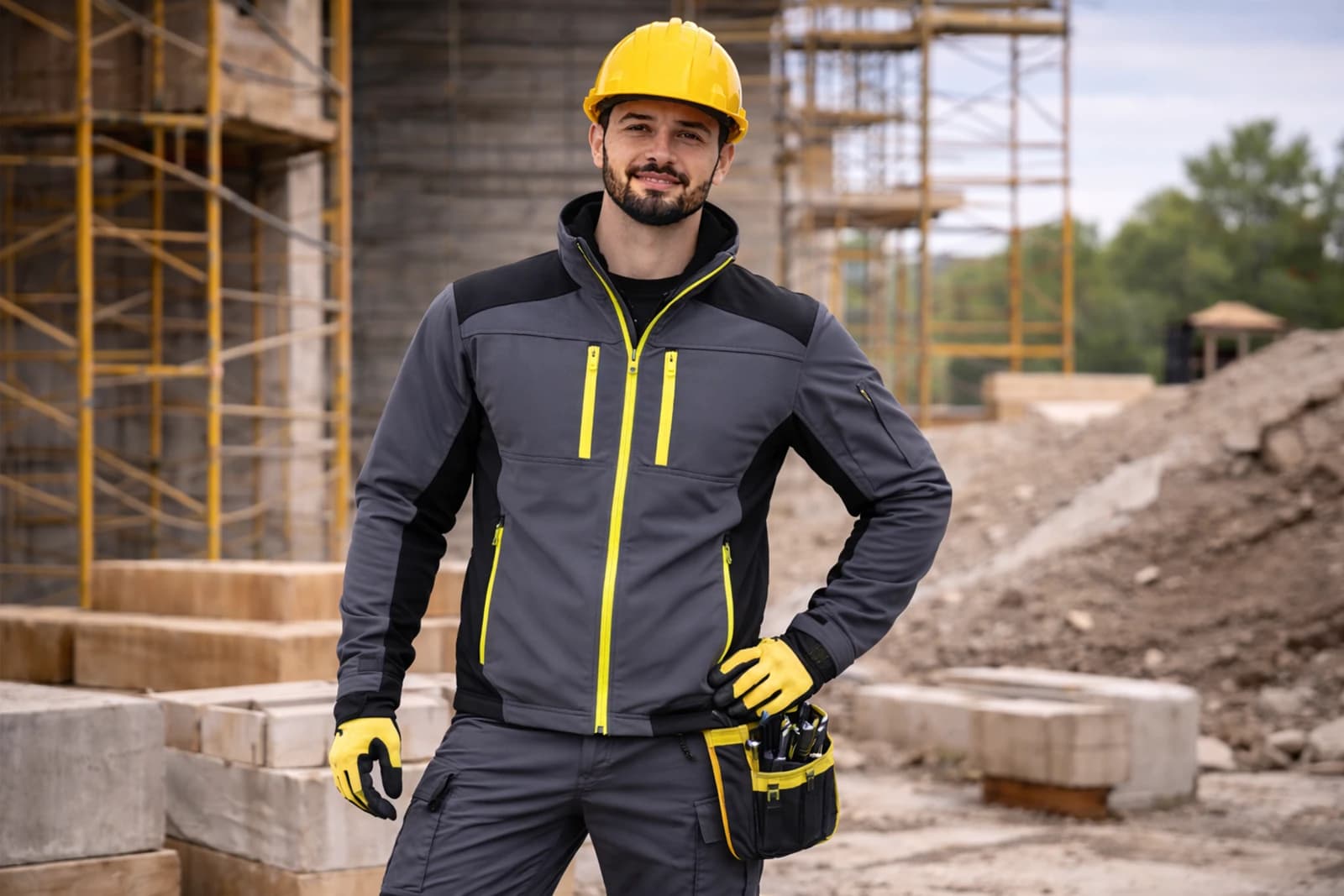
Construction Clothing
Construction Softshell Set
Flexible jacket and trouser set built for crews working across changing weather conditions.
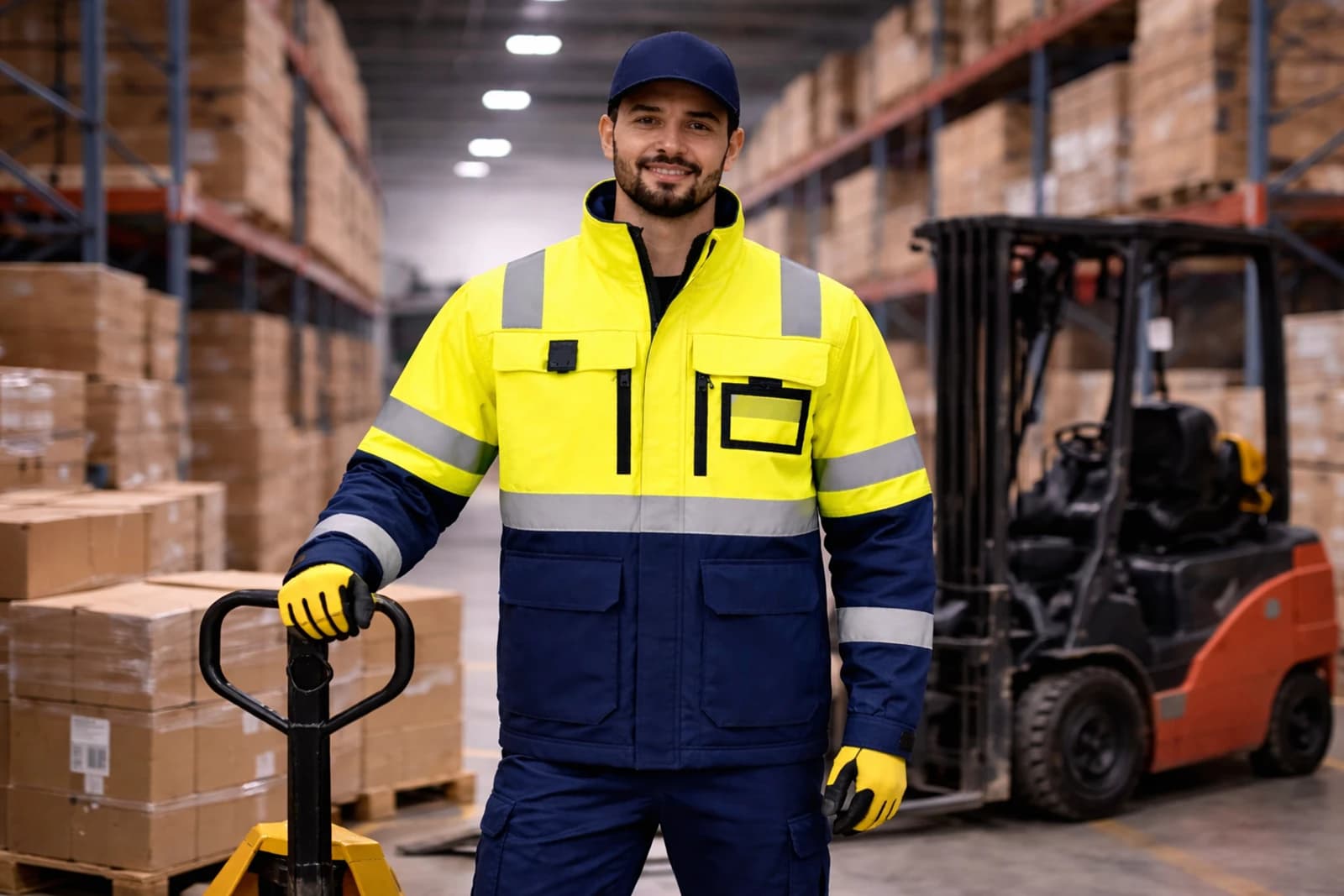
Safety Uniform
Hi-Vis Safety Jacket
Reflective safety jacket for high-visibility site operations and road work crews.