Construction Softshell Sets & Work Coveralls: Sourcing Guide for Middle East B2B Buyers
Saudi Arabia's giga-projects — NEOM, The Line, Qiddiya, and Red Sea Global — alongside Dubai's expanding metro network, Qatar's post-World Cup infrastructure pipeline, and Egypt's new administrative capital have pushed GCC construction activity to record levels. With projects running year-round through summer heat and brief desert winters, contractors across the region are sourcing layered workwear systems that protect workers without sacrificing mobility or comfort. This sourcing guide for Middle East B2B buyers covers construction softshell sets, industrial coverall specifications, fabric and layering strategy for Gulf climates, compliance considerations (EN ISO 20471, EN 13688), and volume procurement from a Chinese workwear manufacturer.

Buyer context
What procurement teams run into
Construction is the backbone of the Middle East economy. Saudi Vision 2030 alone has unleashed hundreds of billions in giga-project spending — NEOM, Qiddiya, Diriyah Gate, Red Sea Global — and the UAE continues to build at pace with Dubai's expanding transit network, Abu Dhabi's industrial zones, and new free-zone cities. Qatar, Oman, and Kuwait all have substantial infrastructure pipelines of their own.\n\nWith projects running 24/7 across extreme weather — 50°C summer afternoons, sandstorms, and surprisingly cold desert nights — contractors face a real workwear challenge: how do you equip a workforce that moves between roasting outdoor sites and air-conditioned high-rises, between summer and a brief but real winter season?\n\nThe answer for most serious contractors is a layered system. And at the centre of that system sits the construction softshell set.\n\n**1. Why softshell sets are winning on GCC sites**\n\nThe softshell jacket-and-trouser set has become the default mid-layer for construction workwear in the Middle East — and for good reason.\n\nUnlike heavy lined jackets, softshell fabric is a bonded three-layer construction: a durable outer shell, a breathable membrane, and a soft inner fleece or brushed layer. The result is a garment that:\n\n- **Blocks wind** — essential on exposed high-rise scaffolding and desert sites where wind chill is real, especially at dawn and dusk.\n- **Breathes** — the membrane lets sweat escape, so workers don't overheat when moving between shaded and sun-exposed zones.\n- **Stretches** — softshell contains elastane or similar stretch fibres, giving the freedom of movement that climbing ladders, bending over rebar, and kneeling on formwork demand.\n- **Dries fast** — sweat and incidental water don't soak in and stay. Workers stay dry, which matters in both summer sweat and winter chill.\n\nFor Gulf contractors, the softshell set is the sweet spot between a t-shirt and a heavy jacket. It works as an outer layer for most of the year and as a mid-layer under a hi-vis vest or shell jacket during winter mornings.\n\n**2. Key specifications for construction softshell sets**\n\nWhen sourcing softshell sets from a Chinese manufacturer, Middle East buyers should specify these details:\n\n**Fabric weight and composition** — Look for 280-350gsm bonded softshell. The outer face should be a durable polyester or polyamide weave (ideally 92% polyester / 8% elastane or similar stretch mix), bonded to a brushed backing. Heavier isn't always better — a 300gsm set hits the right balance for Gulf conditions.\n\n**Water resistance** — Specify a DWR (durable water repellent) finish with 5,000-10,000mm hydrostatic head. This handles the short but intense Gulf rain bursts without turning the garment into a waterproof sweatbox.\n\n**Detachable or integrated hood** — For outdoor roles, a stowable hood that rolls into the collar is ideal. It's there when sandstorms or rain hit, and it doesn't flap or catch on equipment the rest of the time.\n\n**Reinforced elbows and knees** — On a construction site, elbows and knees take the most abrasion. Specify double-layer reinforcement or CORDURA patches on these stress points, especially on trousers.\n\n**Multiple secure pockets** — Softshell sets should include zipped chest pockets for phones and tools, side hand pockets, and cargo pockets on trousers with secure closures. Pocket placement matters: nothing should snag when a worker is on a ladder.\n\n**Reflective detailing** — For workers near site vehicle routes, cranes, and roadworks, add retroreflective piping or small tape segments to the jacket. While not as extensive as a full hi-vis Class 2 or 3 garment, visible accents dramatically improve worker presence at dawn and dusk.\n\n**3. The industrial coverall — the other half of the kit**\n\nFor many roles — scaffolding crews, concrete workers, welders' assistants, MEP trades, and general labourers — a one-piece industrial coverall remains the most practical choice. It eliminates the gap between jacket and trousers (where sparks, dust, and debris can get in), has no waistband to restrict bending, and is simpler to launder as a single garment.\n\nKey specs when sourcing industrial coveralls:\n\n- **Fabric:** A poly-cotton twill (typically 65/35 or 80/20) at 245-300gsm. The blend gives durability and easy-care performance while staying breathable in heat. For heavy trades, specify a ripstop weave to stop small tears from running.\n- **Flame-resistant option:** For welders, electricians near live work, and hot work near sparks, request FR-treated coveralls (EN ISO 11612). Many Chinese manufacturers offer FR-treated poly-cotton at competitive pricing.\n- **Two-way front zip:** Essential. It lets workers sit and bend without the zip digging in, and makes emergency removal faster.\n- **Tool provisions:** Zipped chest pockets, a phone pocket, pen pockets, and generous cargo pockets with reinforced stitching. Specify internal knee pad pockets on trousers — most site workers install their own knee pads, and a pocket that holds them properly is a genuine feature.\n- **Adjustable cuffs and waist:** Elastic or velcro-adjustable cuffs keep dust out, and side adjusters let the waist be tailored per worker.\n\n**4. Layering strategy for Gulf weather**\n\nA smart procurement plan buys a system, not a single garment. For year-round Gulf operation:\n\n- **Summer (May–October):** Lightweight hi-vis vest over a moisture-wicking t-shirt or polo. Skip the softshell — it's too warm.\n- **Shoulder seasons (March–April, November):** Softshell jacket alone, or softshell trousers for cooler mornings with a t-shirt.\n- **Winter (December–February):** Softshell set as the base, layered under a hi-vis shell jacket for outdoor roles. Cold-store and night-shift workers may add a thermal base layer. The softshell set is the critical piece that makes this system work — it's warm enough to be useful, light enough to take on and off.\n\nThis system approach means the softshell set gets real use for 5-6 months a year, not just a couple of weeks of "winter."\n\n**5. Compliance and testing**\n\nConstruction workwear in the region is increasingly held to international standards:\n\n- **EN ISO 13688** — general requirements for protective clothing (ergonomics, sizing, ageing, marking).\n- **EN ISO 20471** — for hi-vis elements, whether the garment is a full hi-vis jacket or a softshell with reflective accents.\n- **EN ISO 11612** — for flame-resistant clothing used near heat and flame.\n\nInsist on third-party test reports from accredited labs (SGS, TÜV, Intertek, BV) and verify the spec sheets against the actual delivered garments. A common failure: the garment label shows a standard, but the delivered batch doesn't match the tested sample.\n\n**6. Procurement and lead-time notes for Middle East buyers**\n\n- **Sizing for Gulf workforces:** Middle East sites employ large numbers of South Asian and North African workers. Specify a size range that reflects actual body dimensions — longer body length and appropriate chest-to-height ratios — rather than defaulting to US/EU sizing charts. Ask for a full size run sample before mass production.\n- **Colour-fastness:** Gulf sun bleaches poor dyes quickly. Specify ISO 105 colour-fastness testing, especially for colours like orange, yellow, and navy.\n- **MOQ and lead times:** A typical softshell set program runs 500–2,000 units per colour/style. Lead times from a Chinese manufacturer are usually 30–45 days after sample approval, plus 2-3 weeks shipping to GCC ports. Plan stocking for the pre-winter season (August–October ordering for December delivery) to avoid the seasonal rush.\n- **Branding:** Embroidery or heat-sealed logos on the chest and back. For larger fleets, consider numbering and name bars integrated at the manufacturing stage rather than added locally — it's cheaper and looks cleaner.
Sourcing approach
How a factory partner can respond
**Sourcing a construction workwear kit from a Chinese manufacturer — the practical checklist**\n\n**For the softshell set:**\n- 280-350gsm bonded softshell, 92/8 poly-elastane face with DWR finish (5,000-10,000mm hydrostatic head)\n- Reinforced elbows and knees, stowable hood, two-way front zip on the jacket\n- Zipped chest pockets, secure cargo pockets, reflective accents for site visibility\n- EN ISO 13688 compliance with third-party test reports\n\n**For the industrial coverall:**\n- 245-300gsm poly-cotton twill (65/35 or 80/20), ripstop option for heavy trades\n- FR-treated option (EN ISO 11612) for welders and hot-work roles\n- Two-way zip, tool pockets, internal knee-pad pockets, adjustable cuffs\n\n**Sizing and logistics:**\n- Specify Middle East / South Asian size ranges; approve a full size-run sample before mass production\n- ISO 105 colour-fastness testing for Gulf sun exposure\n- Order 3-4 months ahead of the winter season; typical lead time 30-45 days after sample approval\n\nA trusted Chinese workwear manufacturer can supply both softshell sets and industrial coveralls from the same fabric and colour program, so your site crew looks like a fleet — consistent branding, consistent quality, one supplier for the whole kit.
Recommended Products
Products that fit this use case
Construction Clothing
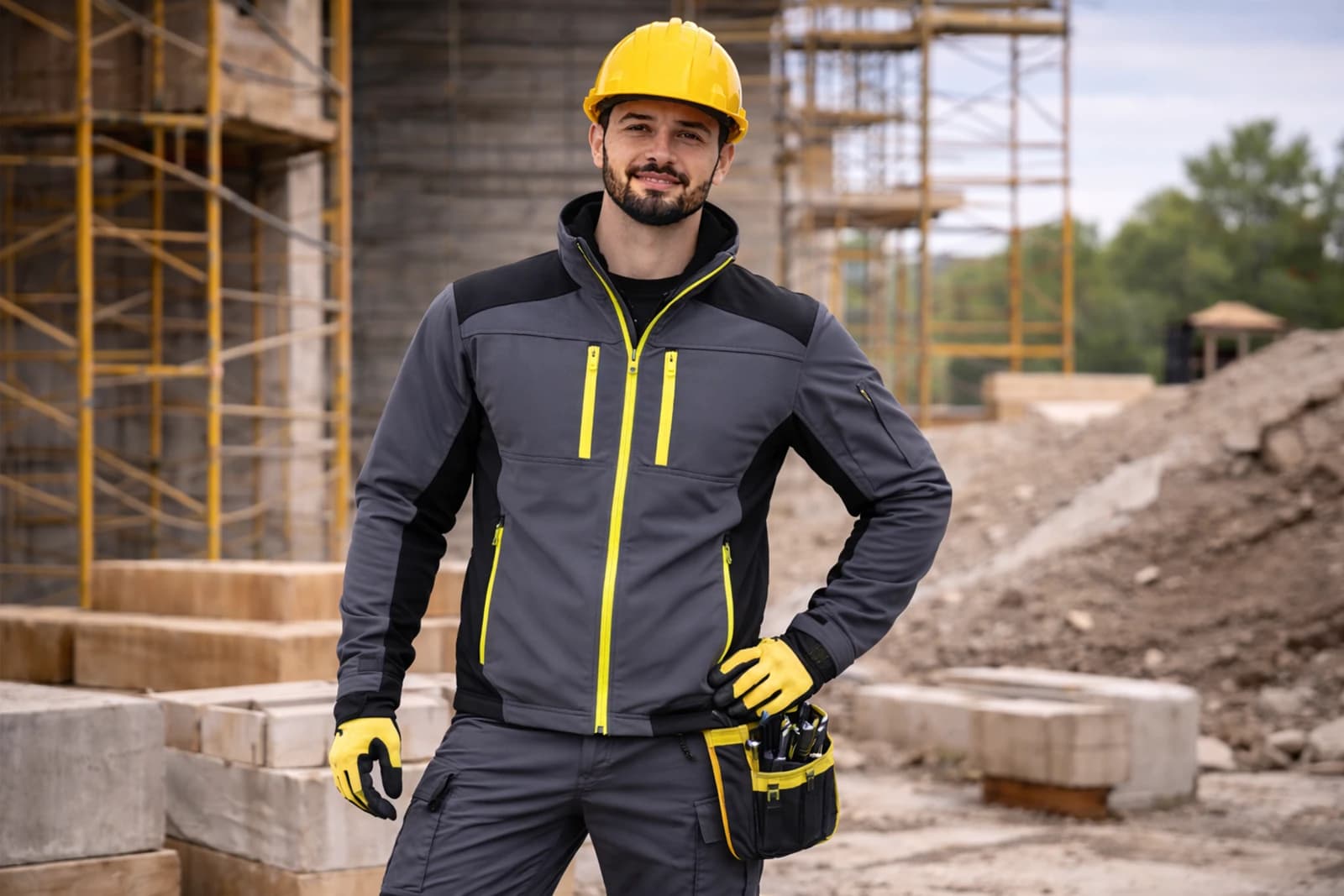
Construction Softshell Set
Flexible jacket and trouser set built for crews working across changing weather conditions.
Industrial Workwear
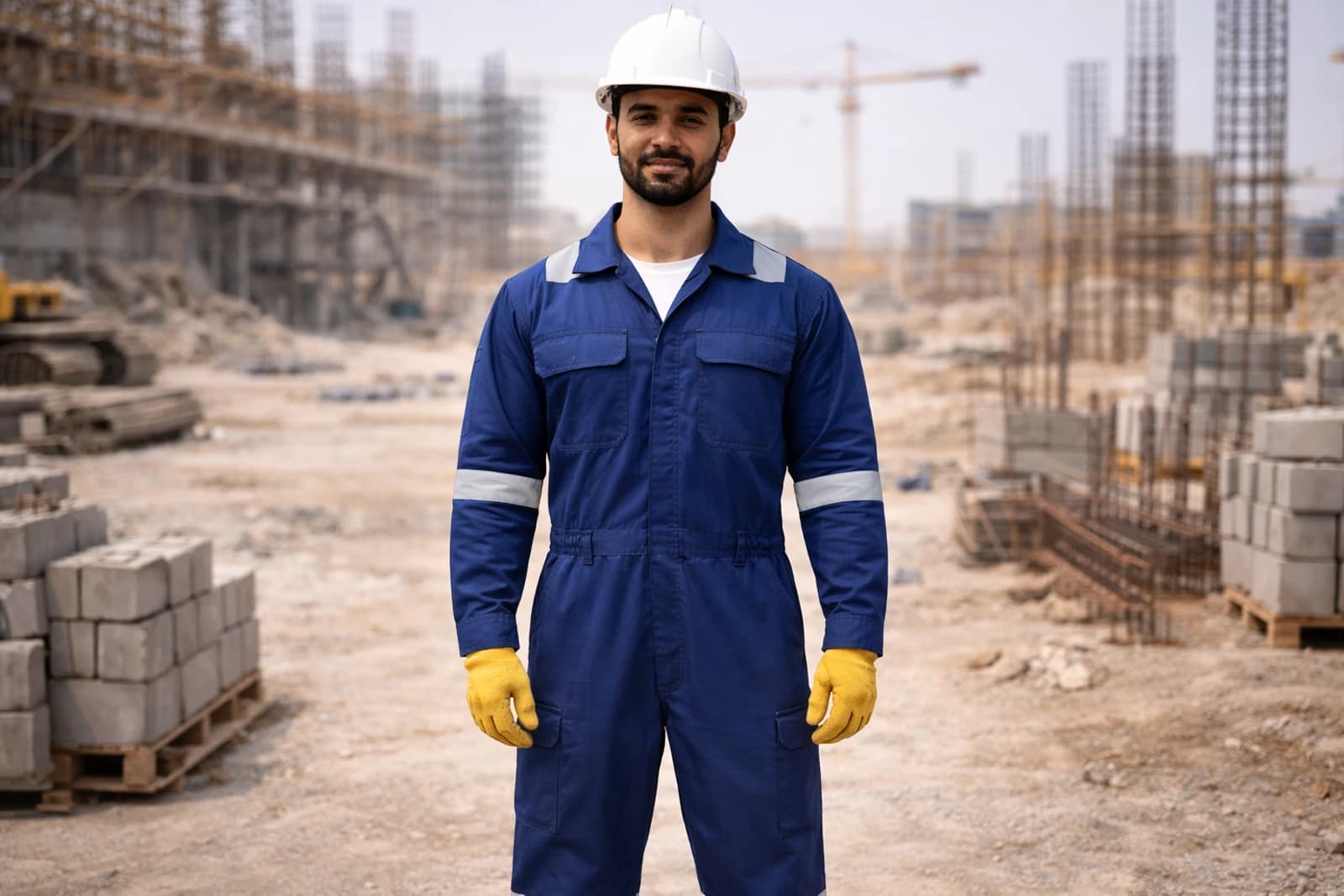
Industrial Coverall Pro
Hard-wearing one-piece coverall for plant, maintenance, and heavy-duty operations.