Why Delivery Teams in the Middle East Need Uniforms Built for Heat and Movement
Last-mile delivery teams in Dubai, Riyadh, and Doha work in 50°C summer heat, making dozens of trips per shift. Standard polo shirts and trousers from general uniform suppliers fade, trap heat, and restrict movement. This article explains what fabric, fit, and features Middle East B2B buyers should specify when sourcing delivery uniforms from Chinese manufacturers.

Buyer context
What procurement teams run into
<p>A procurement manager for a UAE-based logistics company orders 2,000 polo shirts and cargo trousers for their last-mile delivery drivers. The budget is tight, and a local supplier quoted AED 85 per set. A Chinese workwear factory offers a similar-looking uniform for AED 32 per set. Six months later, the drivers are complaining:</p><ul><li>The polo shirts have faded from navy blue to a patchy purple after 15 industrial washes</li><li>The collar edges are curling up, making drivers look unprofessional on customer doorsteps</li><li>The fabric feels damp and heavy after two hours of summer delivery routes — drivers are changing shirts during lunch breaks</li><li>Three trouser knees have blown out at the seams</li></ul><p>The uniforms were supposed to last 12 months. The company is reordering at 8 months with a rush fee, costing more than if they had paid the higher price upfront.</p><p>Middle East logistics companies face a specific challenge: their drivers work in the hottest ambient conditions of any uniformed workforce, while needing unrestricted movement to load, carry, and deliver packages. A uniform that looks good in a showroom but fails in field conditions creates hidden costs — replacement uniforms, damaged brand image, and lower driver morale.</p>
Sourcing approach
How a factory partner can respond
<h2>Fabric Selection: Breathability Meets Durability</h2><p>For delivery uniforms bound for Middle East summers, the fabric choice is the most critical decision. Standard cotton-rich polo shirts absorb sweat and stay wet. Polyester-heavy fabrics trap heat against the skin. The practical middle ground is a <strong>65% polyester / 35% cotton pique knit</strong> with moisture-wicking treatment:</p><ul><li><strong>Moisture management:</strong> The polyester component wicks sweat away from the skin to the outer surface where it evaporates. A wicking finish (such as C6 fluorocarbon-free DWR or hydrophilic silicone treatment) accelerates drying — the shirt feels dry within 15 minutes instead of staying damp for an hour</li><li><strong>Breathability:</strong> Aim for fabric weight of 160–180 GSM for polo shirts. Below 150 GSM and the fabric looks flimsy after a few washes. Above 200 GSM and it retains too much heat</li><li><strong>Colour fastness:</strong> Specify a rating of 4 or higher on the grey scale for both colour change and staining. Test with 20 industrial laundry cycles. Dark colours like navy, charcoal, and black are practical for the Middle East (they hide dust from loading docks) but fade fastest — insist on vat dyeing rather than reactive dyeing for deeper shades</li><li><strong>UV resistance:</strong> Drivers spend up to 6 hours per day partly exposed to direct sunlight. A UPF 30+ rating on the fabric specification adds practical sun protection without extra garment layers</li></ul><p>For trousers, a <strong>65% polyester / 33% cotton / 2% elastane twill</strong> at 210–240 GSM gives enough stretch for the driver to step up into a truck cab or bend to pick up parcels without seam stress. The elastane content is essential — pure cotton or polyester-cotton twill without stretch will show knee bagging within two weeks and crotch seam failure within 3 months.</p><h2>Garment Features That Matter for Delivery Work</h2><p>Beyond fabric, these specific design features make a uniform wearable across a full 10-hour delivery shift:</p><ul><li><strong>Underarm gussets on polo shirts:</strong> A diamond-shaped fabric insert under each arm allows a full range of overhead and reaching motions without the shirt body riding up. This is the single most overlooked feature on delivery uniforms — and the one that drivers notice immediately</li><li><strong>Anti-curl collar tape:</strong> Specify fusible interlining in the collar with a stay (a small plastic strip inside the collar point) to prevent curling after washing. Most Chinese factories will skip this unless it is written into the spec sheet</li><li><strong>Utility pockets on trousers:</strong> A mobile phone pocket on the right thigh (150 mm × 80 mm, with flap and Velcro closure) and a zippered security pocket on the back right hip for the driver's wallet. These should be bar-tacked at the corners for reinforcement</li><li><strong>Elastic waistband insert (trousers):</strong> A 4–6 cm elastic section at each side of the waistband allows the waist to flex when the driver sits, climbs, or bends. A fixed-length waistband will dig in if the driver gains weight between uniform orders.</li><li><strong>Reflective piping or tape:</strong> Even non-hi-vis delivery uniforms benefit from 5 mm reflective piping on the shoulder seams or a single reflective strip across the lower back — drivers are often on foot crossing parking lots and loading bays at dawn or dusk</li></ul><h2>Sizing for Middle East Body Proportions</h2><p>Standard Chinese uniform sizing (cut for East Asian body shapes) will not fit Middle East delivery drivers well. The key differences are broader shoulders, longer arms relative to height, and a wider hip-to-waist ratio for the same chest size.</p><p>When you place an OEM order with a Chinese manufacturer, provide your own measurement spec sheet. The critical measurements to specify for a polo shirt are: chest half width (58/62/66/70 cm across S–3XL), body length from high point shoulder (70/73/76/79 cm), and sleeve length from centre back (45/47/49/51 cm). A 2 cm tolerance is acceptable for body length, but sleeve length should be held to ±1 cm — a sleeve that is too short looks obviously wrong.</p><h2>MOQ, Pricing, and Sampling for Middle East Buyers</h2><p>Most Chinese workwear factories that produce logistics uniforms accept MOQs of 300–500 pieces per colour per style for custom orders with embroidery or screen-printed logos. If you order a stock-colour polo shirt without a custom colour, the MOQ can drop to 100 pieces per colour.</p><p>For a standard uniform set (polo shirt + cargo trousers with the features described above), expect FOB pricing of approximately USD 7.00–9.50 per set for orders of 1,000 pairs, depending on fabric quality, logo method (embroidery costs more than screen printing), and packing requirements. Compare this to local Middle East uniform suppliers who typically charge AED 60–120 (USD 16–33) per set for comparable quality — the Chinese factory pricing represents a 40–55% saving.</p><p>Always order a pre-production sample in each size and colour before production. The sample confirms the fit, fabric hand feel, colour accuracy, and construction quality. Allow 15–20 days for sample making and courier delivery to your office in Dubai, Riyadh, or Doha.</p>
Recommended Products
Products that fit this use case

Logistics Uniform
Logistics Polo Uniform
Breathable uniform polo for warehouse, delivery, and last-mile teams.
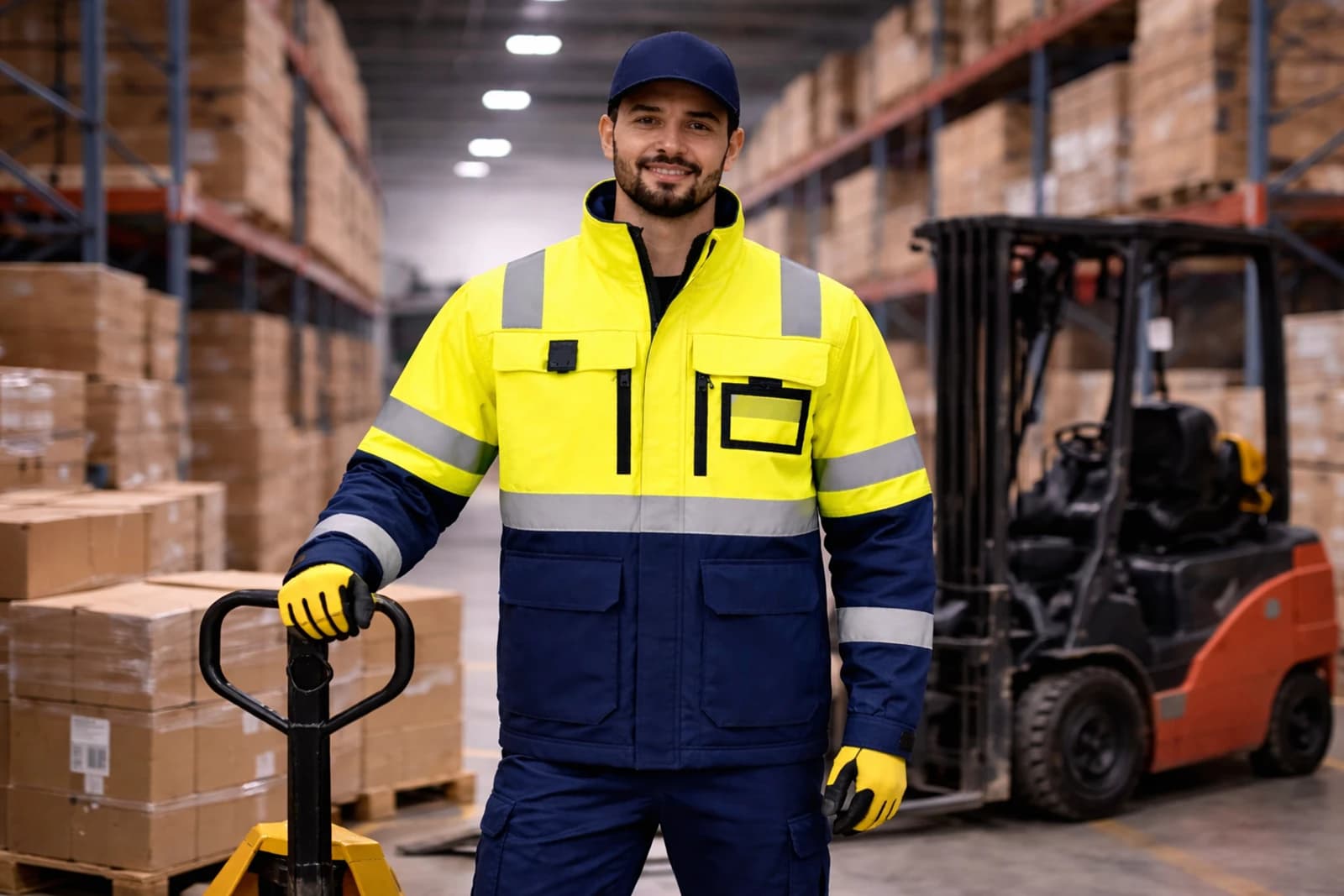
Safety Uniform
Hi-Vis Safety Jacket
Reflective safety jacket for high-visibility site operations and road work crews.