Equipping the Gulf's Solar Workforce: Industrial Coveralls & Polo Uniforms for PV Plant Construction and O&M
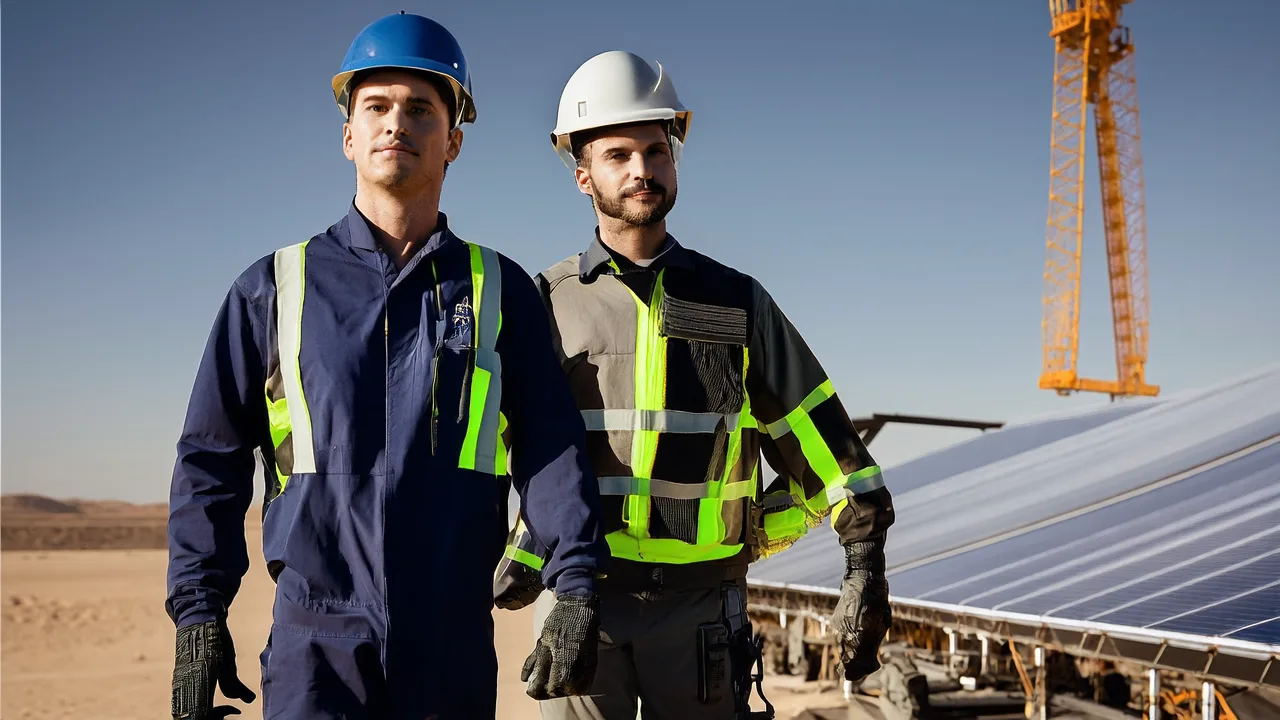
The Middle East is building solar capacity faster than almost any other region on earth — Saudi Arabia's Sudair and NEOM solar projects, the UAE's Al Dhafra 2 GW plant, Qatar's Al Kharsaah, and Egypt's Benban solar park are just the beginning. Behind every installed megawatt is a workforce of panel installers, electrical technicians, civil crews, and site supervisors who need workwear engineered for open-desert solar sites: reflective heat, UV exposure, fine abrasive dust, and sharp aluminium framing. This sourcing guide for Middle East B2B buyers covers industrial coveralls and logistics polo uniforms for solar PV construction and operations, fabric specifications for Gulf desert conditions, compliance considerations, and volume procurement from a Chinese workwear manufacturer.
Buyer context
What procurement teams run into
The Middle East's solar energy sector is entering a phase of unprecedented scale. Saudi Arabia targets 130 GW of renewable capacity by 2030 under Vision 2030, with mega-projects like Sudair (1.5 GW), Shuaibah (2 GW), and the solar components feeding NEOM and The Line. The UAE's Al Dhafra is one of the world's largest single-site solar plants at 2 GW, Qatar's Al Kharsaah delivers 800 MW, and Egypt's Benban complex in Aswan remains one of Africa's largest solar installations. Oman, Kuwait, Bahrain, and Jordan are all scaling up utility-scale PV and concentrated solar power. Every one of these projects sits in open desert. Solar farms are not construction sites in the conventional sense — they are sprawling, low-profile installations spread across kilometres of sand and gravel, with no shade, no windbreaks, and no relief from direct solar radiation. Workers install thousands of panels per day, pull cables across kilometres of racking, wire combiner boxes and inverters, and then stay on for years of operations and maintenance. For B2B buyers procuring workwear for these workforces, the challenge is specific: **1. The solar site environment is unlike any other industrial setting** A utility-scale solar farm combines several hazards in one location: - **Intense radiant heat.** Panels themselves reflect and concentrate sunlight. Workers installing modules on aluminium racking in July face ambient temperatures of 45–50°C plus reflected radiant heat from panel surfaces — effective thermal loads can exceed 60°C at the worker's body. - **Fine abrasive dust.** Desert sites generate constant fine silica dust that infiltrates every seam, pocket, and zipper. Dust accelerates fabric wear, clogs zippers, and causes skin irritation under sweat-soaked clothing. - **Sharp edges and pinch points.** Aluminium panel frames, steel racking, cable trays, and MC4 connectors all present cut and abrasion risks. Workers handle panels weighing 25–30 kg all day — forearms, thighs, and chest contact sharp edges repeatedly. - **Electrical hazard.** Live DC circuits up to 1,500 V are present during commissioning and O&M. While arc-flash protection is a separate category, general coveralls must not generate or retain static charge near live equipment. - **Vehicle and mobile plant traffic.** Solar farms use trucks, telehandlers, cranes, and trenchers across unsealed access roads. Workers on foot share these routes — visibility matters. - **No shade infrastructure.** Unlike a building site, a solar farm has zero natural or temporary shade until the panels themselves are wired and energised. Workers are exposed for full shifts. **2. Industrial coveralls for solar installation and O&M technicians** For panel installers, electrical technicians, cable pullers, and maintenance crews, the one-piece industrial coverall is the correct garment. It eliminates the waist gap where dust and debris enter, protects the full torso from sharp aluminium edges, and presents a clean, professional appearance on client-facing projects. Key specifications when sourcing coveralls for solar work from a Chinese manufacturer: **Fabric weight and composition.** Specify 245–260gsm poly-cotton twill (65/35 or 80/20 blend). The polyester content provides abrasion resistance against aluminium frames, dimensional stability after industrial washing, and faster drying than pure cotton. Avoid heavy 300gsm+ duck canvas — it traps heat and is unbearable in summer. **Anti-static treatment.** For O&M teams working near live DC circuits, specify anti-static fabric treatment or inherent anti-static fibres (carbon filament grid woven into the fabric). This reduces static buildup that can cause discomfort and, in rare cases, interfere with sensitive electronics. Anti-static coveralls meet EN 1149-3 for electrostatic dissipation. **Reinforcement at high-wear zones.** Double-layer knees with internal knee-pad pockets (solar technicians kneel constantly on gravel and sand when wiring panels). Reinforced elbows for cable-pulling work. Bar-tacked stress points at all pocket corners and seam intersections. **Ventilation features.** Specify mesh-lined back vents, underarm eyelets, or half-mesh linings that allow heat escape during physical work. For summer installation campaigns, consider coveralls with articulated sleeves and a two-way front zip that can be opened from the bottom for sitting and bending comfort. **Pocket configuration.** Chest pockets with flaps and snap closures (for phones, radios, and MC4 crimping tools). Thigh cargo pockets with secure closures. Dedicated pen and multimeter pockets. Rule pockets for measurers. All pockets must close cleanly — open pockets collect dust and drop small components into panel junction boxes. **Colour.** Light colours — khaki, sand, light grey — absorb significantly less radiant heat than dark navy or black. For solar sites, specify light colourways as the default. Confirm ISO 105-B02 xenon-arc fade testing so the light colour doesn't bleach to an inconsistent patchwork after three months of Gulf sun. **3. Logistics polo uniforms for supervisors, coordinators, and client-facing staff** Solar projects employ site supervisors, project engineers, HSE officers, client representatives, commissioning managers, and O&M coordinators who spend significant time in site offices, attending progress meetings, and hosting client visits. These roles need a professional, brandable garment that still performs in desert heat. The logistics polo uniform is the right choice. Key specifications: **Fabric.** 180–220gsm pique knit in 65% polyester / 35% cotton. The poly-cotton blend provides easy-care performance, quick drying, and good durability for daily industrial washing. For outdoor-facing supervisors who split time between the racking rows and the site office, specify moisture-wicking treatment and UPF 30+ sun protection. **Collar and trim.** A ribbed collar with contrast piping or two-tone detailing looks professional and makes company branding stand out. Tonal buttons and a clean placket lift perceived quality. For Gulf conditions, the collar must hold its shape after repeated washing — cheap collars curl and look sloppy in client meetings. **Branding.** Embroidered chest logos are the standard for solar EPC companies and O&M operators. Embroidery lasts through industrial laundering and harsh sun better than screen print. Specify Pantone colour matching so every batch is consistent. For larger fleets, add woven name tapes and role patches (e.g., "HSE," "COMMISSIONING," "O&M LEAD") — cheap at volume and genuinely professional. **Sizing.** Gulf solar workforces are multinational — Saudi, Emirati, Indian, Pakistani, Filipino, Egyptian, European specialists. Specify a size range from 2XS through 4XL with Middle East / South Asian body proportions. Ask the manufacturer for a full size-run sample before mass production. **4. The coverall-and-polo system for a complete solar site uniform program** The smartest procurement approach treats coveralls and polos as a unified uniform system: **Installation phase (construction):** All field workers in coveralls. Supervisors and client-facing staff in polos with company branding. HSE officers in polos with a distinct colour (e.g., red or orange polo) for instant recognition on site. **Commissioning phase:** Electrical technicians in coveralls with anti-static specification. Testing and commissioning engineers in polos with "COMMISSIONING" patches. Client representatives visiting the site in branded polos — a professional appearance matters when the client is inspecting a multi-billion-dollar asset. **O&M phase (years 1–25):** Maintenance technicians in coveralls on a replacement cycle (solar O&M companies typically issue 3–4 coveralls per technician per year). Site managers and O&M coordinators in polos. New hires receive a complete uniform pack on day one — consistent branding across the fleet signals a professional operation to the asset owner. This system means one colour palette, one branding scheme, one manufacturer, and one procurement process covering the full project lifecycle from groundbreaking through 25 years of operations. **5. Compliance and testing for solar site workwear** Relevant standards for Middle East solar projects: - **EN ISO 13688** — general requirements for protective clothing (ergonomics, sizing, ageing, marking). Applies to both coveralls and polos. - **EN 1149-3 / EN 1149-5** — anti-static properties. Required for coveralls worn near live DC electrical systems during commissioning and O&M. - **EN ISO 20471** — if coveralls or polos include hi-vis elements for vehicle zones. Many solar EPC contractors require all field staff to wear a hi-vis vest over their coverall or polo — the base garment doesn't need to be hi-vis certified, but it must not interfere with the vest's retroreflective geometry. - **ISO 105-B02** — colour fastness to light (xenon arc). Critical for Gulf solar sites where garments face 8–10 hours of direct UV daily. - **ISO 15797** — industrial laundering durability. Solar O&M coveralls are washed at 60–75°C in industrial machines. Specify dimensional change ≤ 3% after 25+ wash cycles. - **OEKO-TEX Standard 100** — restricted substances. Workers in extreme heat sweat heavily; skin contact with harmful chemicals is a real concern. Insist on third-party test reports from accredited labs (SGS, TÜV, Intertek, Bureau Veritas) for the exact garment and batch you're buying. **6. Procurement strategy for solar EPC and O&M buyers** Solar projects have distinctive procurement patterns: **Phase-based ordering.** Order coveralls in bulk for the installation phase (typically 500–5,000 workers for 3–6 months), then transition to smaller, more frequent O&M orders (50–200 units per quarter for years 1–25). A Chinese manufacturer that can handle both the initial bulk order and the long-tail reorder program is a genuine partner. **Consolidate coveralls and polos into one shipment.** Both garments can be produced and shipped together, reducing freight costs and simplifying customs clearance at Dammam, Jebel Ali, or Sokhna ports. **Plan for seasonal timing.** Order installation-phase coveralls 3–4 months before mobilisation. Avoid ordering for summer delivery during Ramadan production slowdowns. Solar projects often mobilise in autumn (September–November) when temperatures become tolerable — plan production accordingly. **Stock buffer for O&M.** O&M coveralls wear out. Order 15–20% buffer stock above annual requirements. Reordering small batches of custom-branded garments costs far more per unit than including them in the original production run. **Pilot before full volume.** Order 50–100 coveralls and 50–100 polos for a trial fitting before committing to the full installation-phase order. Adjust sizing, fabric weight, or pocket placement based on field feedback.
Sourcing approach
How a factory partner can respond
The solution for Middle East solar PV construction and O&M is a two-garment workwear system — industrial coveralls for panel installers, electrical technicians, cable pullers, and maintenance crews, paired with logistics polo uniforms for supervisors, coordinators, HSE officers, and client-facing staff — sourced from a single Chinese workwear manufacturer for consistent branding, consolidated shipping, and volume pricing across the full project lifecycle. **For industrial coveralls (solar field technicians):** - 245–260gsm poly-cotton twill (65/35 or 80/20 blend) — abrasion-resistant against aluminium frames, quick-drying, dimensionally stable - Anti-static treatment or inherent anti-static fibres (EN 1149-3) for O&M teams working near live DC circuits - Double-layer reinforced knees with knee-pad pockets, reinforced elbows, bar-tacked stress points - Mesh-lined back vents and underarm eyelets for heat escape; two-way front zip for comfort - Light colourways (khaki, sand, light grey) to reduce radiant heat absorption; ISO 105-B02 fade-tested - Secure-closure pockets: chest with flaps, thigh cargo, pen/multimeter/rule pockets - EN ISO 13688, ISO 15797 industrial wash durability (≤ 3% dimensional change after 25+ cycles), OEKO-TEX Standard 100 **For logistics polo uniforms (supervisors, coordinators, client-facing staff):** - 180–220gsm pique knit in 65% polyester / 35% cotton with moisture-wicking treatment and UPF 30+ - Ribbed collar with contrast piping; tonal buttons; clean placket - Embroidered chest logos with Pantone colour matching; woven name tapes and role patches ("HSE," "COMMISSIONING," "O&M LEAD") - Full size range (2XS–4XL+) with Middle East / South Asian body proportions - ISO 105 colour-fastness certified for Gulf sun and industrial laundering **Procurement strategy:** - Treat coveralls and polos as a unified uniform system across installation, commissioning, and 25-year O&M - Consolidate both garments into one shipment to reduce freight and simplify customs - Order installation-phase bulk 3–4 months before mobilisation; avoid Ramadan production slowdowns - Stock 15–20% buffer for O&M replacement cycles - Pilot 50–100 units per garment type before full volume commitment
Recommended Products
Products that fit this use case
Industrial Workwear
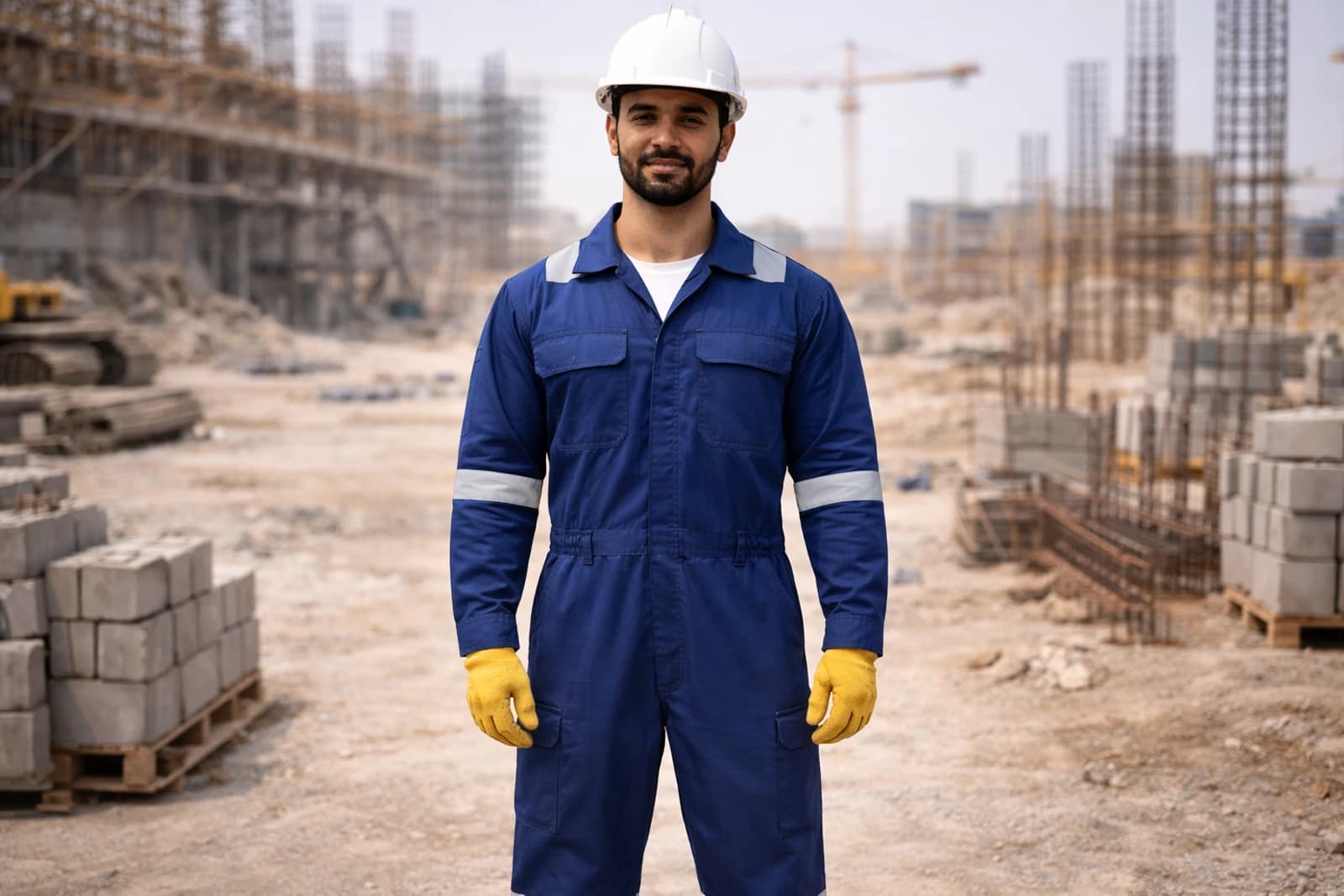
Industrial Coverall Pro
Hard-wearing one-piece coverall for plant, maintenance, and heavy-duty operations.

Logistics Uniform
Logistics Polo Uniform
Breathable uniform polo for warehouse, delivery, and last-mile teams.