Equipping Middle East 5G Networks: Sourcing Construction Softshell Sets & Logistics Polo Uniforms for Telecom Tower Construction and Field Service Operations
The Middle East is undergoing one of the world's fastest and most ambitious 5G rollouts — Saudi Arabia's STC and Mobily are deploying tens of thousands of new 5G sites across the Kingdom under Vision 2030's digital infrastructure programme, the UAE's Etisalat and du have achieved near-complete 5G coverage across all seven emirates, Qatar's Ooredoo and Vodafone Qatar built world-class 5G networks for the FIFA World Cup legacy, and Kuwait's Zain, Bahrain's Batelco, and Oman's Omantel are all accelerating fibre-and-5G convergence. Behind every new macro tower, every rooftop small cell, every in-building DAS node, and every fibre splice closure is a workforce of tower climbers, riggers, field service engineers, fibre optic technicians, small-cell installers, and network operations staff who work at height, in desert heat, and in customer-facing environments across the region. This sourcing guide for Middle East B2B buyers covers construction softshell sets and logistics polo uniforms for telecom tower construction and field service operations, fabric specifications for desert telecom conditions, role-based garment allocation, compliance considerations, and volume procurement from a Chinese workwear manufacturer.
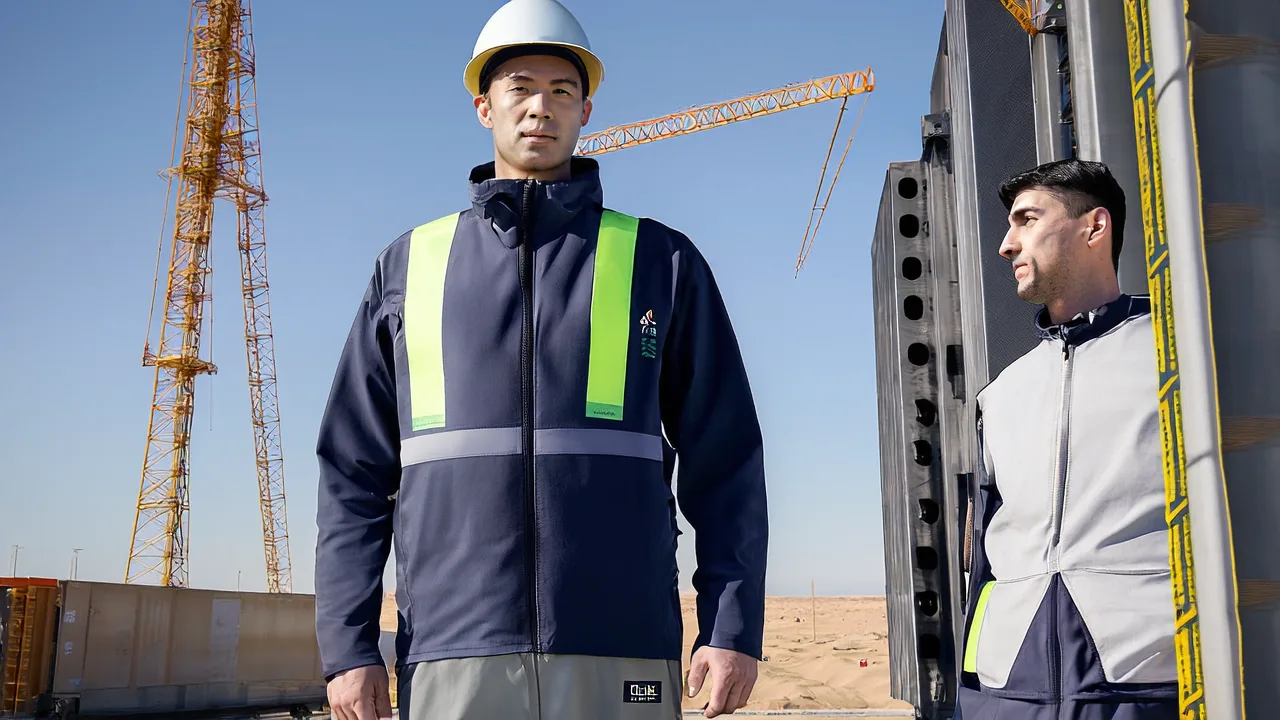
Buyer context
What procurement teams run into
The Middle East's telecommunications sector is investing billions in 5G infrastructure, fibre-to-the-home (FTTH) expansion, and smart-city connectivity. Saudi Arabia's digital infrastructure programme targets 100% 5G coverage of populated areas by 2030. The UAE's "We the UAE 2031" vision positions the country as a global digital hub. Qatar's TASMU smart nation programme integrates 5G with IoT across transport, healthcare, and logistics. Kuwait's "New Kuwait 2035" and Oman's "Vision 2040" both prioritise digital infrastructure. Every telecom site — whether a 60-metre guyed macro tower in the Empty Quarter, a rooftop small cell on a Dubai Marina high-rise, an in-building DAS system in a Doha shopping mall, or a fibre distribution hub in a Riyadh suburb — requires a workforce that operates in some of the most physically demanding and customer-visible conditions in the industrial sector. For B2B buyers procuring workwear for telecom operators, tower companies (TowerCos), and field service contractors, the challenge is specific because telecom work combines height-at-height risk, extreme desert thermal exposure, long driving distances between sites, and the need for professional appearance when technicians are visible to the public and to enterprise customers. **1. The telecom tower and field service environment combines height, heat, and public visibility** A telecom construction or maintenance site presents a combination of working conditions that demand specific garment solutions: - **Working at height on towers and masts.** Tower climbers and riggers work at 30–80 metres elevation on guyed towers, monopoles, rooftop masts, and telecommunications structures. Workers face wind exposure, solar radiation, and temperature extremes at height that are significantly more intense than at ground level. Garments must resist wind penetration, provide UV protection, and allow full range of motion for climbing and rigging tasks. - **Desert thermal extremes.** Telecom sites across Saudi Arabia, UAE, Qatar, Kuwait, Oman, and Bahrain face 45–55°C ambient temperatures in summer, with tower steel temperatures reaching 65–75°C in direct sun. Workers driving between remote desert sites face temperature transitions from air-conditioned vehicles (18–22°C) to full desert heat within seconds. Garments must manage moisture, resist UV degradation, and provide thermal comfort across these extremes. - **Sand and dust exposure.** Desert telecom sites face constant sand and dust exposure — shamal winds carry fine sand particles that abrade fabric surfaces, clog pockets and zippers, and penetrate poorly sealed garments. Tower climbers working at height are fully exposed to wind-blown sand. Garments must resist sand abrasion and have secure closures that prevent dust ingress. - **Long driving distances between sites.** Telecom field service engineers and maintenance technicians drive 100–400 km per day between scattered tower sites, fibre splice closures, and customer premises. Workers transition from vehicle to tower to equipment shelter to customer building multiple times per day. Garments must be comfortable for extended driving, quick to don and remove, and presentable across all these environments. - **Customer-facing and public visibility.** Unlike refinery or mining workers who operate in controlled industrial sites, telecom technicians frequently work in public view — on rooftop towers visible from surrounding buildings, in shopping mall equipment rooms, in office building telecommunications closets, and in residential neighbourhoods. Field service engineers meeting enterprise customers at their premises need a professional appearance. Garments must look clean, branded, and professional while maintaining full field functionality. - **Electrical and RF exposure.** Telecom workers near antenna arrays face radio-frequency (RF) radiation exposure. Workers at equipment shelters and power cabinets face low-voltage electrical contact risk. While workwear cannot provide RF shielding, garments must not contain metallic components that could interact with RF fields or create electrical conduction paths. - **Remote and lone working.** Many desert telecom sites are 50–200 km from the nearest town. Technicians working alone or in two-person teams at remote sites must be self-sufficient. Garments need adequate pocket capacity for tools, phones, satellite communicators, water bottles, and personal protective equipment. **2. Construction softshell sets for tower climbers, field engineers, and outdoor telecom operations** For telecom workers who spend significant time outdoors — tower climbers, riggers, field service engineers performing outdoor antenna and microwave link work, construction crews building new tower sites, and fibre crews performing outdoor trenching and pole mounting — the construction softshell set is the primary outer layer for cooler months, early morning shifts, and desert evening work. Key specifications when sourcing softshell sets for telecom operations from a Chinese manufacturer: **Fabric construction for desert telecom conditions.** Three-layer bonded construction: outer face of stretch-woven polyester with DWR finish (sand and dust resistant, wind resistant), middle membrane layer (windproof, water-resistant), inner face of brushed polyester fleece (thermal insulation for cool desert mornings and evenings). This construction provides warmth during early morning tower climbs (8–15°C in Gulf winter mornings) without bulk that restricts climbing movement. **Wind resistance at height.** Tower climbers at 40–80 metres elevation face wind speeds 30–50% higher than at ground level. Softshell jackets must resist wind penetration completely — any wind chill at height during winter mornings (when ambient may be 10°C but wind chill at 60m is -5°C) creates hypothermia risk. Specify windproof membrane with zero air permeability. **Sand and dust resistance.** Desert telecom softshell sets face constant sand abrasion from shamal winds and site conditions. Specify tightly woven outer face fabric (500D+ abrasion resistance) with DWR finish that sheds sand and dust. Sand-resistant zip closures with internal storm flaps. Sealed seams at shoulders and elbows where sand accumulates. **Climbing-specific fit and articulation.** Tower climbers need full range of motion for vertical climbing, horizontal scrambling, and working at height in confined tower sections. Specify articulated sleeves for reaching overhead to antenna mounts and cable trays. Action back for freedom of movement when climbing. Gusseted underarms for reaching tasks. Athletic fit that doesn't snag on tower members, cable trays, and antenna brackets. **Pocket configuration for tower work.** Chest pockets sized for radios and phones (must work with climbing harness — pockets positioned above harness chest strap). Thigh cargo pockets for cable ties, crimp tools, and connectors. Internal mesh pockets for small components (bolts, nuts, connectors). Pen pockets for site documentation. All pockets must have secure zip or Velcro closures — dropped items from tower height are lethal dropped-object hazards. **Non-metallic components for RF environments.** Telecom workers near active antenna arrays must not wear garments with metallic components that could interact with RF fields. Specify plastic zippers (not metal), plastic snap buttons (not brass), and non-metallic fibre content. Remove or avoid metal eyelets, metal belt loops, and metallic logos in garments worn by tower climbers working near active antennas. **Hi-vis integration for tower and roadside work.** Tower climbers working near roadways and field crews performing roadsideside fibre trenching need visibility compliance. Specify softshell jackets with EN ISO 20471 Class 2 compliant retroreflective tape on sleeves and torso — one garment provides weather protection and visibility compliance for roadside and construction-zone work. **Durability for telecom conditions.** Telecom softshell sets face abrasion from tower steel members, fibreglass antenna radomes, fibreglass cable trays, concrete equipment pads, and fibreglass manhole covers. Specify reinforced elbows and shoulders with abrasion-resistant patches. Confirm fabric and retroreflective tape maintain performance after 50+ wash cycles. **3. Logistics polo uniforms for field service engineers, NOC technicians, customer-facing roles, and indoor telecom operations** For telecom workers who split time between outdoor sites and indoor environments — field service engineers performing indoor DAS and small-cell installations, network operations centre (NOC) technicians, customer premises equipment (CPE) installers, enterprise account engineers, and indoor fibre termination technicians — the logistics polo uniform is the standard daily garment. Key specifications when sourcing polo uniforms for telecom operations from a Chinese manufacturer: **Fabric weight and composition for Gulf telecom conditions.** Specify polyester-cotton blend (65/35 or 60/40) at 180–220gsm for Gulf telecom operations. Polyester provides durability, colour retention, and moisture-wicking; cotton provides softness and breathability against skin. For extreme summer heat, specify 100% polyester moisture-wicking pique knit at 150–180gsm with mesh ventilation panels under arms and across back. **Professional appearance for customer-facing work.** Telecom field service engineers visit enterprise customer premises — data centres, office buildings, hospitals, airports, and government facilities. The polo uniform must present a professional, branded image. Specify clean collar construction (no curling after washing), consistent colour across all units, and high-quality embroidery or sublimation printing for company logo, technician name, and department identification. **Moisture management for desert field work.** Field service engineers performing outdoor CPE installations, rooftop small-cell work, and fibre splice closures in 45–55°C Gulf heat sweat heavily. Specify moisture-wicking fabric that pulls sweat away from skin and dries rapidly — preventing the uncomfortable sensation of working in a soaked garment. Anti-odour treatment for multi-day field assignments where laundry access is limited. **UV protection for outdoor work.** Telecom field workers face 8–10 hours of direct UV exposure daily. Specify UPF 40+ fabric that blocks ultraviolet radiation and protects skin during outdoor antenna work, rooftop small-cell installation, and fibre trenching supervision. Confirm UPF rating is maintained after 50+ wash cycles. **Pocket configuration for field tools.** Chest pockets sized for phones and access cards. Pen pockets for site surveys and work orders. Internal pocket for small test equipment (optical power meters, fibre identifiers). Polo shirts worn under softshell jackets must have pockets accessible when layered. **Fit for layering under softshell sets.** Logistics polo uniforms in telecom operations are worn as base layers under softshell jackets during cool-weather outdoor work and as standalone garments during indoor work and hot-weather outdoor work. Specify athletic fit that layers cleanly under softshell jackets without bunching. Collar construction that sits flat under softshell collar. Sleeve length that doesn't protrude beyond softshell cuffs. **Colour and branding for telecom operators.** Major Middle East telecom operators have strong brand identities — STC (purple and white), Etisalat (gold and white), Ooredoo (red), Zain (green), Omantel (blue), Batelco (red and white). Specify polo uniforms in operator brand colours with embroidered logos, technician names, and department identification. Colour consistency across all uniform orders is critical for brand presentation. **Industrial wash durability.** Telecom polo uniforms are washed daily — field technicians return from dusty, sweaty desert sites and their garments require industrial laundering at 60°C. Specify fabric with ≤ 3% dimensional change after 50+ wash cycles. Confirm colour fastness, collar integrity, and embroidery quality after repeated industrial washing. **4. The softshell-and-polo system for complete telecom operations uniform** The smartest procurement approach treats construction softshell sets and logistics polo uniforms as a unified telecom operations uniform system: **Tower climbers and riggers (outdoor tower construction and maintenance):** Logistics polo as base layer (moisture-wicking, UV-protective) + construction softshell jacket as outer layer for cool-weather tower work (windproof, sand-resistant, climbing-articulated). In summer, polo alone for early morning and evening tower work; softshell for winter tower climbs and high-wind conditions. **Field service engineers (outdoor and indoor mixed work):** Logistics polo as standard daily garment for customer visits, indoor DAS installations, and hot-weather outdoor work. Construction softshell jacket for cool-weather outdoor antenna work, rooftop small-cell installations, and desert site visits. One uniform system covers the full range from customer premises to desert tower sites. **Fibre optic technicians (indoor and outdoor mixed work):** Logistics polo for indoor fibre termination, splice closure work in equipment rooms, and customer premises CPE installation. Construction softshell jacket for outdoor fibre trenching supervision, pole-mounted fibre work, and desert route surveys. **Network operations centre (NOC) staff (indoor only):** Logistics polo as standard daily uniform in climate-controlled NOC environments. Professional appearance for 24/7 operations centre work. Branded with operator colours and technician identification. **Enterprise account engineers and customer-facing technical staff:** Logistics polo as standard uniform for enterprise customer visits, data centre equipment installations, and technical presentations. Professional appearance with operator branding. Construction softshell jacket for outdoor site surveys and rooftop equipment inspections at customer premises. **Construction crews (new tower site builds):** Logistics polo as base layer + construction softshell jacket as outer layer for all-weather tower construction work. Hi-vis retroreflective tape on softshell for construction-zone visibility. Sand-resistant and windproof for desert tower sites. This system means one colour palette for base layers, one softshell specification for outdoor work, one manufacturer, and one procurement process covering every role across the telecom operator's field operations, construction, and customer-facing teams. **5. Compliance and testing for telecom operations workwear** Relevant standards for Middle East telecom operations: - **EN ISO 20471** — high-visibility clothing. Class 2 minimum for softshell jackets worn by tower climbers near roadways and field crews in construction zones. Confirm retroreflective performance after 50+ wash cycles. - **EN ISO 13688** — general requirements for protective clothing (ergonomics, sizing, ageing, marking). Applies to both softshell sets and polo uniforms. - **UPF 40+ rating** — ultraviolet protection factor for outdoor telecom work. Specify fabric tested to AS/NZS 4399 or EN 13758 with UPF 40+ minimum. Confirm rating maintained after 50+ wash cycles. - **ISO 105-B02** — colour fastness to light (xenon arc). Critical for Gulf telecom operations where garments face 8–10 hours of direct UV daily on desert tower sites and rooftop installations. - **ISO 15797** — industrial laundering durability. Specify ≤ 3% dimensional change after 50+ wash cycles at 60°C. - **OEKO-TEX Standard 100** — restricted substances. Telecom workers in extreme heat sweat heavily; skin contact with harmful chemicals from fabric treatments is a real concern. - **Operator-specific uniform standards.** Major Middle East telecom operators (STC, Etisalat, Ooredoo, Zain, Omantel, Batelco) have corporate uniform specifications covering brand colours, logo placement, fabric quality, and garment construction. Confirm the manufacturer can meet specific operator brand standards. - **Tower company (TowerCo) standards.** TowerCos like TAWAL (Saudi Arabia), edotco, and American Tower have their own PPE and uniform specifications for tower climbers and riggers working on their structures. Confirm compliance with TowerCo requirements. - **Non-metallic garment requirements for RF environments.** Confirm garments for tower climbers contain no metallic components that could interact with active antenna RF fields. Specify plastic zippers, plastic snaps, and non-metallic trims. **6. Procurement strategy for telecom operations buyers** Telecom operators, TowerCos, and field service contractors have distinctive procurement patterns: **Volume and frequency.** A mid-size Gulf telecom operator or TowerCo employs 500–5,000 field technicians, tower climbers, and engineers. Order logistics polo uniforms in bulk (2,000–10,000 units) for initial fleet outfitting with quarterly reorders. Order construction softshell sets in smaller volumes (500–3,000 units) with annual reorders. **Consolidate orders.** Order polo uniforms and softshell sets in one shipment to reduce freight costs and simplify customs clearance at Jebel Ali, Dammam, Hamad Port, or Shuwaikh. A Chinese manufacturer with in-house capability for both garment types can produce and ship them together — critical when both garments must share the same brand colour palette. **Plan for seasonal timing.** Order softshell sets 3–4 months before Gulf winter (October–March) when cool-weather tower work requires outer layers. Order polo uniforms year-round with quarterly replenishment. **Stock buffer.** Order 25–30% buffer stock above annual requirements. Telecom workwear faces accelerated wear from sand abrasion, UV exposure, tower steel contact, and daily industrial laundering. Reordering small batches of custom-branded garments costs far more per unit than including buffer in the original production run. **Pilot before full volume.** Order 50–100 polo uniforms and 50–100 softshell sets for a trial fitting before committing to the full fleet order. Adjust sizing, fabric weight, pocket placement, and branding based on field feedback from tower climbers, field service engineers, fibre technicians, and customer-facing staff. **Standardise across all field operations roles.** Whether your operation focuses on tower construction, maintenance, fibre deployment, or customer premises installation, the same polo-and-softshell system works. Standardise on one polo specification and one softshell specification across all roles — this simplifies procurement, ensures consistent brand presentation, and makes all field staff instantly identifiable to customers and the public. **Coordinate with operator brand standards.** Each Middle East telecom operator has specific brand guidelines. Confirm the manufacturer can match exact brand colours (Pantone matching), execute precise logo embroidery, and maintain colour consistency across repeat orders. Request lab dips and strike-offs before bulk production.
Sourcing approach
How a factory partner can respond
The solution for Middle East telecom tower construction and field service operations is a two-garment workwear system — construction softshell sets for tower climbers, riggers, field engineers, and outdoor telecom operations in cool weather and desert conditions, paired with logistics polo uniforms for field service engineers, NOC technicians, customer-facing roles, and indoor telecom operations — sourced from a single Chinese workwear manufacturer for consistent brand presentation, consolidated shipping, and volume pricing. **For construction softshell sets (tower climbers, riggers, field engineers, outdoor operations):** - Three-layer bonded construction: stretch-woven polyester outer with DWR finish (sand and dust resistant), windproof membrane, brushed polyester fleece inner - Windproof membrane with zero air permeability for tower work at height (wind speeds 30–50% higher than ground level) - Sand-resistant zip closures with internal storm flaps; sealed seams at shoulders and elbows - Climbing-specific articulation: articulated sleeves, action back, gusseted underarms for full range of motion on towers - Tower-work pocket configuration: chest pockets above harness chest strap line, thigh cargo for tools, all with secure closures (dropped-object prevention) - Non-metallic components: plastic zippers, plastic snaps, no metal eyelets — safe for work near active antenna RF fields - Integrated EN ISO 20471 Class 2 retroreflective tape for roadside and construction-zone visibility - Reinforced elbows and shoulders for abrasion resistance against tower steel, fibreglass radomes, and cable trays - UPF 40+ UV protection for desert tower sites **For logistics polo uniforms (field service engineers, NOC technicians, customer-facing roles, indoor operations):** - Polyester-cotton blend (65/35 or 60/40) at 180–220gsm; or 100% polyester moisture-wicking pique at 150–180gsm with mesh ventilation for extreme heat - Professional appearance: clean collar construction, consistent colour, high-quality embroidered logos and technician names - Moisture-wicking and anti-odour treatment for multi-day field assignments in 45–55°C Gulf heat - UPF 40+ UV protection for outdoor antenna work, rooftop small-cell installation, and fibre route surveys - Layering-compatible fit: athletic cut that layers cleanly under softshell jackets without bunching - Operator brand colour matching (Pantone) with precise logo embroidery - ISO 15797 industrial wash durability (≤ 3% dimensional change after 50+ cycles at 60°C) **Procurement strategy:** - Treat polo uniforms and softshell sets as a unified telecom operations uniform with one brand colour palette across all garments - Consolidate both garments into one shipment to reduce freight and simplify customs - Order softshell sets 3–4 months before Gulf winter; order polo uniforms year-round with quarterly replenishment - Stock 25–30% buffer for replacement cycles (telecom workwear faces accelerated wear from sand abrasion, UV exposure, and daily laundering) - Pilot 50–100 units per garment type before full fleet commitment - Standardise one polo specification and one softshell specification across all field operations roles - Coordinate with operator brand standards — request lab dips and strike-offs before bulk production
Recommended Products
Products that fit this use case
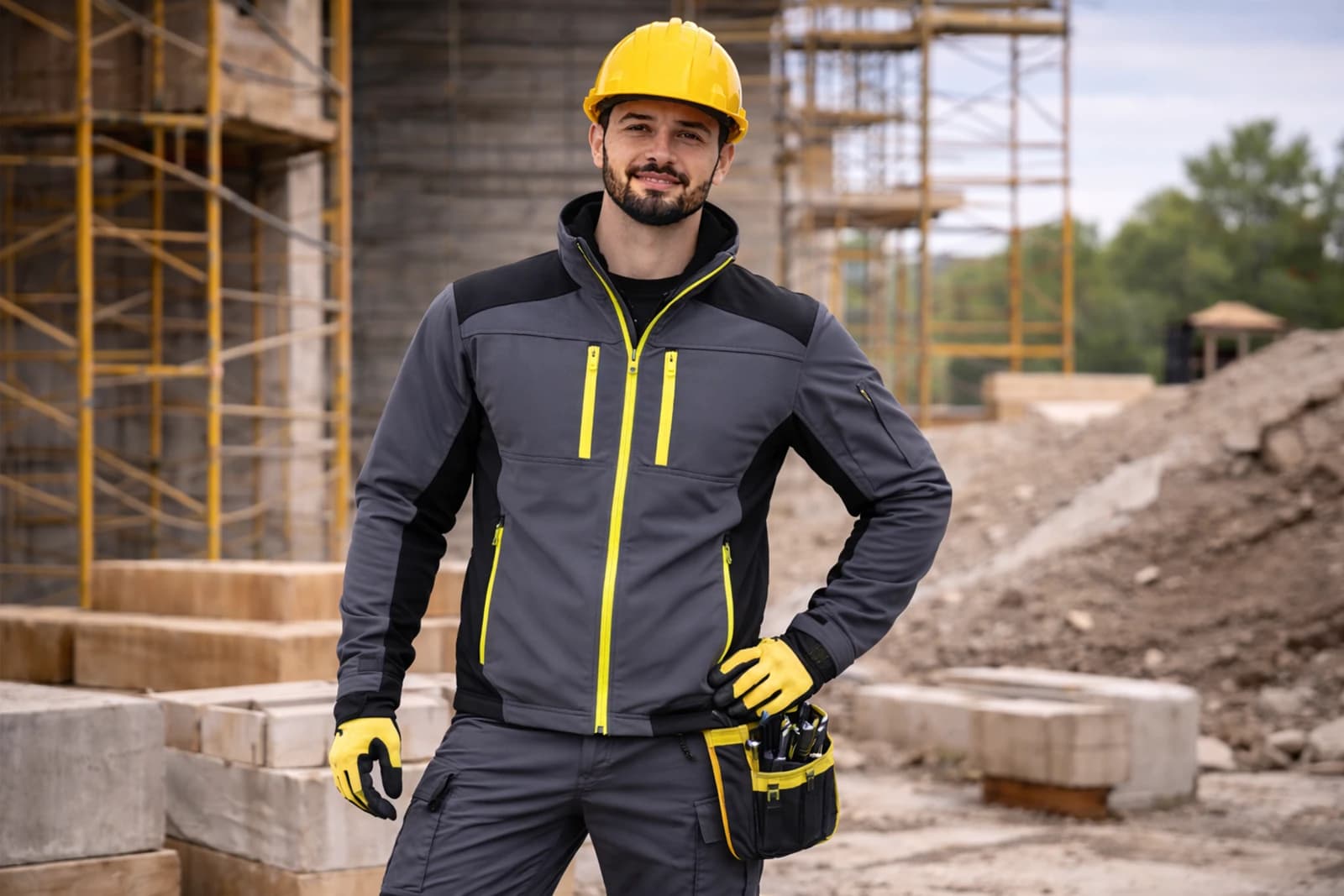
Construction Clothing
Construction Softshell Set
Flexible jacket and trouser set built for crews working across changing weather conditions.

Logistics Uniform
Logistics Polo Uniform
Breathable uniform polo for warehouse, delivery, and last-mile teams.