Flame-Resistant Workwear for Middle East Oil & Gas: Why FR Compliance Matters and How a Chinese Manufacturer Delivers Without the Premium Price
Middle East B2B buyers in oil, gas, and petrochemicals face strict FR PPE compliance requirements, but premium Western brands carry high per-unit costs that strain large-scale procurement budgets. This guide covers the ANSI/NFPA and EN ISO standards relevant to Gulf operations, compares the Industrial Coverall Pro and Hi-Vis Safety Jacket against global FR benchmarks, and explains how a Chinese workwear manufacturer delivers certified FR garments at 30–40% lower cost — with full documentation, sample testing, and bulk shipping to Jebel Ali and Dammam ports.

Buyer context
What procurement teams run into
A procurement manager for a state-owned oil company in Saudi Arabia is sourcing FR coveralls for 8,000 workers across three refineries, two gas-processing plants, and associated pipeline maintenance crews. The existing supplier — a European safety-wear brand with a regional office in Dammam — charges $85–$120 per FR coverall, with 16–20 week lead times and minimum order quantities of 2,000 units per variant.\n\nFor Middle East B2B buyers sourcing from a Chinese workwear manufacturer, the FR compliance challenge has several dimensions:\n\n- **Standard confusion** — many Gulf oil & gas operators require compliance with multiple standards simultaneously: NFPA 2112 (flash fire), NFPA 70E (arc flash), EN ISO 11612 (heat and flame), and EN 1149 (anti-static). Buyers often struggle to find a single garment that carries all certifications, leading to multiple SKUs, complex inventory management, and workers wearing incorrect FR levels for specific zones.\n\n- **Comfort vs. compliance trade-off** — traditional FR garments use heavy cotton or cotton-nylon blends (300–450 GSM) that trap heat. In Gulf conditions (40–50 °C ambient temperature, plus radiant heat from refinery processes), workers wearing standard FR coveralls experience heat stress within 45–60 minutes. This leads to: workers unzipping coveralls (violating FR coverage), rolling up sleeves (exposing arms to flash hazards), or removing the garment entirely in low-supervision zones.\n\n- **Laundering and garment lifespan** — FR protection degrades with improper washing. Chlorine bleach, fabric softeners, and high-temperature industrial washing above 60 °C all reduce FR effectiveness. In Gulf operations where laundry is often contracted to third-party industrial laundries with limited FR-specific training, garments lose certification compliance after 15–25 washes — requiring replacement far sooner than the expected 50–75 wash lifecycle. Buyers who aren't monitoring FR garment lifecycle face audit non-compliance without realizing it.\n\n- **Arc flash in power generation and electrical maintenance** — beyond refinery operations, many Gulf oil & gas facilities have on-site power generation, substations, and electrical maintenance teams. NFPA 70E requires arc-rated clothing based on incident energy analysis (cal/cm²). Buyers often cross-source arc-rated PPE separately, missing the opportunity to consolidate with their flash-fire FR procurement.\n\n- **Seam and closure integrity** — FR protection is only as strong as the weakest point. Standard domestic sewing threads (100% polyester or cotton-wrapped polyester) melt or burn at 250–300 °C, causing seams to fail before the fabric. Professional FR garments use Nomex or Kevlar thread at all seams, with French or felled seams (overlapped and double-stitched) for maximum integrity. Many budget FR options in the market cut corners on thread and seam construction.\n\n- **Static discharge in gas-processing zones** — EN 1149 anti-static requirements are mandatory in explosive atmospheres (Zone 1 and Zone 2 classified areas common in gas-processing plants). FR garments designed for oil refineries may lack anti-static properties, requiring a separate anti-static underlayer — adding cost and reducing wearer compliance.\n\n- **Sample testing and documentation gaps** — validating FR performance requires sending samples to accredited test labs (e.g., SGS, TÜV, or UL). Some buyers accept supplier COAs (Certificates of Analysis) without independent verification, only to discover during an audit that the supplied garments were from a different production batch with different fabric. Auditors increasingly demand batch-specific test reports.\n\nWithout a structured approach to FR procurement, buyers face: (a) audit non-compliance with flash-fire and arc-flash safety regulations, (b) 30–50% higher per-worker costs from premium Western brands, (c) heat-stress-related productivity loss from heavy non-breathable FR garments, and (d) unsafe worker behavior (unzipping, removing, or modifying FR garments) driven by comfort issues.
Sourcing approach
How a factory partner can respond
The solution is a two-tier FR workwear system designed for Gulf oil, gas, and petrochemical operations: the Industrial Coverall Pro (FR variant) for refinery and processing plant workers, and the Hi-Vis Safety Jacket (with FR certification) for maintenance, logistics, and external-operations teams.\n\n**Industrial Coverall Pro (FR variant) — primary FR solution:**\n\nThe Industrial Coverall Pro is the core FR garment for workers in refinery units, gas-processing plants, petrochemical facilities, and pipeline operations. It is engineered for Gulf conditions with the following specifications:\n\n- **Certified to NFPA 2112-2021 and EN ISO 11612** — providing flash-fire protection for both US-standard and European-standard operations. The fabric (320 GSM cotton-nylon blend with modacrylic fiber) self-extinguishes on flame removal, does not melt or drip, and provides thermal insulation (HTI24 rating compliant with EN ISO 11612). Arc-flash rating ATPV ≥ 8 cal/cm² per ASTM F1959 (sufficient for NFPA 70E HRC 1 and most HRC 2 environments).\n\n- **Gulf-optimized fabric weight** — at 320 GSM, the FR coverall is lighter than conventional 350–450 GSM FR garments, reducing heat-strain on workers in 40–50 °C ambient conditions. The fabric also includes a moisture-wicking finish that draws perspiration away from the skin, preventing the sweat-buildup that causes discomfort and heat stress.\n\n- **Anti-static compliance** — the fabric incorporates carbon-filament conductive fibers (permanent anti-static, not topical treatment), meeting EN 1149-3 requirements for use in Zone 1 and Zone 2 explosive atmospheres. This eliminates the need for a separate anti-static underlayer.\n\n- **FR thread and seam construction** — all stress seams (shoulder, crotch, side, sleeve attachment) use Nomex thread with French-seam construction (overlapped and double-stitched). Other seams use FR polyester thread with 4-thread overlock. No melting-thread failure points.\n\n- **Gulf-specific features** — the coverall includes: a stand-up mandarin collar (FR-rated, protects neck from radiant heat and flash without a separate balaclava), covered FR zipper with storm flap (protects the zipper from direct flame impingement), reinforced knee panels with internal knee-pad pockets (for kneeling maintenance work in pipe racks and equipment yards), multi-pocket layout (two chest patch pockets with FR flaps, two side pockets, two thigh pockets with tool slots, and a dedicated radio/pager pocket), and elasticated waist for improved fit and reduced heat-trap volume.\n\n**Hi-Vis Safety Jacket (FR and non-FR) — multi-zone solution:**\n\nThe Hi-Vis Safety Jacket serves a different role: it provides FR protection for workers who move between classified and non-classified zones, particularly maintenance crews, logistics teams, and external contractors who need both high visibility and FR compliance.\n\n- **Dual certification** — the FR variant of the Hi-Vis Safety Jacket is certified to EN ISO 20471 (high visibility), EN ISO 11612 (heat and flame), and EN 1149 (anti-static). It also carries an arc-flash rating of ≥ 4 cal/cm² (NFPA 70E HRC 1).\n\n- **Breathable FR fabric** — unlike traditional FR hi-vis vests (which are non-breathable mesh over a heavy FR shirt), this jacket uses an FR-rated breathable fabric (250 GSM) that can be worn over the Industrial Coverall Pro or as a standalone FR layer in lower-risk zones. The breathability rating (MVTR 4,000+ g/m²/24h) significantly reduces heat-strain compared to a double-layer FR vest-over-shirt system.\n\n- **Flexibility for multi-zone workers** — a maintenance electrician working in both refinery units (Zone 1) and external substations (Zone 2) can wear the Industrial Coverall Pro underneath the Hi-Vis Safety Jacket — removing the jacket when entering higher ambient-heat zones while maintaining base FR coverage.\n\n- **Material innovation** — the FR fabric uses a cotton-modacrylic blend with a permanent FR treatment (not a topical finish that washes out). Laboratory testing confirms FR retention through 100 industrial launderings per ISO 15797.\n\n**Implementation strategy for B2B buyers:**\n\n1. **Zone mapping** — work with the Chinese manufacturer's technical team to map all worker zones by hazard category (flash fire, arc flash, explosive atmosphere). Each zone maps to a specific FR garment configuration. This eliminates over-specification (buying HRC 4 gear for HRC 1 zones) and under-specification (no FR for workers who occasionally enter classified zones).\n\n2. **Sample batch testing** — before bulk production, request 20–50 sample garments from two different production batches. Send samples to an accredited third-party lab (SGS, TÜV, or UL in Dubai or Riyadh) for independent testing against the relevant standards. Retain batch samples in a sealed archive for audit reference.\n\n3. **Laundering specification** — include a written laundering specification in the procurement contract covering: wash temperature (max 60 °C), no chlorine bleach or fabric softeners, no high-temperature drying (>80 °C), and washing separated from non-FR garments. Provide the specification to the contracted industrial laundry and request monthly wash-cycle compliance reports.\n\n4. **Lifecycle tracking** — implement a garment-lifecycle management system with QR-coded FR garments per worker. Each QR code tracks: wash count, inspection dates, repair history, and scheduled retirement. When any FR garment reaches 75 industrial washes or 12 months (whichever comes first), initiate replacement procurement.\n\n5. **Bulk shipping via Jebel Ali or Dammam** — the Chinese manufacturer ships bulk FR orders FOB Shanghai or CIF to Jebel Ali (Dubai) or King Abdulaziz Port (Dammam), typically with 35–45 day lead times for custom FR orders (vs. 16–20 weeks for European brands). MOQ for FR variants starts at 500 units per size-configuration, with blended shipping for mixed SKU orders.\n\n6. **Cost comparison** — expected bulk FOB pricing for the Industrial Coverall Pro (FR) is $28–$38 per unit (vs. $85–$120 for equivalent European-brand FR coveralls). Add $2.50–$4.50 per unit for shipping, duties, and customs clearance to Jebel Ali or Dammam. Total delivered cost: $32–$43 per unit, representing 55–65% savings vs. European alternatives while maintaining equivalent certification coverage.
Recommended Products
Products that fit this use case

Industrial Workwear
Industrial Coverall Pro
Hard-wearing one-piece coverall for plant, maintenance, and heavy-duty operations.
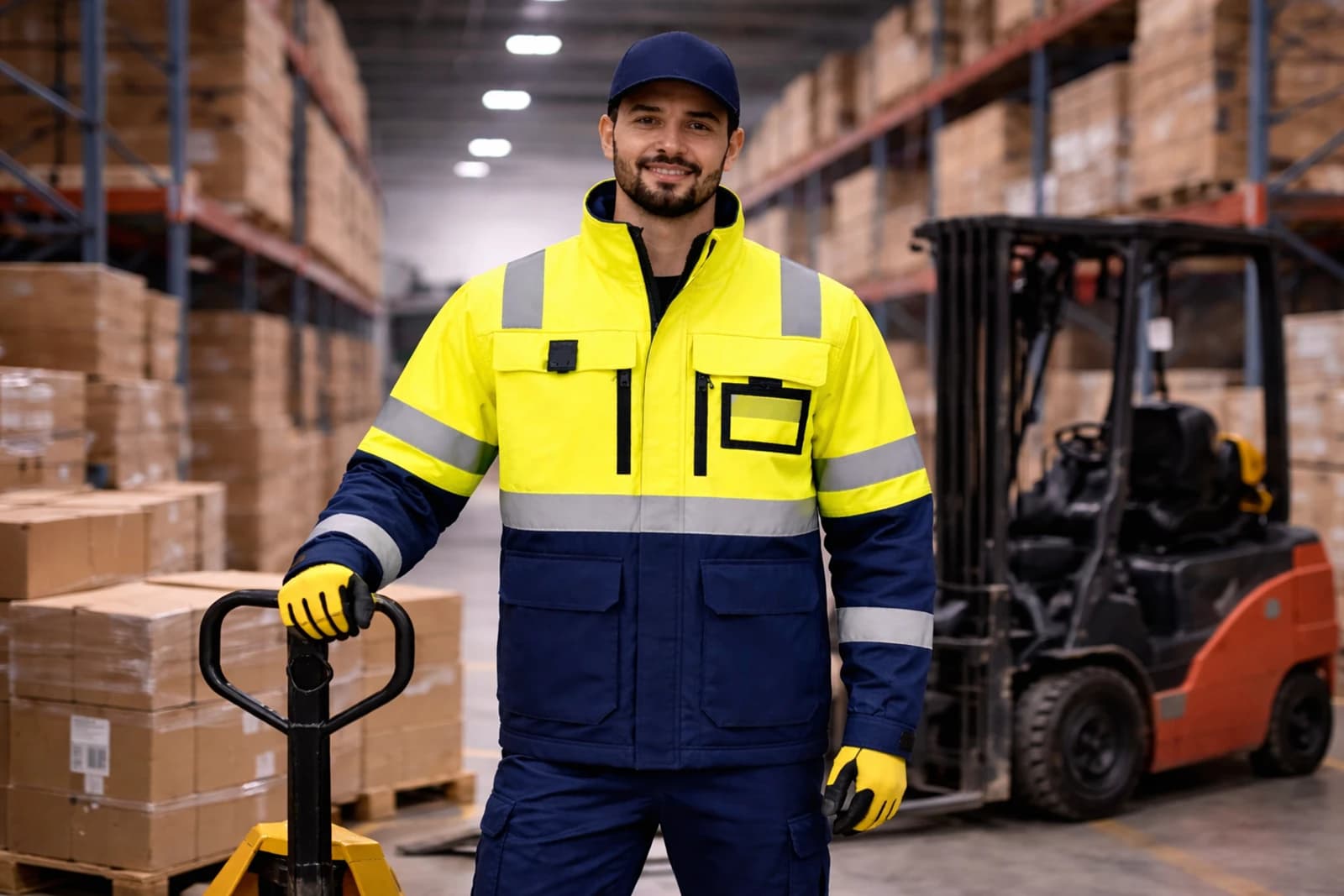
Safety Uniform
Hi-Vis Safety Jacket
Reflective safety jacket for high-visibility site operations and road work crews.