Glass Edge Contacts Cut Through Standard Workwear Sleeves in Days, Not Weeks
Glass manufacturing workers handling raw glass sheets, cullet, and finished products expose their workwear sleeves to sharp glass edges that slice through standard polyester-cotton fabric within days. The forearm and wrist areas fail from cut damage long before the fabric reaches its expected wash or wear life. This article covers the fabric and construction specification that extends garment life for glass-handling roles.
Buyer context
What procurement teams run into
Glass manufacturing involves handling raw materials (silica sand, cullet — crushed recycled glass), semi-finished glass (sheets emerging from the float bath, annealed glass), and finished products (cut, edged, tempered, laminated glass). Every handling step exposes the worker's forearms and wrists to sharp glass edges. Glass edges are extremely sharp — even "smooth" cut edges have microscopic sharp points that act as cutting agents against fabric. Standard workwear fabric (240-280 GSM polyester-cotton, plain or twill weave) is designed for general industrial use. The fabric resists moderate abrasion but has low cut resistance. When a worker lifts a glass sheet, the glass edge contacts the forearm sleeve. The sharp edge catches individual yarns in the fabric weave and cuts them. The result is a slash or hole in the sleeve within days of regular glass-handling work. **1. The failure pattern: forearm, wrist, and chest areas fail first** The failure pattern is consistent across glass-handling roles: - Forearm sleeves: the inner forearm contacts glass edges when lifting, carrying, or positioning glass. Sleeves develop cuts and holes within 3-7 days of daily glass handling. - Wrist cuffs: the wrist cuff contacts glass edges when the worker reaches into glass racks, positions glass on cutting tables, or handles small glass pieces. Cuffs fray and tear within days. - Chest and torso: when carrying glass sheets against the body, the glass edge contacts the chest area of the garment. The chest fabric develops cuts within 1-2 weeks. - Thighs: when glass sheets are rested against the thigh during positioning, the thigh area is cut. The garment is replaced because of localized cut damage — not because the entire garment is worn out. The rest of the fabric may be in good condition, but the cut damage at the forearm, wrist, or chest area makes the garment unusable (exposed skin, risk of glass shards entering the garment, unprofessional appearance). **2. The cut mechanism: sharp edge vs. woven fabric** Glass edge cutting is different from the abrasion that standard workwear is designed to resist. Standard abrasion involves smooth surfaces rubbing against fabric — the fabric wears gradually over time. Glass edge cutting involves a sharp, hard edge pressing into the fabric and slicing through individual yarns. The mechanism is not surface wear — it is yarn severing. A standard 240 GSM polyester-cotton fabric may survive 15,000-20,000 Martindale cycles (simulating smooth-surface abrasion) before showing significant wear. But the same fabric exposed to glass edge contact develops visible cuts after 3-7 days of daily glass handling. The fabric's expected service life of 6-12 months is not achieved — the garment fails from cut damage within the first week. **3. The specification gap: cut resistance is not addressed in standard workwear procurement** Most glass manufacturing workwear specifications do not address cut resistance. The specification calls for standard polyester-cotton fabric (e.g., "260 GSM polyester-cotton, twill weave") without requiring cut resistance testing (e.g., ISO 13997 or ASTM F2992). The garment is delivered with adequate fabric weight and composition — but inadequate cut resistance for glass-handling tasks. The procurement process does not capture the distinction between glass-handling roles (cutting operators, edging operators, laminating operators, glass handlers, warehouse operators handling glass) and non-glass-handling roles (admin, maintenance of non-production equipment, quality lab). The same garment is issued to all workers — and the garment fails quickly for workers who handle glass regularly. **4. The safety consequence: cut damage exposes skin to glass edges and shards** When the garment sleeve is cut, the worker's skin is exposed to glass edges and shards. The exposed skin is at risk of cuts from glass contact — a safety hazard beyond the garment failure. The worker also risks glass shards entering the garment through the cut holes and contacting the skin — causing discomfort, skin irritation, and potential injury. The cut damage also compromises the garment's professional appearance — the worker wears a garment with visible cuts and holes, which reflects poorly on the operation's standards. **5. The hi-vis compliance risk** Glass-handling workers in warehouse areas typically require hi-vis compliance (working near forklifts, overhead cranes, and transport vehicles). When the garment develops cuts and holes from glass edge contact, the hi-vis compliance is compromised: the fabric surface area is reduced, the reflective tape may be damaged by glass contact, and the background fabric color may be contaminated with glass dust (which reduces the fluorescent background's visibility). A garment with cut damage may no longer meet the hi-vis standard (e.g., EN ISO 20471 Class 2 or Class 3) — not because the hi-vis elements have failed, but because the garment's structural integrity has been compromised by cut damage.
Sourcing approach
How a factory partner can respond
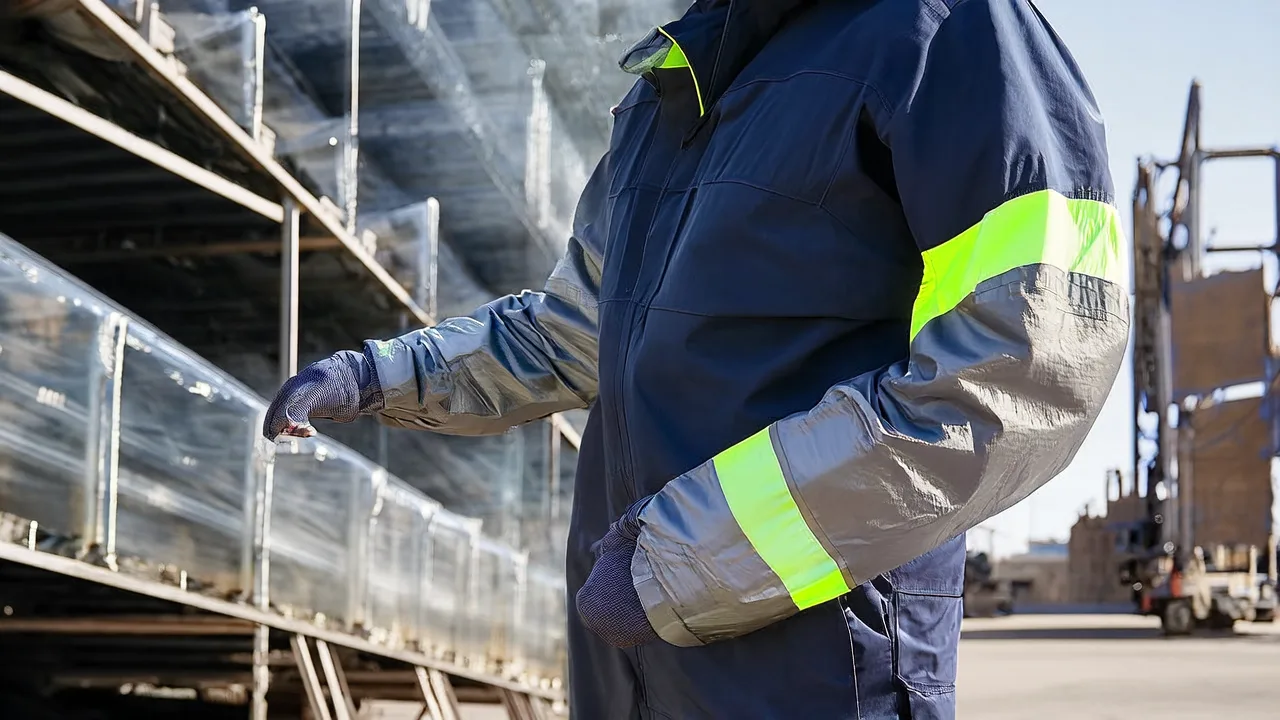
The solution is to specify fabric and construction that address cut resistance specifically for glass-handling roles — not by making the garment heavier, but by selecting fabric types and reinforcement strategies that resist the yarn-severing mechanism of glass edge cutting. **Step 1: Specify fabric with cut resistance for glass-handling roles** For workers who handle glass regularly (cutting operators, edging operators, laminating operators, glass handlers, warehouse operators handling glass), specify fabric that resists cutting from sharp glass edges: - High-tenacity polyester fabric: specify fabric made with high-tenacity polyester yarn. High-tenacity polyester has higher tensile strength — it resists the cutting force of glass edges better than standard polyester. The fabric resists glass edge cuts 2-3 times better than standard polyester-cotton fabric of the same weight. - Glass-fiber blended fabric: for the highest cut resistance, specify fabric blended with glass fiber (e.g., polyester-glass fiber blend). The glass fiber in the fabric provides cut resistance — the glass fiber yarns resist the cutting action of glass edges. Glass-fiber blended fabric resists glass edge cuts 5-10 times better than standard polyester-cotton fabric. - Cut-resistant liner: specify a cut-resistant liner at high-wear areas (forearm, wrist, chest). The liner is made from cut-resistant fiber (e.g., UHMWPE — ultra-high-molecular-weight polyethylene, or stainless steel mesh). The liner provides cut resistance at the specific areas that contact glass edges. The tradeoff is cost: cut-resistant fabric costs more than standard fabric — typically 20-40% more for high-tenacity polyester, 40-60% more for glass-fiber blend, and the cut-resistant liner adds 15-25% to garment cost. However, the garment lasts 3-5 times longer in glass-handling roles, reducing total replacement cost. **Step 2: Specify targeted reinforcement at high-wear areas** Rather than making the entire garment from cut-resistant fabric (expensive), specify targeted reinforcement at the areas that contact glass edges: - Forearm reinforcement: specify a cut-resistant panel on the inner forearm (the side that contacts glass edges when lifting). The panel should extend from 50 mm below the elbow to 100 mm above the wrist cuff, covering the full inner forearm width. - Wrist cuff reinforcement: specify a cut-resistant wrist cuff. The cuff should be made from cut-resistant fabric or have a cut-resistant liner. - Chest reinforcement: specify a cut-resistant panel on the chest area (where glass sheets contact the body when carried). The panel should cover the upper chest from shoulder to waist. The targeted reinforcement approach adds cost (10-20% more than non-reinforced garments) but extends garment life at the specific failure points — the garment fails at the unreinforced areas at the same rate as before, but the reinforced areas last 3-5 times longer. **Step 3: Specify garment design that reduces glass contact** Specify garment design features that reduce the frequency and intensity of glass edge contact: - Long sleeves with closed cuffs: specify long sleeves that cover the full forearm and wrist. Closed cuffs (elastic or snap-closed) prevent glass shards from entering the sleeve. - Minimal external pockets on the forearm: external pockets on the forearm create additional contact points with glass edges. Specify minimal or no external pockets on the forearm area. - Smooth fabric surface: specify fabric with a smooth surface (tight weave, minimal texture). A smooth surface allows glass edges to slide along the fabric rather than catching individual yarns. Textured or loose-weave fabric allows glass edges to catch yarns and cut them. **Step 4: Separate glass-handling garments from general garments** Procure separate garment types for glass-handling roles and general roles: - Glass-handling garments: specify cut-resistant fabric with targeted reinforcement. Issue only to workers who handle glass regularly. - General garments: specify standard polyester-cotton fabric. Issue to workers who perform tasks without regular glass contact (admin, maintenance of non-production equipment, quality lab). The separation ensures that glass-handling workers receive garments designed for their specific cut environment — and general workers are not over-specified (paying for cut-resistant construction they do not need). **Step 5: Define garment end-of-life criteria based on cut damage** Define the garment's end-of-life criteria so that workers and supervisors know when to replace the garment for cut damage reasons: - Cut depth: replace the garment when a cut penetrates through the outer fabric layer (the cut is visible as a hole or slash). - Cut length: replace the garment when a cut exceeds a specified length (e.g., 25 mm) — shorter cuts may not compromise the garment's protection, but longer cuts expose skin. - Glass shard entry: replace the garment when glass shards are found inside the garment (indicating that the fabric has been compromised and shards have penetrated). Communicate the end-of-life criteria to workers and supervisors — and provide a simple visual guide (e.g., a poster showing acceptable vs. unacceptable garment condition) so that the decision to replace the garment is consistent and objective. **Recommended garments for glass manufacturing workwear:** - **Industrial coverall-pro** — specify with high-tenacity polyester fabric and cut-resistant reinforcement at forearms, wrists, and chest for glass-handling workers in production areas. Specify the coverall with long sleeves, closed cuffs, and minimal external pockets on the forearm. Specify the coverall with a smooth fabric surface to reduce glass edge catching. The coverall provides full-body protection for glass-handling tasks while the cut-resistant fabric and reinforcement extend garment life in the glass manufacturing environment. - **Hi-vis safety jacket** — specify with cut-resistant fabric at forearms and chest for warehouse workers handling glass products who require visibility for forklift traffic. Specify the jacket with high-tenacity polyester fabric, cut-resistant reinforcement at the inner forearm and upper chest, and closed cuffs. The hi-vis jacket provides warehouse visibility while the cut-resistant construction extends garment life for workers who handle glass products.
Recommended Products
Products that fit this use case

Industrial Workwear
Industrial Coverall Pro
Hard-wearing one-piece coverall for plant, maintenance, and heavy-duty operations.

Safety Uniform
Hi-Vis Safety Jacket
Reflective safety jacket for high-visibility site operations and road work crews.