Hi-Vis Safety Jackets & Logistics Polo Uniforms for Middle East: A B2B Buyer's Guide to Sourcing from China
From Dubai's Jebel Ali Port to Saudi Arabia's NEOM gigaproject construction sites and Qatar's expanding logistics hubs, the Middle East demands hi-vis safety jackets and logistics polo uniforms that endure 50°C heat, abrasive sand, and industrial laundering while meeting EN ISO 20471, ANSI 107, and GCC-specific visibility standards. For B2B buyers sourcing from a Chinese workwear manufacturer, this guide covers retroreflective tape specifications (3M™ Scotchlite™ vs. domestic alternatives), polyester-cotton vs. breathable mesh fabric selection, polo uniform moisture-wicking performance, rib-knit collar durability, pocket configurations for warehouse operators, and bulk procurement for fleets of 500–50,000+ workers.

Buyer context
What procurement teams run into
The Middle East is in the midst of a massive infrastructure and logistics expansion. Saudi Arabia's NEOM ($500 billion, 170 km linearcity under construction with 30,000+ construction workers on site), the Riyadh Metro expansion ($22 billion, 6 lines spanning 176 km), Dubai's Logistics Corridor expansion (handling 12+ million TEU annually at Jebel Ali, the 9th busiest port globally), Qatar's Hamad Port Phase 2, and Abu Dhabi's Khalifa Industrial Zone (KIZAD) are collectively driving demand for over 1 million workers in construction, logistics, warehousing, and transportation across the GCC through 2028. Each of these workers requires at least 3 sets of hi-vis safety garments and 4-5 polo/uniform shirts annually (replaced every 3-6 months due to fading, contamination, and laundering wear), translating to a market of 3-5 million hi-vis units and 4-6 million polo uniform units per year across the GCC. For Middle East B2B buyers sourcing hi-vis safety jackets and logistics polo uniforms from Chinese workwear manufacturers, the critical technical, certification, and quality considerations span five essential areas: **Retroreflective tape specification for GCC conditions:** The most visible failure point in Middle East hi-vis garments is retroreflective tape delamination and degradation. After 15-25 industrial launderings, cheaper domestic (Chinese) retroreflective tape often peels, cracks, or loses 60-80% of its reflective brightness—a safety hazard on active construction sites and logistics yards. The proven standard for GCC durability is: - **Base material:** Specify 3M™ Scotchlite™ 5510 or 8710 series (silver heat-bonded transfer tape) or JOHO® reflective material (a Chinese alternative that passes EN 20471 testing at lower cost). Avoid non-branded "glass bead" tape which degrades within 10 wash cycles. - **Width and placement:** EN ISO 20471 Class 2 requires minimum 0.50 m² of fluorescent background material and 0.13 m² of retroreflective tape at minimum 50 mm width per band. For the GCC, specify 50-70 mm wide tape (Narrower 25 mm tapes used in Europe fail inspection at NEOM and QatarEnergy sites). - **Minimum performance:** Retroreflective coefficient (RA) per EN ISO 20471 must be ≥ 330 cd/(lux·m²) for Class 2 after 5 washes, and ≥ 250 cd/(lux·m²) after 25 washes. Request test reports from the ISO 20471-certified lab, not a factory in-house report. - **Anti-UV treatment for tape edge-adhesive:** The GCC sun (UV index 9-11 for 8+ months/year, vs. 5-7 in most of Europe) accelerates tape-edge lifting. Specify heat-resistant adhesive with -30°C to +120°C operating range and UV-stable backing. Key warning for Middle East buyers: Many Chinese factories source reflective tape from domestic mills that use zinc oxide (ZnO)-based glass beads instead of the larger, higher-refractive-index glass beads used by 3M. These cheaper tapes (costing 1/3 of 3M) look identical new but degrade rapidly. Always request Third-party certified wash-test reports before production. **Fluorescent fabric selection for 50°C ambient heat:** Hi-vis safety garments in the Middle East serve two contradictory functions: high visibility AND breathability in extreme heat. The three-dimensional color space (CIE xyY chromaticity coordinates) must be maintained while minimizing heat stress. The practical choices: - **Polyester-cotton (65/35 or 60/40) with fluorescent treatment:** This is the standard for GCC construction sites. Acceptable weight ranges from 170-260 gsm depending on season and role. Key specification: ISO 20471 Daytime chromaticity for high-visibility yellow (Y: Y/x = 0.387, y = 0.610 minimum) or fluorescent orange-red (O/R: x = 0.610, y = 0.300 minimum). Fluorescent pigment must be embedded in the fiber (dope-dyed or solution-dyed), NOT surface printed—surface print loses 50% of fluorescence within 10 wash cycles. - **100% polyester mesh with 3M™ tape:** Preferred for logistics workers in non-air-conditioned warehouses (Dubai South, Jebel Ali Bonded Zone) and outdoor port workers. Mesh construction (ventilated back panel, perforated sides) reduces core temperature by 2-4°C vs. solid fabric in 45°C conditions. However, polyester mesh has lower abrasion resistance (15-25 Martindale cycles vs. 40-60 for polyester-cotton) and lower FR rating if the garment requires both hi-vis and flame resistance. - **Inherent FR hi-vis fabrics (modacrylic-cotton with fluorescent fiber):** Required for oil & gas logistics zones and chemical port operations. These cost 2-3× more but are mandatory at facilities like ADNOC's terminal zones or Saudi Aramco's logistics hubs. The critical GCC-specific issue: Most Chinese fluorescent polyester fabric fades to pastel within 8-12 weeks in direct summer sunlight with UV 9+. For Middle East orders, specify 100+ hours of xenon-arc fade resistance per ISO 105-B02 (minimum Grade 4 on the Blue Wool Scale, with Grade 5 being the highest). Premium Chinese suppliers offer Tex-Mex or YGM fluorescent fabrics with 200+ hours UV resistance—these cost 15-25% more but pass 6-month outdoor exposure tests in Dubai. **Polo uniform fabric performance for warehouse and logistics workers:** Logistics polo uniforms (the most common workwear for warehouse operators, forklift drivers, and port workers) must balance professional appearance with extreme sweat management in GCC conditions. Minimum specification: - **Moisture-wicking performance:** Specify ISO 11092 (Water Vapor Resistance Ret) ≤ 6 m²·Pa/W and Moisture Management Class (MMC) ≥ 3 on the AATCC 195 scale. Typical Chinese "breathable" polo fabric (100% cotton or basic 65/35 polyester-cotton) scores MMC 1-2 and Ret 10-15, leading to soaked-through uniforms within 2 hours of work in 45°C/60% humidity Dubai summer conditions. - **Wicking fabric architecture:** Dobby weave (small geometric patterns) for ventilation with honeycomb or hexagonal mesh zones at the underarm and back panels. Pique polo knit is the gold standard for logistics polos in the GCC—the textured surface reduces skin contact by 30-40% vs. flat jersey, reducing sweat adhesion. - **Anti-odor treatment:** Specify silver-ion or zinc-based antimicrobial finish (ISO 20743 compliant). GCC logistics workers operate 8-12 hour shifts, and unmitigated bacterial growth on sweat-soaked polyester causes odor within 4-6 hours. A zinc pyrithione treatment typically lasts 50+ washes. - **Color fastness to sweat and light:** The GCC demand for colorfastness is extreme. POLO uniforms in corporate colors (NAVY blue, charcoal grey, forest green are most common for logistics compliance) must pass ISO 105-E04 (color fastness to perspiration) at Grade 4-5 and ISO 105-B02 (light fastness) at Grade 5-6 minimum. Request test reports; many Chinese suppliers can only achieve Grade 2-3 for certain dyes. **Rib-knit collar and cuffs durability in sand and heat:** The most high-wear area on any logistics polo is the collar—specifically the 1×1 or 2×2 rib knit at the collar band. In GCC conditions, collars experience: - Sand and dust abrasion (200-400 micron particles) wear down the rib-knit surface - Salt from sweat crystallizes and abrades the cotton component of the rib blend - Sun exposure UV-degrades the elastane/spandex component Specification for GCC-grade polo collar: 100% polyester or 80/20 polyester-cotton rib knit (not cotton/elastane, which degrades within 20 washes). Minimum 250 gsm collar weight, with 1×1 rib construction at 16-18 gauge for shape retention. Many Chinese logistics polos use 200 gsm cotton-cotton mix collars that "collar curl" (the collar tips twist upward) after 5-10 washes in GCC heat—requiring workers to constantly adjust them, which is unprofessional in customer-facing roles. **Hi-vis jacket closure, pocket, and accessory configuration for Middle East operations:** GCC logistics and construction hi-vis jackets need different functional features than their European or North American counterparts: - **YKK zippers with sand-resistant coating:** As with coveralls, the number-one failure point on hi-vis jackets in the GCC is zipper jamming from sand ingress. Specify YKK or SBS molded resin (Vislon® type) zippers, NOT nylon coil zippers, for the main front closure. Minimum 25,000 cycle rating. For pocket zippers, waterproof YKK Aquaseal® zippers prevent sand accumulation. - **Pocket configuration:** Middle East logistics workers prefer the following for their typical carry items: (1) Left chest internal phone pocket with Velcro closure for 6.5"+ devices; (2) Right chest radio/DMR pocket with webbing loop and pen slot; (3) Two lower front pockets (warm pockets) with zipper closure; (4) Left sleeve pit pocket for access card/ID badge. The extra pockets add $1.50-$2.50 per garment but significantly reduce worker frustration. - **Reflective trim placement optimized for Gulf driving conditions:** The GCC has one of the highest vehicle-pedestrian accident rates globally (2-3× higher than Europe per vehicle km). For jackets worn by roadside logistics workers (toll booth operators, highway construction crews, port traffic management), specify 360-degree retroreflective trim placement including a loop across the shoulders (visible from above for crane/cherry picker operators) and double bands below the waistband (visible from behind when bending). The EN ISO 20471 Class 3 standard is recommended (0.80 m² fluorescent + 0.20 m² reflective material) over Class 2 for all Gulf road-adjacent workers. - **Ventilation panels for hot-weather hi-vis:** A key selling point for GCC buyers is zippered ventilation openings in the jacket back—two vertical zippers that open to a mesh panel, allowing airflow through the back where sweat accumulates most. This feature adds $2-3 per unit but is extremely popular at procurement evaluations for Gulf logistics districts. - **Name tape and company logo attachment:** In the GCC, logistics workers require name tapes (Arabic and English) and company logo patches. Specify heat-sealed or woven labels rather than screen-printed logos which crack and fade within 5-8 washes. The label attachment must pass 25 industrial launderings at 75°C per ISO 15797 without edge curling. **Certification and compliance checklist for Middle East B2B buyers:** | Standard | Region/Endorsement | Coverage Area | |---|---|---| | EN ISO 20471:2013 (Class 2 or 3) | EU/GCC/UKCA | Hi-vis garment performance | | ANSI/ISEA 107-2020 (Class 2 or 3) | US/GCC accepted | Equivalent US standard | | SASO/OSAS (Saudi/Qatar standards) | GCC | National adoption of ISO 20471 | | ISO 15797 | EU/GCC | Industrial laundering testing (25 cycles minimum) | | REACH (EU Regulation) | EU/GCC imported goods | Chemical safety compliance | | OEKO-TEX® Standard 100 | Global | Textile chemical safety (Class 2, sensitive skin) | For Gulf construction contractors subject to SGS, Bureau Veritas, or Intertek quality audits, ensure that the Chinese manufacturer holds EN ISO 20471 certification from a notified body (not just a factory self-declaration). Many GCC facilities (especially QatarEnergy's contractor zones and NEOM construction sites) require third-party audit of the manufacturer's quality management system (ISO 9001:2015 for garment manufacturing) before approving a new supplier. **Bulk procurement and multi-fleet considerations:** GCC logistics and construction buyers typically order hi-vis jackets and polos in mixed-fleet consignments. The procurement strategy differs from industrial coveralls: - Hi-vis jackets are most commonly ordered in 3-tier quality classes: (1) Standard poly-cotton with 3M™ tape for general use ($8-$14 FOB); (2) Premium with mesh ventilation, YKK Aquaseal zippers, and reflective striping (Class 3) for road-adjacent workers ($15-$22 FOB); (3) FR hi-vis for oil & gas logistics zones ($20-$30 FOB) - Logistics polo uniforms are typically ordered by the case (50/75/100 units) in pre-selected corporate colors with custom embroidery, with MOQ of 500-1,000 units per color. Embroidery setups cost $80-$200 per logo per position (chest + sleeve is standard), and woven labels cost $0.30-$0.80 per unit depending on detail. The shipping season matters: Ordering 60-90 days before peak demand (October-November for winter construction season, and February-March for summer uniforms) avoids the premium freight rates of the Ramadan/June-August shutdown periods when GCC ports experience 15-25% congestion. **Partnering with a reliable Chinese workwear manufacturer:** For Middle East B2B buyers, the key advantages of sourcing hi-vis safety jackets and logistics polo uniforms from an experienced Chinese manufacturer include: - Understanding of GCC-specific fit, sand-resistant hardware, and ventilation - 3M™ and JOHO®-certified retroreflective tape sourcing and application - OEKO-TEX® and REACH compliant fabrics and dyes - MOQ flexibility (500 units for hi-vis jackets, 500 units for polo shirts) - Custom embroidery and woven label capabilities in-house - ISO 9001:2015, ISO 20471 certified production facilities - DDP delivery options to Jebel Ali, Dammam, Hamad Port, and Dubai South The Middle East logistics and construction sectors are projected to grow at 6-8% CAGR through 2028, driven by the Saudi Vision 2030 and UAE National Agenda spending. For B2B buyers looking to secure multi-year supply agreements for hi-vis and polo workwear, a strategic partnership with a Chinese manufacturer that offers consistent quality, GCC-specialized features, and third-party certification will deliver significant cost savings (averaging 30-50% vs. European or Turkish alternatives) without compromising worker safety or comfort.
Sourcing approach
How a factory partner can respond
For Middle East B2B buyers sourcing hi-vis safety jackets and logistics polo uniforms from a Chinese workwear manufacturer, the path to reliable, compliant, and cost-effective procurement requires attention to six critical specification areas: **1. Retroreflective tape specification:** Specify 3M™ Scotchlite™ 5510/8710 series or certified JOHO® reflective material with EN ISO 20471 certification. Require third-party wash-test reports showing RA ≥ 330 cd/(lux·m²) after 5 washes and ≥ 250 cd/(lux·m²) after 25 washes per ISO 15797. Require UV-stable heat-resistant adhesive rated for -30°C to +120°C. **2. Fluorescent fabric with GCC UV resistance:** Specify ISO 20471 Daytime chromaticity with minimum 100 hours xenon-arc fade resistance per ISO 105-B02 (Grade 4+). Choose dope-dyed or solution-dyed fluorescent pigments (not surface-printed). For 50°C environments, specify 170–260 gsm poly-cotton or ventilated polyester mesh construction. **3. Polo uniform moisture-wicking performance:** Specify MMC ≥ 3 per AATCC 195, Water Vapor Resistance Ret ≤ 6 per ISO 11092. Use pique knit (reduces skin contact by 30-40%), add silver-ion antimicrobial finish per ISO 20743, and specify 100% polyester or 80/20 poly-cotton rib knits for collars at minimum 250 gsm. **4. Sand-resistant hardware:** Specify YKK or SBS molded resin (Vislon®) zippers with minimum 25,000 cycle rating for main closures. Ensure name tapes and logos are heat-sealed or woven labels that pass 25 wash cycles. **5. GCC-specific features:** Require zippered ventilation back panels on hi-vis jackets, 360-degree Class 3 reflective trim for road-adjacent workers, and pocket configurations optimized for mobile phones, two-way radios, and ID badges. **6. Certification compliance checklist before purchase:** - EN ISO 20471:2013 (Class 2 or 3) from a notified body - ANSI/ISEA 107-2020 (for dual US/GCC compliance) - OEKO-TEX® Standard 100 (Class 2) - ISO 9001:2015 (manufacturing quality system) - Third-party wash-test reports (25 cycles minimum) By sourcing from an experienced Chinese workwear manufacturer that specializes in GCC-grade hi-vis and polo workwear—offering the right fabric, tape, hardware, and certification—Middle East B2B buyers can secure high-quality safety garments at 30-50% lower cost than European or Turkish alternatives, while ensuring full compliance with local safety standards and passing the most stringent contractor audits at NEOM, Jebel Ali, Hamad Port, and Qiddiya.
Recommended Products
Products that fit this use case
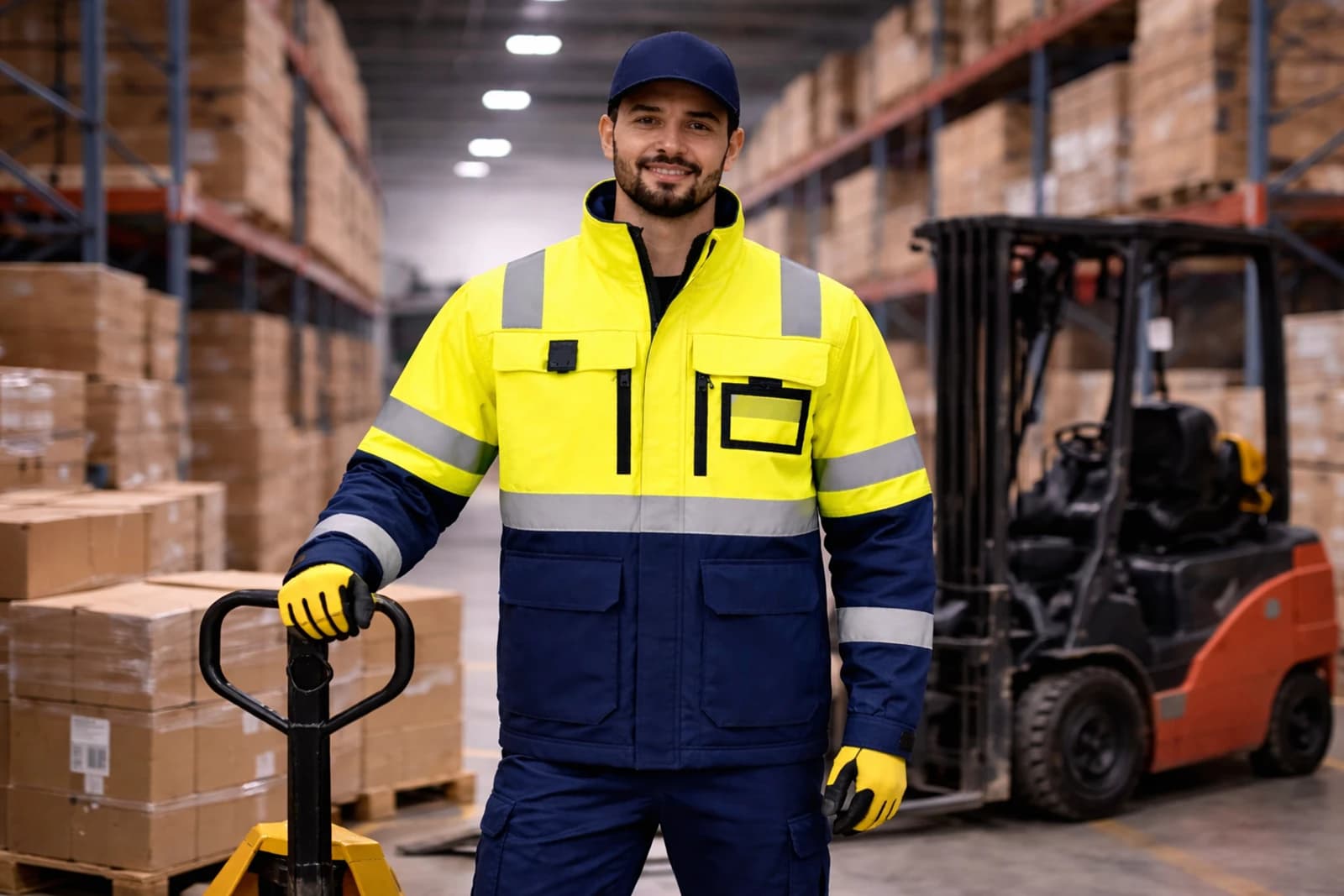
Safety Uniform
Hi-Vis Safety Jacket
Reflective safety jacket for high-visibility site operations and road work crews.

Logistics Uniform
Logistics Polo Uniform
Breathable uniform polo for warehouse, delivery, and last-mile teams.