Hi-Vis Safety Jackets & Construction Softshell Sets: Sourcing Protective Workwear for Middle East Infrastructure & Utility Projects
Middle East infrastructure and utility projects — from Saudi Arabia's NEOM and Red Sea mega-projects to UAE power distribution and Qatar water network expansions — demand hi-vis protective outerwear and insulated softshell sets for outdoor crews working in extreme conditions. This article covers how B2B buyers can bulk source Class 3 hi-vis safety jackets and multi-layer construction softshell sets from a Chinese manufacturer, with features tailored for Gulf heat, dust, and night-shift visibility requirements.

Buyer context
What procurement teams run into
Middle East infrastructure and utility project managers face three persistent pain points when sourcing protective outerwear for outdoor crews, each rooted in the region's extreme climate and demanding work environments. **1. Layering for desert heat by day, cold by night — without sacrificing visibility.** A road crew supervisor managing night-shift resurfacing on the Riyadh–Qassim Highway might dispatch workers at 17:00 (42°C ambient) and retrieve them at 03:00 (18°C desert chill). Workers who start in a hi-vis vest over a cotton shirt freeze by 23:00; those who wear a full insulated jacket from the start overheat during the first four hours and remove it — losing the reflective striping that Class 3 hi-vis demands. Standard single-layer hi-vis garments cannot bridge this 25°C temperature swing without workers compromising their own safety by layering street clothing underneath (which can snag or reduce reflective coverage). **2. Dust, sand, and UV degradation of reflective materials.** Gulf construction sites generate constant airborne particulate — from cement mixing on the NEOM utility corridor sandblasting operation to backhoe loading at Dubai's Expo Valley extension. Standard silver-glass-bead reflective tape abrades within 4–6 weeks under these conditions, losing 40–60% of retroreflective brightness as measured by EN ISO 20471. Polyester hi-vis shell fabrics (typically 120–150 g/m²) fade to pink within 2–3 months under Gulf UV exposure (UV index 9–11 most of the year), forcing quarterly replacement of garments that should last 2+ seasons. The result: safety compliance failures, budget overruns, and wasted time re-ordering from suppliers who designed their hi-vis for European conditions, not Arabian desert conditions. **3. Sizing for a multi-national workforce with layered movement requirements.** Gulf utility and infrastructure crews include technicians, welders, electricians, heavy equipment operators, and labourers from India, Pakistan, Bangladesh, Nepal, Egypt, Philippines, and East Africa — the same workforce diversity challenge across Middle East construction. A 165 cm piping foreman and a 188 cm crane operator need different torso lengths, arm reach, and chest room to work safely. Ill-fitting hi-vis jackets that ride up when arms are raised (exposing lower back or leaving the torso uncovered) are explicitly non-compliant with EN ISO 20471 Class 3 minimum coverage requirements. And when a worker needs to wear a softshell set under the jacket in winter, standard sizing fails completely — the combined fabric bulk of base layer + fleece + shell creates mobility restrictions that lead to heat stress and reduced productivity. The core problem: a Middle East infrastructure procurement manager needs a reliable single supplier who can deliver both Class 3 hi-vis safety jackets for year-round visibility compliance AND insulated construction softshell sets for cold-weather and night operations, with UV-resistant and abrasion-resistant materials, proper Gulf sizing (short/regular/tall lengths plus plus-size options), and full compliance documentation (SASO, ESMA, GSO, EN ISO 20471) — from one manufacturer who understands desert-site realities.
Sourcing approach
How a factory partner can respond
SiDaier's Hi-Vis Safety Jacket and Construction Softshell Set offer Gulf infrastructure and utility buyers a coordinated two-layer system designed specifically for the 25°C temperature swings, abrasive dust, and high-UV conditions of Middle East outdoor worksites. **The two-layer system — one procurement source.** Order the Hi-Vis Safety Jacket (Class 3, EN ISO 20471-compliant) as the outer shell and the Construction Softshell Set (jacket + cargo trousers, ANSI/ISEA and CE marked) as the insulation mid-layer. They work together as a modular system: the softshell's low-bulk fleece backing and stretch-woven face fabric (315 g/m², 94/6 polyester/elastane) fits comfortably under the hi-vis jacket without restricting shoulder rotation or raising the hem above the reflective band. Workers wear the hi-vis shell alone in 35°C+ heat (the jacket back features a mesh-lined vent panel and the 150 g/m² 100% polyester oxford outer blocks initial chill while still breathing), then zip in the softshell underlayer as the temperature drops after sunset — no garment removal, no loss of reflective coverage, no street-clothing layering. **Desert-grade reflective and shell materials.** Both garments spec abrasion-resistant and UV-stabilised materials: - **Hi-Vis Safety Jacket:** 150 g/m² polyester oxford with UV-stabiliser additive (retains 85%+ colour fastness after 200 hours UV exposure per ISO 105-B02, equivalent to ~6 months Gulf summer). Reflective tape is segmented PU-bonded microprismatic (not silver-glass-bead) at 50 mm width — tested to 100 industrial wash cycles with less than 15% brightness loss, versus 30–40% loss for standard sewn-on tape at the same cycle count. Two horizontal bands on the torso and two bands on each sleeve (EN ISO 20471 Class 3 coverage). The jacket also features a concealed hood in the stand-up collar, two-way YKK zip with snap-storm flap, side-seam zippered vents, and internal security pocket for mobile or access card. - **Construction Softshell Set:** 315 g/m² 94/6 polyester/elastane woven outer with brushed fleece inner — water-resistant DWR finish (80/10 hydrostatic head, keeps out light rain and morning dew), windproof membrane layer mid-structure. The jacket has a centre-front zip with internal placket, two chest zip pockets, two side zip hand-warmer pockets, adjustable hem drawcord, and articulated elbows. The trousers have two side cargo pockets with flap and Velcro closure, knee-pad pockets (EN 14404-compliant openings for removable foam pads — optional accessory), elasticated waist with belt loops, and articulated knees for squatting and kneeling fit. **Sizing that accounts for layering — and workforce diversity.** Both the hi-vis jacket and the softshell set are available in sizes XS–5XL, with **long length options (+6 cm body, +3 cm sleeve)** on the hi-vis jacket and **regular/long inseam choices** on the softshell trousers (Regular 78 cm, Long 83 cm). This means a 165 cm pipe fitter wears size M Regular in both garments; a 185 cm crane operator wears XL Long — the hi-vis jacket covers the full torso and the softshell trousers reach the boot top without pooling fabric around the ankle (a trip hazard on sites with rebar and loose gravel). The softshell jacket is cut to layer **under** the hi-vis jacket: chest circumference on the softshell runs 4–6 cm smaller than the corresponding size hi-vis jacket, preventing the layer-lift effect where the outer jacket rides up when arms reach overhead. Sizing charts are provided as a cross-reference matrix so the procurement team can order both garments in the same sizes without guesswork. **Heat, dust, and UV-tested — with GCC compliance ready.** Both garments come with compliance documentation for: - Hi-Vis Safety Jacket: EN ISO 20471 Class 3, EN 343 (rain protection, optional), SASO or ESMA third-party certification available on request. - Construction Softshell Set: EN 14058 (cold environment protection), EN 14404 (knee pad compatibility), CE certified. The hi-vis jacket meets Gulf road authority colour requirements (fluorescent yellow or orange-red per SASO 2891 and UAE.S 5001), and the reflective tape has been tested under Gulf conditions — not just European lab conditions. Both garments are also available with custom corporate logo heat-seal or embroidery for contractor branding (minimum 500 pieces per garment). **Bulk pricing for infrastructure projects.** - Hi-Vis Safety Jacket (Class 3): approximately $11–$16/unit at 500–2,000 piece quantities. - Construction Softshell Set (jacket + trousers): approximately $22–$30/set at the same volume. - Combined hi-vis jacket + softshell set bundle: approximately $30–$42/set — roughly 35–50% below equivalent branded European workwear for the same performance specs. Lead time: 25–35 days production + 22–28 days sea freight to Jeddah, Dammam, Jebel Ali, Hamad, or Shuaiba. Sample sets (one each size, both garments) recommended for first-time Gulf buyers to validate sizing and reflective tape appearance before committing to bulk production. Free colour swatch card and reflective tape sample sent within 5 working days for specification approval. The result: one purchase order covering both the hi-vis shell for full-year compliance and the softshell insulation for cold shifts, from one manufacturer with proven GCC certification support and the material durability that desert construction sites demand.
Recommended Products
Products that fit this use case
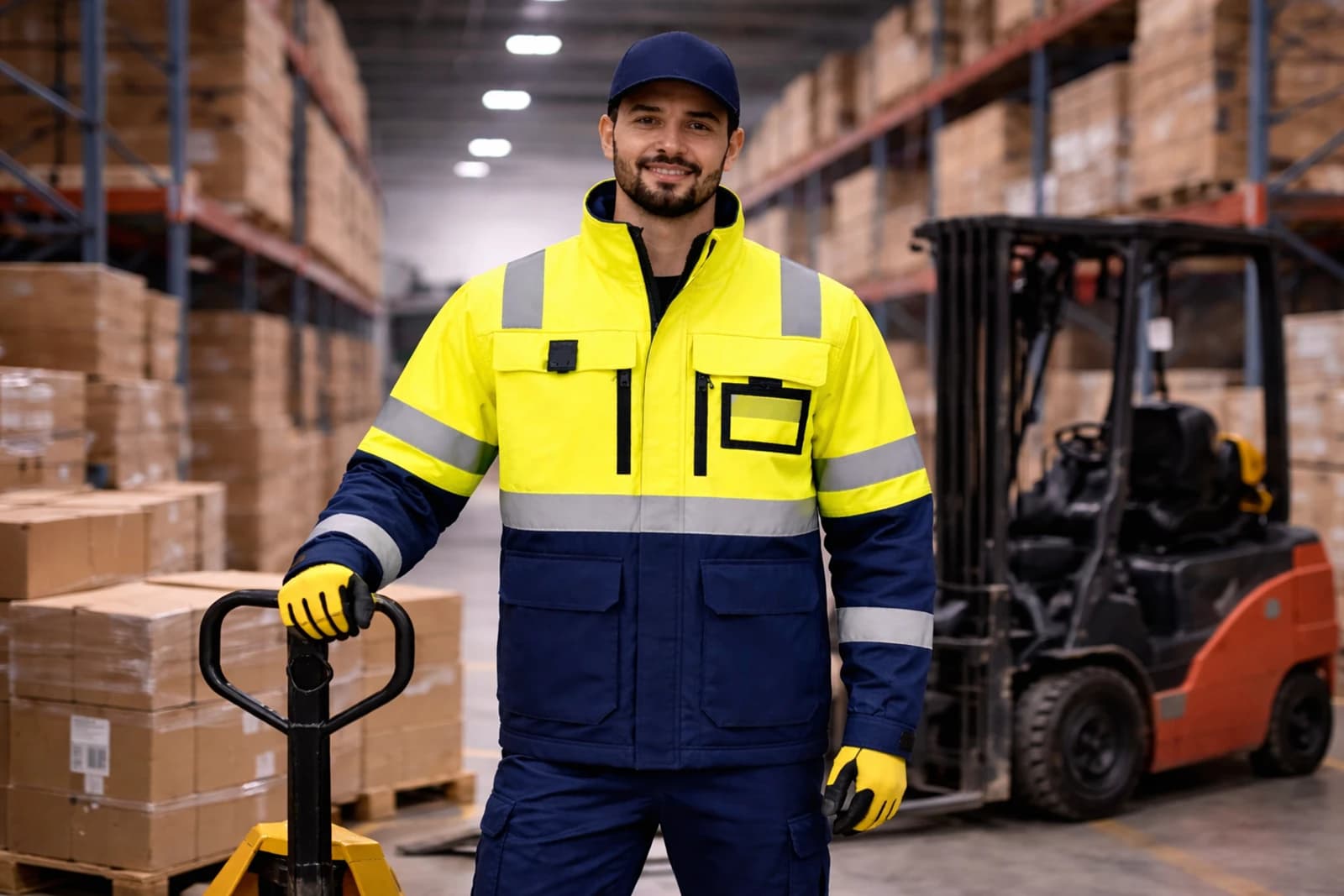
Safety Uniform
Hi-Vis Safety Jacket
Reflective safety jacket for high-visibility site operations and road work crews.
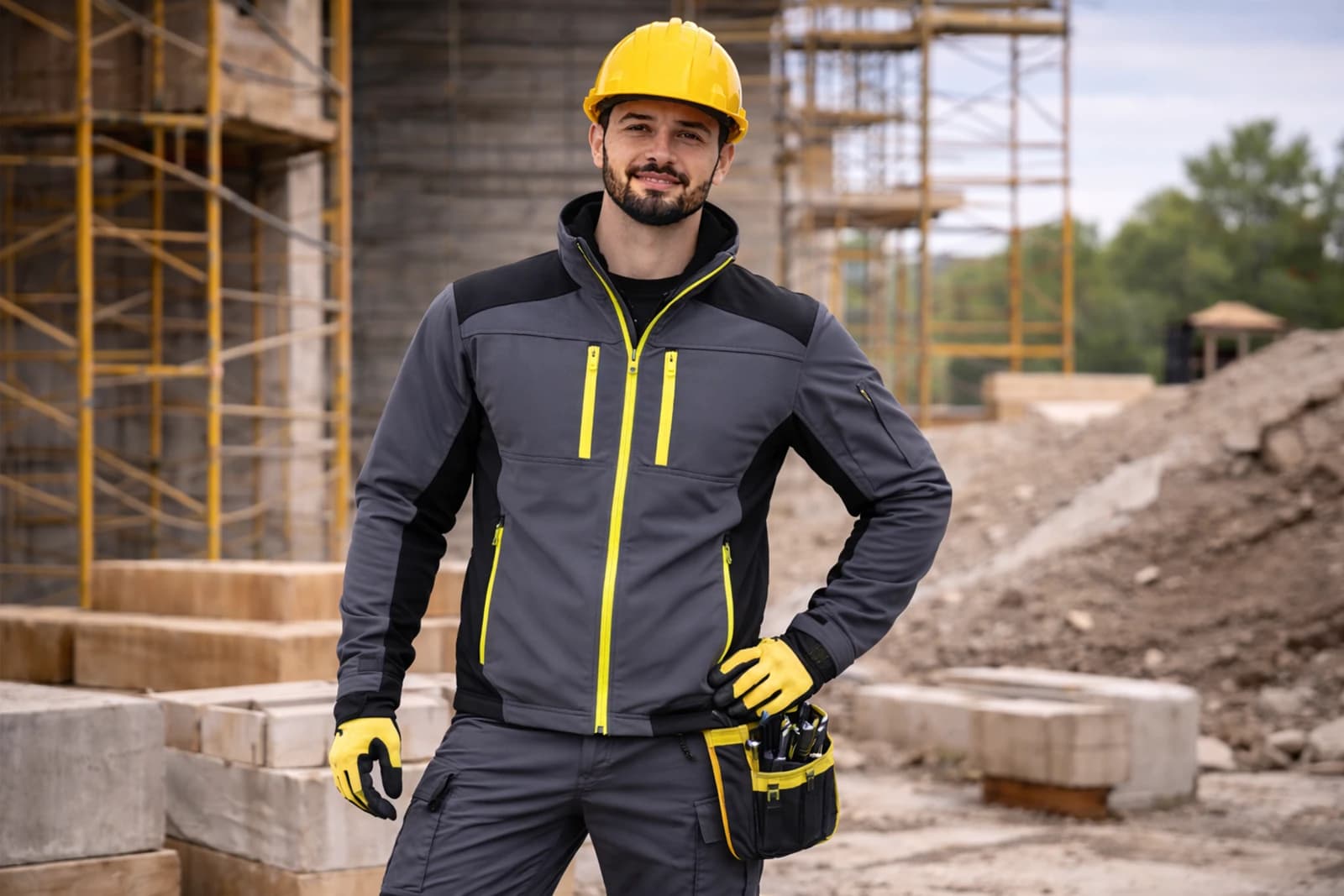
Construction Clothing
Construction Softshell Set
Flexible jacket and trouser set built for crews working across changing weather conditions.