Hi-Vis Garments Lose Compliance When Retroreflective Tape Fades Through Washing
Retroreflective tape on hi-vis garments degrades through industrial washing, losing its reflective performance and creating compliance gaps for workers exposed to traffic. Standard hi-vis specifications don't address tape durability through wash cycles, leaving buyers without replacement criteria. This article covers how retroreflective tape degrades, when hi-vis garments lose compliance, and the wash-cycle-based replacement criteria that maintain visibility performance.

Buyer context
What procurement teams run into
Municipal road maintenance crews—performing pothole repair, road marking, signage installation, and emergency road works—work in close proximity to live traffic and depend on hi-vis garments to maintain visibility to drivers. Retroreflective tape on hi-vis garments degrades through industrial washing, losing its reflective performance and creating compliance gaps. Standard hi-vis specifications focus on initial fabric and tape performance but don't address tape durability through wash cycles, leaving buyers without replacement criteria. The mechanism: **1. Retroreflective tape degrades through mechanical agitation and chemical exposure during industrial washing** Retroreflective tape consists of tiny glass beads or micro-prisms embedded in a polymer matrix bonded to fabric backing. The glass beads or prisms create retroreflection—light from vehicle headlights strikes the tape and reflects back toward the driver, making the worker visible. Industrial washing subjects retroreflective tape to mechanical agitation (tumbling, spinning), elevated temperatures (40-60°C), and chemical exposure (alkaline detergents, bleach). The combination of mechanical stress, heat, and chemicals degrades the polymer matrix that holds the glass beads or prisms in place. Glass beads become dislodged from the polymer matrix, micro-prisms develop surface scratches, and the polymer matrix itself cracks and delaminates from the fabric backing. The root cause: retroreflective tape is designed for outdoor exposure (UV, rain, temperature variation) but not for repeated industrial washing. The polymer matrix that protects the glass beads or prisms degrades under washing conditions. Workers in municipal road maintenance wash their hi-vis garments frequently (2-3 times per week) due to dirt, oil, and asphalt staining from road works. Each wash cycle degrades the retroreflective tape, reducing its reflective performance. **2. Reflective performance decreases exponentially after 15-25 wash cycles** New retroreflective tape meets minimum reflective performance standards (EN ISO 20471 specifies minimum retroreflection coefficients: 350 cd/lx/m² for Class 2, 400 cd/lx/m² for Class 3). After 15-25 wash cycles, retroreflective performance decreases to 50-70% of initial values. After 30-40 wash cycles, retroreflective performance can drop below 200 cd/lx/m²—below the minimum required for Class 2 compliance. The degradation is exponential, not linear: each wash cycle damages already-weakened tape, creating accelerating performance loss. The root cause: retroreflective tape degradation follows a fatigue pattern. Initial wash cycles cause minimal performance loss (polymer matrix intact, glass beads secure). After 15-25 wash cycles, polymer matrix develops micro-cracks that propagate with each subsequent wash. Glass beads become dislodged, micro-prisms develop scratches, and retroreflection performance drops rapidly. The exponential degradation means that garments that meet compliance at 20 wash cycles can fall below compliance at 30 wash cycles—a 50% performance drop in just 10 wash cycles. **3. Standard hi-vis specifications don't require wash-cycle testing** Most hi-vis garment specifications require compliance with EN ISO 20471 or equivalent standards but don't specify retroreflective performance after a defined number of wash cycles. Suppliers quote garments with retroreflective tape that meets initial performance requirements but don't provide wash-durability testing data. The buyer receives garments that meet hi-vis standards at delivery but doesn't know how reflective performance changes after 10, 20, 30 wash cycles. The root cause: hi-vis standards (EN ISO 20471, ANSI/ISEA 107) specify minimum retroreflection coefficients but don't mandate wash-durability testing. Some standards include optional wash-durability testing (EN ISO 20471 includes wash testing protocols), but buyers don't typically require suppliers to provide wash-durability testing data. Without wash-durability specification, suppliers optimize for initial compliance rather than sustained compliance through wash cycles. The buyer has no data on how garment retroreflective performance changes through wash cycles. **4. Faded tape creates compliance gaps for workers exposed to traffic** Municipal road maintenance crews work in close proximity to live traffic. Drivers depend on retroreflective tape to detect workers in low-light conditions (dawn, dusk, night, fog, rain). Retroreflective tape that has degraded through washing no longer reflects sufficient light back to drivers, creating visibility gaps. Workers wearing faded hi-vis garments are less visible to drivers, increasing the risk of vehicle-worker collisions. The root cause: hi-vis compliance is based on retroreflective performance. Garments that no longer meet minimum retroreflection coefficients are non-compliant, regardless of whether the fluorescent background fabric still meets color requirements. Workers wearing faded hi-vis garments are non-compliant with hi-vis standards, creating regulatory compliance risk (occupational safety regulations require hi-vis garments that meet standards) and safety risk (reduced visibility to drivers). **5. The cost of getting it wrong** The buyer who specifies hi-vis garments without wash-durability testing faces: - Compliance gaps (garments falling below hi-vis standards after 20-30 wash cycles) - Safety risk (reduced worker visibility to drivers, increasing collision risk) - Regulatory compliance risk (occupational safety regulations require hi-vis garments that meet standards) - Worker complaints (faded tape creating visible compliance gaps, worker concern about safety) - Inefficient replacement scheduling (calendar-based replacement without data on actual tape performance) The buyer who specifies hi-vis garments with wash-durability testing faces: - Compliance maintained (garments replaced before retroreflective performance falls below standards) - Safety maintained (workers remain visible to drivers throughout garment service life) - Regulatory compliance maintained (hi-vis garments meet standards throughout service life) - Optimized replacement scheduling (garments replaced based on actual tape performance rather than calendar cycle)
Sourcing approach
How a factory partner can respond
The solution is a hi-vis garment specification that requires wash-durability testing data for retroreflective tape and sets replacement thresholds based on wash cycles—replacing garments before retroreflective performance falls below hi-vis standards. **Step 1: Specify retroreflective tape with wash-durability testing data** Specify hi-vis garments with retroreflective tape that includes wash-durability testing data. Require suppliers to provide retroreflective performance testing after 0, 10, 20, 30, and 40 wash cycles. Specify minimum retroreflection coefficients at each wash cycle interval: - After 0 wash cycles (new garment): minimum 350 cd/lx/m² (Class 2) or 400 cd/lx/m² (Class 3) - After 10 wash cycles: minimum 300 cd/lx/m² - After 20 wash cycles: minimum 250 cd/lx/m² - After 30 wash cycles: minimum 200 cd/lx/m² - After 40 wash cycles: minimum 150 cd/lx/m² The retroreflective performance limits ensure that garments maintain compliance throughout service life. Require suppliers to provide testing data from accredited laboratories using standardized test methods (EN ISO 20471 wash testing protocols or equivalent). **Step 2: Specify high-durability retroreflective tape construction** Specify hi-vis garments with high-durability retroreflective tape construction that resists wash degradation: - **Segmented tape construction:** specify retroreflective tape with segmented construction (tape divided into small segments connected by flexible bridges) that resists cracking and delamination. Segmented tape flexes with garment movement and washing, reducing stress on the polymer matrix. - **Protected bead construction:** specify retroreflective tape with protected glass bead construction (glass beads embedded deeper in the polymer matrix, with a protective top layer) that resists bead dislodgement during washing. - **High-temperature polymer matrix:** specify retroreflective tape with high-temperature polymer matrix (polymer that resists degradation at washing temperatures up to 60°C) that maintains integrity through repeated washing. The high-durability tape construction resists wash degradation, extending retroreflective performance through more wash cycles. **Step 3: Set replacement thresholds based on wash cycles** Set garment replacement thresholds based on wash cycle performance data rather than visible condition: - **Replacement threshold:** replace garments when retroreflective performance falls below 200 cd/lx/m² (below Class 2 minimum). This threshold ensures garments maintain compliance with hi-vis standards. - **Replacement scheduling:** use supplier wash-durability testing data to predict garment service life. If supplier data shows that garments fall below 200 cd/lx/m² after 30 wash cycles, set replacement threshold at 30 wash cycles. Replace garments at the wash cycle threshold regardless of visible condition. - **Wash cycle tracking:** implement a garment tracking system that tracks wash cycles for each garment and flags garments that have reached the replacement threshold. Tag each garment with a unique identifier (barcode, RFID tag, or numbered tag) that enables tracking of individual garment wash cycle history. The replacement threshold ensures that garments are replaced before retroreflective performance falls below hi-vis standards. **Step 4: Specify garment construction features that protect retroreflective tape** Specify hi-vis garments with construction features that protect retroreflective tape from wash degradation: - **Tape placement:** specify garments with retroreflective tape placed on flat garment surfaces (chest, back, sleeves) rather than at high-stress areas (shoulders, elbows, knees). Flat surfaces experience less mechanical stress during washing, reducing tape degradation. - **Tape coverage:** specify garments with retroreflective tape coverage that meets hi-vis standards (minimum tape width 50mm, minimum tape area requirements) with additional tape area to compensate for performance degradation. Extra tape area provides a performance buffer as tape degrades. - **Tape edge protection:** specify garments with bound edges or protective stitching at retroreflective tape edges that prevent tape delamination. Tape edges are vulnerable to peeling and delamination during washing; edge protection secures tape edges and prevents delamination propagation. The construction features protect retroreflective tape from wash degradation, extending tape service life. **Step 5: Implement garment inspection for retroreflective performance** Implement a garment inspection protocol that checks retroreflective tape condition and correlates with wash cycle counts: - **Visual inspection:** inspect garments weekly for visible tape degradation (fading, cracking, delamination, missing segments). Visual degradation indicates tape performance loss. - **Reflective testing:** test garments periodically for retroreflective performance using a retroreflectometer (portable device that measures retroreflection coefficient). Test garments at 10, 20, 30, and 40 wash cycles to validate supplier wash-durability data and confirm replacement thresholds. - **Replacement decision:** replace garments when visual inspection shows significant tape degradation or when reflective testing shows performance below 200 cd/lx/m². Use both visual inspection and reflective testing to make replacement decisions. The inspection protocol enables proactive replacement based on actual tape condition, preventing compliance gaps. **Step 6: Train workers on hi-vis garment care and inspection** Train workers on hi-vis garment care practices that extend retroreflective tape life and inspection protocols that identify tape degradation: - **Washing care:** train workers on washing care practices that minimize tape degradation (wash garments inside-out to protect tape surface, avoid bleach and fabric softeners that degrade tape, use moderate washing temperatures rather than high temperatures). - **Drying care:** train workers on drying care practices that minimize tape degradation (air-dry garments rather than machine-dry, avoid high-temperature drying that degrades tape). - **Inspection training:** train workers on how to inspect garments for tape degradation (visual inspection for fading, cracking, delamination; reflective testing using a retroreflectometer). Train workers to report tape degradation and request garment replacement. The training ensures that workers understand hi-vis garment care practices and inspection protocols, extending tape life and enabling proactive replacement. **Recommended garments for municipal road maintenance hi-vis requirements:** - **Hi-vis safety jacket** — specify the hi-vis safety jacket for road maintenance crews who require high-visibility coverage in close proximity to live traffic. The jacket provides full-torso coverage with retroreflective tape on chest, back, and sleeves that meets EN ISO 20471 Class 2 or Class 3 requirements. Specify the jacket with high-durability retroreflective tape (segmented construction, protected bead construction, high-temperature polymer matrix) that maintains retroreflective performance through 30+ wash cycles. Specify the jacket in fluorescent background fabric (fluorescent yellow or fluorescent orange-red) that meets EN ISO 20471 color requirements. The jacket's high-visibility coverage, durable retroreflective tape, and fluorescent background fabric make it suitable for municipal road maintenance operations where worker visibility to traffic is critical. - **Construction softshell set** — specify the softshell set for road maintenance crews who work in cooler weather conditions where additional insulation and weather protection are required. The softshell set (jacket and trouser) provides weather protection (wind resistance, light rain resistance) with hi-vis fluorescent fabric and retroreflective tape. Specify the softshell set with high-durability retroreflective tape that maintains performance through wash cycles. Specify the softshell set in fluorescent background fabric with enclosed seams and covered closures that protect retroreflective tape from wash degradation. The softshell set's weather protection, hi-vis coverage, and durable retroreflective tape make it suitable for municipal road maintenance operations in cooler weather where visibility and weather protection are both required.
Recommended Products
Products that fit this use case

Safety Uniform
Hi-Vis Safety Jacket
Reflective safety jacket for high-visibility site operations and road work crews.
Construction Clothing
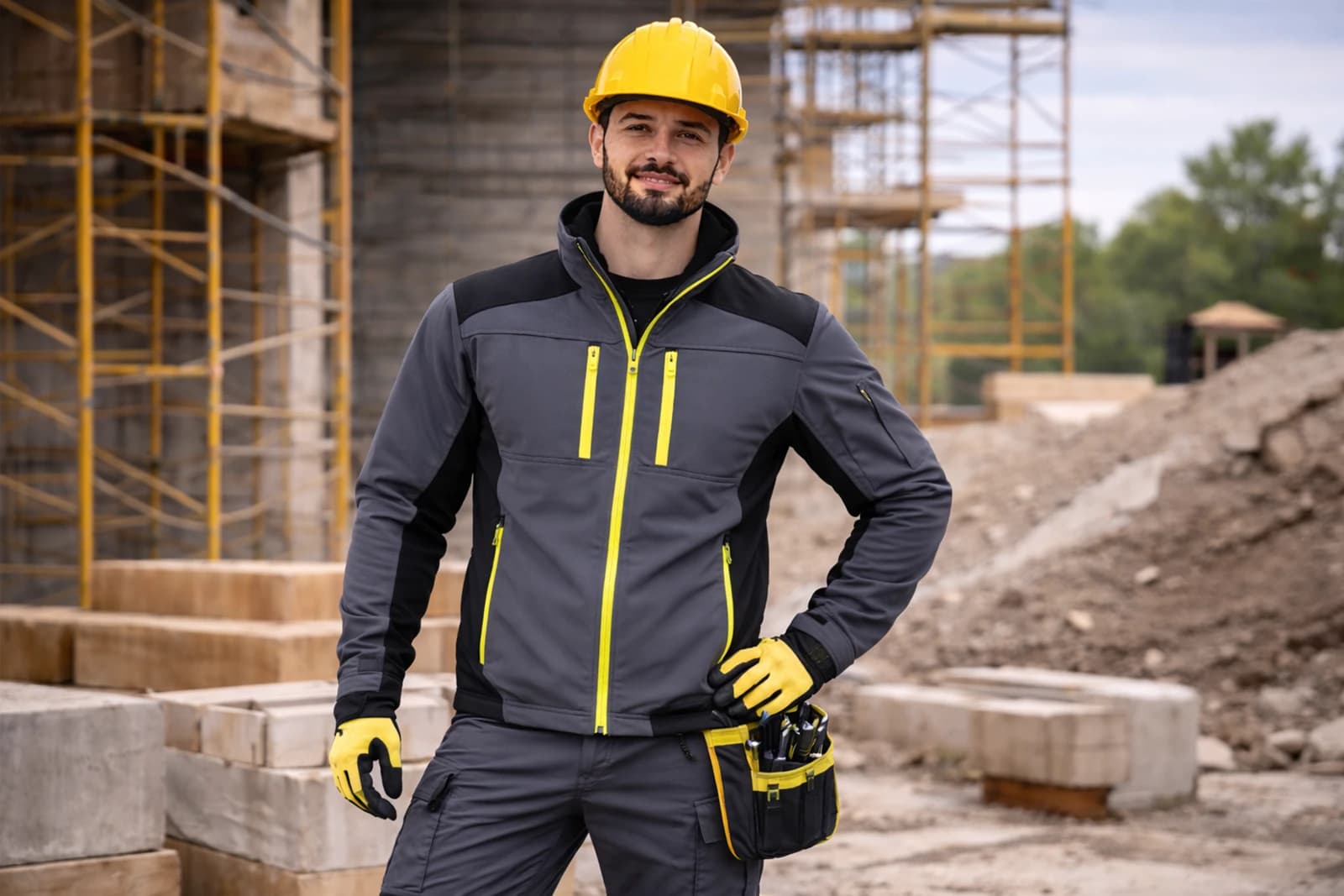
Construction Softshell Set
Flexible jacket and trouser set built for crews working across changing weather conditions.