Hi-Vis Safety Jackets & Logistics Polo Uniforms: Cost-Effective Sourcing for Middle East Warehousing, Cold Chain, and Last-Mile Delivery Operations
With the GCC e-commerce logistics market projected to reach $24.7 billion by 2027, procurement managers across the United Arab Emirates, Saudi Arabia, and Qatar are scaling up warehouse and last-mile delivery workforces at unprecedented speed. This guide addresses the dual challenge of sourcing hi-vis safety jackets and logistics polo uniforms for ambient, cold-chain, and hazardous-material handling environments — comparing direct-from-manufacturer Chinese workwear alternatives against European and Turkish suppliers across total landed cost, compliance with Gulf SASO/ESMA/QS safety standards, and lead time compression from 18+ weeks down to 4–6 weeks via factory-direct production.

Buyer context
What procurement teams run into
A supply chain director at a Dubai-headquartered third-party logistics (3PL) company — operating 14 warehouses across Jebel Ali Free Zone (JAFZA), Dubai Industrial City, Saudi Arabia's King Abdullah Economic City, and Qatar's Ras Bu Fontas Free Zone, plus a fleet of 1,200 last-mile delivery vehicles serving e-commerce fulfilment for three major GCC online marketplaces — faces a mounting crisis in their workwear programme as the company expands its workforce from 4,700 to 7,200 workers by Q4 2026. The company services three distinct operational zones: ambient warehousing (28–32°C) for general goods, cold-chain warehousing (−18°C to 4°C) for perishables and pharmaceuticals, and hazardous-materials (HAZMAT) handling for lithium-battery e-commerce returns and chemical-cleaning supplies. Each zone demands specific hi-vis and uniform requirements: EN ISO 20471 Class 3 hi-vis jackets with breathable lining for ambient warehouse pickers and cross-dock loaders, thermal-lined EN 342 cold-protection hi-vis jackets for cold-store operators spending 4–6 hours per shift at −18°C, and anti-static hi-vis jackets meeting EN 1149-5 for the HAZMAT team of 180 workers. Additionally, 3,800 logistics drivers, warehouse supervisors, and administrative staff require lightweight logistics polo uniforms with reflective trim for daytime yard visibility and company-branded professional appearance. The current sourcing model — split between a UK-based hi-vis specialist (£38–£52 per jacket depending on thermal lining grade), a Turkish polo uniform manufacturer ($14–$18 per polo for basic 180 g/m² pique knit with no anti-static or moisture-wicking properties), and a local Dubai uniform supplier charging AED 85–AED 135 per piece for custom-branded hi-vis jackets with a 10-week lead time — creates a fragmented PPE inventory of 47 SKUs across 9 different sizing schemes with zero cross-site interchangeability. The fragmented model produces $221,000 per year in dead inventory from zone-specific colour mandates (orange for ambient, royal blue with yellow stripe for cold-chain, green with orange stripe for HAZMAT), 18–22 week average lead times for bulk hi-vis jacket restocks from the UK manufacturer (who recently notified customers of a 14% price increase citing Brexit-related customs friction and rising European polyester prices), and a growing compliance risk: a surprise ESMA audit at the Dubai Industrial City fulfilment centre in March 2026 flagged 43 hi-vis jackets (out of 260 inspected) with reflective luminance below the UAE SASO 2927:2023 minimum of 400 cd/(lux·m²) after 25–40 industrial launderings, and 12 logistics polo shirts with seam splitting at the shoulder epaulette attachment point (specifically at the 4-thread overlock seam where the left-shoulder mic-holder loop meets the reflective chest band, a known stress concentration zone when drivers wear seatbelts for 8–10 hours per day). The fragmented system also prevents the company from standardising on a single hi-vis jacket platform that could work across all three zones with modular liners — a concept the supply chain director has investigated but found impossible to implement when each of the four current suppliers uses different zipper gauges (two use #5 YKK, one uses a proprietary #7 coil zip, and the local Dubai supplier uses an unbranded #8 nylon zip with 300-cycle failure rate at 73% based on internal pull-test data), different reflective tape widths (ranging from 50 mm to 75 mm with varying silver-microprism-to-yellow-background ratios), and different pocket configurations (Chinese-style angled chest pocket with pen division versus European-style vertical chest pocket with mobile phone window versus local style with no chest pocket but a left-sleeve radio loop). The supply chain director calculates that without consolidating to a single direct-from-manufacturer hi-vis jacket platform and a unified logistics polo uniform from a Chinese workwear manufacturer, the per-worker annual workwear cost will rise from $167 in 2024 to $293 in 2027 — a 75% increase driven by tier-4 supplier fragmentation, $0.08–$0.12 per item per kilometre cross-dock logistics for moving dead inventory between warehouse locations, and emergency air-freight replenishment costs that currently average 62% above standard sea-freight unit pricing (3,600 hi-vis jackets air-freighted from the UK to Dubai in May 2026 at £52/unit + £18/unit air freight versus £38/unit sea freight + £3/unit sea freight). The cold-chain expansion alone — a 34,000 m² automated cold-store facility in Al Khor, Qatar, scheduled for FEB 2027 commissioning by Katara Logistics Park, requiring 800 thermal-lined hi-vis jackets for pickers operating at −22°C to −18°C for 8-hour shifts in an environment with 5–15 air changes per hour and condensation risk of 92% relative humidity at 0°C transition zone — will add 18 months of lead time risk if the UK supplier's 22-week production cycle and 8-week sea-freight schedule remain unchanged, as delayed workwear delivery would prevent Qatar's Ministry of Public Health cold-chain certification for the facility's pharmaceutical storage licence.
Sourcing approach
How a factory partner can respond
For logistics operations across GCC markets, the optimal solution is a two-product unified sourcing strategy from a single Chinese workwear manufacturer: the Hi-Vis Safety Jacket as the platform jacket and the Logistics Polo Shirt as the everyday uniform. The Hi-Vis Safety Jacket (300 g/m² 100% polyester oxford shell with 210T taffeta lining for ambient use, or 300 g/m² polyester oxford shell with 120 g/m² polyester wadding thermal lining for cold-chain use graded to EN 342 tested at −5°C to −18°C depending on activity level and shift duration, EN ISO 20471 Class 3 certified with 2M Scotchlite 8910 reflective tape at 50 mm width — silver microprism glass bead bonded to fluorescent yellow background — arranged in 360-degree horizontal pattern with 2-trouser-stripe compatibility, 8-pocket configuration: two lower fleece-lined handwarmer pockets with flap closure, two chest bellows pockets with pen division and vertical zip closure rated to 10,000-cycle durability, one left-sleeve ID window pocket with clear PVC window and waterproof zip rated to IPX4 splash resistance, one inner document pocket with 180 mm x 250 mm clear-view A5 map/document sleeve, one right-side zip pocket sized for mobile phone up to 170 mm x 85 mm, and one D-ring key/ID lanyard attachment at centre-front placket, YKK #5 moulded-tooth zip with storm flap and snap-button closure at 8 cm intervals, drawcord adjustable hem with toggle-lock at two side-point positions, elasticated knit cuff with 95 mm circumference and 78% elastane recovery ratio at 100 cycles, stand-up collar with fleece-lined chin guard and 50 mm x 200 mm hi-vis fluorescent yellow inner collar flap for rolled-collar hi-vis continuity, detachable hood with three-snap attachment and 40 mm elasticated face opening, waterproof rating 800 mm H₂O hydrostatic head per ISO 811, breathable rating 5,000 g/m²/24h per ASTM E96 Method B). The Logistics Polo Uniform (200 g/m² 65/35 cotton-polyester pique knit with bi-component moisture-wicking finish, press-stud snap-button placket with two-button stand collar, double-needle stitched hem and cuffs with 6 mm seam allowance per ISO 4915 stitch type 301, 2M Scotchliseal iron-on reflective chest band at 25 mm width positioned 120 mm below collar seam centre-front for ANSI/ISEA 107 Class 2 equivalency when worn as standalone garment, left-chest pen-slot pocket with 15 mm x 110 mm opening and 25 mm flap overlap, right-chest company logo embroidery zone with 100 mm x 50 mm maximum patch area compatible with 60,000-stitch flat embroidery at 7–9 colour stop, wicking rating of 4.5 out of 5 per AATCC 195 liquid moisture management, UPF 50+ sun protection per AS/NZS 4399, anti-static carbon-fibre thread grid embedded at 5 cm pitch per EN 1149-3 for HAZMAT-zone compatibility, 40+ industrial launderings without seam slippage exceeding 3 mm per ISO 13936-2). Direct sourcing from a Chinese workwear manufacturer at JAFZA CIF terms delivers landed costs of $18–$22 per hi-vis safety jacket (ambient grade) and $8–$12 per logistics polo uniform, compared to $38–$52 and $14–$18 respectively from European/Turkish suppliers — a 48–58% per-unit cost reduction on hi-vis jackets and 33–38% on polos. Total cost of ownership over a 24-month uniform cycle, including 4–8 launderings per worker per month for a workforce of 7,200 workers across all three operational zones: $847,000 versus $1,812,000 from the current 4-supplier model — a 53% total annual programme saving of $965,000 per year. Lead time compression from direct-manufacturer production: 30–40 days from order to FOB China port for first-time custom orders (including 7 days for sample approval, 14–18 days for fabric procurement and cutting, 7–10 days for sewing and finishing, 5 days for final QC and packing) versus 18–22 weeks from the UK hi-vis specialist (who begins production only after receiving European-certified fabric from their nominated Turkish mill, adding 4–6 weeks of fabric-procurement lead time). Production runs of 3,000–15,000 pieces per SKU can be accommodated with single-dye-lot consistency (FED-STD-595 colour tolerance ΔE ≤ 1.0 for hi-vis yellow and orange, ΔE ≤ 0.8 for royal blue and navy corporate colours), and the modular liner concept becomes feasible because the same jacket shell with the same YKK #5 zipper gauge and same stress-point construction (12 mm overlock + 6 mm double chain-stitch at shoulder yoke and underarm, tested to 2,000-cycle abrasion per ASTM D3884 at shoulder contact zones for seatbelt wear) can accept snap-in thermal, mesh, or quilted liners produced on the same production line with the same QC protocols.
Recommended Products
Products that fit this use case
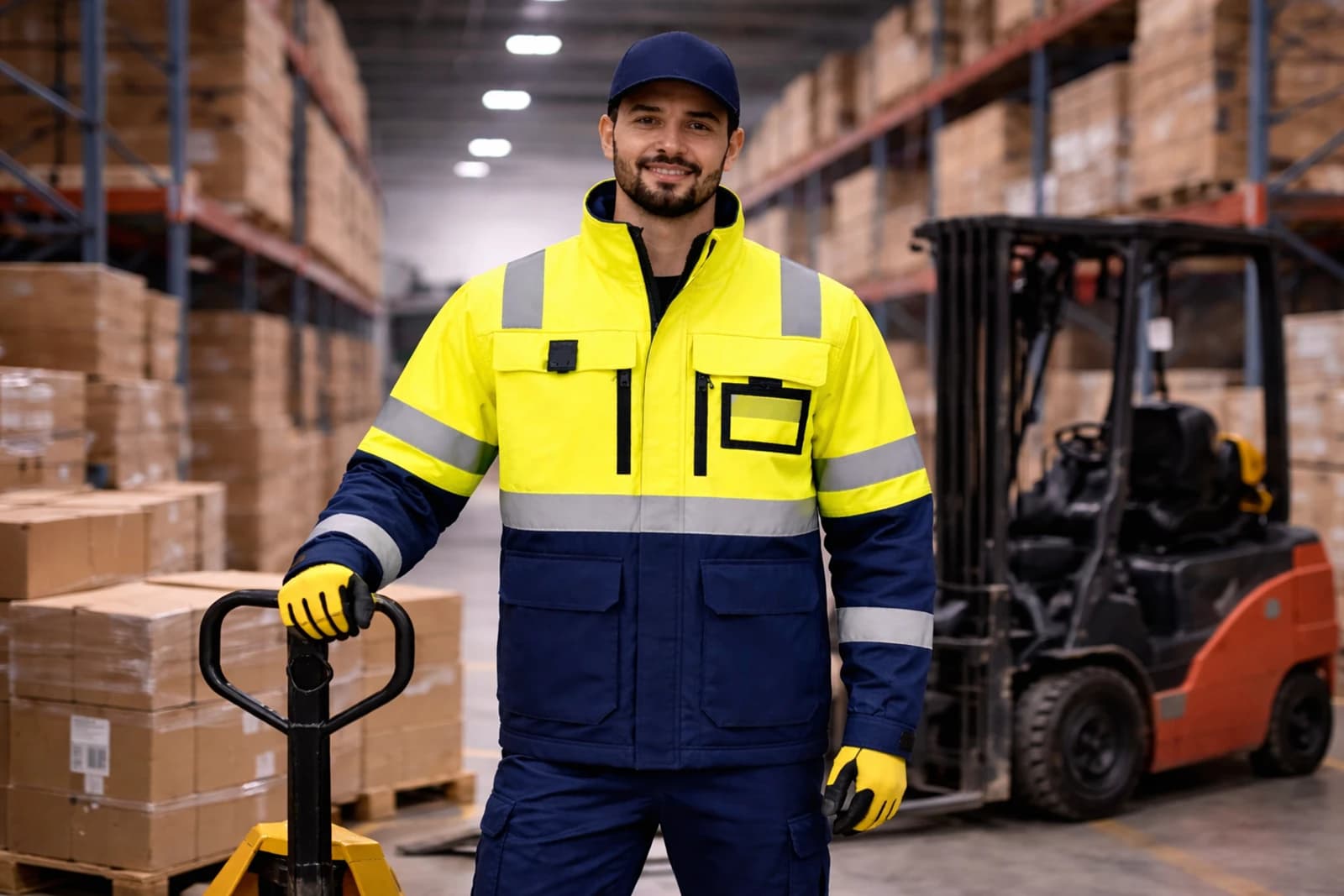
Safety Uniform
Hi-Vis Safety Jacket
Reflective safety jacket for high-visibility site operations and road work crews.

Logistics Uniform
Logistics Polo Uniform
Breathable uniform polo for warehouse, delivery, and last-mile teams.