Hi-Vis Safety Jackets vs. High-Visibility Polo Uniforms: What Middle East Oil & Gas and Logistics Buyers Need to Know
Middle East B2B buyers in oil & gas, logistics, and utilities often hesitate between hi-vis safety jackets and hi-vis polo uniforms for their workforce. This guide breaks down the key differences — thermal comfort in Gulf climates, layering strategy, compliance with EN ISO 20471, and total cost of ownership — and explains when to choose each option. Written for procurement managers sourcing from a Chinese workwear manufacturer, with practical advice on specification, customization, and bulk ordering.

Buyer context
What procurement teams run into
A procurement manager at a logistics and oil-field services company in Saudi Arabia needs to outfit 400 workers across three operational zones: a crude oil loading terminal (outdoor, 45–50 °C in summer), a spare-parts warehouse (indoor, air-conditioned to 24 °C), and a fleet maintenance depot (mixed indoor-outdoor). The current uniform policy specifies hi-vis safety jackets for everyone, worn over cotton polo shirts. But the complaints are constant: field workers at the oil terminal say the jackets are unbearably hot and come off within an hour of starting their shift—defeating the purpose of hi-vis compliance. Warehouse staff find jackets too bulky for tight racking aisles. Mechanics complain the jacket sleeves restrict arm movement when working under vehicle hoods. For Middle East B2B buyers sourcing from a Chinese workwear manufacturer, choosing between hi-vis safety jackets and hi-vis polo uniforms isn't just about preference—it directly affects safety compliance rates, worker satisfaction, and annual uniform spend. The wrong choice leads to: - **Low compliance** — if workers consistently remove their hi-vis layer because it's too hot or restrictive, your safety audit scores drop and incident risk rises. - **Double procurement** — buying both jackets and polos from different suppliers doubles your qualification, sampling, and quality-control overhead. - **Mismatched fade rates** — hi-vis yellow or orange garments from different manufacturers fade at different rates under Gulf UV. After three months, a jacket from Supplier A and a polo from Supplier B no longer match, creating an unprofessional appearance. - **Wasted spend on layering** — if your jackets are ANSI Class 3 but the risk assessment only requires Class 2, you're paying 15–25% more per garment for reflective tape coverage that goes unused. The core problem: most buyers treat hi-vis as a single category and default to jackets for everyone, when modern hi-vis polo uniforms offer a lighter, more practical solution for specific work zones—but only if specified correctly for Gulf conditions.
Sourcing approach
How a factory partner can respond
The solution is a zone-based hi-vis strategy: match the garment type to the work environment rather than issuing a one-size-fits-all hi-vis policy. For Middle East buyers sourcing from a Chinese manufacturer, both the hi-vis safety jacket (hi-vis-safety-jacket) and the logistics polo uniform (logistics-polo-uniform) can be sourced from the same supplier for consistent color, fade rate, and quality across your entire uniform program. **When to choose hi-vis polo uniforms:** Hi-vis polo uniforms (also called hi-vis knit shirts or polo-style safety shirts) are the right choice when: - **Work is primarily indoors or in direct sun without rain or wind** — in air-conditioned warehouses, covered loading docks, or assembly lines, the polo provides adequate visibility without overheating. - **Workers need maximum mobility** — the knit fabric of a hi-vis polo stretches with the body, unlike woven jacket shells. This matters for mechanics, pickers, and technicians who reach, bend, and climb. - **Ambient temperatures exceed 40 °C** — a hi-vis polo with mesh side panels or moisture-wicking fabric is significantly cooler than even a ventilated jacket. Field workers actually wear it, which is the whole point. - **Risk assessment requires Class 2 or Class 1** — hi-vis polos are typically rated Class 2 (when background fabric covers the torso and reflective tape is applied) or Class 1 (for non-road-use). They are not suitable where Class 3 (high-risk road work) is required. **Key specifications for Gulf-region hi-vis polo uniforms:** - **Fabric** — 180–200 GSM 100% polyester pique knit with moisture-wicking finish. The knit should be tight enough to hold reflective tape securely (a common failure point in cheap polos where tape peels after 10 washes). Avoid cotton-blend polos for hi-vis — cotton absorbs sweat and retains heat, while polyester wicks and dries fast. - **Reflective tape** — specify EN ISO 20471-certified silver reflective tape with a minimum width of 50 mm. Two horizontal bands on the torso are standard for Class 2. For indoor-only use where EN ISO 20471 isn't mandatory, a single 50 mm band on the chest still provides practical visibility. - **Color** — hi-vis yellow (Luminescent Yellow, RAL 1026 or equivalent) for oil & gas and construction; hi-vis orange (RAL 2005 or Safety Orange) for road work and logistics. Match your local regulatory preference — Saudi Aramco, for example, specifies hi-vis yellow for most contractor roles. - **Collar and placket** — a knit collar with 2–3 button placket (contrast dark color, e.g., navy or black) creates a professional uniform look while maintaining hi-vis torso coverage. Avoid full-zip polo fronts for hi-vis — buttons keep the reflective tape layout intact. - **Sleeve length** — short sleeves (elbow length) for Gulf summer, with a small reflective band around each bicep (optional, adds Class 2 compliance). If EN ISO 20471 Class 3 is required, long sleeves with continuous reflective stripes are necessary, but this is rare for polo-style garments. **When to choose hi-vis safety jackets (vest-style or shell):** Hi-vis safety jackets are the right choice when: - **Work is outdoor in variable conditions** — wind, dust, rain, or cooler desert nights (15–20 °C) make a jacket the practical choice. The shell provides weather protection that a polo cannot. - **Class 3 compliance is required** — jackets can carry the full reflective tape layout (torso + sleeves + vertical stripes) needed for high-risk road work, airport aprons, or heavy equipment zones. - **Workers need pockets** — a hi-vis jacket with 4+ pockets (radio pocket, chest pockets, side pockets) is essential for supervisors, safety officers, and technicians who carry tools, phones, and paperwork. - **Layering for temperature swings** — a lightweight hi-vis jacket worn over a standard polo or t-shirt allows workers to adjust their thermal comfort without switching garments. This is valuable for early-morning shifts that start at 25 °C and peak at 45 °C. **Key specifications for Gulf-region hi-vis safety jackets:** - **Fabric** — lightweight 120–150 GSM 100% polyester or nylon shell with mesh lining for breathability. Do not specify a waterproof membrane or PU coating for hot-weather use — it traps heat. Instead, look for "air-mesh" or ventilated back panel designs that let air circulate while maintaining the hi-vis background. - **Style** — vest-style (sleeveless) for maximum airflow, or short-sleeve jacket for a more uniform appearance. Full-sleeve jackets are only recommended for Class 3 applications or cooler months. - **Closure** — a full-front zipper with snap-button storm flap. The zipper should be plastic or nylon (not metal) to avoid heat conduction against bare skin if worn over a t-shirt. - **Fit** — roomy enough to fit over a polo shirt or thin long-sleeve base layer, but not baggy. Adjustable side tabs (elastic or hook-and-loop) allow the worker to tighten the fit when worn alone. - **Reflective tape** — EN ISO 20471 Class 2 or Class 3. For Class 3, require two horizontal torso bands (min 50 mm each) plus two vertical bands over each shoulder and two bands around each sleeve. The silver retroreflective tape should have a minimum coefficient of retroreflection (RA) of 330 cd/lx/m² for Level 2 performance. **Zone-based procurement strategy for a mixed workforce:** For the Saudi procurement manager with 400 workers across three zones, a split-buy approach minimizes cost while maximizing compliance: | Zone | Workers | Recommended Garment | Key Specs | |------|---------|-------------------|-----------| | Oil terminal (outdoor) | 120 | Hi-vis polo uniform + lightweight vest jacket | Class 2 polo (primary), breathable vest jacket (for early morning/cooler days) | | Warehouse (indoor) | 180 | Hi-vis polo uniform only | Class 2 polo, short sleeves, moisture-wicking | | Maintenance depot (mixed) | 100 | Hi-vis safety jacket (vest-style) | Class 2 vest, worn over standard polo | **Why source both from one Chinese manufacturer:** - **Color consistency** — the same dye lot and fabric supplier ensures hi-vis yellow is identical across jackets and polos. - **Bulk pricing leverage** — combining 400 polo orders with 100 jacket orders qualifies for a better FOB price tier than sourcing separately. - **Simplified QC** — one pre-production sample approval, one inspection, one shipment. Reduces your procurement cycle by 3–4 weeks. - **Brand continuity** — logo placement, embroidery thread color, and reflective tape position are consistent across all garments. Your workforce looks uniform even though they're wearing different garment types. **What to specify in your RFQ to a Chinese manufacturer:** 1. **Garment A:** Hi-vis polo uniform (logistics-polo-uniform) × 500 pcs — hi-vis yellow, 180 GSM polyester pique, 2-button placket, EN ISO 20471 Class 2 with two horizontal torso reflective bands, left chest logo embroidery. 2. **Garment B:** Hi-vis safety jacket vest-style (hi-vis-safety-jacket) × 120 pcs — hi-vis yellow, 130 GSM air-mesh polyester shell, sleeveless, EN ISO 20471 Class 2, 4 pockets (2 chest + 2 side), adjustable side tabs. 3. **Accessories:** Replaceable reflective tape kits × 50 sets — allows re-taping jackets after 6–8 months of wear instead of replacing the whole garment, extending lifecycle by 40%. By matching the hi-vis garment type to the work environment — rather than defaulting to one style for everyone — you improve wear compliance from an estimated 60% (where workers remove jackets in heat) to 90%+, reduce per-worker uniform spend by approximately 18% (no wasted jacket budget for indoor staff), and maintain a professional, safety-compliant appearance across all operational zones.
Recommended Products
Products that fit this use case
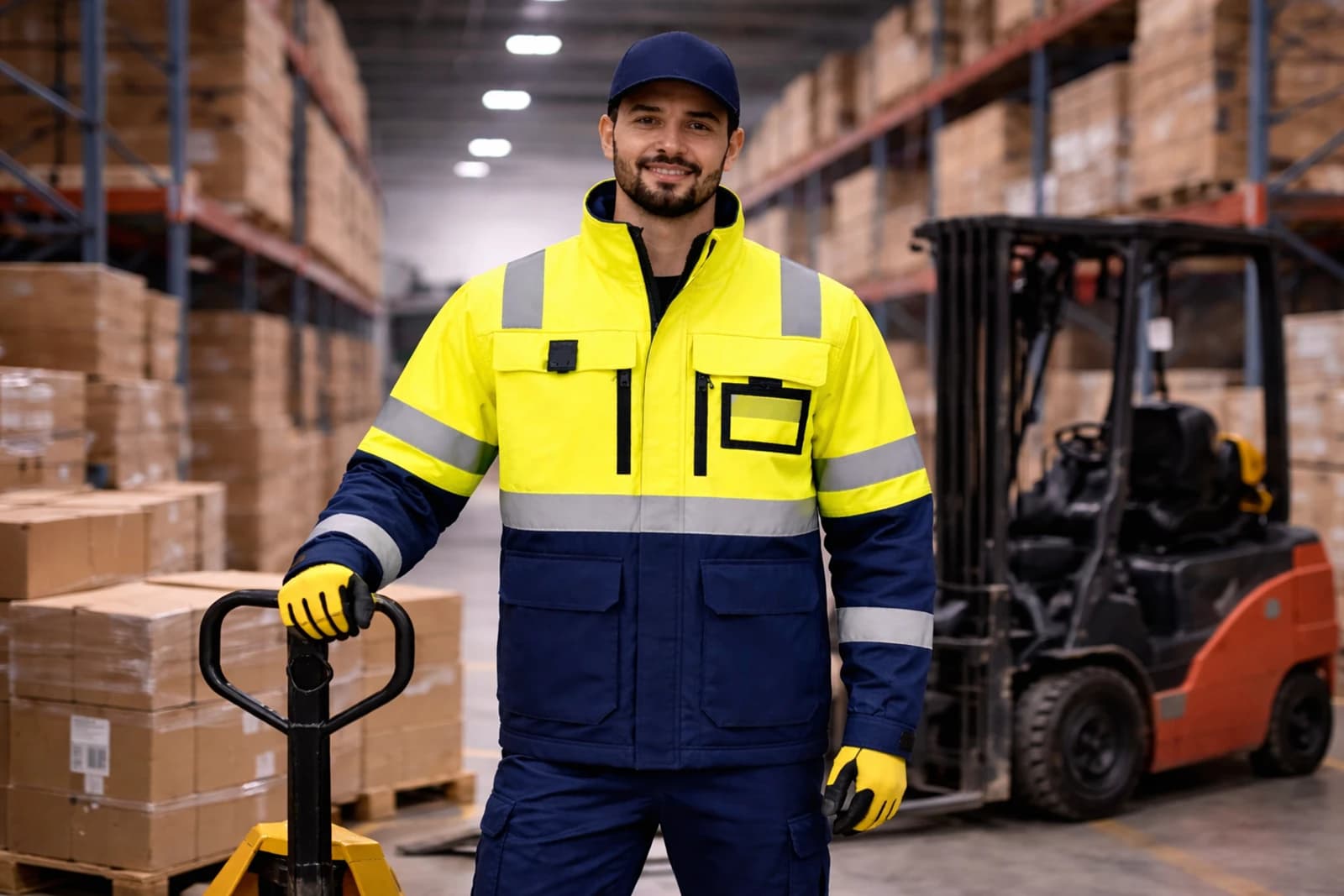
Safety Uniform
Hi-Vis Safety Jacket
Reflective safety jacket for high-visibility site operations and road work crews.

Logistics Uniform
Logistics Polo Uniform
Breathable uniform polo for warehouse, delivery, and last-mile teams.