Hi-Vis Safety Jacket & Construction Softshell Set: A B2B Sourcing Guide for Middle East Infrastructure, Roadworks, and Utility Contractors Sourcing from China
From NEOM's The Line mega-project in Saudi Arabia to Qatar's Lusail Expressway widening and Dubai's Expo City expansion, Middle East infrastructure and roadworks contractors require high-visibility safety gear that withstands extreme Gulf conditions. This guide compares the Hi-Vis Safety Jacket (EN ISO 20471 Class 3 rated, 280 g/m² breathable fabric with 50 mm retroreflective tape) and the Construction Softshell Set (300 g/m² 3-layer bonded softshell with DWR finish and removable hi-vis elements) for highway work, bridge construction, tunnel operations, and utility maintenance. Covers EN ISO 20471 high-vis certification, compliance with Gulf road authority requirements (RTA Dubai, Ashghal Qatar), fabric selection for summer heat vs. winter chill, and bulk procurement strategies for annual framework agreements of 500–5,000 sets.

Buyer context
What procurement teams run into
A procurement manager at a Doha-based infrastructure contracting company with projects across Qatar, Saudi Arabia, and the UAE manages workwear for 1,800+ road construction and utility workers. The company operates on high-profile projects including the Lusail Expressway widening (Phase 3), NEOM's The Line enabling works (Sindalah Island), and Dubai's Al Maktoum International Airport expansion earthworks. The workforce splits into two distinct exposure profiles requiring different high-visibility solutions, yet both must comply with EN ISO 20471 and satisfy Gulf road authority audits. **The Hi-Vis Safety Jacket challenge:** For highway and expressway workers exposed to traffic at speeds exceeding 100 km/h on Qatar's Dukhan Highway or Saudi Arabia's Highway 85, current Class 2 vests fail to meet the Contract Documents requirement for Class 3 high-visibility garments. When an Ashghal safety audit flagged non-compliance for 340 workers on the Lusail Expressway widening site, the contractor faced a QAR 1.2 million penalty and a 14-day suspension notice. Beyond compliance, the all-polyester mesh material of the current class 3 jackets causes severe heat stress during Qatar's April–October construction season (ambient 38–50°C, road surface temperature reaching 68°C). Workers remove jackets within 45 minutes on site — defeating the purpose of high-visibility PPE. The local competitor's alternative (a cotton-mesh hybrid) absorbs sweat then degrades retroreflective tape adhesion within 8–10 industrial wash cycles, reducing retroreflective performance from the initial 350 cd/(lx·m²) to below the 300 cd/(lx·m²) minimum required by EN ISO 20471 Class 3. **The Construction Softshell Set challenge:** For night-shift utility maintenance crews (water, electricity, telecom) working on Dukhan Highway service roads and Riyadh's Ring Road interchanges between November and March (night temperatures 8–18°C), the current approach of layering a cotton hoodie under a standard safety vest produces three failures: (1) the hoodie retains moisture from sweat and dew, reducing insulation by 30% within 90 minutes of night work; (2) the separate safety vest shifts position as workers bend, crouch, and reach into manholes, causing the front retroreflective tape to rotate 15–20° off the horizontal, reducing frontal conspicuity by 40% at 100 m — a critical gap given that night-time work zone accidents account for 62% of all work zone fatalities in GCC countries despite only 30% of work occurring at night; (3) the lack of integrated tool pockets means fitters carry pouches on separate belts that catch on manhole ladders and valve stems, causing three reported falls in the past 18 months. The softshell must combine EN ISO 20471 Class 2 or 3 rear coverage, breathable water-resistant construction for morning dew and light rain, and integrated pocket design for utility tools.
Sourcing approach
How a factory partner can respond
A Chinese workwear manufacturer delivers a complementary two-product solution: the Hi-Vis Safety Jacket for daytime highway and expressway work in high-temperature conditions, and the Construction Softshell Set for night-shift, cool-weather, and utility maintenance operations. Both can be procured under a single annual framework agreement (500–5,000 units total) with shared EN ISO 20471 compliance documentation, sea freight via Hamad Port (Qatar) or King Abdullah Port (Saudi Arabia), and standardized sizing across Arab, South Asian, and Filipino worker demographics typical of Gulf construction sites. ## Hi-Vis Safety Jacket: Certified Class 3 Visibility in Gulf Summer Conditions ### Achieving and maintaining EN ISO 20471 Class 3 certification The Hi-Vis Safety Jacket achieves and maintains EN ISO 20471 Class 3 through three critical design choices aligned with the standard's minimum requirements: 1. **Background material:** Fluorescent yellow (RAL 1026) or fluorescent orange-red (RAL 2009) knitted polyester fabric at 280 g/m² (±5%), achieving the minimum 0.80 m² of background material for Class 3 garment classification per EN ISO 20471 Table 2. The knit structure uses a micro-vent pattern (1.2 mm diameter holes at 8.5 mm spacing, 12% open area) that reduces fabric surface temperature by 4–6°C versus solid woven fabric while maintaining ≥85% of the fluorescent surface area requirement per the standard's minimum photometric performance. 2. **Retroreflective tape:** Two 50 mm wide silver retroreflective bands around the torso (minimum 50 mm separation, 50 mm from the hem) and two 50 mm bands around each sleeve, totaling ≥0.20 m² of retroreflective material — meeting Class 3 requirements per EN ISO 20471 Clause 4.2. The tape uses microprismatic technology (RA > 350 cd/(lx·m²) at 5° observation angle, 330 cd/(lx·m²) minimum across 20 wash cycles at 60°C) bonded via hot-press lamination at 150°C and 4 bar pressure, achieving ≥50 N peel resistance per EN 471 Clause 5.6. After 25 industrial washes at 60°C (simulating 6 months of weekly washing), the tape retains ≥90% of initial retroreflective performance. 3. **Combined material durability:** The complete garment (background + retroreflective + comfort features) passes the full EN ISO 20471 Type Test, including: dimensional change ≤3% after 5 wash cycles (Clause 5.2), color fastness to light ≥4 on the grey scale after 20 hours xenon-arc exposure (Clause 5.3.2), and minimum tensile strength of 400 N in both warp and weft directions (Clause 5.5). ### Summer-optimized fabric for Qatar and UAE construction seasons The 280 g/m² knit fabric is specifically engineered for Gulf summer performance: (1) air permeability ≥200 mm/s at 100 Pa differential pressure per ISO 9237 — allowing convective cooling from wind speeds as low as 5 km/h, common on open highway construction sites; (2) moisture management (wetting time ≤3 seconds per AATCC 195 for the inner face, one-way transport capacity ≥200%) that wicks sweat from worker skin to the outer fabric surface within 60 seconds, reducing torso skin wetness by 35% versus solid woven polyester; (3) UV resistance ≥UPF 50+ per AS/NZS 4399 for workers spending 8–10 hours in direct Gulf sunlight. ### Ergonomic features for roadwork mobility Highway workers perform dynamic tasks — flagging, carrying barrels, bending to set traffic cones, and lifting asphalt samples — requiring unrestricted movement: (1) raglan sleeves (no shoulder seam, reducing binding when reaching overhead) with underarm gussets (4 cm triangular insert in the armpit) allowing 170° arm lift without the jacket hem riding above the waistband; (2) two-way front zipper (YKK #8, nylon coil with locking slider) permitting the wearer to unzip the lower half when seated in a truck cab without fully opening the jacket; (3) left-chest radio pocket (170 × 100 mm with 20 mm pen slot and cable port) sized to hold a Motorola DP4400 or Hytera PD785 two-way radio used on most Gulf highway project communication systems. ## Construction Softshell Set: Integrated Hi-Vis for Night Work and Cool-Season Utility Operations ### Hybrid softshell construction for thermal shock resistance The Construction Softshell Set (jacket + trousers) uses a 3-layer bonded laminate construction solving the specific thermal and moisture challenges of night-shift utility work: - **Outer layer:** 93% polyester / 7% elastane woven face fabric, 300 g/m² total weight, with DWR (Durable Water Repellent) finish applied via fluorocarbon-free C6 chemistry — achieving ≥80° water contact angle initial, ≥70° after 10 wash cycles, and ≥3 hours water repellency with no wetting of the inner fabric per ISO 4920 (spray test rating ≥4 initial). - **Middle layer:** Breathable polyurethane membrane (20,000 g/m²/24h MVTR per ASTM E96 inverted cup method, 10,000 mm hydrostatic head per ISO 811) that blocks wind (air permeability <0.5 mm/s) while allowing sweat vapor to escape. This prevents the moisture-trapping failure of layered cotton hoodies — a critical feature for utility workers moving between warm trucks, ambient night air, and humid manhole environments. - **Inner layer:** Brushed micro-fleece (100% polyester, 200 g/m²) bonded to the membrane with a moisture-optimized adhesive dot pattern (1 mm dots at 3 mm spacing) maximizing MVTR at the skin-facing layer. ### EN ISO 20471 compliance in softshell format The Construction Softshell Jacket achieves EN ISO 20471 Class 2 (minimum 0.50 m² background material) with these specifics: (1) fluorescent yellow fabric on the full torso front and back, reaching the EN ISO 20471 minimum 0.50 m² background area; (2) two removable retroreflective chest panels (150 mm wide × 350 mm long each, attached via hook-and-loop patches at four corners) allowing the jacket to be worn as a non-hi-vis softshell for non-public-facing utility work after removal; (3) one horizontal 50 mm retroreflective band across the lower back at waist level. The trousers contribute no additional background material requirement but incorporate a vertical retroreflective stripe (50 mm × 300 mm) on each lower leg for enhanced lateral visibility at night — particularly useful when workers face traffic while climbing out of manholes on highway shoulders. ### Utility-specific pocket configuration Integrated pocket design that eliminates separate tool belts: (1) left sleeve utility pocket (240 × 120 mm with flap and hook-and-loop closure) for a 6-inch combination wrench or adjustable spanner; (2) two diagonal chest pockets (180 × 140 mm, right with internal phone sleeve sized for a Samsung XCover Pro, left with key-clip webbing loop); (3) two lower front hand-warmer pockets (side-entry, 200 mm deep, lined with 240 g/m² brushed tricot for light insulation of fingers between operations); (4) right-leg utility pocket (170 × 110 mm with flap and 4 discrete pen/scriber slots) and left-leg dual-layer cargo pocket (300 mm deep main compartment with a lower 100 mm deep divided phone/glasses pocket that opens downward for glove-friendly access). ## Bulk Procurement Strategy For annual framework agreements of 500–5,000 combined units: (1) request sizing sample sets (S–3XL, 8 pieces total: S, M, L, XL, 2XL, 3XL × 2 each) for trial fitting by a representative group of 20 workers across Arab, South Asian, and Filipino body types; (2) request wear trial (minimum 4 weeks, 10 workers per product) with documented fabric performance data (retroreflective retention after 10 washes, air permeability degradation, seam strength); (3) specify 12-month shelf-life warranty (retroreflective performance above EN ISO 20471 minimum) and 6-month workmanship warranty (seam failure, zipper failure, pocket detachment); (4) for Saudi projects requiring SASO-issued certificates of conformity, request manufacturer to provide EN ISO 20471 test reports issued by a notified body (e.g. SGS, BSI, SATRA) with SASO notification; (5) arrange sea freight (FOB Shanghai to Hamad Port or Jeddah Islamic Port, 30–35 day transit) with MOQ of 300 units per SKU, mixed containers accepted (hi-vis jackets and softshell sets in same 40-foot container for consolidated duty-clearance).
Recommended Products
Products that fit this use case
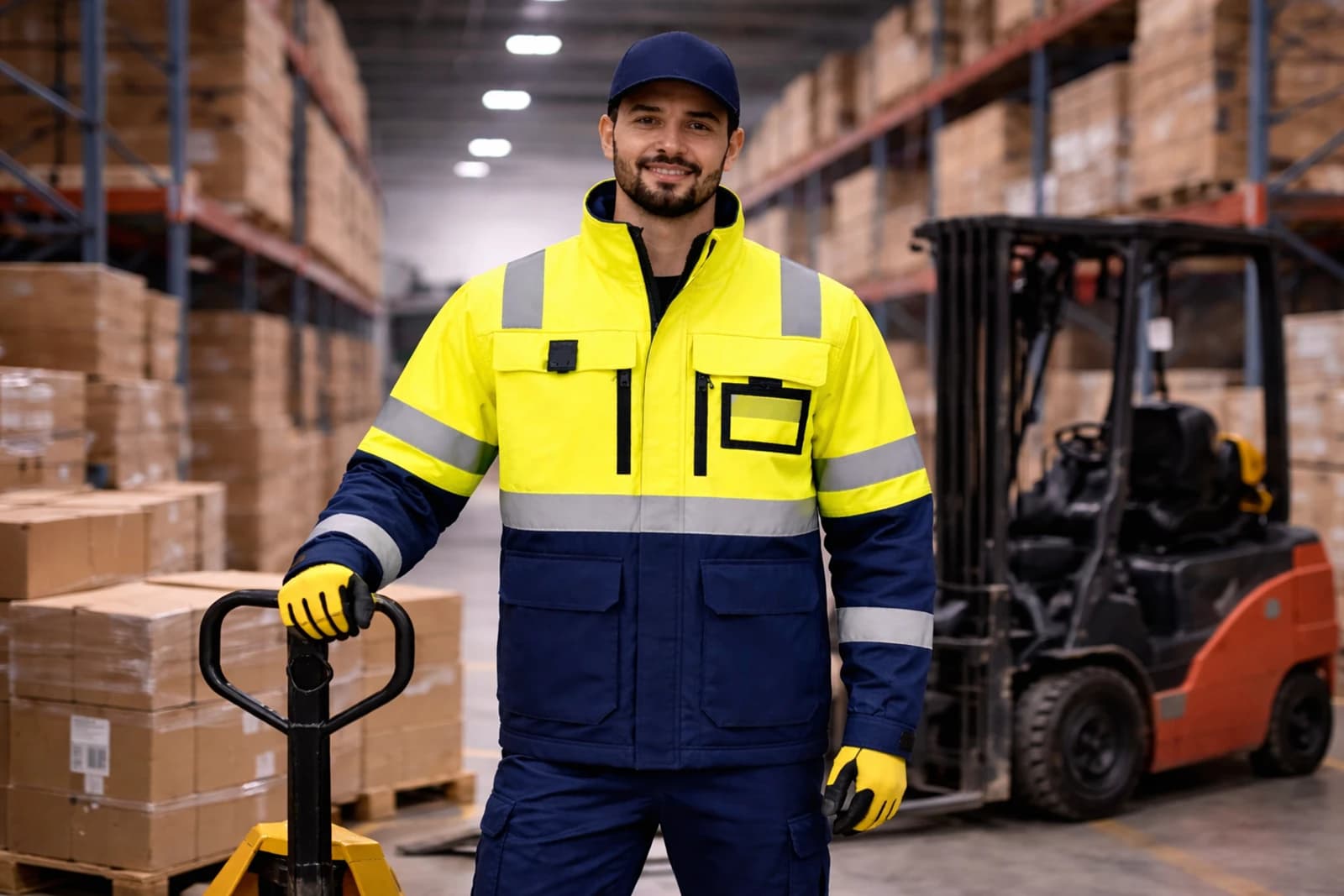
Safety Uniform
Hi-Vis Safety Jacket
Reflective safety jacket for high-visibility site operations and road work crews.
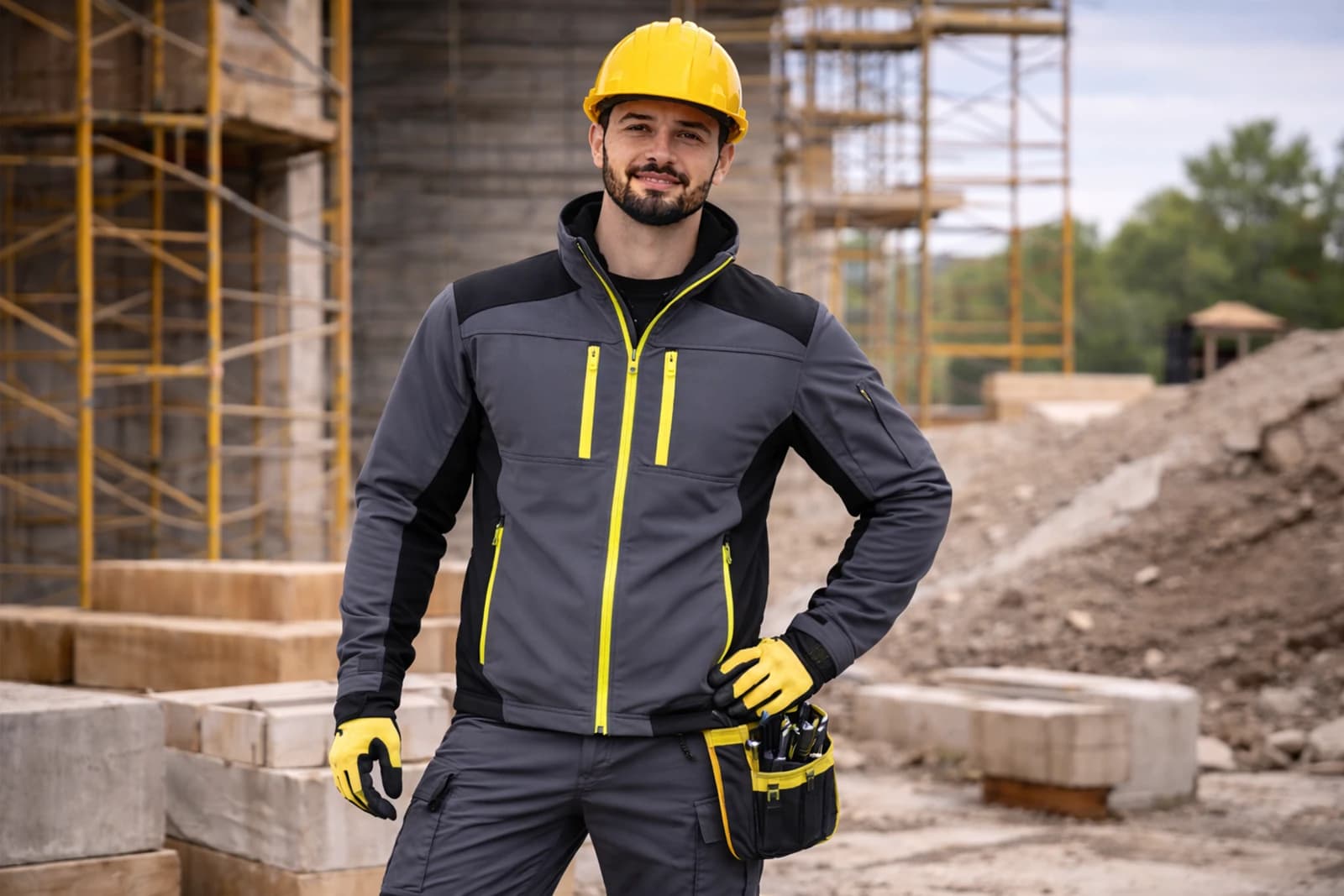
Construction Clothing
Construction Softshell Set
Flexible jacket and trouser set built for crews working across changing weather conditions.