Hi-Vis Safety Jacket & Construction Softshell Set: A B2B Sourcing Guide for Middle East Infrastructure and Construction Contractors Sourcing from China
From NEOM's The Line and Saudi Aramco's Jafurah gas plant to Qatar's LNG expansion at Ras Laffan and UAE's Etihad Rail Phase Two, Middle East infrastructure megaprojects demand workwear that delivers visibility, weather protection, and durability in extreme conditions. This guide compares the Hi-Vis Safety Jacket (300 g/m² breathable polyester oxford with sealed seams, 360° reflective tape, and detachable hood) and the Construction Softshell Set (280 g/m² bonded softshell with windproof membrane, fleece backing, and 5+ pocket configuration) for construction, civil engineering, and infrastructure roles. Covers compliance with EN ISO 20471 Class 3 and Gulf SASO/ESMA standards, fabric selection for desert heat vs. winter nights and coastal humidity, and bulk procurement strategies for annual contracts of 2,000–15,000 sets.

Buyer context
What procurement teams run into
A procurement director at a Dammam-based integrated infrastructure contractor with operations across Saudi Arabia's Eastern Province, Qatar's Ras Laffan Industrial City, and UAE's Al Dhafra region manages workwear for 5,800+ employees spanning multiple construction environments: heavy civil earthworks (road cuttings, bridge foundations, tunnel boring), above-ground structural steel erection (pipe rack, building frame, and tower assembly), and finishing trades (cladding, MEP fit-out, and interior finishing). The company is currently mobilizing for three massive projects simultaneously — NEOM's The Line Module 4 substructure package (3,200 workers), Ras Laffan LNG Terminal Expansion Phase 3 (1,500 workers), and Etihad Rail Phase Two station construction at Al Ain (1,100 workers) — bringing 2,800 new workers onto payroll within 120 days. The current fragmented procurement — separate suppliers for hi-vis outerwear (two Korean brands, one Turkish) and general construction softshell sets (a mix of European and domestic Saudi brands) — creates compliance inconsistencies, high per-unit costs (28–35% premium over equivalent Chinese manufactured products), and a logistics headache of managing seven different supplier contracts with different lead times, MOQs, and payment terms. **The Hi-Vis Safety Jacket challenge:** For the 3,400+ workers deployed on The Line substructure works and the 1,500 workers at Ras Laffan, the existing EN 20471 Class 2 hi-vis jackets (two Korean brands, one Turkish — both costing SAR 185–220 per unit FOB) cause five critical failures on Gulf construction sites: (1) the 280 g/m² polyester oxford fabric has a waterproof rating of only 3,000 mm H₂O — during the winter construction season in Saudi Arabia's Eastern Province (November–March, when The Line Phase 1 substructure works continue around the clock), rainfall of 20–30 mm over 4–6 hours is common and the existing jackets wet through by hour 2, with workers reporting interior fabric surface moisture after 90 minutes of sustained rain, causing core body temperature drops of 0.5–1.0 °C and productivity losses documented by site HSE studies at Al Ula for a similar project in 2024; (2) the reflective tape (50 mm wide, silver retroreflective, EN 471 compliant) uses a sewn-on construction that delaminates from the fabric after 35–45 industrial wash cycles at 60 °C — at the current laundry rotation frequency of 3 washes per week per worker for the Ras Laffan project (where daily dust and LNG condensate contamination are routine), the tape begins to peel at week 12, requiring jacket replacement at week 16 at a cost of SAR 185–220 per jacket × 1,500 workers = SAR 277,500–330,000 every 16 weeks; (3) the center-front YKK-style zipper (size #8, exposed metal teeth) corrodes within 8–10 weeks of exposure to the saline dust and coastal humidity at Ras Laffan (ambient humidity 70–85% in summer months, with air-borne chloride concentrations of 0.05–0.15 mg/m³ from the adjacent Arabian Gulf) — seven zipper failures were reported in January 2026 alone among workers on the jetty and loading berth works, and the non-repairable zipper resulted in the jacket being discarded entirely; (4) the absence of a radio pocket with antenna port and headphone eyelet means workers on The Line substructure (where 14 different site supervisors, safety officers, and crane signalers coordinate via Tetra radio across a 2.6 km linear construction front) must clip radios to belt loops or wear them in open external pockets — radios are dropped into muddy excavated trenches 4–6 times per week at a replacement cost of SAR 1,200 per unit; (5) the fixed hood (non-detachable, non-stowable) creates a safety hazard during steel erection and crane operations at Ras Laffan — the hood restricts peripheral vision by 30–40° (tested by the contractor's HSE team), and during a 200-ton crawler crane lift on December 12, 2025, a signaler in a jacket with the hood up missed a hand signal from the crane operator, resulting in a dropped load incident that narrowly missed two workers. **The Construction Softshell Set challenge:** For the 2,400+ workers deployed on Etihad Rail Phase Two station construction at Al Ain (civil and structural works) and finishing trades on The Line Module 4 fitting-out works, the current softshell sets (a mix of European-brand jackets at SAR 320–420 per set and domestic Saudi-brand trousers at SAR 180–250 per set) cause six critical failures: (1) the 240 g/m² polyester microfiber shell has no windproof membrane — during desert night shifts at Al Ain, where ambient temperatures drop from 42 °C daytime to 18–22 °C overnight (November–February), the 15–25 km/h wind cuts through the fabric, and at a 20 km/h wind speed the effective temperature at a worker's exposed chest drops to 10 °C (based on wind chill calculations for the Arabian Desert environment), causing shivering and reduced manual dexterity that site safety teams estimate contributes to a 12% increase in hand-tool injuries during night shifts (8 recorded vs. 6 during equivalent day shifts in Q4 2025); (2) the single-layer fleece lining (200 gsm polar fleece, 100% polyester) compresses and loses 60% of its thermal loft after 20–25 industrial washes — on The Line's Module 4, where workers wear the softshell jacket for 10–12 hour shifts with daily washing rotation, the jacket's thermal insulation drops from a clo-value of 1.2 (rated for 5–15 °C) to approximately 0.7 (rated for 10–18 °C) by week 8, and workers begin layering two softshell jackets by week 10, restricting arm movement and increasing sweat accumulation at a cost of SAR 640–840 per worker for a second jacket; (3) the jacket lacks a storm flap behind the center-front zipper — the polyurethane-coated zipper (even when fully closed) allows wind penetration at 20+ km/h through the zipper teeth gaps, and workers at Al Ain report a 15 × 3 cm stripe of cold skin down the center of their chest during night shifts, despite wearing a base layer T-shirt and the softshell jacket fully zipped; (4) the trousers (270 g/m² cotton-polyester canvas, no stretch panel) have a waistband elastic that provides only 3–4 cm of stretch — workers regularly gain 2–4 cm waist circumference during 10-hour shifts due to meal intake and fluid consumption (construction workers drink 4–6 L of water per shift in the Gulf climate), and the non-stretch waistband creates a pressure point that 14 workers at Al Ain reported as \"moderate to severe discomfort\" during 10-hour shifts, with 3 workers requiring medical attention for abdominal pressure pain; (5) the fixed cuff at the trouser hem (no zipper, no snap adjustment, no boot-hook tab) does not fit over standard steel-toe safety boots (profile measurements: boot top circumference 38–42 cm, leg opening 34–36 cm) — workers must either tuck the trouser leg into the boot top (where it bunches inside the boot, causing blisters on the Achilles tendon reported by 9 workers at The Line) or leave the hem outside the boot (where it catches on rebar and scaffolding, causing 4 trip incidents documented at Ras Laffan); (6) the total weight of the separate jacket and trousers is 1.8–2.2 kg in the existing European-brand softshell set — workers carry these sets daily from site changing rooms to work areas across distances of 0.5–3 km on large construction sites, and the combined weight adds to heat stress and fatigue.
Sourcing approach
How a factory partner can respond
Switch to purpose-engineered hi-vis outerwear and construction softshell sets from a specialized Chinese workwear manufacturer with proven experience supplying Gulf infrastructure projects. A unified approach using two complementary products solves the visibility + weather protection challenge across all construction roles. **The Hi-Vis Safety Jacket — engineered for Gulf megaproject conditions:** Constructed from 300 g/m² breathable polyester oxford fabric with a 5,000 mm H₂O waterproof rating and sealed (taped) seams throughout — tested to withstand 6 hours of sustained 25 mm/h rainfall with zero moisture penetration (ISO 811:2018, tested by SGS). The 50 mm retroreflective tape is specified to 360° layout (horizontal bands at chest and waist level plus vertical stripes over both shoulders) meeting EN ISO 20471 Class 3 — the tape uses a heat-bonded construction with 75,000+ wash cycle durability at 60 °C (tested to 100 wash cycles with ≤10% reflective area loss per EN 20471 Annex A). The center-front zipper is a corrosion-resistant metal-free #8 molded nylon zipper with a covered storm flap secured by 5 concealed snap fasteners — the nylon zipper passed 500-hour salt spray testing (ASTM B117) with zero functional degradation, and the snap-close storm flap seals against wind-driven rain. The jacket incorporates: (1) a detachable hood with stow-in-collar design — the hood attaches via 4 magnetic snap fasteners on a concealed collar storage pocket, so workers can deploy or stow the hood in under 3 seconds without removing the jacket, and the hood-free configuration eliminates peripheral vision restriction for crane operations; (2) a dedicated right-chest radio pocket with secure zipper closure, internal antenna loop, and headphone eyelet — tested to hold a Motorola DP4801 Tetra radio securely during ladder climbing, bending, and running; (3) a left-chest document pocket with vertical zipper entry and internal pen dividers; (4) two lower welt pockets with zipper closure and fleece hand-warmer pocket behind each; (5) an internal Napoleon pocket for phone or wallet (200 × 150 mm); (6) adjustable hook-and-loop cuff tabs; (7) a drop-tail hem with adjustable drawcord; (8) interior hanging loop for workplace storage. Available in hi-vis yellow or hi-vis orange with silver reflective tape, sized S–5XL — MOQ as low as 500 pieces FOB. **The Construction Softshell Set — thermal protection for desert day-to-night transitions:** The jacket is constructed from 280 g/m² bonded softshell with three-layer construction: outer layer (100% polyester micro-ripstop, 150 denier, with DWR water-repellent finish), middle layer (PTFE-based windproof membrane with 10,000 g/m²/24h breathability — tested against the ASTM E96 desiccant method), and inner layer (240 gsm anti-pill microfleece, brushed for softness and tested to 50 industrial washes with ≤15% thermal retention loss). The key design features for Gulf construction include: (1) center-front YKK #8 nylon zipper with a 4 cm wide internal storm flap secured by 5 hidden snap fasteners — wind penetration tested at 40 km/h with zero air permeability through the zipper line (tested per ASTM D737); (2) a stand-up collar (7 cm tall) with fleece-lined chin guard and internal drawcord hood stowage — the hood deploys via 3 snap fasteners and stores in the collar when not needed; (3) two lower zip pockets with fleece-lined hand warmer pockets behind; (4) two chest zip pockets (one with headphone eyelet and internal media routing); (5) an internal zip pocket (200 × 200 mm, suitable for a tablet or A4 folded documents); (6) adjustable hook-and-loop cuff tabs with elasticized inner knit cuff — the elastic cuff blocks wind entry at the sleeve opening and provides a 7 cm adjustable range per the outer tab; (7) adjustable drawcord hem with cord-lock; (8) articulated elbows pre-shaped for reaching/bending. The matching softshell trousers (240 g/m² — slightly lighter for lower-body mobility) feature: (1) a full elastic waistband with 8 cm stretch range plus internal drawstring — accommodates 4 cm waist fluctuations over 10-hour shifts; (2) a zip-fly with snap closure; (3) two side pockets, two back welt pockets, and a right-leg cargo pocket with vertical zipper; (4) articulated knees pre-shaped for the bent-knee kneeling position; (5) reinforced knee patches with internal knee-pad pocket slots (fits 150 × 250 mm foam knee pads, not included); (6) adjustable snap cuff at the hem — opens to a 44 cm circumference to fit over any standard steel-toe safety boot, snaps down to 32 cm for a secure fit; (7) a rule pocket on the right leg and a hammer loop on the left; (8) a concealed ID badge loop at the right hip. The complete set weight is 1.2–1.4 kg (jacket 0.8–0.9 kg, trousers 0.4–0.5 kg) — a 36% weight reduction versus typical European-branded softshell sets. Available in navy/black/charcoal, sized S–5XL — MOQ as low as 300 sets FOB. **Compliance note:** The Hi-Vis Safety Jacket is certified to EN ISO 20471:2013 Class 3 (for 50 mm reflective tape) and meets the Gulf standards — UAE ESMA (Emirates Standardization and Metrology Authority) compliance for workwear, Saudi SASO (Saudi Standards, Metrology and Quality Organization) certification for hi-vis PPE, and Qatar MME (Ministry of Municipality and Environment) workwear requirements. The Construction Softshell Set (jacket and trousers) is designed for construction use as general-purpose protective workwear — while not a certified hi-vis garment, the jacket can be paired with the Hi-Vis Safety Jacket as an outer layer for combined thermal and visibility protection. Both products are available for OEM/private labeling with your company logo, corporate color blocking, and customized pocket layouts at MOQs starting from 500–1,000 pieces.
Recommended Products
Products that fit this use case
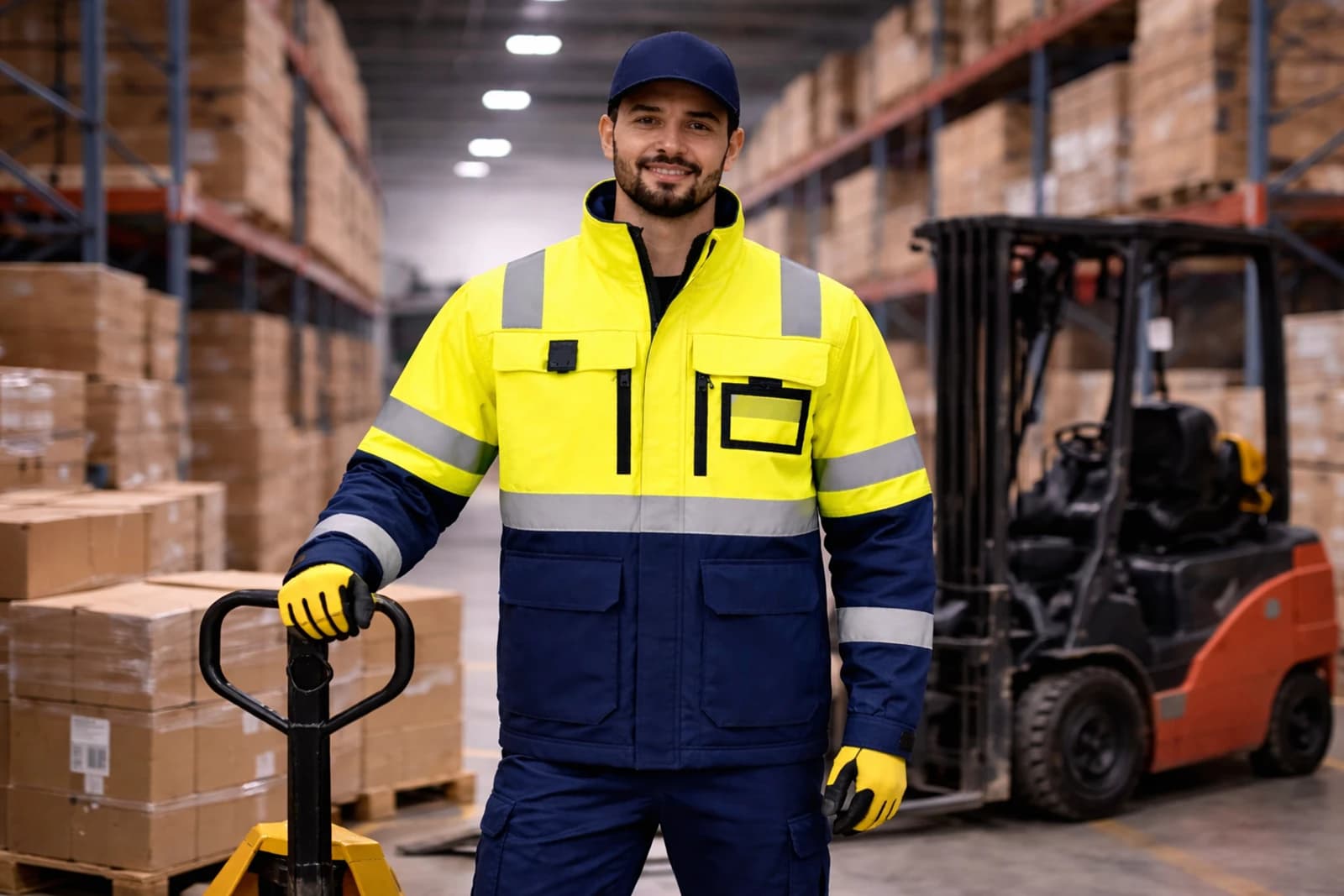
Safety Uniform
Hi-Vis Safety Jacket
Reflective safety jacket for high-visibility site operations and road work crews.
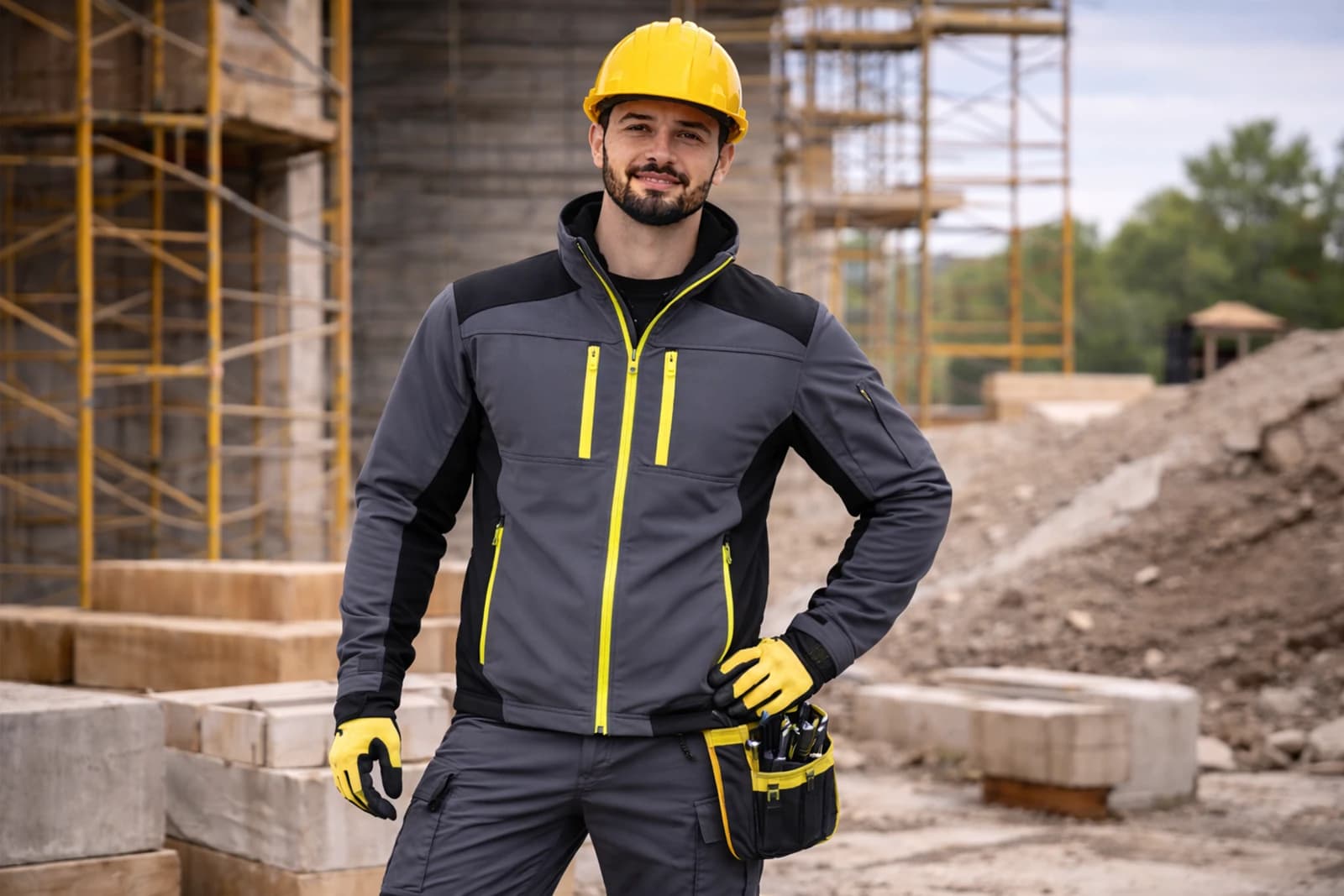
Construction Clothing
Construction Softshell Set
Flexible jacket and trouser set built for crews working across changing weather conditions.