Hi-Vis Safety Jacket & Construction Softshell Set: A B2B Sourcing Guide for Middle East Infrastructure and Road Work from China
From Saudi Arabia's NEOM and Giga-projects to the UAE's Etihad Rail expansion and Qatar's highway infrastructure program, Middle East construction and road workers need hi-vis safety gear and cold-weather softshells that perform in extreme desert conditions. This guide covers sourcing the Hi-Vis Safety Jacket for road work and highway maintenance and the Construction Softshell Set for cooler months and night shifts, discussing EN ISO 20471 compliance, breathability in arid climates, and bulk procurement from a Chinese manufacturer.

Buyer context
What procurement teams run into
A procurement director at a major Saudi Arabian infrastructure contractor managing 4,000+ workers across NEOM's THE LINE (Tabuk region), the Riyadh Metro expansion, and the Red Sea Global tourism project faces two distinct workwear challenges.\n\nThe first challenge: hi-vis safety gear for road construction and highway maintenance crews working along Saudi Arabia's expanding 5,500+ km highway network, including the 908 km Makkah–Madinah Express Link. Current hi-vis vests from a regional supplier show critical failures: (1) retroreflective tape luminance degrades from the required 330 cd/lx/m² (EN ISO 20471 Class 3) to below 250 cd/lx/m² after 12 weeks of outdoor exposure in 48–52°C ambient temperatures with 2,200+ kWh/m²/year solar radiation; (2) fluorescent background fabric loses its yellow-green chromacity within 8–10 weeks due to UV degradation, reducing contrast ratio below the 0.70 minimum specified in ISO 20471; (3) polyester mesh fabric at 120 g/m² causes heat stress incidents — workers covering 12 km/day on highway surfacing crews report core temperature spikes of 1.5–2.0°C within 2 hours of continuous wear in July conditions (49°C, 15% RH).\n\nThe second challenge: cold-weather workwear for night shifts and winter months. Saudi Arabia's northern regions (Tabuk, NEOM, AlUla) experience nighttime temperatures dropping to 2–8°C between November and March, with occasional sub-zero conditions in the Sarawat Mountains. Mountain construction crews working on NEOM's Lakeside Town and Trojena ski resort need insulated but mobile softshell jackets that withstand 800+ hours of annual UV exposure at 2,400m altitude. Their current generic softshells pill after 5–7 washes, the water-resistant DWR coating fails after 3–4 months of sand abrasion, and the jacket-to-trouser waist connection lacks sufficient overlap for workers frequently bending and crouching during foundation and steel erection work.
Sourcing approach
How a factory partner can respond
A Chinese workwear manufacturer delivers a two-layered solution: the Hi-Vis Safety Jacket for road and highway crews, and the Construction Softshell Set for cold-weather and night-shift workers. Both products can be procured within a single bulk framework agreement (1,000–5,000 pieces per SKU), sharing compliance packages, sea freight via King Abdullah Port or Jebel Ali, and a unified sizing matrix for the Middle East's multinational workforce.\n\n**Technical specifications for the Hi-Vis Safety Jacket in Middle East road construction:**\n\n**UV-stable fluorescent materials that survive 24+ weeks in open desert** — Specify fabric meeting EN ISO 20471 Class 3 with minimum 0.80 m² of fluorescent background material and 0.20 m² of retroreflective tape, both front and back. The fluorescent fabric (typically 100% polyester pique knit at 170–190 g/m² ±3%) must retain ≥ 90% of its original color coordinates (x, y chromaticity per CIElab, measured at D65/10°) after 200 hours of ISO 105-B02 xenon-arc lightfastness testing with Grade 4 minimum on the blue wool scale. The retroreflective tape (50 mm wide silver segmented film, EN ISO 20471 Class 2 tape — or preferably 70 mm / Class 3) must maintain ≥ 300 cd/lx/m² coefficient of retroreflection after 25 industrial launderings per EN ISO 6330 with sand-abrasion pre-conditioning (500 g load, 50 cycles per ISO 12947-2 Martindale using 120-grit silicon carbide paper). For Gulf-specific UV intensity — Dubai receives 2,500+ UV-index days annually vs. 800 in Northern Europe — request extended UV testing at 400 hours with a spectral cut-off below 290 nm to simulate Middle East desert sunlight conditions.\n\n**Heat management in 50°C ambient conditions** — Demand maximum breathability of 25 m³/m²/min at 200 Pa per ASTM D737 for mesh panel sections (front zip, back yoke, and side gussets in black mesh with ≥ 50% open area). The main fabric should meet ISO 11092 RET value ≤ 6.0 m²·Pa/W (Class 2–3 evaporative resistance) to prevent sweat vapor trapping. Weight target: complete jacket under 450 g (±20 g) for a size L to minimize heat load on workers covering 8–12 km walking per shift on highway surfacing and barrier installation crews. Additional requirement: inner moisture-wicking mesh lining on the back panel (no PVC or PU coating that creates vapor barrier in high-sweat conditions), and vent zips under both arms with mesh gusset (25 cm openable length, two-way YKK zippers with corrosion-resistant nickel plating for the salt-laden Gulf coastal environments).\n\n**Durability for the abrasive construction site environment** — Seam construction using high-tenacity polyester thread (Tkt 80, minimum 4.0 kg breaking strength) with 5–6 stitch/cm density. Critical wear zones (shoulders, elbows, lower back seam, crotch area for jacket-over-trouser overlap) require bar-tack reinforcement stitching (3–5 mm length, 12–15 stitches per bar). Zip specification: YKK Vislon or metal two-way front zip with water-resistant treatment, rubberized zip pullers for gloved-hand operation, and inner storm flap (5 cm width minimum) with snap button closure points every 8 cm. Pockets: two lower patch pockets with Velcro closure (20 × 15 cm), one left sleeve pocket with pen divider (15 × 8 cm), one internal mobile phone pocket (18 × 10 cm), and a radio loop attachment on the right chest with D-ring for earpiece cord management.\n\n**Visibility in the 24-hour construction cycle** — NEOM's THE LINE project operates 24/7 with floodlit night shifts. Require EN ISO 20471 Class 3 certification with the additional condition that retroreflective tape performance be verified at 5° observation angle and 30° entrance angle (the geometry of overhead floodlight illumination at a typical 8–10 m pole height on construction sites). For road construction crews on highways with opposing headlight traffic (typically 3–5 m lane width, headlight angles of 2–15°), also verify retroreflection at 1° observation angle with 450 cd/lx/m² minimum per the stricter German DIN EN 20471 supplementary requirement sometimes specified in Saudi Aramco road safety contractors.\n\n**Sizing for the multinational Gulf construction workforce** — A typical SAR (Saudi Arabian Roads) contractor's crews include South Asian (Bangladesh, Pakistan, India: 55%), Egyptian (15%), Syrian (10%), Filipino (8%), Saudi nationals (7%), and others (5%). Size coverage: chest 92–136 cm (S–5XL), waist 78–120 cm, with sleeve length options (short: 78–82 cm, regular: 82–86 cm, long: 86–90 cm) to accommodate the varied arm-span-to-torso ratios across Afro-Asian body types. Manufacturing tolerance: ±1.0 cm on chest and waist, ±0.5 cm on sleeve length and shoulder width, per AQL 2.5 batch inspection (ISO 2859-1 Level II).\n\n**Technical specifications for the Construction Softshell Set in Middle East cold-weather operations:**\n\n**Fabric that insulates in cold nights and breathes in sun** — Specify a 3-layer bonded softshell: outer layer 92% polyester / 8% spandex woven face (280–320 g/m² ±5%), middle waterproof-breathable membrane (PU or ePTFE, minimum 5,000 mm water column hydrostatic head per ISO 811, minimum 3,000 g/m²/24h MVTR per ASTM E96-B), and inner brushed micro-fleece (150–180 g/m²). Total fabric weight target: 450–500 g/m². For the Middle East's unique diurnal temperature swings (e.g., NEOM November: 22°C midday sun → 6°C post-sunset), the fabric must achieve ISO 11092 clo value of 1.2–1.5 (light-to-medium insulation for active work). Breathability priority: RET ≤ 9.0 m²·Pa/W to prevent moisture buildup during the 10–15°C daytime temperature rise that can occur between 6 AM and noon.\n\n**Abrasion resistance against limestone and silica sand** — Northern Saudi construction sites — particularly the Sarawat Mountains (granite and basalt rock) and the Tabuk formation (sandstone with high quartz content) — produce extremely abrasive dust. Require Taber abrasion resistance per ASTM D3884 (H-18 wheels, 500 g load) showing no fabric breakthrough at 25,000 cycles, and minimum 15,000 cycles for the internal fleece layer to prevent pilling. For the elbow and seat areas, specify Schoeller Keprotec or similar Kevlar-reinforced fabric patches (400D + para-aramid blend) sewn into the panel, not simply topically coated. DWR treatment demand: initial spray rating ISO 5 (ISO 4920) with re-oiling capability — the DWR should survive 10 industrial launderings before dropping below ISO 3, and the re-treatment process should use C6 fluorocarbon-free chemistry (compliant with EU REACH SVHC, a growing concern for SABIC and Aramco ESG supply chain audits).\n\n**Articulated design for mobile construction work** — Jacket features: pre-shaped elbows with articulation darts (two darts per sleeve, 30° and 60° bend angles), adjustable cuffs with Velcro tab closure (hook-and-loop, 6 × 3 cm) and thumb-loop sleeve end for layering over work gloves, drawcord-adjustable hem with internal toggle, removable hood with wired peak and three-point adjustment (gaiter draw, side elastic, rear toggle). Trouser features: gusseted crotch with diamond-shaped insert (7 × 7 cm gusset, bi-directional stretch fabric), pre-shaped knees with fleece-insulated knee pad pockets (one fixed-height pocket for 15 mm foam knee pads, one adjustable height pocket for 20 mm foam knee pads), articulated waist with 6 cm elastic side panels (60% polyester / 40% rubber, minimum 30,000 flex cycles without cracking per EN ISO 7854), and boot-length leg hem with zippered expansion (20 cm YKK nylon zipper from hem upward). Waist connection system: 360° snap-button interface between jacket and trouser with 8 attachment points (4 front, 4 back, 8 cm spacing) to prevent gap exposure during bending.\n\n**Sand and dust sealing** — Middle East construction sites generate PM10 dust concentrations of 500–2,000 µg/m³ (vs. WHO 24-hour guideline of 45 µg/m³). Require: storm flap over front zip (7 cm width with 3 hidden snap buttons), elasticated inner cuff gaiter (neoprene, 10 cm depth) with thumb-hole for dust seal, inner waist gaiter (elasticated poly mesh, 12 cm drop, silicone grip strip on inner edge) to prevent sand ingress between jacket and trouser, zippered closure for all exterior pockets with water-resistant YKK zippers and lip seal (2 mm silicone rubber lip), and collar with inner microfleece chin guard (6 × 20 cm) and 3 cm stand-up height with wire-stay for shape retention in wind.\n\n**Certification packaging for the Middle East infrastructure sector** — Both products must carry: EN ISO 20471 (jacket Class 3, full set Class 3), EN 343 (softshell set Class 3/3 for rain protection and breathability per the buyer's specification — typically 10,000 mm hydrostatic head / 4,000 g/m²/24h MVTR for cold-weather PPE), CE Category III PPE certification (EU 2016/425 for life-risk applications), and SABIC or Aramco vendor-level compliance paperwork including: fabric testing reports (origin of yarn, dye-lot traceability, sizing for the GSO-compliant (Gulf Standardization Organization) GCC Conformity Mark). For Saudi buyers specifically, note SASO (Saudi Standards, Metrology and Quality Organization) requirements — all textile imports must pass SASO's listed chemical testing including formaldehyde (max 75 ppm for direct skin contact per ISO 14184-1), azo dyes (banned amines per EU 1907/2006 Annex XVII), and pentachlorophenol (PCP max 0.5 mg/kg).
Recommended Products
Products that fit this use case
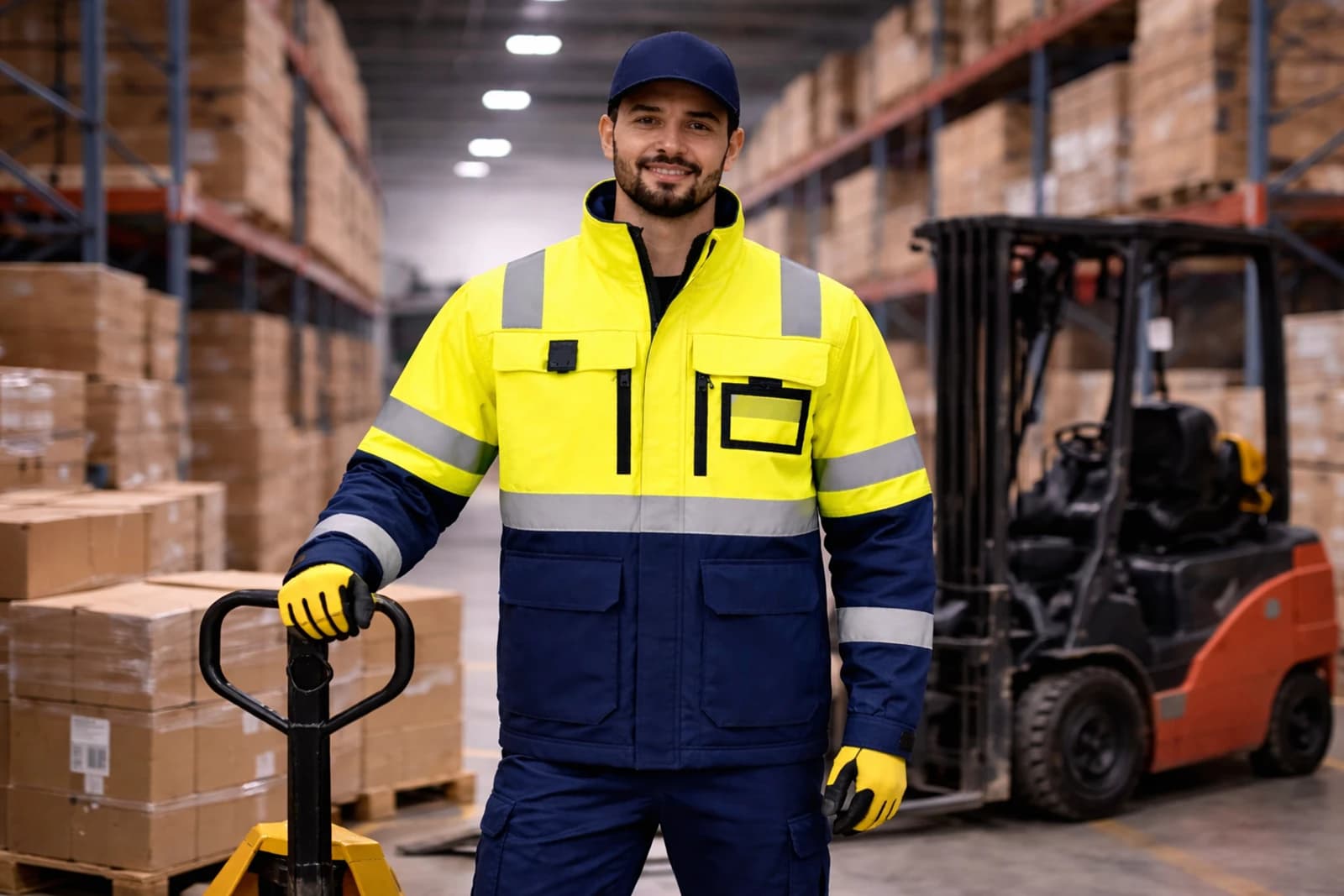
Safety Uniform
Hi-Vis Safety Jacket
Reflective safety jacket for high-visibility site operations and road work crews.
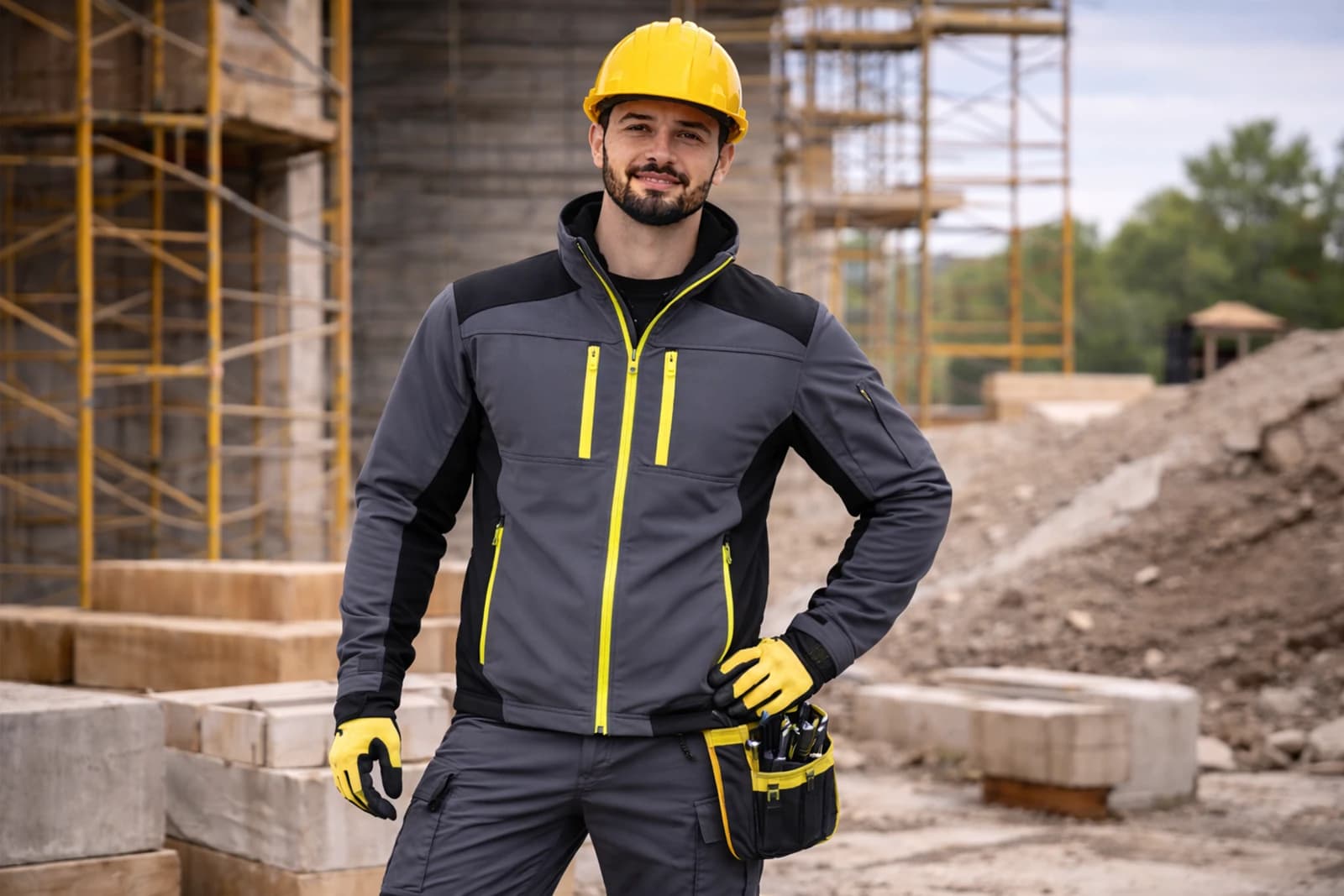
Construction Clothing
Construction Softshell Set
Flexible jacket and trouser set built for crews working across changing weather conditions.