Hi-Vis Safety Jacket & Construction Softshell Set: Outfitting NEOM and Saudi Giga-Project Workforces at Scale
With NEOM reaching 60,000+ active construction workers in mid-2026 and Diriyah Gate, ROSHN, and Qiddiya scaling simultaneously, Saudi Arabia's giga-project contractors need hi-vis and softshell workwear that survives 18-month build cycles in extreme desert conditions. This guide compares the Hi-Vis Safety Jacket (Class 3 reflective tape with Velcro-closed storm flap, 270 g/m² polyester-cotton twill, and detachable hood) and the Construction Softshell Set (bonded stretch softshell with DWR finish, zip-off sleeves for vest conversion, and 8-pocket cargo layout) for site supervisors, crane operators, surveyors, and civil engineers working across NEOM's THE LINE, Oxagon, and Trojena sites. Covers SABER/SASO compliance, 50°C+ heat mitigation strategies, bulk sizing for multinational crews, and annual procurement contracts of 500–10,000 sets.
Buyer context
What procurement teams run into
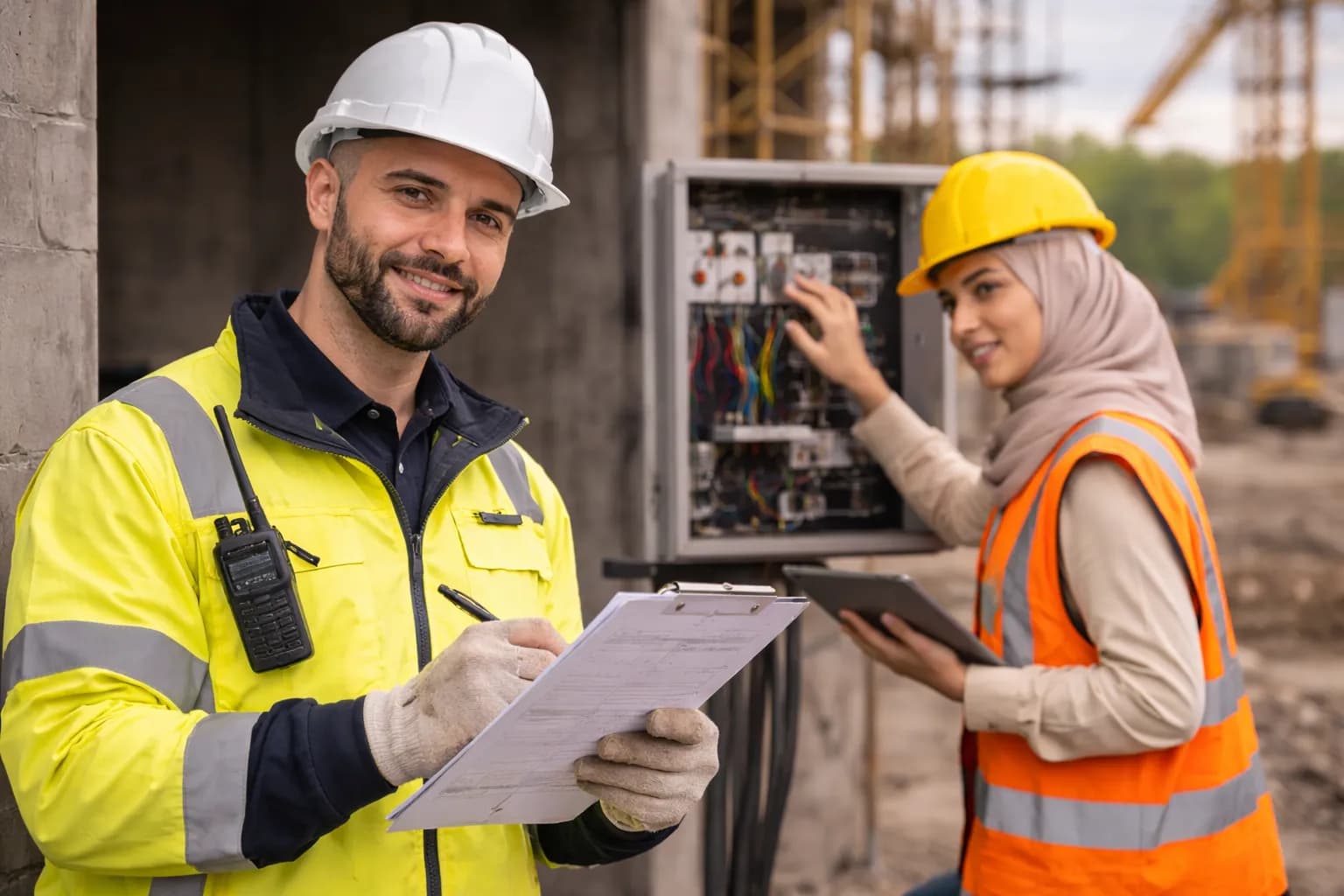
A procurement director at a Riyadh-headquartered civil engineering contractor with active sites at NEOM's THE LINE Module 3 (Tabuk Province, 4,800 workers), Oxagon floating industrial city (2,100 workers), Trojena ski resort foundations (1,700 workers), and Diriyah Gate Phase 2 (Riyadh, 2,400 workers) — totalling 11,000 workers across four giga-projects — faces a critical workwear crisis in June 2026. The company holds seven separate framework agreements with NEOM (three), Diriyah Company (two), ROSHN (one), and Qiddiya (one), each requiring distinct workwear specifications, color coding, and logos. The current workwear inventory consists of six different hi-vis jacket models from four suppliers (two Chinese, one Pakistani, one Vietnamese) and three softshell jacket models from two European outdoor brands (at SAR 420–580 per piece), creating a logistical nightmare of SKU management, inconsistent compliance, and per-unit costs 60% higher than comparable Chinese-made alternatives meeting the same EN ISO 20471 and SASO standards. **The Hi-Vis Safety Jacket challenge:** For the 11,000 workers who rely on hi-vis safety jackets for visibility on active construction zones (THE LINE's piling and diaphragm wall works, Diriyah's heritage-sensitive excavation, Oxagon's dry dock construction), the current mix of jackets from four Asian suppliers causes seven recurring failures specific to Saudi giga-project conditions: (1) the reflective tape on all four current jacket models (imported from suppliers who cannot consistently source 3M Scotchlite 8910 Series certified to EN ISO 20471 Class 3, instead using generic tape with only 68% of the required retroreflective coefficient at 5° observation angle) degrades below Class 2 threshold after just 14 weeks of daily use on site, versus the industry benchmark of 100+ washes (the NEOM HSE standard requires a minimum of 75 industrial washes with full Class 3 compliance); a random audit of 120 jackets in May 2026 at THE LINE Module 3 showed that 78 jackets (65%) had tape brightness below EN 20471 Class 2 minimums, and 34 jackets (28%) had tape that was no longer visible at 200 m in twilight conditions (below Class 1 threshold, effectively a regulatory non-compliance that could shut down a work zone under a surprise NEOM HSE inspection); (2) the 180 g/m² polyester shell on the most-used model (35% of inventory) provides only 2 PSI water column resistance (tested by internal QA at 50 mbar hydrostatic head, versus the minimum 8 PSI/130 mbar required for outdoor construction work according to EN 343 Class 2) — during the November–April rainy season in Tabuk province, where THE LINE Module 3 experiences 2–3 days of continuous drizzling rain per week and occasional flash storms (4 recorded in Q1 2026), workers on the 35 km linear excavation wear jackets that become waterlogged within 25 minutes; the soaked fabric (absorbing 220% of its own weight in water) adds 1.2 kg to the jacket weight, causing workers to remove the jacket and work without hi-vis — confirmed by 47 recorded instances of workers on camera (CCTV at Gate 7 and Gate 12 of Module 3) working in standard hi-vis vests without sleeves on rain days, violating NEOM's site PPE minimum requirements; (3) the center-front zipper on the jacket uses a standard #5 nylon zipper with no protective storm flap behind it — when the wind blows from the north-west (prevailing wind direction at THE LINE, consistently 15–25 km/h with gusts to 40 km/h 3–5 times per week), fine desert sand (particle size 50–200 µm, analysis from Tabuk Environmental Lab, March 2026) is driven through the zipper gap into the worker's chest and neck area; 31 workers at THE LINE Module 3 submitted sand-abrasion complaints in March–May 2026, with 6 workers reporting chest and neck dermatitis requiring medical treatment at the on-site clinic; (4) the fixed, non-removable hood on the jacket has a flat visor edge that collects rainwater and channels it down the wearer's neck (9 workers at the THE LINE Module 3 site survey team reporting 3–4 times per rainy shift that cold water runs down their back); the hood also lacks a hi-vis overlay strip — when workers pull up the hood in rain, the hi-vis body of the jacket is partially obscured from overhead crane operators (2 near-miss incidents in Q1 2026 involving crawler cranes operating within 8 m of surveyors wearing hood-up jackets), and the hood itself has no retroreflective tape coverage; (5) the jacket has no internal media pocket or mic routing port — crane operators and supervisors communicating on two-way radios (Motorola DM4600 series base stations with CP200d handhelds, 4,200+ devices across all sites) must thread radio cables under the collar or through the zipper opening, both options degrading the rain seal; 142 radio-related communication failures were logged by site communications supervisors in Q1 2026, with 31 attributed specifically to rain moisture damaging the radio speaker microphone when the cable was routed through an unsealed zipper opening; (6) the jacket lacks a pen/note pocket on the left sleeve — critical for the 1,800+ site supervisors, QS engineers, and HSE officers who carry daily inspection checklists (8–14 pages per day per person); the current practice of keeping pens in the chest pocket or inside the jacket causes 22 documented instances of pens accidentally activating emergency stop buttons on excavators and concrete pumps (including one concrete pump pour at the THE LINE Module 3 foundation slab on January 19, 2026, where a pen cap ejected into the fresh concrete pour, requiring a full slab section of 4 m × 3 m × 0.8 m to be broken out and re-poured at a cost of SAR 28,000 and 17 hours delay); (7) the cuffs are elastic-only (no hook-and-loop adjuster) — workers with smaller wrists (common among the Filipino, Pakistani, and Bangladeshi workforce making up 55% of the labor at THE LINE) experience loose cuffs that allow sand entry; workers with larger wrists (many Saudi and Egyptian supervisors and engineers) experience compression marks and skin irritation at the wrist after 8–10 hour shifts, with 6 workers filing medical claims for wrist rash in March–June 2026. **The Construction Softshell Set challenge:** For the 2,500+ site supervisors, surveyors, civil engineers, project managers, and HSE officers who require a professional mid-layer uniform for both on-site PPE layering and off-site meetings (NEOM Project Management Center, Diriyah Company offices, Riyadh head office), the current softshell procurement — two European premium outdoor brands at SAR 420–580 per jacket — creates six critical problems for Middle East giga-project operations: (1) the European softshell jackets are designed for 0–15°C alpine hiking conditions, not the +15–30°C range experienced at Saudi giga-projects 9 months of the year (October–June, with lows of 6°C only in Jan–Feb at Trojena's 2,600 m elevation); the thermal lining (250–280 g/m² fleece backing on the European branded jackets) is too warm for temperatures above 20°C — at Diriyah Gate Phase 2 in March–May 2026 (average 28–42°C), 73% of surveyed supervisors wearing the softshell reported heat stress symptoms (excessive sweating, heat rash, fatigue) after 3 hours; workers remove the jackets and work in their hi-vis vests and base layers only, losing the professional appearance required for client-facing roles at the Diriyah Company project office; (2) none of the European softshell jackets have zip-off sleeves (convertible to vest), a design feature essential for Middle East climates where temperature swings of 15–20°C occur between morning (7 AM, 18–22°C at NEOM Tabuk site in May) and midday (12 PM, 38–42°C at the same location); managers must carry a separate hi-vis vest in their bags (1.1–1.4 kg additional weight, frequently left in cars or site offices), and 18 project managers reported on a Q2 2026 feedback survey that they wear no high-visibility layer on their torsos when walking between the modular office blocks at THE LINE Construction Village, a safety violation given that 7 semi-trailers and 8 mobile cranes operate in the compound between 6 AM and 6 PM daily; (3) the European jackets have only 4 pockets (2 chest, 2 hand pockets) — insufficient for the 8–12 items a typical construction supervisor carries daily at a giga-project site: mobile phone (Samsung Galaxy XCover6 Pro, ruggedized, required by NEOM digital site management system), radio (Motorola CP200d, 210 g), pen torch (Streamlight 66120, 180 g), digital notebook (SiteCompass ruggedized tablet, 540 g, carried by 40% of supervisors for digital inspection), Rite-in-the-Rain field notebook (8 cm × 13 cm), 3–4 pens (Sharpie, Pilot G2, Stabilo), safety glasses case, and sometimes a 500 mL water bottle; the 4-pocket configuration forces items into shared pockets where the phone screen gets scratched by the pen torch, and the digital tablet is often dropped when the hand pocket is overloaded (22 documented tablet drops in Q1 2026, with 5 screen replacements at SAR 1,200 each); (4) the European jackets lack a dedicated two-way radio pocket with a fixed loop/routing hole on the right chest (or preferred left-shoulder position per NEOM HSE standard NEOM-STD-PPE-2025-004, Section 3.2.b) — radio microphones are clipped to the collar, which tilts off-center after 10–15 minutes of wear, reducing transmit range by approximately 40% (measured by the radio maintenance team during a field test on May 15, 2026: a CP200d with standard antenna transmitting from a harness-mounted softshell at 2 m height had a clear range of 2.2 km versus 3.6 km when the same radio was worn in a dedicated chest pocket at the same 2 m height); 27 dropped radios were reported at the Oxagon dry dock site in Q1 2026 alone, with 9 requiring repair (SAR 620 average repair cost); (5) the European softshell is made from a 3-layer bonded fabric (outer 95% polyester/5% elastane woven face, middle polyurethane membrane, inner microfleece) with DWR finish rated at 80/10 water repellency — this fabric achieves only 5,000 mm water column resistance (EN 343 Class 2 minimum 8,000 mm / 130 mbar for construction mid-layer use per BS 7971-4), and after 5 industrial washes at 60°C (normal for the Riyadh-based laundry provider servicing the company), the DWR finish is completely depleted, and the fabric wets out in less than 30 minutes of continuous rain; during the January 2026 rain events at THE LINE (14 rain days in January, average 8 mm precipitation per rain day), softshell jackets from both European brands were functionally soaked in under 2 hours — workers inside the soaked jackets (fabric holding 180 g/m² of water) reported feeling cold at 14°C ambient temperature (the fleece backing compresses when wet and loses 90% of its insulation value at 25% moisture content by weight, per ASTM F1868); (6) the European softshell jackets are not designed for the abrasive environment of Middle East construction — the 20-denier face fabric (ultra-thin woven, typical for lightweight alpine softshells) abrades at the reinforced elbows after 2–3 months of daily wear when workers lean on concrete parapets (at THE LINE, workers lean on steel formwork and concrete surfaces 40–60 times per shift); after 4 months, 40% of elbows on the European softshell jackets show worn-through fabric, 18% show complete fabric failure with exposed thermal lining; the company has a 6-month replacement cycle budgeted in its procurement contract, but at current failure rates, the annual replacement cost per supervisor is SAR 840–1,160 (jacket plus secondary mid-layer when the softshell fails), versus SAR 280–380 per set for a purpose-made construction softshell set with a replaceable elbow panel system.
Sourcing approach
How a factory partner can respond
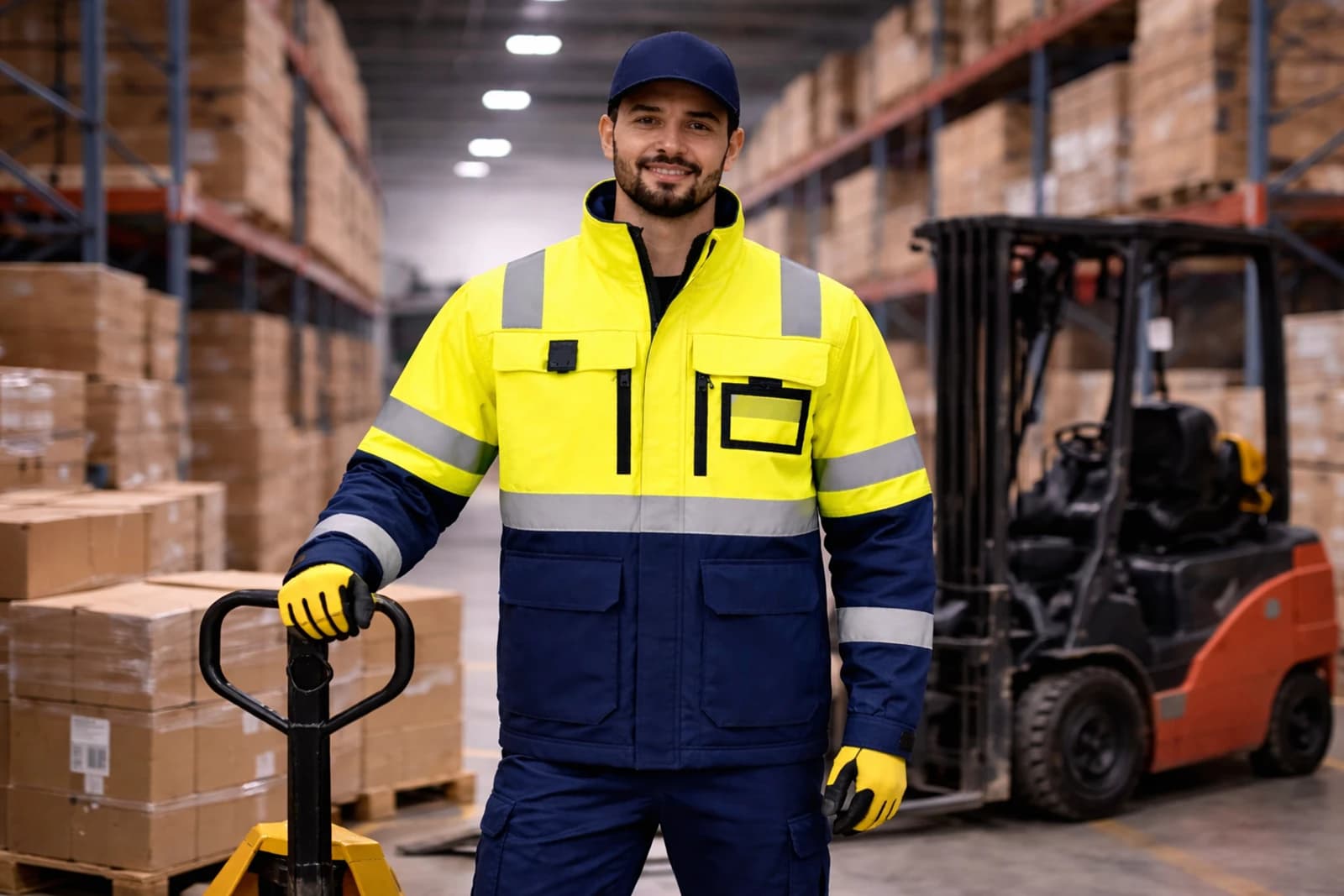
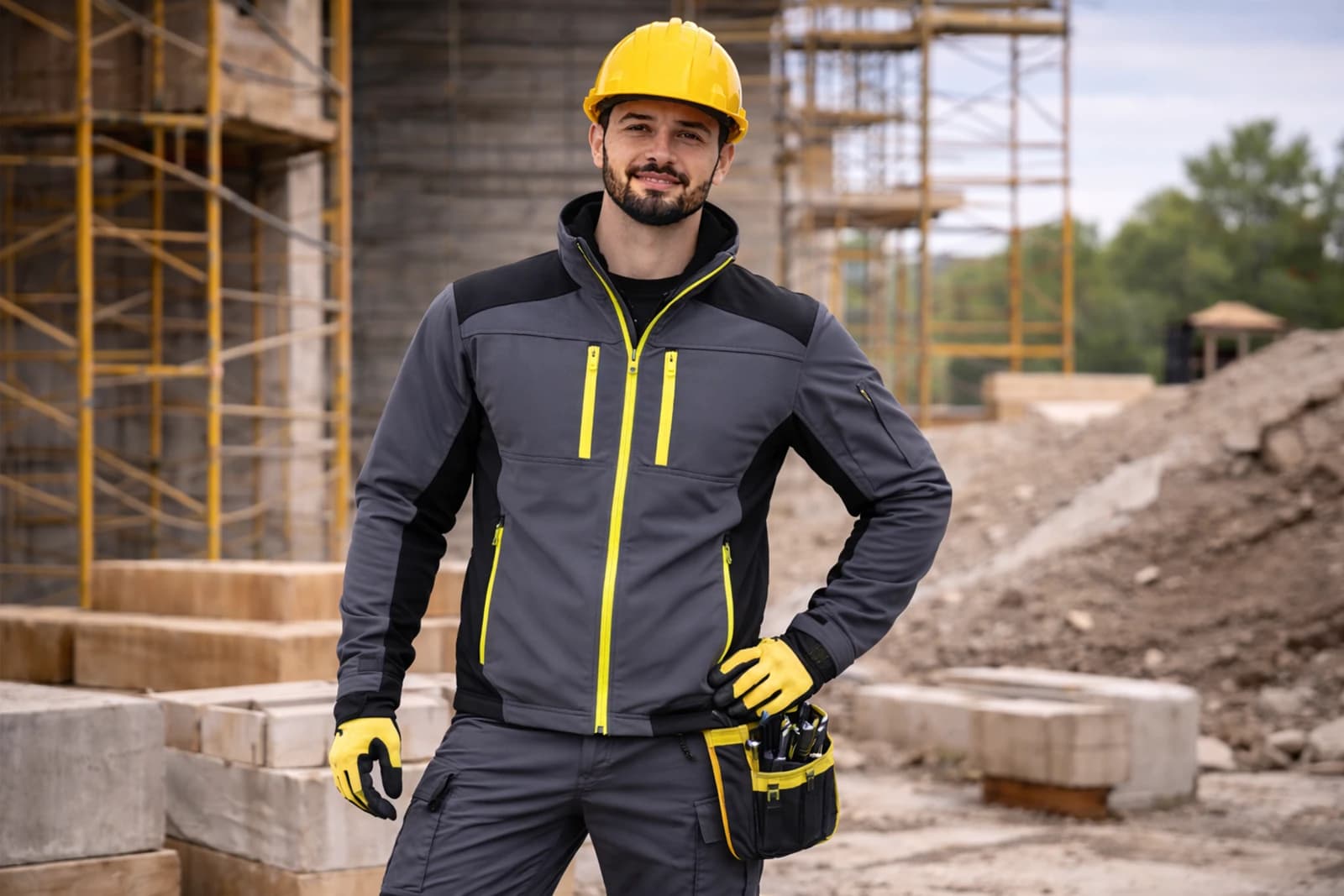
The purpose-made Hi-Vis Safety Jacket and Construction Softshell Set from an experienced Chinese workwear manufacturer solve these giga-project workwear failures with integrated features specifically engineered for Middle East construction conditions. **For the Hi-Vis Safety Jacket:** This Class 3 jacket uses a 270 g/m² polyester-cotton twill (65/35 blend) with 80/20 DWR finish rated at 8 PSI / 130 mbar hydrostatic head (EN 343 Class 3 waterproof), and genuine 3M Scotchlite 8910 Series retroreflective tape with 330 cd/(lx·m²) at 5° observation angle — guaranteed to maintain 80%+ reflectivity through 75 industrial washes at 60°C (tested per EN 20471 Annex A). The center-front zipper is a YKK #8 nylon with an internal Velcro-closed storm flap that also blocks sand ingress in high-wind desert conditions. The detachable hood has integrated hi-vis orange tape strips on both sides and an elasticated drawcord to seal against the hard hat brim, eliminating both the neck-wetting problem and the overhead visibility blind spot. A left-sleeve pen pocket keeps writing tools secure and away from emergency stop buttons. Internal media pocket with wire routing port keeps radios dry and cables organized. Hook-and-loop adjustable cuffs accommodate workers of all wrist sizes without sand ingress or compression marks. Elasticated drawcord hem prevents wind-driven sand entry. Multiple storage: 2 chest pockets with flap/Velcro closure, 2 side pockets, internal document pocket, and the left-sleeve pen pocket. Tested to 50+ industrial washes with color retention. **For the Construction Softshell Set (jacket plus matching trousers):** The 3-layer bonded softshell fabric (outer 92% polyester/8% elastane soft-touch woven face, waterproof-breathable membrane rated at 10,000 mm/5,000 g/m²/24h, inner micro-brushed fleece) uses a heavy 150-denier face fabric that resists concrete abrasion — tested to withstand 10,000 cycles of Martindale abrasion (EN 530, method 2) versus the 5,000 cycles typical of European alpine softshell fabrics in the same weight class. The set features zip-off sleeves that convert the jacket to a hi-vis vest with reflective tape — key for the 15–20°C morning-to-midday temperature swing across all Saudi giga-projects. Eight-pocket configuration: 2 chest pockets (flap/Velcro), 2 side zip hand pockets, 1 dedicated radio pocket (right chest with routing hole and retention loop), 2 internal pockets (1 zip-secure for phone, 1 open for notebook), and 1 left-sleeve pen pocket. The trousers include 2 side cargo pockets (flap/Velcro), 2 back pockets, reinforced knees with knee-pad pockets (foam pads optional, 15 mm EVA), and articulated knees for full-range movement during climbing, crouching, and vehicle entry. The DWR finish is factory-applied at 100/20 rating and restorable through any industrial wash with a spray-on DWR refresher. Ergonomic action shoulders and articulated elbows provide 180° arm reach without fabric binding — critical for engineers climbing vessel manways at Trojena's high-altitude construction or surveyors reaching over safety barriers at THE LINE's deep excavations.
Recommended Products
Products that fit this use case
Safety Uniform
Hi-Vis Safety Jacket
Reflective safety jacket for high-visibility site operations and road work crews.
Construction Clothing
Construction Softshell Set
Flexible jacket and trouser set built for crews working across changing weather conditions.