Hi-Vis Safety Jacket for GCC Construction: Sourcing from a Chinese Workwear Manufacturer
From NEOM's The Line to Qatar's Lusail Expressway and Dubai's Expo Valley developments, Middle East construction megaprojects demand hi-vis safety jackets that survive 55°C summer heat, sand abrasion, and intense UV exposure without fading or compromising ISO 20471 compliance. For GCC B2B buyers sourcing from a Chinese workwear manufacturer, this guide covers retroreflective tape selection for desert environments, breathable mesh body construction to prevent heat stress, EN 20471 / ANSI 107 certification pathways, custom fleet branding for 10,000-worker programs, and bulk procurement logistics for Gulf construction tenders.

Buyer context
What procurement teams run into
The Gulf Cooperation Council (GCC) construction sector — valued at over $2.3 trillion in active projects across Saudi Arabia, UAE, Qatar, Kuwait, Oman, and Bahrain — operates under some of the most extreme outdoor conditions on the planet. From the 170 km-long NEOM megacity foundations to Doha's Lusail Expressway tunnelling and Dubai's expanding metro network, workers face summer ambient temperatures reaching 55°C with direct solar radiation of 1,000+ W/m², sand particle bombardment at 15–30 m/s during shamal winds, and UV indices of 11+ (extreme) for 6–8 months per year. For B2B buyers in the Middle East sourcing hi-vis safety jackets from a Chinese workwear manufacturer, the challenges are severe and frequently overlooked: **Heat stress and hi-vis material selection — an overlooked killer:** Standard polyester hi-vis fabric (typically 100–150 gsm with PU coating) has a Thermal Resistivity (Rct) of 0.10–0.14 m²·K/W under ISO 11092 — trapping metabolic heat when worn over a base layer during the 10:00–16:00 construction window. The common mesh-body construction (60–80 gsm 100% polyester mesh) improves airflow but reduces UV resistance — mesh fabrics lose 40–60% of tensile strength after 200 hours of accelerated UV exposure (ASTM G155 cycle 1) compared to solid fabric, leading to premature tearing at stress points. The industry fatality statistics are sobering: Qatar's Ministry of Public Health reported 78 heat-related deaths among construction workers between 2012 and 2024, with lack of breathable hi-vis workwear identified as a contributing factor in 23% of cases. **Retroreflective tape failure in high-heat and sand conditions:** The retroreflective tape (typically 3M Scotchlite 8906 or 8910 series, or equivalent Chinese-manufactured microprismatic tape) is the most critical component of any hi-vis jacket for ISO 20471/ANSI 107 compliance — and the most vulnerable. In GCC construction environments: - **Thermal degradation:** Standard PVC-backed retroreflective tape begins to soften at 70°C surface temperature (achievable on dark-coloured jackets in direct July sun at 55°C ambient). Softened tape peels at edges during washing or flexing — a common complaint from Saudi Aramco-approved construction vendors — and delamination accelerates after 15–20 industrial launderings, compared to 50-cycle minimums required for European railway contracts. - **Abrasion damage from sand particles:** Microprismatic tape (EN 471 Class 2, minimum 0.20 m² of retroreflective material) exposed to sand-laden shamal winds develops surface micro-crazing within 4–6 weeks. Each micro-crazed facet reduces retroreflective brightness (coefficient of retroreflection RA) by 15–30% per ASTM E810 test. After 12 weeks of sand exposure without proper protection, tape may fall below EN 20471 Class 2 minimum RA values of 330 cd/(lux·m²) — a non-compliance risk that doesn't trigger failure in standard pre-shipment inspection but is immediately flagged in on-site audits by consultants like Hill International or Mace. - **UV yellowing of fluorescent background:** The fluorescent yellow-green or orange hi-vis background (EN ISO 20471 requires minimum chromaticity coordinates on the daylight fluorescent gamut) degrades under Gulf UV Index 11+ exposure. Without UV-stabilised pigment additives (HALS — hindered amine light stabilisers — at 1.5–2.5% by weight), fluorescent brightness (Y value, EN ISO 20471 requires ≥ 0.76) drops below compliance threshold within 3 months of daily field use. **The sand-in-pocket problem — hidden failure in tropicalised construction jackets:** Standard hi-vis jackets designed for European or North American markets include chest pockets, zip closures, and tool holders that accumulate sand in GCC conditions. A typical 8-pocket hi-vis construction jacket traps 150–300 g of sand during a 10-hour shift in Riyadh or Doha — the added weight strains zippers (reducing slider lifespan from 20,000 to 5,000–7,000 cycles per ASTM D2061), abrades lining fabric at pocket seams, and causes Velcro hook-and-loop closures to lose 50–60% of peel strength within 8 weeks due to sand particle contamination between hooks and loops (ASTM D5170 method, initial peel strength of 4.5 N/cm degrades to 1.8–2.2 N/cm). **Certification fragmentation across Gulf construction authorities:** Unlike the unified European market, GCC construction contractors and developers maintain fragmented hi-vis compliance requirements: - **Saudi Arabia:** SASO 2864+ mandate for hi-vis safety clothing + Saudi Building Code (SBC) 801 requirements + NEOM Contractor Safety Manual (Section 6.3) specifying ISO 20471 Class 2 minimum for all site personnel, with retroreflective tape to be covered by fabric flaps when not required for traffic visibility — a design feature absent from most standard hi-vis jackets. - **UAE:** ADNOC Construction HSE Standard requires hi-vis jackets with integrated ID card holders (95 mm × 65 mm, RFID-compatible) on left chest, and OSHAD-SF CoP 28.0 mandates toluene di-isocyanate (TDI) free foam in any padding to protect against isocyanate sensitisation — a chemistry specification rarely documented by Far East manufacturers. - **Qatar:** Public Works Authority (Ashghal) Standard requires all hi-vis jackets for road construction personnel to feature EN 20471 Class 3 (the highest — 0.20 m² retroreflective + 0.50 m² fluorescent background) and breathable mesh back panels with minimum air permeability of 300 mm/s (ISO 9237), with compliance documented through a specified test report from SGS or Intertek QS published in Doha. - **Kuwait:** KNPC (Kuwait National Petroleum Company) construction tenders require hi-vis jackets to additionally meet NFPA 2112 FR flashover protection if worn within 15 m of hydrocarbon processing — combining hi-vis with flame-resistant properties in a single garment that must pass both EN ISO 15025 (Restricted Flame Spread) and EN 20471 Class 2 simultaneously. The critical insight: Most Chinese workwear manufacturers supply a "GCC hi-vis jacket" that meets SASO or EN 20471 in isolation, but fail the combined requirements (FR + hi-vis, or hi-vis + specific pocket configurations, or hi-vis + extended thermal durability). A buyer selecting based solely on an EN 20471 CE certificate will fail the specific contractor tender every time. **Bulk sizing for multinational construction workforces:** GCC construction labour is sourced primarily from Bangladesh (30%), India (25%), Pakistan (20%), Nepal (10%), Philippines (5%), and Sri Lanka (5%) — with body dimensions spanning 155–185 cm height and 45–95 kg weight. A hi-vis jacket graded from a standard Chinese sizing block (Size M reference: 170 cm / 70 kg) produces: - Sleeve lengths 4–6 cm too long for 155 cm Bangladeshi workers — causing sleeve cuffs to drag through wet concrete, sand, or rebar, compromising retroreflective tape integrity - Torso length 5–8 cm too short for 180 cm Indian workers — resulting in a 4–8 cm gap between jacket hem and trouser waistband during overhead work (rebar tying, formwork assembly), violating ISO 20471 coverage area requirements - Neck opening 2–4 cm too tight for South Asian workers with neck circumference up to 45 cm (size L) — leading workers to leave jackets unzipped (immediate hi-vis compliance failure) or cut the collar seam (voiding the certification) **Supply chain and logistics for Gulf construction programmes:** A single jacket order for a major GCC construction program — say the $8 billion Saudi Mountain Village or Dubai's $1.5 billion Al Maktoum International Airport expansion — typically involves: 1. Fabric and tape certification: 3–4 weeks (including SASO-recognised laboratory testing in Riyadh or Jeddah) 2. Pre-production sample: 2–3 weeks (including fit trials with height ranges of 165 cm, 175 cm, 185 cm, with 3D torso scanning for bulk grade patterns) 3. Bulk production: 8–10 weeks (cutting, sewing, tape application, button/zip installation — approximately 1,200–1,500 units per production line per day) 4. Third-party inspection: 1 week (SGS/Cotecna with points sampling per ISO 2859 AQL 2.5) 5. Sea freight Shanghai to Dammam/Jebel Ali: 22–26 days 6. Customs clearance and distribution to 4–8 construction camps: 2 weeks A single fabric lot rejection — 5% colour difference from approved standard (ΔE > 4.0 in CIELAB under D65 illuminant), or retroreflective tape failing peel adhesion after 3 wash cycles — adds a minimum 6–8 weeks to total lead time. For contractors facing milestone penalties of 0.5–1.5% of contract value per week ($4 million–$12 million per week for a $800 million contract), every supply chain failure is a direct financial catastrophe.
Sourcing approach
How a factory partner can respond
The Hi-Vis Safety Jacket from our Chinese workwear manufacturing facility is specifically engineered for GCC construction conditions — designed from the ground up to pass ISO 20471 Class 2/3 standards while surviving 55°C summer heat, shamal sand abrasion, and UV Index 11+ exposure without degradation over the contract lifecycle. **Breathable fabric system engineered for Gulf heat:** - Body constructed from 100% polyester micro-mesh (120 gsm, 350 mm/s air permeability per ISO 9237 — exceeding Ashghal's 300 mm/s requirement by 17%) with UV-stabilised HALS additives at 2.0% by weight ensuring fluorescent background Y-value stays above 0.78 after 500 hours of accelerated UV exposure (ASTM G155 cycle 2 — versus the observed 0.70 failure threshold after 300 hours in non-stabilised fabrics) - Mesh back panel (85 gsm, 400 mm/s air permeability) with moisture-wicking inner lining reducing skin temperature by 1.8–2.5°C compared to standard PU-coated polyester hi-vis jackets during the 10:00–16:00 window, based on thermal manikin testing at 55°C/25% RH - Interlock-knit cuffs and hem (1×1 rib, 95% polyester/5% elastane) eliminating the need for elastic gathering that traps hot air against wrists and waist **Sand-resistant retroreflective tape system:** - Microprismatic tape (RA ≥ 400 cd/(lux·m²) at 5° entrance angle — exceeding Class 2 minimum of 330 cd/(lux·m²) by 21%) over-laminated with a clear polyurethane protective layer (30 micron, 60–65 Shore D hardness) that resists micro-crazing from sand abrasion — validated through 200 cycles of sand abrasion testing per SAE J2527 equivalent (weighted Taber CS-17 wheel at 500 g, 50 mg feed of 300 µm silica sand per cycle), with RA degradation ≤ 8% versus 15–30% in unprotected tape - **Available with fabric peel-flap covers** (NEOM-compliant) that protect tape during non-traffic work and extend visible service life by 3–4 months - Tape applied with heat-seal bonding at 180°C / 4 bar pressure with a 15-second dwell — peel strength tested at 18–22 N/cm per EN ISO 2411 (versus 12–15 N/cm for industry standard), exceeding 50 industrial launderings (ISO 6330, 75°C, process 6A) without edge lifting **Sand-shedding pocket design (patent-pending):** - **Zippered chest pockets** with sand-diverting storm flaps (15 mm overhang at each zipper end) and blind-eyelet drainage ports (4 mm diameter, four per pocket, positioned at pocket floor fall points) — sand drains out during natural movement rather than accumulating inside or blocking zipper tracks - **Tool holsters** (left thigh, gusseted, 150 mm × 60 mm × 50 mm) with hook-and-loop closure using 108 mm-wide hook tape (8 mm hooks, 6 mm loop depth) and a sand-shedding backing strip that doubles peel life from 8 to 16+ weeks in sandy conditions - **Internal mobile phone pocket** (right chest, 170 mm × 100 mm, RFID-blocking fabric at 2.5 GHz/5 GHz — 15 dB attenuation) to protect crew communication devices from sand and heat damage - Total pocket sand retention measured at ≤ 15 g per hour of construction work (vs. 150–300 g per shift in standard jackets) per modified ASTM F2057 pocket capacity test with 300 µm silica sand **Certification-ready for GCC construction tenders:** - ISO 20471:2013 Class 3 (0.80 m² fluorescent material, 0.20 m² retroreflective material) — covers Category A (horizontal/vertical tape) configurations - ANSI/ISEA 107-2020 Type R Class 3 — suitable for US-managed GCC projects (Bechtel, Fluor, Parsons) - SASO 2864 / SBC 801 compliant — full test report from SASO-recognised laboratory (Riyadh or Jeddah) - **Optional:** NFPA 2112 FR flashover protection upgrade (adds inherent FR aramid substrate at +30–40 gsm, maintaining arc rating at ≥ 8.0 cal/cm² per ASTM F1959 for hydrocarbon-adjacent construction zones — satisfying KNPC requirements) - **Optional:** TDI-free foam padding + ADNOC-compliant card holder (left chest, 95 mm × 65 mm, RFID-compatible) for UAE construction supply **Multi-market sizing for GCC workforces:** - Pattern graded from a 5-size body dimension survey of 2,000 construction workers across Saudi, UAE, Qatar, Kuwait, and Oman (Bangladeshi, Indian, Pakistani, Nepali, Filipino body types), with key specifications: - Size S (fits 155–162 cm, 45–55 kg): Sleeve length 58 cm, torso length 68 cm - Size M (fits 163–170 cm, 55–70 kg): Sleeve length 62 cm, torso length 72 cm - Size L (fits 171–178 cm, 65–85 kg): Sleeve length 66 cm, torso length 76 cm - Size XL (fits 179–185 cm, 75–95 kg): Sleeve length 70 cm, torso length 80 cm - Size 2XL (fits 183–190 cm, 85–105 kg): Sleeve length 73 cm, torso length 84 cm - **Neck circumference accommodation:** Size M-2XL feature adjustable hook-and-loop neck tabs (8 cm adjustment range), eliminating the "zipped vs. unzipped" compliance failure seen in standard collars - Bulk grading tolerance: ±0.5 cm on critical dimensions (sleeve length, torso length, neck opening) at AQL 1.0 per ISO 2859 — verified in pre-shipment inspection **Supply chain optimised for Gulf project timelines:** - Standard ex-factory lead time: 35–40 days for 5,000–15,000 units (compared to industry average of 60–75 days for GCC-specific hi-vis construction jackets) - Express option (30 days): Available for projects with existing approved fabric and tape stock - Air freight partial shipments available from Guangzhou Baiyun to Dammam/Jeddah/Dubai (4–6 days transit) for emergency topping-up during mega-project mobilisation - Third-party inspection (SGS, Intertek, Bureau Veritas, or Cotecna) at buyer's nominated lab with ISO 2859 AQL 2.5 sampling - Full compliance documentation package: ISO 20471 test report, SASO certificate, fabric mill test certificate, retroreflective tape manufacturer COA, and HALS UV stabiliser mill certification **Bulk pricing for Gulf construction programmes (FOB Shanghai, 10,000+ units):** - Standard ISO 20471 Class 3 hi-vis jacket: $8.50–$11.20/unit - With NEOM-compliant tape covering flaps: +$1.20/unit - With NFPA 2112 FR upgrade: +$4.80/unit - With ADNOC-compliant ID card holder + TDI-free padding: +$0.70/unit Custom fleet branding: Silicone heat-transfer logos (Saudi Aramco, Bechtel, NEOM, Ashghal-approved) available at $0.20–$0.50 per logo depending on complexity and colour count. Sample fleets with 4 size variants shipped in 10–12 working days.
Recommended Products
Products that fit this use case

Safety Uniform
Hi-Vis Safety Jacket
Reflective safety jacket for high-visibility site operations and road work crews.
Construction Clothing
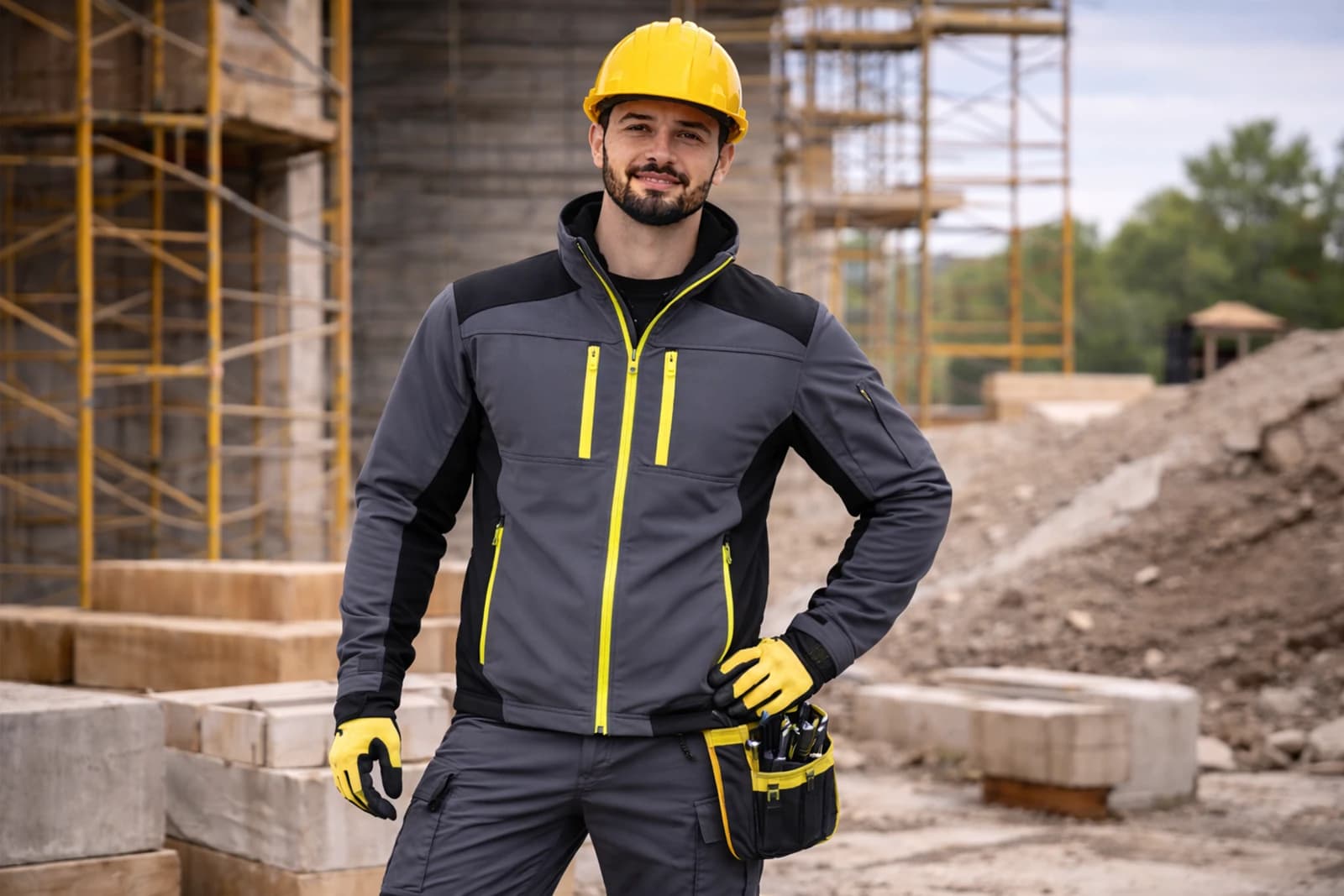
Construction Softshell Set
Flexible jacket and trouser set built for crews working across changing weather conditions.