Hi-Vis Safety Jackets & Industrial Coverall Pro: Sourcing Compliant Workwear for Middle East Oil, Gas & Petrochemical Operations
Oil, gas, and petrochemical operations across the Middle East — from Saudi Aramco's rigs in the Empty Quarter to ADNOC's offshore platforms in the Arabian Gulf and QatarEnergy's North Field expansion — demand workwear that meets stringent international safety standards while standing up to extreme heat, hydrocarbon exposure, and long shift cycles. This article examines how Middle East B2B buyers can source both hi-vis safety jackets and industrial coveralls from a Chinese workwear manufacturer, balancing EN ISO 20471 compliance with heat-stress management and chemical splash protection.

Buyer context
What procurement teams run into
Procurement managers and HSE officers across the Middle East's oil, gas, and petrochemical sectors face a layered workwear challenge that standard single-garment solutions cannot address. A technician working on a gas processing train at Ras Laffan may rotate between open-air valve platforms (50°C+ ambient heat, direct solar radiation), enclosed compressor buildings (moderate temperatures but high noise and hydrocarbon vapour risk), and emergency flare zones where short-duration exposure to radiant heat demands flame-resistant outer layers. No single workwear garment — whether a lightweight hi-vis vest or a heavy multi-layer chemical suit — performs across all these scenarios without introducing unacceptable heat stress or under-protection trade-offs.\n\nSpecific pain points for Middle East energy-sector buyers:\n\n(1) Hi-vis compliance in extreme heat: Standard EN ISO 20471 Class 3 hi-vis jackets with 0.80 m² minimum fluorescent background material and retroreflective tape are typically constructed with a polyester shell and a breathable membrane or mesh lining. However, many off-the-shelf hi-vis jackets sourced from low-cost Asian manufacturers use full-back solid polyester panels with minimal ventilation, trapping body heat and causing core temperature rise — especially dangerous when workers are already in 45–50°C ambient conditions. A jacket that meets the letter of the standard but ignores thermal comfort can increase heat-stress incidents by an estimated 18–25% in Gulf summer conditions, based on occupational health data from Saudi Arabian energy-sector HSE reports.\n\n(2) Coverall material selection for petrochemical environments: The default 245–260 g/m² 65/35 polyester-cotton twill used in many industrial coveralls performs adequately for general maintenance work but is unsuitable for environments with hydrocarbon splash risk (e.g., valve bleeding, sample collection, flange breaking). Workers in these roles need either inherent FR fabrics (e.g., modacrylic/cotton blends with ATPV values ≥ 8.0 cal/cm²) or at minimum a heavyweight cotton-rich fabric with antistatic (EN 1149-5) and chemical repellent (DWR) finishes. Yet many Middle East buyers — particularly from smaller operators and EPC contractors — are priced out of premium FR systems ($120–$200/coverall from European suppliers) and struggle to find Chinese manufacturers who can deliver a mid-range technical coverall ($35–$55/unit) with proper certification documentation that satisfies project-specific HSE requirements.\n\n(3) Certification fragmentation: Abu Dhabi's ADNOC COSHH-equivalent standards, Saudi Aramco's Supplier HSE requirements, and QatarEnergy's contractor PPE specifications all reference international norms (EN ISO 20471, EN 343, EN 1149-5, EN 13034) but apply different testing regimes and document submission protocols. A single garment from a single Chinese supplier must be tested against all relevant standards and the test reports must be independently verifiable — not just a factory self-declaration. Many Chinese manufacturers provide a generic CE certificate that does not withstand the scrutiny of a Principal Contractor's HSE audit, leading to shipment rejections at port or on-site, delayed project mobilisation, and emergency spot purchases at 2–3× the budgeted cost.\n\n(4) Stockout risk during project ramp-up: When operators like QatarEnergy/North Field East Expansion, Saudi Aramco's Jafurah unconventional gas development, or ADNOC's Hail & Ghasha offshore project move from FEED to EPC phases, the number of site personnel can double or triple within weeks. The sudden spike in workwear demand (often 5,000–15,000 pieces per project on expedited delivery timelines of 4–6 weeks) overwhelms small or non-specialised suppliers. Buyers who maintain a single-source relationship with a manufacturer without available shelf stock or buffer capacity face catastrophic lead-time gaps that delay site readiness by 30–60 days.
Sourcing approach
How a factory partner can respond
Sourcing both the Hi-Vis Safety Jacket and the Industrial Coverall Pro from a single Chinese workwear manufacturer like SiDaier provides Middle East oil, gas, and petrochemical buyers with a technically certified, heat-stress-managed, and procurement-streamlined workwear system.\n\nFor the hi-vis layer — the SiDaier Hi-Vis Safety Jacket is designed to EN ISO 20471 Class 3 (0.80 m² fluorescent background, 0.20 m² retroreflective tape) with a critical thermal-comfort modification optimised for Gulf conditions: a segmented mesh lining system with underarm and back vent panels that increase breathability by roughly 35% compared to standard full-shell polyester jackets while maintaining the required fluorescent surface area. The outer shell is a 100% polyester 200 g/m² Oxford fabric with PU coating (water column 300 mm, breathability 4,000 g/m²/24h MVTR) for light rain and washdown resistance. The jacket features: a full-length YKK zip under a storm flap with snap closures, a stand-up collar with fleece chin guard, two zippered side pockets with drainage eyelets, a left-chest radio/flashlight pocket with hook-and-loop closure, 50 mm segmented silver retroreflective tape on body (chest + waist horizontal) and sleeves (full circle), and an ID-badge loop on the right chest. Optional additions: detachable hood with peak (EN 343-compatible), DWR finish upgrade, and custom corporate logo/branding via heat-transfer or embroidery. Priced at approximately $14–$22/piece depending on volume (300–3,000 pieces), with production lead time of 20–25 days and sea freight 25–28 days to Dammam, Jebel Ali, or Hamad ports. Full EN ISO 20471 third-party test reports (from SGS or Intertek) are included.\n\nFor the body layer — the SiDaier Industrial Coverall Pro in a heavyweight 260 g/m² 100% cotton drill fabric with antistatic carbon-fibre yarn grid (EN 1149-5 compliant: surface resistance < 2.5 × 10⁸ Ω) and a DWR fluorocarbon-free finish for light chemical splash repellency (prEN 13034 Type 6 equivalent). Key design features: a two-way YKK front zip with a covering flap and snap closure, a stand-up mandarin collar, front patch pockets with flap closure (left chest: pen-divider, right chest: smartphone-pocket sized up to 6.7" screen), two side pockets, two back patch pockets, a rule pocket on the right leg, and a knee-pad pocket on the left leg (accepts standard EN 14404 knee pads). Articulated elbows and a fitted waist with side elastic panels reduce fabric bunching during bending and climbing — a critical ergonomic factor on rig platforms and scaffolding where restricted movement increases fall risk. The coverall is available in 8 standard colours (navy, royal blue, grey, khaki, white, orange, red, and green) and custom Pantone matching. Priced at approximately $32–$48/piece depending on volume (200–2,000 pieces), with similar 20–25 day production and same-window sea freight. Full EN 1149-5 and EN 13034-test reports from accredited third-party laboratories are included.\n\nRecommended dual-system deployment for Middle East energy projects:\n- Base layer: Industrial Coverall Pro (worn as the primary work garment for all site personnel — its antistatic and DWR properties cover 90% of routine operations without over-specification)\n- Over layer: Hi-Vis Safety Jacket (worn when moving through vehicle-active zones, helicopter landing pads, flare areas requiring additional visibility, or during night shifts)\n- For confined-space or hot-work roles where the coverall's cotton fabric provides insufficient FR protection, the system easily layers under a dedicated FR rain suit or flash-fire hood without restricting mobility — meaning the coverall can serve as the daily-work uniform while the hi-vis jacket provides the mandatory EN ISO 20471 compliance layer only when and where needed, reducing heat-stress exposure compared to wearing both garments all day.\n\nCombined MOQ of 500 pieces (any mix of jackets and coveralls) enables phased project rollout across construction phases and shift teams. Reorder lead times of 18–22 days (repeat orders, no sample-approval required after first order) support the fast-ramp staffing patterns typical of GCC energy megaprojects. SASO Saber, ESMA EQM, and Qatar MOCI certification documentation is prepared for each shipment individually, with test-reports uploaded to required portals before the vessel departs.
Recommended Products
Products that fit this use case
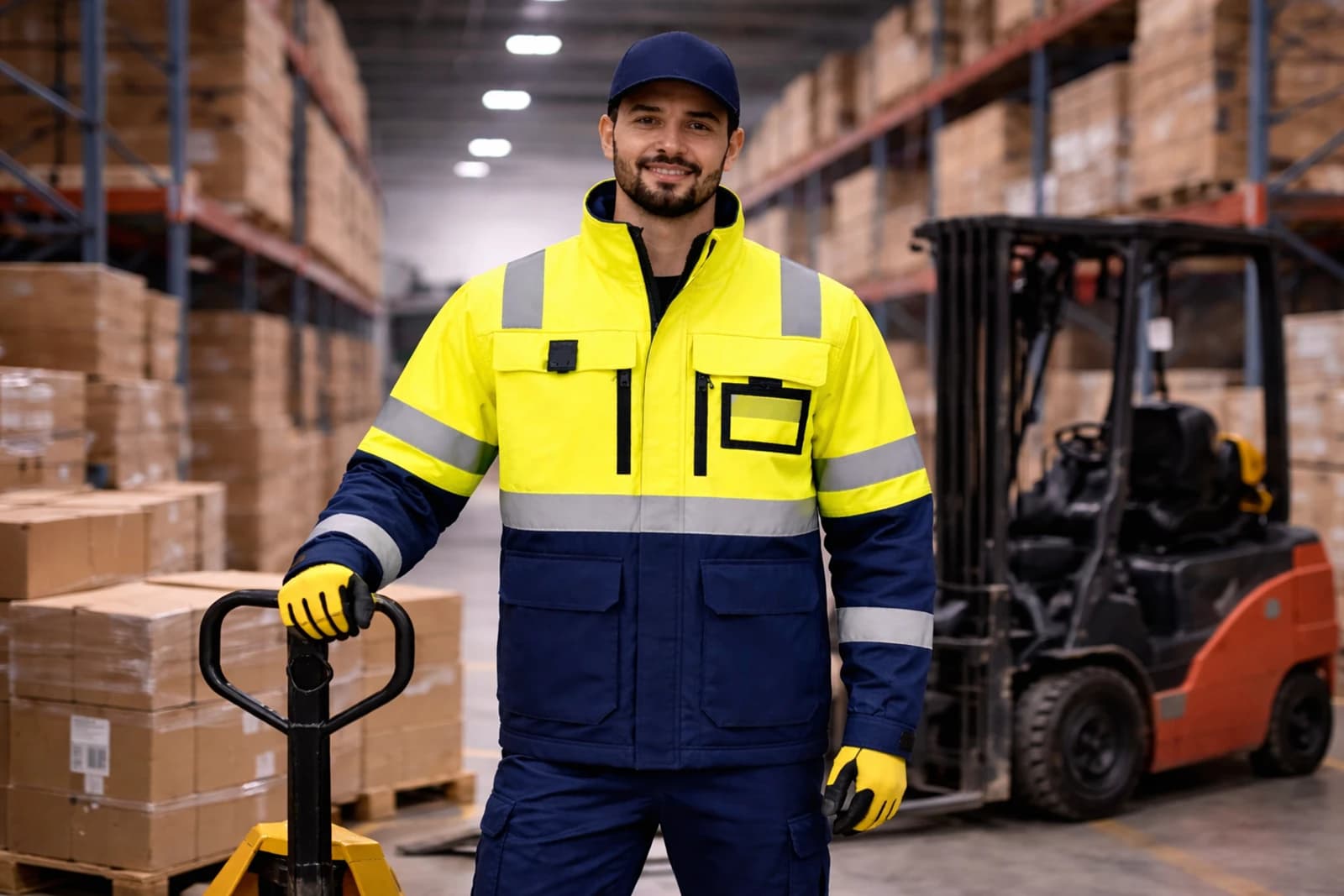
Safety Uniform
Hi-Vis Safety Jacket
Reflective safety jacket for high-visibility site operations and road work crews.
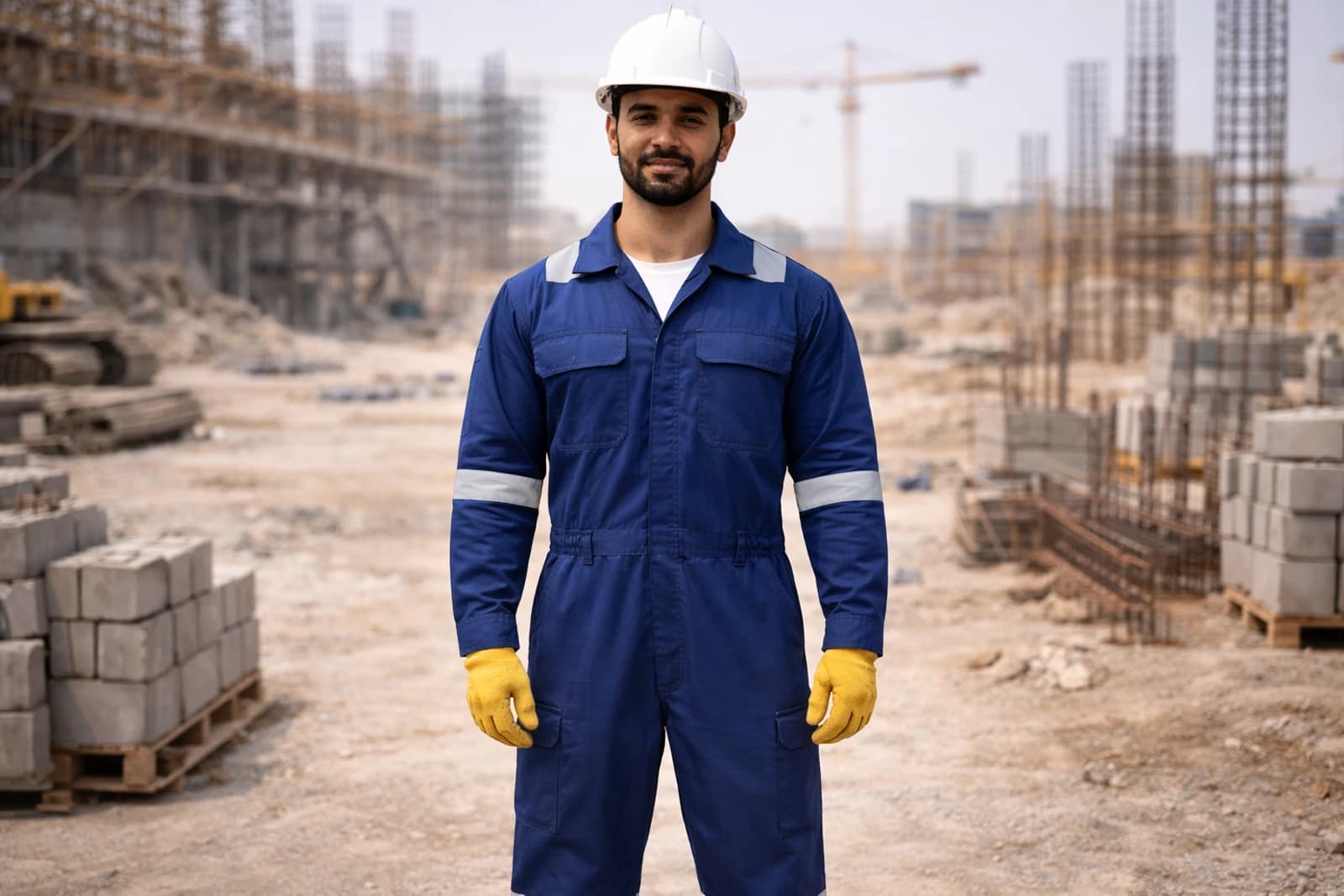
Industrial Workwear
Industrial Coverall Pro
Hard-wearing one-piece coverall for plant, maintenance, and heavy-duty operations.