Hi-Vis Safety Jackets for Middle East Logistics & Warehousing: Why B2B Buyers Source from Chinese Manufacturers for ANSI/EN-Compliant PPE
From Dubai's Jebel Ali Free Zone to Saudi Arabia's King Abdullah Port and Qatar's Hamad Port, logistics and warehousing operations across the Middle East rely on hi-vis safety jackets to protect workers in high-traffic environments. This guide explains how B2B procurement managers for logistics operators, 3PL providers, and warehouse developers can source ANSI/EN-compliant hi-vis jackets from a Chinese workwear manufacturer that delivers certified retroreflective materials, heat-optimized breathable fabrics for Gulf climate conditions, custom corporate color matching, bulk FOB pricing, and reliable delivery schedules to Jebel Ali, Dammam, and Hamad ports.

Buyer context
What procurement teams run into
A procurement manager at a leading 3PL logistics operator in Dubai South needs Class 3 hi-vis safety jackets for 1,500 warehouse and yard workers across five distribution centers serving e-commerce and cold-chain clients. The current supplier — a Turkish workwear brand — provides compliant jackets at $28–$35 per unit with 6-week lead times. While quality is acceptable, the buyer faces three recurring issues: (1) jackets trap heat in Dubai's 8-month summer season, leading to workers removing them inside active warehouse zones — a direct safety violation under UAE labor law that risks fines of AED 10,000+ per incident; (2) the reflective tape on current jackets begins delaminating after 15–20 industrial launderings, requiring full replacement every 4–5 months at significant cost; and (3) the supplier cannot accommodate the client's corporate Pantone color matching for branded jackets across their entire 1,500-worker fleet. For Middle East B2B procurement teams sourcing hi-vis safety jackets from a Chinese manufacturer, the specific challenges differ from general workwear procurement: **Multi-standard certification requirements** — Middle East logistics operators typically require hi-vis jackets certified to both ANSI/ISEA 107 (Type R, Class 3) for US-influenced operations and EN ISO 20471 (Class 3) for European-standard projects. Some operations (particularly in Saudi Arabia under Saudi Aramco contractor requirements) additionally require NFPA 70E arc-rated hi-vis for workers near electrical equipment in warehouse maintenance zones. Chinese manufacturers exporting to the Middle East must maintain current SGS or TÜV certification for each jacket model, with batch-specific test reports covering retroreflective luminance (minimum 330 cd/lx/m² for Class 3), background material colorfastness (minimum Grade 4 after 5 washes per ISO 105-C06), and mechanical strength of reflective tape adhesion. **Heat management without compromising visibility** — Standard hi-vis jackets for temperate climates use a three-layer construction: polyester outer, PU waterproof membrane, and polyester mesh lining. In Dubai's summer (May–October, 38–48°C), this construction creates a greenhouse effect, raising core body temperature by 3–5°C over a 10-hour shift. Warehousing giants like Agility and Aramex have started requiring "ventilated hi-vis" with mesh panel inserts in the back yoke and underarm gussets, along with moisture-wicking inner linings (e.g., Coolmax or similar wicking polyester). The challenge for Chinese manufacturers is balancing ventilation (which reduces fabric coverage) with maintaining the minimum background material area required for Class 3 certification (0.80 m² total, with 0.50 m² from background material and 0.13 m² from retroreflective material per EN ISO 20471). **reflective tape durability under Gulf conditions** — UV radiation in the Middle East is 2–3× higher than in Europe (UV index 10–12 vs. 4–6). Standard silver retroreflective tape (glass bead technology) degrades after 8–12 weeks of continuous outdoor exposure in Gulf conditions, losing 40–60% of its reflective luminance. Better-performing micro-prismatic tape (similar to 3M Scotchlite 8910 or 8912 series) maintains 80%+ luminance after 12 weeks but costs 2–3× more per linear meter. For a logistics operator with 1,500 jackets, the tape cost difference is approximately $4–$6 per jacket — significant at scale, but failing a compliance audit over degraded reflective tape carries far higher costs in penalties and contract disqualification. **Workforce categorization and color coding** — Many Middle East mega-warehouses (e.g., Dubai CommerCity, Jeddah Logistics Park) use color-coded hi-vis systems to identify worker roles at a distance: yellow for general warehouse workers, orange for heavy equipment operators, green for safety inspectors, red for emergency response teams. Chinese manufacturers must be able to source consistent background fabric colors across all these categories with the same reflective tape integration, seam construction, and sizing — not a simple task when each color requires a separate dye lot and fabric procurement run. **Sizing for diverse warehouse workforces** — Logistics and warehousing in the Gulf employs a wide mix: Arab warehouse supervisors (tall, slim to medium build), South Asian pickers and packers (shorter, broader shoulders), Filipino forklift operators (medium build), and occasional Western expatriate managers (taller, larger frames). A 2023 ergonomic study in Qatar's logistics sector found that 23% of workers in standard-issue hi-vis jackets experienced restricted shoulder movement, leading to decreased picking productivity. Chinese manufacturers need to offer extended sizing (S–5XL) with adjustable side tabs, longer torso lengths (3–4 cm longer than standard Asian sizing), and articulated elbows to accommodate the range of body types common in Gulf logistics. **Bulk ordering and JIT delivery** — Logistics operators in the Middle East frequently operate on just-in-time (JIT) inventory models. A 3PL winning a new contract for a large e-commerce client (e.g., noon.com or Amazon.ae) may need to ramp up from 800 to 2,500 workers within 4–6 weeks, requiring a corresponding rapid increase in hi-vis jacket supply. Chinese manufacturers who can hold buffer stock of semi-finished jackets (unbranded with standard hi-vis background colors) and complete customization (logo embroidery, corporate color reflective tape, size labeling) within 7–10 days have a significant advantage over Turkish or European suppliers with 6–10 week lead times. Without a strategic approach, logistics procurement teams face: (a) heat-related non-compliance as workers remove jackets in active zones, (b) accelerated reflective tape degradation from UV exposure requiring replacement 3–5× per year instead of 1–2×, (c) color inconsistency across role-coded jackets, (d) sizing-related productivity losses of 8–15%, and (e) supply chain delays from JIT orders that standard lead times cannot accommodate.
Sourcing approach
How a factory partner can respond
By partnering with a Chinese workwear manufacturer experienced in Gulf-region PPE export, logistics procurement teams can secure hi-vis safety jackets purpose-built for Middle East operations. The specific advantages include: **Certified multi-standard compliance** — Chinese manufacturers regularly exporting to the Middle East maintain SGS-verified certifications for ANSI/ISEA 107 and EN ISO 20471 across their hi-vis jacket range. Certifications cover the full garment assembly rather than just constituent materials, with batch-specific test reports available for buyer audit review. This eliminates certification risk during NOC or government logistics contract compliance checks. **Heat-optimized ventilation engineering** — Purpose-designed hi-vis jackets for Gulf logistics feature 360° ventilation: open-weave mesh back panel inserts, underarm gusset ventilation, moisture-wicking inner lining, and lighter-weight background fabrics (120–150 GSM vs. 200+ GSM for standard hi-vis jackets). These modifications reduce core temperature by 2–4°C during active warehouse work while maintaining the minimum background material area (0.50 m²) required for Class 3 certification — verified through pre-shipment testing. **Premium micro-prismatic reflective tape** — Factories can fit micro-prismatic tape (3M Scotchlite or equivalent) with guaranteed 80%+ luminance retention after 12 months of Gulf climate exposure, compared to 40–60% retention for standard glass-bead tape. While this adds $4–$6 per unit cost, it extends replacement cycles from 4–5 months to 12–14 months, producing a net savings of $18–$25 per jacket per year after factoring replacement labor. **Consistent Pantone-matched color coding** — With established supplier relationships across textile mills in Zhejiang and Jiangsu, Chinese manufacturers can source consistent background fabric colors across yellow, orange, green, and red variants within the same production run. Each dye lot comes with a ΔE ≤ 1.5 color difference measurement (industry standard for acceptable visual consistency), enabling logistics operators to deploy clear role-based color coding across their workforce. **Extended sizing for multinational workforces** — Full S–5XL sizing with body measurements based on Middle East workforce anthropometric data (longer torso, broader shoulders, larger hip circumference in upper size ranges). Jacket fit is validated through sizing trial events where 50–100 workers test prototype fits and provide feedback before bulk production. **JIT production and regional warehousing** — Lead time for customized hi-vis jackets with logo embroidery and corporate color reflective tape: 25–30 days from order confirmation to FOB Chinese port. For urgent orders, manufacturers can maintain semi-finished stock (unbranded jackets in standard hi-vis colors) and deliver customized products within 12–15 days. With weekly FCL/container consolidation services to Jebel Ali (Dubai), Dammam (Saudi Arabia), Hamad (Qatar), and Sohar (Oman), logistics operators benefit from consistent 18–22 day total transit time from factory to warehouse, supporting JIT inventory cycles. Warehousing consolidation programs in Dubai South can also hold 3–6 months of buffer stock for established clients, reducing the need for operators to maintain their own safety inventory.
Recommended Products
Products that fit this use case
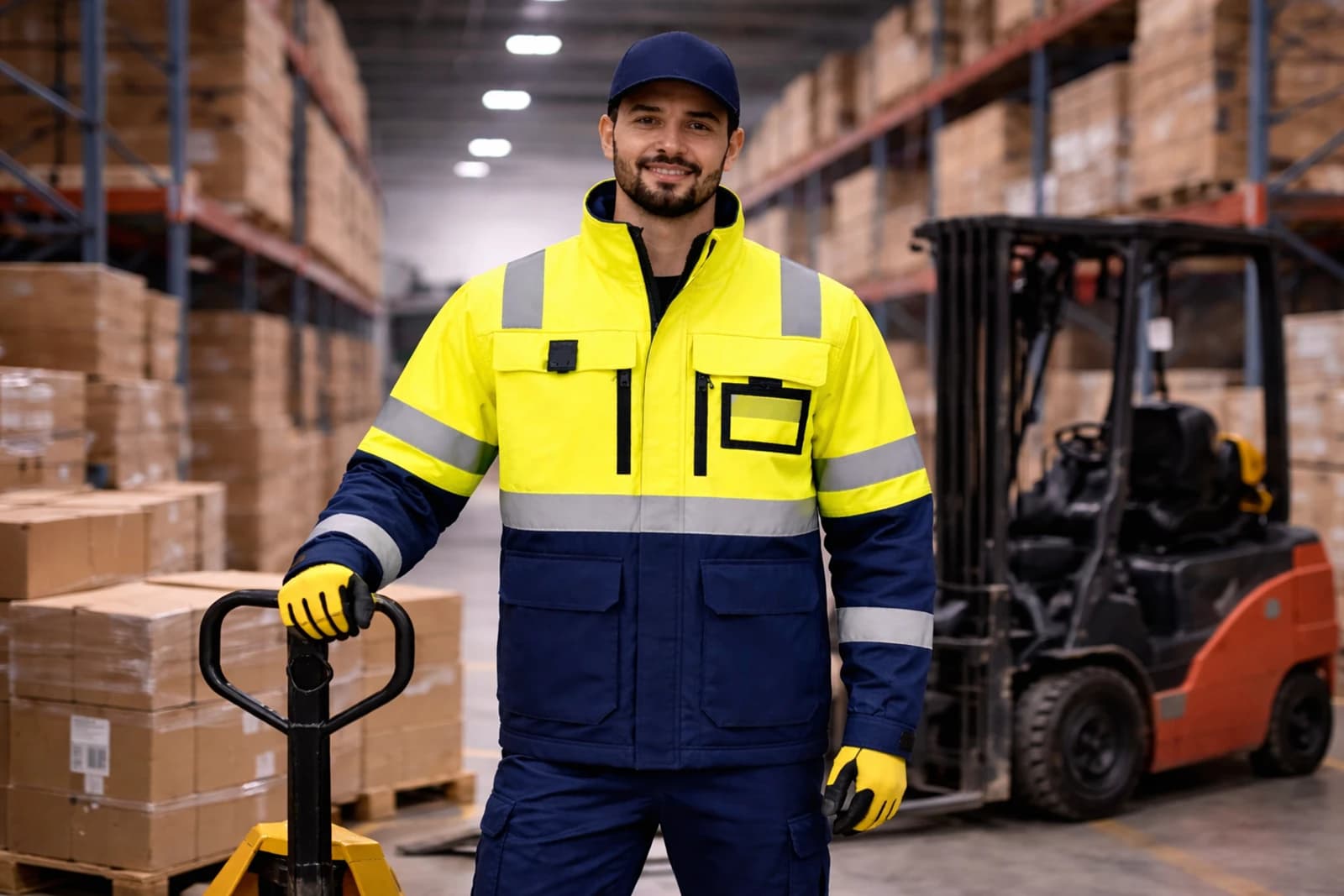
Safety Uniform
Hi-Vis Safety Jacket
Reflective safety jacket for high-visibility site operations and road work crews.