Hi-Vis Safety Jackets & Logistics Polo Uniforms for Middle East: B2B Sourcing from a Chinese Workwear Manufacturer
The Middle East logistics sector is booming — Jebel Ali in Dubai, Khalifa Port in Abu Dhabi, King Abdullah Port in Saudi Arabia, and the expanding Red Sea gateway at Jeddah Islamic Port move millions of containers annually, with warehousing and last-mile delivery fleets growing faster than almost anywhere else on earth. For B2B buyers sourcing from a Chinese workwear manufacturer, hi-vis safety jackets and logistics polo uniforms are the two garment categories that define a modern supply-chain operation. This guide covers EN ISO 20471 Class 2 and Class 3 compliance for dockside and yard workers, breathable hi-vis layering for 45°C Gulf heat, reflective tape placement that survives industrial laundering, durable polo uniform fabrics and embroidery for customer-facing staff, plus bulk procurement and lead-time strategies for fleets of 500-10,000+ employees.

Buyer context
What procurement teams run into
The Middle East logistics industry is in hypergrowth. Jebel Ali remains the region's largest container port, Khalifa Port has tripled capacity in five years, Saudi Arabia's King Abdullah Port and NEOM's emerging logistics corridors are absorbing billions in investment, and last-mile delivery in the UAE and KSA is expanding at double-digit rates as e-commerce compounds. Across the GCC, hundreds of thousands of dock workers, yard operators, forklift drivers, warehouse pickers, and delivery staff need uniforms that perform in extreme conditions. For Middle East B2B procurement officers, fleet managers, and uniform distributors sourcing from a Chinese workwear manufacturer, two categories dominate the logistics uniform roster: **hi-vis safety jackets** for dockside, yard, and roadside staff, and **logistics polo uniforms** for customer-facing warehouse, delivery, and terminal personnel. Getting both right reduces workplace accidents, improves brand presence, and — critically — keeps workers comfortable in a climate where a poorly designed garment will simply be left in the locker. **1. Hi-vis visibility classes — what GCC ports and yards actually require** Many Middle East logistics contracts — especially those tied to government-linked port authorities, free zones, and major retail distribution networks — specify hi-vis garments to **EN ISO 20471**. The key decision is class selection: - **Class 1:** Minimum visibility. Suitable only for low-risk indoor tasks with minimal vehicle traffic. Rarely specified for logistics work in the GCC. - **Class 2:** The workhorse for warehouse, yard, and dockside staff. Requires a minimum of 0.50 m² of fluorescent background material and 0.13 m² of retroreflective tape. Enough visibility for staff working beside moving forklifts, trucks, and container handlers in daylight and yard lighting. - **Class 3:** The highest standard — 0.80 m² fluorescent background and 0.20 m² retroreflective material. Required for staff working on public roads, on active container quays beside moving gantry cranes and straddle carriers, or during night operations where driver headlights are the primary visibility source. GCC port authorities and major logistics operators (DP World, AD Ports, Maersk GSC) increasingly specify Class 3 as their default for all active-yard personnel. **2. High-visibility + heat = the GCC fabric engineering problem** The fundamental challenge on Middle East logistics sites is that hi-vis garments must be highly visible in extreme heat. Three solutions define good sourcing: - **Breathable mesh hi-vis:** For peak summer (May-September, ambient 40-48°C), specify hi-vis safety jackets or vests with a 100% polyester **mesh** body rather than solid fabric. Mesh allows air to pass through, which is the single most effective heat-management feature for outdoor Gulf work. Fluorescent yellow or orange mesh at 150-180 gsm with a lightweight polyester solid yoke retains the class rating while staying wearable. - **Layered systems:** Many GCC operators adopt a two-part system: a lightweight hi-vis vest (Class 1 or 2) worn over a wicking base tee, plus a separate hi-vis jacket (Class 2 or 3) with removable sleeve lining for cooler months and night shifts. This gives the operator two functional garments from one procurement line and extends wear season from ~6 months to year-round. - **High-temperature retroreflective tape:** Standard retroreflective tape can delaminate or lose reflectivity after prolonged UV exposure. For Gulf sites, specify **silver-grey engineered-grade tape** rated for extended outdoor UV life, and ask the factory for evidence of accelerated weathering test results. Cheap tape is the most common failure point on budget hi-vis garment lines — and the most dangerous one on a live quay. **3. Hi-vis jacket design details that matter on GCC logistics sites** Beyond the class rating, specific design features determine whether a hi-vis jacket actually gets used: - **Zip-through neck and collar tabs:** Workers on ports and yards are moving constantly; a full-front zip allows rapid cooling breaks without removing the garment for safety compliance. - **Ventilation panels:** Underarm mesh gussets and a perforated back panel reduce heat buildup during forklift operations and container handling. Specify them even on Class 3 garments — compliance does not require a sealed construction. - **Pocket configuration:** Dockside and yard staff need secure storage for tools, scanners, and radio devices. Specify zippered chest pockets with phone/radio compartments, and reinforced side pockets. Avoid open cargo pockets that catch on container twist locks and pallet racking. - **Size range:** As with all GCC workwear, ensure sizes to 3XL-4XL. Gulf logistics workforces include large South Asian, Filipino, and Egyptian cohorts; a size chart that stops at 2XL is a guaranteed delivery-day dispute. **4. Logistics polo uniforms — brand, comfort, and durability for customer-facing staff** Warehouse, terminal, and delivery personnel who interact with customers, drivers, and port authority staff typically wear **logistics polo uniforms** — a category that balances professional appearance with extreme-climate comfort: - **Fabric:** The GCC default is a **65/35 polyester-cotton pique** at 200-220 gsm, or a 100% polyester micro-pique with moisture-wicking treatment. Both offer the professional knit look expected of a uniform polo while drying faster than pure cotton after sweat or washing. For premium accounts, ask about anti-odour (silver-ion or zinc) finishes that stay effective for at least 50 industrial washes. - **Colour fastness:** This is the number-one polo failure point in the Gulf. Specify washfastness of 4+ (ISO 105-C06) and lightfastness of 4-5 for brand colours (especially the dark navy, black, and green used across GCC logistics brands). Cheap reactive dyes fade to a washed-out grey within 10-15 washes under harsh Gulf laundering. - **Embroidery vs. transfer:** For fleets of 500+, most GCC logistics operators prefer **embroidered chest logos** over heat transfers or screen print. Embroidery survives industrial laundering far better and projects the premium image that port authorities and major retailers expect. Work with the factory early to digitize the logo artwork correctly for the garment's pique texture. - **Cut and fit:** Customer-facing staff in the Gulf expect a trimmer, more tailored fit than industrial workers. Confirm the polo's side-seam shaping, collar construction (self-fabric with fused interlining holds shape), and sleeve length with the buyer before first article approval. **5. Sizing, sampling, and bulk lead times for GCC logistics fleets** Sourcing from a Chinese workwear manufacturer for Middle East logistics operations requires disciplined procurement sequencing: - **First article approval (FAA):** Always insist on a physical pre-production sample per size and colour before bulk cutting — 4-6 weeks minimum buffer in the timeline. - **Size mapping:** Provide the factory with your workforce size distribution (chest, height, weight percentiles) rather than assuming the factory's default Asian size chart fits a Gulf logistics workforce with substantial South Asian and East African representation. - **Bulk lead time:** Typical bulk production for hi-vis jackets and polo uniforms from a Chinese manufacturer is 45-60 days (fabric booking, cutting, sewing, finishing, QC, packing). For fleet roll-outs timed to a Q4 peak or a new terminal opening, build a 90-day sourcing calendar that includes sampling and approval buffers. - **Consolidated purchases:** Ordering jackets and polos in a single consolidated PO from one manufacturer reduces freight cost per unit, simplifies customs documentation (one HTS line), and — because both garments use the same embroidery and tag platform — shortens the production queue. **6. Compliance documentation to request before bulk production** Before authorizing bulk production, request from the manufacturer: - Third-party EN ISO 20471 test certificates (SGS, TÜV, Intertek) for each hi-vis class and fabric variant — not the supplier's self-declaration. - Wash-test evidence showing retroreflective tape performance after 25 industrial wash cycles (EN ISO 20471 requires tape to maintain reflectivity through repeated laundering). - Fabric test reports for colour fastness, tear strength (ISO 13937-2), and — for any FR-adjacent specification — EN ISO 11612 documentation. - A full dimensions/spec sheet mapping every size's critical measurements (chest, back length, sleeve, waist) to the approved production standard. With the right specifications, the right certificates, and a disciplined sampling process, a Chinese workwear manufacturer can deliver a Middle East logistics uniform program that keeps workers safe, visible, and comfortable — and keeps your brand looking professional through every peak-season shift.
Sourcing approach
How a factory partner can respond
For Middle East B2B buyers sourcing logistics workwear from a Chinese manufacturer, this guide delivers a complete procurement playbook: **Hi-vis safety jackets:** - Specify **EN ISO 20471 Class 2** for warehouse and indoor yard staff; **Class 3** for dockside, quay, and public-road operations. - Choose breathable **polyester mesh hi-vis** (150-180 gsm) for peak summer wearability; use a two-layer system (vest + removable-sleeve jacket) for year-round coverage. - Demand engineered-grade retroreflective tape rated for extended UV exposure, with third-party wash-test evidence through 25 industrial cycles. - Include ventilation panels, zippered tool/radio pockets, and sizes to 4XL. **Logistics polo uniforms:** - Specify **65/35 poly-cotton pique** at 200-220 gsm, or moisture-wicking micro-pique, for durability and rapid drying. - Demand washfastness 4+ and lightfastness 4-5 for brand colours — the #1 failure point on Gulf uniforms. - Prefer **embroidered chest logos** over transfers for fleet programs of 500+ staff. - Confirm side-seam shaping and collar construction for a professional, tailored fit. **Procurement process:** - Build a 90-day sourcing calendar: FAA sampling → approvals → fabric booking → 45-60 day bulk production → QC → shipping. - Consolidate jackets and polos into one PO from one manufacturer to cut freight, simplify customs, and shorten the production queue. - Request third-party test certificates (SGS/TÜV/Intertek) before bulk authorization — never accept self-declarations.
Recommended Products
Products that fit this use case
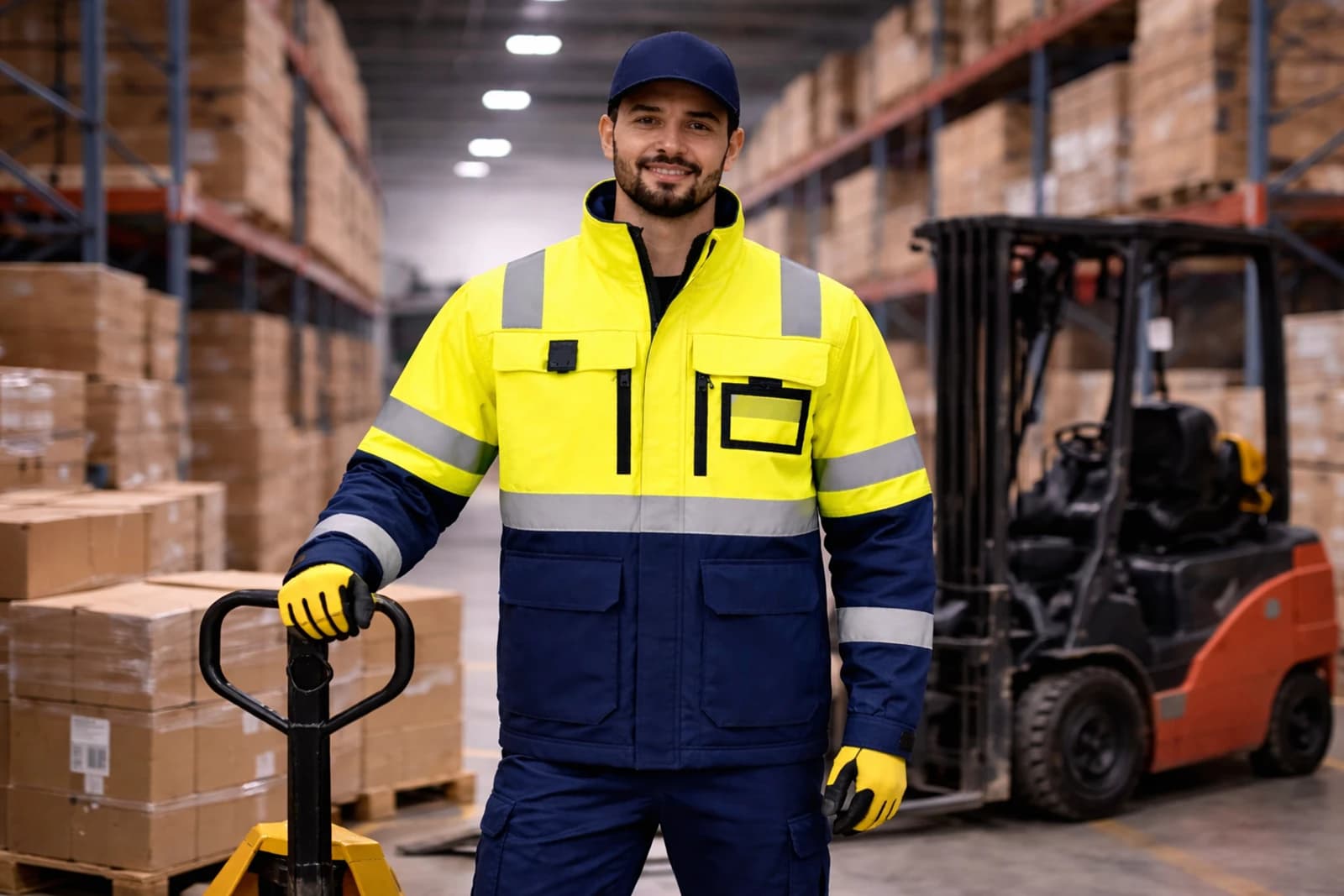
Safety Uniform
Hi-Vis Safety Jacket
Reflective safety jacket for high-visibility site operations and road work crews.

Logistics Uniform
Logistics Polo Uniform
Breathable uniform polo for warehouse, delivery, and last-mile teams.