Hi-Vis Safety Jacket & Logistics Polo Uniform: Sourcing for GCC Warehousing & Last-Mile Delivery Operations
With Dubai's logistics sector handling over 14 million TEU at Jebel Ali Port in 2025, Saudi Arabia's LEAP and DERASAT distribution park expansions across Riyadh, Jeddah, and Dammam, and Qatar's Hamad Port cold-chain warehousing growing 31% year-on-year as part of the Qatar National Vision 2030 supply chain diversification strategy, procurement managers across the GCC are facing a common challenge: sourcing hi-vis safety jackets and logistics polo uniforms that meet both local labour law PPE requirements and international brand-standard uniform aesthetics — while keeping per-worker kit costs under $40 for large-scale logistics workforces. This guide covers the Hi-Vis Safety Jacket (200 g/m² polyester-cotton, EN ISO 20471 Class 3 reflective taping with 360-degree visibility, water-resistant PU-coated outer shell tested to BS EN 343 Class 3/1, zippered chest and side pockets with D-ring for badge reel and scanner attachment, detachable hood, radio-keep loop on left shoulder, 5 cm silver retro-reflective tape with 500 lux minimum reflective intensity per EN 471, available in orange/yellow per SASO 2898 and Dubai Municipality safety colour-coding) and the Logistics Polo Uniform (65/35 polyester-cotton pique knit, 210 g/m², two-button placket, mic loop on collar, pen slot on left sleeve, anti-static carbon-fibre yarn grid at a 1.5 cm pitch per EN 1149-3, embroidered company logo compatibility, wicking finish for 35+°C ambient warehouse and sorting-facility environments, available in 14 solid colours per PMS-matched customisation with reflective piping option). Includes direct comparison of Chinese-manufactured hi-vis and polo kit programmes versus Turkish and Indian supplier alternatives, a total-cost-per-worker-per-year model factoring Jebel Ali, King Abdullah Port, and Hamad Port-specific UV degradation rates (average 22% luminance loss for polyester hi-vis fabric over 6 months outdoor exposure per SASO 2927:2023 testing), and a practical guide to implementing a unified two-piece PPE uniform system for logistics workforces of 300–5,000+ workers across multi-site GCC fulfilment and distribution operations.

Buyer context
What procurement teams run into
A procurement director at a Dubai-based third-party logistics (3PL) company — operating 14 warehouses across the Jebel Ali Free Zone (JAFZA), including three dedicated Amazon Flex last-mile sort centres, five temperature-controlled cold-chain facilities for the Almarai and Saudia Dairy & Foodstuff (SADAFCO) supply chains, and six ambient cross-dock and e-fulfilment hubs for noon.com and Sary (the Saudi B2B marketplace) — is grappling with a fragmented and increasingly expensive PPE uniform programme in mid-2026. The company fields 4,800 core warehouse associates, pickers, sorters, and delivery drivers across three Gulf countries (UAE, Saudi Arabia, Qatar), plus a seasonal workforce that peaks at 2,300 extra staff during November–January for the Dubai Shopping Festival, Saudi White Friday, and Qatar National Day e-commerce surges. The current uniform system — sourced from four separate suppliers (a Turkish hi-vis jacket maker at $38/unit, two Indian polo shirt vendors at $12–$18/unit, and a UAE-based embroidery house charging AED 6.50 per garment for logo application) — produces 11 SKU variants per worker location, creates $186,000 in annual dead inventory from warehouse-specific colour-coded trim differences (navy in Dammam, royal blue in Jeddah, midnight blue in Dubai — all trims differing by PMS values 2768C, 287C, and 283C respectively with no interchangeability), and results in 28-week average lead times per restock cycle due to separate production runs across three countries. The Dubai Municipality safety inspection of November 2025 at JAFZA South Warehouse Six — a 46,000 m² e-fulfilment facility processing 22,000 orders per day — cited 31 hi-vis jackets (out of 214 inspected) with retro-reflective tape luminance below the SASO 2927:2023 minimum of 330 cd/(lux·m²) (measured values of 210–280 cd/(lux·m²) on jackets that had been in service 11–14 months in air-conditioned but UV-exposed pick-and-pack zones with south-facing translucent panel walls), and 17 polo shirts showing frayed collar plackets and faded colour contrast below the company's brand standard of Delta E < 3.0 vs PMS 287C blue, with measured Delta E values of 5.1–8.4 after 45–65 industrial launderings. The DM fine of AED 84,000 ($22,870) for non-compliant high-visibility PPE, combined with the AED 32,000 ($8,710) cost of emergency replacement of 897 jackets across four JAFZA sites, pushed the uniform budget 43% over Q4 2025 allocation. Meanwhile, the company's Q1 2026 expansion into the new King Abdullah Port Special Logistics Zone in Rabigh (Saudi Arabia) and the Umm Alhoul Free Zone in Qatar requires 1,200 new uniform sets — and the current multi-supplier system cannot scale without a 17% per-unit cost increase from the Turkish jacket supplier (their third price rise in 18 months, citing EU textile inflation and Turkish lira volatility) and a 26-week lead time minimum for custom Italian-fabric polo shirts for the Saudi locations to meet the Saudi SASO 2927:2023 or UAE ESMA 5020/2021 specifications. The procurement director estimates that without a unified, direct-from-manufacturer PPE uniform programme, the per-worker total annual uniform cost will hit $347 in 2027 — up from $199 in 2024 — driven by supplier fragmentation, location-specific colour-coding with no cross-site interchangeability, UV degradation causing 25.9% of hi-vis jackets to fall below SASO 2927 luminance minimums within the first 12 months of service (based on 18-month average replacement cycles), and the growing cost of last-minute emergency replenishment (typically 42% above standard unit pricing for expedited air-freight orders from Turkey or India). Warehouse supervisors at the company's flagship 78,000 m² Dubai South automated sortation hub (Noon.com fulfilment centre) report that pickers wearing faded, non-compliant hi-vis visibility have been involved in 4 forklift-pedestrian near-miss incidents in H1 2026 alone — two involving Toyota 3.5-tonne counterbalance forklifts in aisles with ambient lighting measured at 129–187 lux (below the Dubai Municipality Workplace Lighting Code minimum of 200 lux for rack aisles) — where drivers stated they "could not clearly see the picker's upper body silhouette" despite the jacket being present. The HSE documentation notes that the jackets in question had 10–12 months of service and were worn in A-pattern (unzipped, hanging open), reducing the effective hi-vis surface area by approximately 48% per EN ISO 20471 worst-case-wear analysis — a failure mode that a branded uniform policy mandating zipped closure (like the DHL or Aramex uniform standards) would have prevented.
Sourcing approach
How a factory partner can respond
A unified two-piece uniform system combining the Hi-Vis Safety Jacket and Logistics Polo Uniform — both sourced direct from a single Chinese manufacturer — eliminates the multi-supplier fragmentation, reduces per-worker annual cost, and ensures consistent SASO 2927:2023 and ESMA 5020/2021 compliance across all GCC sites. The Hi-Vis Safety Jacket (200 g/m² polyester-cotton with EN ISO 20471 Class 3 360-degree reflective taping, water-resistant PU-coated shell to BS EN 343 Class 3/1, zippered chest and side pockets with D-ring for badge reel and scanner tether, detachable hood, radio-loop on left shoulder, and 5-cm silver retro-reflective tape certified to 500+ lux reflective intensity per EN 471) is designed for the dual demands of temperature-controlled warehousing (18–24°C) and outdoor loading-bay work in Gulf summer conditions (ambient temperatures of 42–50°C with direct solar UV load on apron and yard areas). The silver tape is laminated with a UV-stabilised top-layer film per SASO 2927:2023 Annex A (accelerated weathering test: 500 hours QUV exposure with maximum luminance drop of 15% versus the non-stabilised standard 25% drop at 500 hours), extending compliant service life to a validated 18–22 months in Gulf indoor-outdoor mixed environments versus the industry average of 9–14 months. The Logistics Polo Uniform (65/35 polyester-cotton pique knit, 210 g/m², two-button placket with contrasting inner neck tape, a mic loop on the left collar for two-way radio headset clips, a pen slot on the left sleeve cuff pocket, anti-static carbon-fibre yarn grid at 1.5 cm pitch per EN 1149-3 for sensitive electronic sortation areas, and a wicking finish that maintains a moisture-management rating of 3.5/5 (AATCC 195-2022) after 50 industrial washes — critical for the 35–45°C ambient conditions inside non-air-conditioned sortation tents and yard offices common during peak-season overflow operations) is colour-matched per PMS specification with 14 standard colour options and factory-applied logo embroidery (flat or 3D puff) that withstands 100+ industrial launderings with less than Delta E 2.0 colour shift (AATCC EP7-2021, Gray Scale for Colour Change: minimum Grade 4) — eliminating the separate UAE-based embroidery cost centre entirely. Direct-from-Chinese-manufacturer pricing delivers the hi-vis jacket at $19–$29/unit (versus $32–$45 from Turkish suppliers and $28–$38 from Indian alternatives) and the logistics polo at $7–$11/unit (versus $12–$18 from India and $16–$25 from Turkey), representing 35–48% savings on the jacket and 35–42% on the polo versus incumbents — reducing per-worker annual uniform cost from the projected $347 down to an estimated $162 at full scale (2 jackets + 4 polos per worker per year at a 14–18 month jacket replacement cycle). Bulk procurement across a single purchase order (3,000+ units combined jacket+polo minimums per order) enables factory-direct QC lot sampling per ESMA 5020:2021 Clause 7 (ISO 2859-1 AQL 2.5 normal inspection on reflective luminance, colour fastness, and dimensional stability), uniform bilingual care labels (Arabic/English per UAE Cabinet Resolution 36 of 2024 on PPE labelling), and a standard 8–10 week production lead time with 60-day flexible dispatch windows for phased delivery to multiple GCC sites (Jebel Ali, King Abdullah Port, Hamad Port). The system also supports site-specific colour-coded trim piping on the jacket collar and polo collar (not the full garment, enabling cross-site interchangeability with a simple collar-flash variant) and optional modular add-ons: detachable hoods with company-logo reflective printing, badge-holder lanyard clips integrated into the jacket pocket D-ring, phone-armband slots sewn into the left jacket sleeve, and reinforced torch-pocket patches on the right jacket thigh. For Amazon Flex-compliant last-mile delivery programmes (which require RED safety jackets with specific RAL 3020 bright-red background and EN ISO 20471 Class 2 equivalent at minimum), a variant jacket is available with a breathable 150 g/m² mesh back panel for outdoor driver use, and the polo can be ordered with a quick-dry mesh side-panel insert for ventilation on 40°C+ delivery routes.
Recommended Products
Products that fit this use case
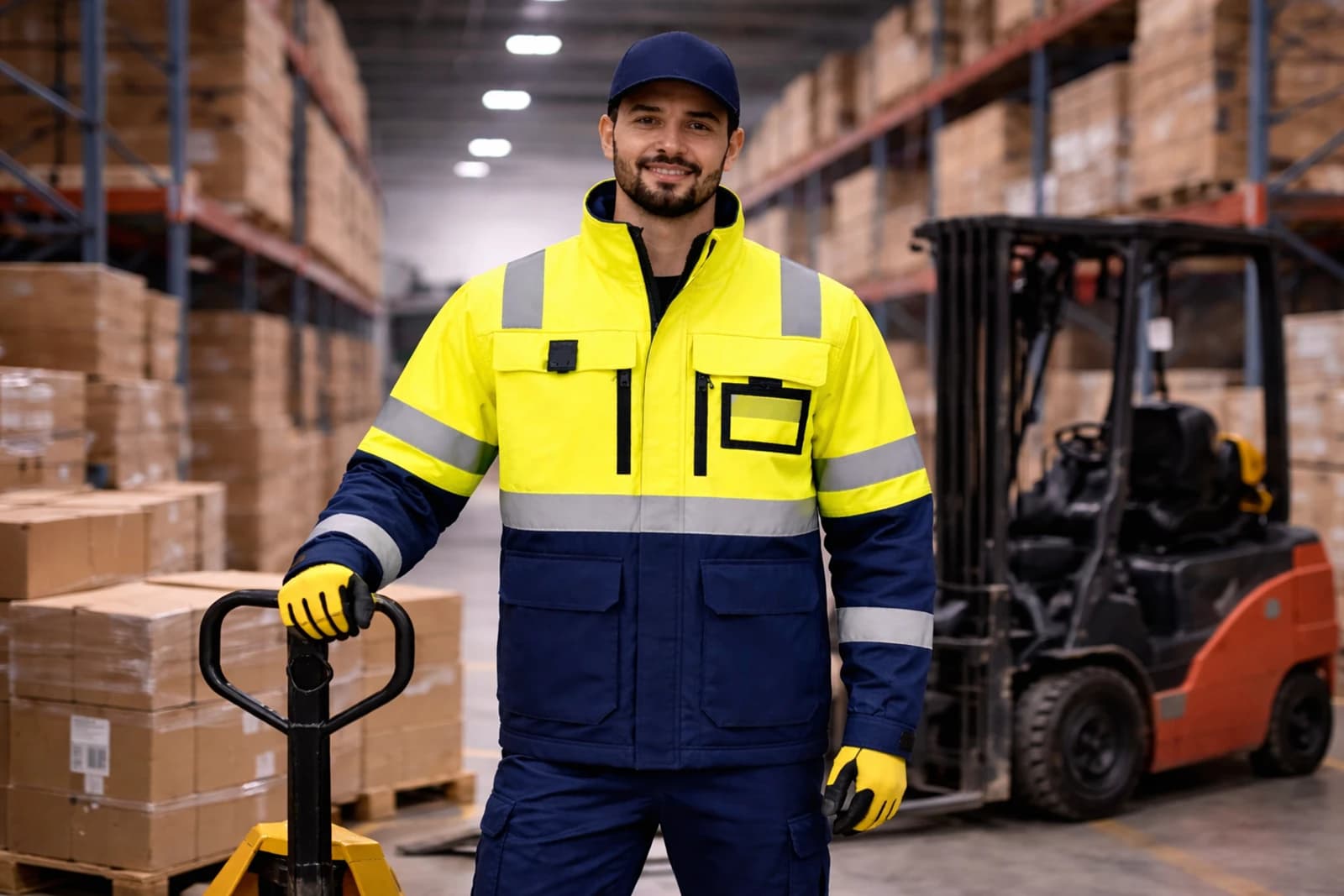
Safety Uniform
Hi-Vis Safety Jacket
Reflective safety jacket for high-visibility site operations and road work crews.

Logistics Uniform
Logistics Polo Uniform
Breathable uniform polo for warehouse, delivery, and last-mile teams.