Hi-Vis Safety Jacket for Middle East Infrastructure: Sourcing from a Chinese Workwear Manufacturer
From NEOM's billion-dollar construction sites and Qatar's FIFA legacy expressways to Saudi Arabia's Giga-projects under Vision 2030 and UAE's Expo City expansion, Middle East infrastructure megaprojects demand hi-vis safety jackets that withstand 50°C heat, desert sand abrasion, and rigorous GCC certification requirements. For B2B buyers sourcing from a Chinese workwear manufacturer, this guide covers fabric weight and breathability trade-offs for hot-climate hi-vis, retroreflective tape specifications for ISO 20471 Class 3 compliance, anti-static and FR-compatible options, sizing considerations for multinational workforces, and bulk procurement strategies for 5,000–50,000+ unit tenders.

Buyer context
What procurement teams run into
The Middle East is in the middle of an infrastructure spending boom unlike any other region on earth. Saudi Arabia's Vision 2030 has mobilized over $1 trillion in Giga-projects including NEOM ($500 billion), Red Sea Project, Diriyah Gate, Qiddiya, and ROSHN — each requiring tens of thousands of workers on site simultaneously. Qatar continues its post-World Cup infrastructure expansion with the $5.9 billion Doha Metro Phase 2 and ongoing Lusail City development. The UAE's infrastructure pipeline includes $35 billion in road and rail projects under the Dubai 2040 Urban Master Plan, plus the $10 billion Expo City Dubai expansion. Kuwait's $110 billion Development Plan, Oman's $25 billion Duqm Special Economic Zone, and Bahrain's $32 billion infrastructure strategy round out a regional construction market that will require an estimated 2.3 million new construction workers by 2030. For B2B buyers in the Middle East sourcing hi-vis safety jackets from Chinese workwear manufacturers, the specific challenges are significant: **Heat stress vs. hi-vis coverage conflict:** ISO 20471 Class 3 requires minimum 0.80 m² of fluorescent background material and 0.20 m² of retroreflective tape — which means a jacket that covers a significant portion of the torso. In GCC summer conditions (June–September ambient temperatures reaching 50–55°C), workers wearing traditional hi-vis jackets face heat stress risks measured at Wet Bulb Globe Temperature values exceeding 30°C by 10 AM. Many Chinese manufacturers default to 150–180 gsm polyester-cotton fabrics that trap heat rather than releasing it. Buyers specifically need lightweight 120–135 gsm segmented polyester mesh fabric with a 3-layer construction: an outer mesh that allows air circulation, a middle fluorescent dye layer meeting ISO 20471 background color fastness requirements (minimum Grade 4 for lightfastness, Grade 4–5 for rubbing fastness per ISO 105), and an inner wicking layer directing moisture outward. This "heat-adaptive" construction is not standard across most Chinese factories and must be specified explicitly. **Retroreflective tape adhesion and reflectivity degradation:** The most common rejection reason for hi-vis jackets in Middle East tenders is retroreflective tape performance failure after 25 industrial wash cycles at 75°C. Standard acrylic-adhesive tapes used by most Chinese factories delaminate from the fluorescent backing within 10–15 washes under GCC washing conditions — the combination of high wash temperatures, hard water (200–400 ppm TDS typical across the Gulf), and aggressive industrial detergents accelerates adhesive breakdown. Buyers must specify silicone-free polyurethane-based retroreflective tape with confirmed EN 20471 Annex B testing after 25 wash cycles at 75°C, minimum retroreflection coefficient of 330 cd/(lux·m²) (vs. the standard 250 minimum for Class 3), and tape adhesion tested at 85°C oven exposure for 72 hours to simulate mid-summer transport container conditions. **Certification fragmentation across Gulf states:** Unlike Europe where a single EN ISO 20471 certification covers all EU markets, GCC buyers face a disjointed approval landscape. Saudi Arabia mandates SASO conformity with IECEx or ATEX certification for oil & gas zone applications, plus Saudi Aramco's specific HSE standard requiring combined hi-vis + FR compliance for refinery and rig work. Qatar requires QSAS certification through the Ministry of Municipality and Environment (MME) with local wash-testing at approved labs. The UAE accepts EN ISO 20471 but Dubai Municipality additionally requires UAE.S 20471:2019 with local testing for sweat resistance and UV exposure. Kuwait Oil Company (KOC) imposes its own HSSE-0030 standard that adds anti-static properties per EN 1149-5 on top of hi-vis requirements. A single jacket claiming "EN ISO 20471 certified" without addressing these local overlays will be rejected in tender evaluation. **Sizing for multinational workforce anthropometry:** GCC infrastructure projects employ workers from India, Pakistan, Bangladesh, Philippines, Nepal, Egypt, Sudan, and Sri Lanka — a workforce with significant anthropometric variation. Standard Chinese factory size blocks (designed for East Asian proportions with a chest-to-height ratio of 0.50–0.53) do not fit South Asian body types (C/H ratio 0.50–0.58) or African body types (C/H ratio 0.52–0.60). Workers wearing oversized jackets get tape snagged on rebar and scaffolding, while undersized jackets restrict arm movement (critical for overhead steel fixing and cable pulling). Buyers need a 10-size sizing block (2XS to 4XL) with C/H-adjusted grading across all sizes, tested with a minimum 50-person anthropometric fitting trial before tender submission.
Sourcing approach
How a factory partner can respond
GCC infrastructure buyers sourcing hi-vis safety jackets from a Chinese workwear manufacturer can ensure compliance, durability, and worker acceptance by following a structured technical specification: **(1) Specify heat-adaptive fabric construction:** Require 120–135 gsm 3-layer segmented polyester mesh: outer layer (fluorescent yellow or orange per ISO 20471 background color, minimum lightfastness Grade 4), middle layer (disperse dye carrier for UV resistance, minimum Violet Scale 5 after 100 hours Xenon arc testing), and inner wicking layer (hydrophilic finish, wicking time ≤ 30 seconds per AATCC 197). Require air permeability ≥ 300 mm/s per ISO 9237 to ensure airflow during active work. This lightweight construction reduces core temperature rise by an estimated 2–3°C compared to standard 170 gsm fabric under identical conditions — a critical difference when WBGT approaches 32°C work-rest thresholds. **(2) Mandate 25-wash retroreflective performance certification:** Require the supplier to provide EN 20471 test reports after 25 industrial wash cycles at 75°C (not the standard 60°C domestic wash cycle that most Chinese test reports use). The report must show minimum 330 cd/(lux·m²) retroreflection coefficient (Class 3), tape adhesion strength ≥ 25 N/50mm after 72 hours at 85°C (ISO 2411), and no delamination or edge lifting. For Gulf offshore or refinery work, specify combined hi-vis + FR retroreflective tape using aramid fiber backing (Nomex® or equivalent) that maintains retroreflective performance after 25 industrial wash cycles per ISO 15797. **(3) Address local certification overlays upfront:** Submit a "GCC Hi-Vis Compliance Matrix" with your tender documentation covering: (a) EN ISO 20471:2013+A1:2016 (base), (b) SASO 20471:2021 with Saudi Aramco HI-FR annex for oil & gas applications, (c) QSAS/MME-specific wash-cycle verification for Qatar projects, (d) UAE.S 20471:2019 with added UV and sweat-resistance testing for UAE Ministry of Labour acceptance, and (e) combined EN 1149-5 anti-static + EN 20471 for KOC/HSSE-0030 compliance in Kuwait. Pre-test all combinations at an ISO 17025 accredited lab (TÜV Rheinland, SGS, or Intertek) before tender submission. **(4) Invest in anthropometric sizing with C/H-adjusted grading:** Commission a sizing study using a minimum 50-person sample representing the target workforce demographics. Use C/H ratio (chest circumference ÷ height) as the primary sizing parameter with 8–10 sizes (2XS to 4XL or 5XL). Each size should be graded with 3–5 cm chest increments and 2–3 cm height increments — flatter than standard Chinese grading (typically 5–6 cm chest) to accommodate shorter but broader South Asian and African torsos. Include adjustable sides (Velcro side tabs or elastic gussets) to allow ±5 cm adjustment per size. **(5) Build a tiered sample-to-bulk procurement workflow:** For tenders of 5,000–50,000+ units, use a 3-stage approach: Stage 1 — 100 samples across 5 sizes for HSE wear trial (minimum 2 weeks, 10+ workers, daily comfort log), Stage 2 — 500-unit pilot batch for full wash-test certification and fit adjustment, Stage 3 — main bulk order with 3–5% over-quantity buffer and AQL 4.0 sampling inspection per ISO 2859-1. This structured approach reduces rejection rates from the typical 15–25% to under 3% for first-time GCC tenders sourced from a Chinese manufacturer. By following these specifications, Middle East B2B buyers can source hi-vis safety jackets that not only meet local certification requirements but actually perform in the Gulf's extreme climate — reducing heat stress incidents, improving worker compliance with PPE rules, and ensuring tender approvals without costly rework.
Recommended Products
Products that fit this use case
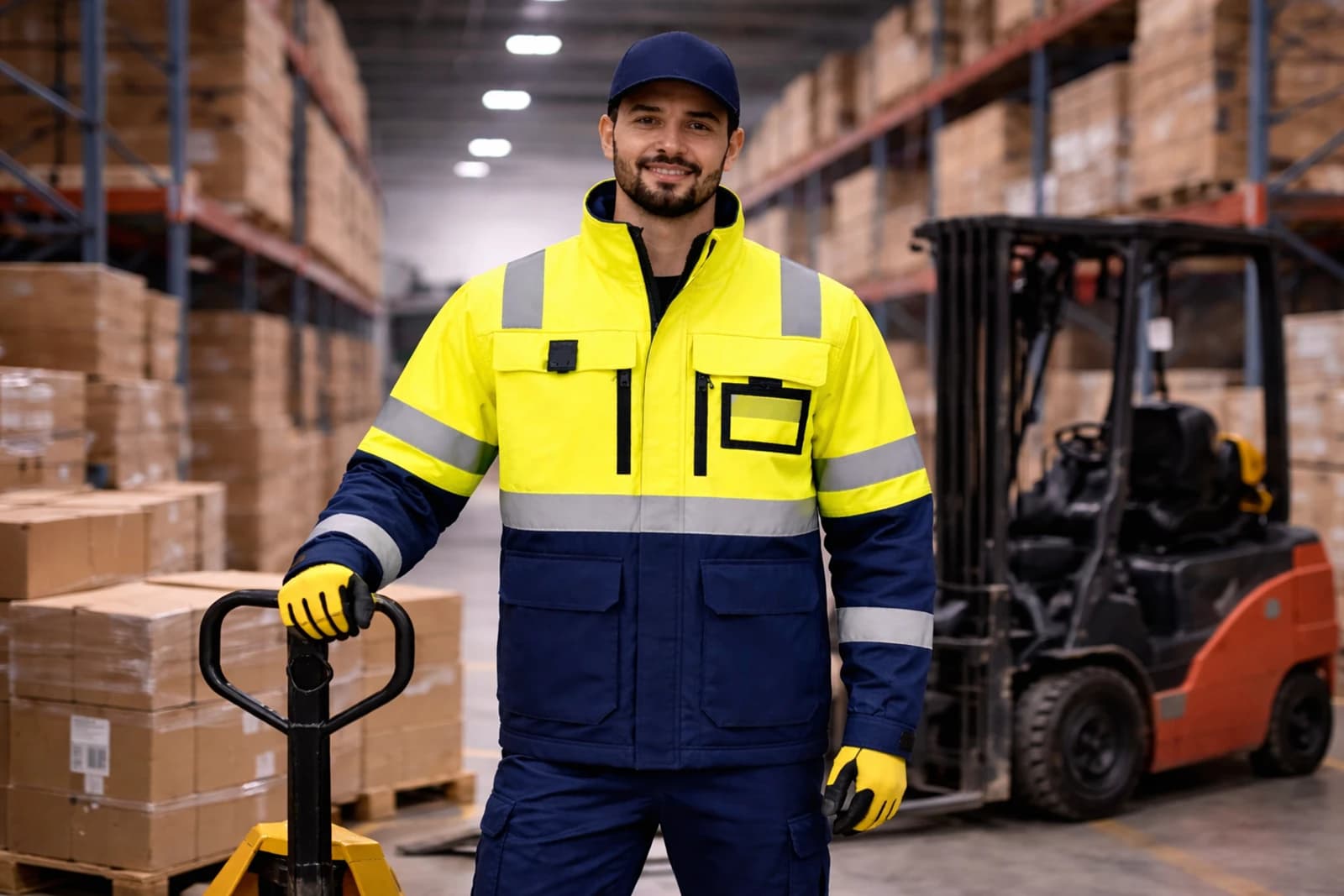
Safety Uniform
Hi-Vis Safety Jacket
Reflective safety jacket for high-visibility site operations and road work crews.
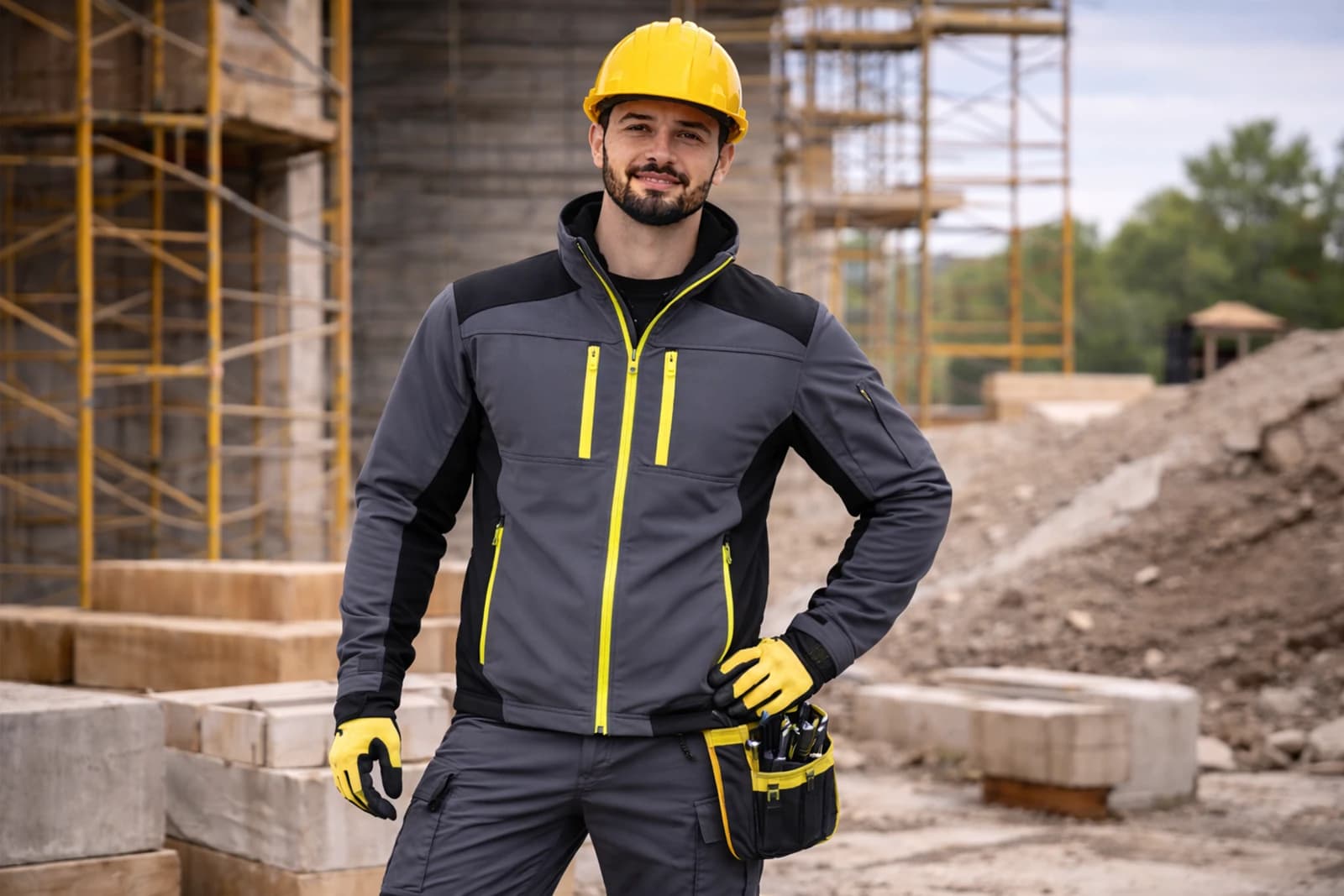
Construction Clothing
Construction Softshell Set
Flexible jacket and trouser set built for crews working across changing weather conditions.