Hi-Vis Safety Jacket: B2B Procurement Guide for Middle East Road & Construction Projects from China
From NEOM megaprojects to Qatar highway expansions, hi-vis safety jackets are mandatory PPE across Middle East construction and roadwork sites. This guide helps B2B buyers in the GCC source high-visibility jackets from a Chinese manufacturer — covering EN ISO 20471 / ANSI 107 compliance for Gulf climates, breathable fabric options for 50°C heat, reflective tape durability under abrasive desert conditions, and bulk procurement strategies for 1,000–10,000+ worker deployments.

Buyer context
What procurement teams run into
The Middle East is undergoing a historic construction boom. Saudi Arabia's Vision 2030 mega-projects — NEOM, the Red Sea Project, Diriyah Gate, Roshn housing developments — require hundreds of thousands of construction workers on active sites. Qatar's post-World Cup infrastructure continues expanding with the Lusail tram network and new industrial zones. The UAE's Dubai 2040 Urban Master Plan drives ongoing road and building projects across the emirate. Oman's Duqm Special Economic Zone is adding refinery and port facilities. Kuwait's Silk City and Mubarak Al-Kabeer Port developments demand large-scale construction workforce deployment. Across all these projects, two types of workers need hi-vis safety jackets daily: road construction crews operating near live traffic, and general construction workers on active build sites. For B2B buyers sourcing from a Chinese workwear manufacturer, recurring challenges arise: **Heat stress vs. mandatory hi-vis wear:** Gulf summer temperatures hit 50°C, yet hi-vis safety jackets must be worn on all roadwork and construction sites per local labour law. A standard polyester hi-vis vest or jacket traps heat against the body — workers on a Doha road project in July can lose 1.5 litres of sweat per hour under a non-breathable hi-vis shell. Some workers remove their hi-vis garments during breaks or "forget" them in their lockers, creating safety violations and fines for contractors. The challenge: finding a hi-vis jacket with adequate breathability (MVTR above 5,000 g/m²/24h) that still meets the fluorescent background and retroreflective area requirements of EN ISO 20471 Class 2 or 3, or ANSI/ISEA 107 Type R Class 3. **Reflective tape durability in abrasive desert conditions:** Road construction and concrete work generate airborne dust and grit. Reflective tape on hi-vis jackets operating in Saudi desert sites or Qatari road projects often begins delaminating at the edges within 4–6 weeks. The microscopic silica particles in desert sand act as abrasives — every brush against a concrete barrier or rebar cage scrapes micro-fragments off the tape surface. After 3 months, a jacket that passed the initial retroreflection test of 330 cd/lx/m² may have degraded to under 100 cd/lx/m², falsifying compliance. Many Chinese manufacturers use standard PET-based reflective tape with a 50–80 micron protective coating, but Gulf conditions require 120+ micron coatings or segmented ceramic-bead tape technology for adequate lifespan. **Fluorescent fabric fading under extreme UV:** The Middle East receives 3,500–4,000 hours of annual sunshine with UV indices of 11+ during summer afternoons. Hi-vis fluorescent yellow or orange fabrics — typically dyed with fluorescent pigments — are inherently prone to UV degradation. A hi-vis jacket that starts at the required minimum of 0.51 luminance factor (EN ISO 20471) may fade to 0.30 within 3–4 months of daily outdoor use in Riyadh or Abu Dhabi — below the legal threshold, rendering the jacket non-compliant. Buyers need clarity on which UV stabilisers and dye systems their Chinese manufacturer uses. Value-add option: suppliers offering pre-aged UV testing data (per ISO 105-B02, 100+ hours Xenon arc) give procurement teams confidence the garment will stay compliant through its intended 6–12 month service life. **Ventilation design for 50°C environments:** Standard hi-vis safety jackets are designed for European or North American climates where insulation is valued. A typical ANSI Class 3 jacket with a polyester shell, mesh liner, and solid front panel is unbearable at 45°C. Workers in the Gulf need hi-vis jackets engineered for hot climates: mesh back panels (allowing air exchange while maintaining fluorescent coverage minimums), breathable mesh side inserts, front zippers that allow partial opening, and lightweight fabric weights (120–150 gsm for the fluorescent shell material rather than 200+ gsm). Some Chinese manufacturers now produce EN ISO 20471 Class 2 hi-vis vests that are essentially mesh vests — these are the most practical for Gulf construction workers but lack the pocket capacity and durability for tradespeople carrying tools. **Dual compliance — EN ISO 20471 and ANSI 107:** Middle East projects often involve multinational contractors. A Saudi Aramco contractor may require ANSI 107 compliance (US standard) while a Qatari Diar project specifies EN ISO 20471 (EU standard). These standards differ in minimum background material area, tape width, tape placement, and testing methods. A jacket certified for EN ISO 20471 Class 3 does not automatically meet ANSI 107 Class 3 — the tape pattern requirements differ. Chinese manufacturers who hold dual certification for both standards on a single garment reduce the procurement headache for buyers supplying multinational project sites. The ideal scenario: one hi-vis jacket model with dual EN ISO 20471 Class 3 / ANSI 107 Type R Class 3 certification that covers roadwork and construction use across all Gulf states. **Sweat-related fabric degradation:** The combination of sweat (salt and urea), UV, and heat creates an aggressive chemical environment for hi-vis fabrics. Fluorescent dyes can shift in hue under repeated sweat saturation — yellow shifts toward green, orange shifts toward red. Reflective tape adhesive can fail when constantly moist. Zippers and closures can corrode (especially in coastal construction sites like Dubai's Palm Jumeirah or Doha's Lusail waterfront). Stainless steel or nickel-plated hardware is preferable to standard zinc-alloy for Gulf-use hi-vis garments. **Bulk sizing for multinational workforces:** Gulf construction workforces are heavily multinational — Indian and Pakistani masons, Nepalese labourers, Filipino carpenters, Bangladeshi general workers, Egyptian and Syrian foremen, European and American project managers. A single hi-vis jacket SKU in a "standard Asian" cut fits the majority of the South Asian workforce well, but the Egyptian foreman or American safety inspector needs a different proportion. Buyers often need to order at least two fit types (standard Asian and standard Western) for a single project. Measuring critical points — chest-to-waist ratio, sleeve length differential, and back length — across the target workforce before commitment is critical. **Procurement documentation and site acceptance:** Major Middle East contractors — Saudi Binladin Group, Al Habtoor, CCC, Larsen & Toubro (active in Gulf projects) — require certificates of conformity for PPE before accepting delivery. A hi-vis jacket shipment can be rejected at the site gate if the fluorescent class or retroreflective performance doesn't match the specification. Test reports from ISO 17025-accredited labs, preferably in the region (Qatar's TUV莱茵 lab, Saudi SASO, UAE's ESMA), carry more weight than Chinese domestic test reports. Buyers should request pre-shipment testing of a production sample at an approved third-party lab before committing to bulk production.
Sourcing approach
How a factory partner can respond
## The Practical Procurement Path for Hi-Vis Safety Jackets in the Gulf B2B sourcing of hi-vis safety jackets for Middle East construction and road projects doesn't have to be a compliance minefield. Here's the structured approach that works for GCC buyers dealing with Chinese workwear manufacturers. ### 1. Start with Climate-Specific Fabric Specifications Don't accept a generic hi-vis jacket spec sheet. Insist on Gulf-adapted fabric parameters in your RFQ: - **Fluorescent shell fabric:** 120–150 gsm polyester or poly/cotton blend rated for 100+ hours Xenon-arc UV exposure (ISO 105-B02) without dropping below required luminance factor - **Retroreflective tape:** 50 mm wide, segmented ceramic-bead or microprismatic technology, 120+ micron protective coating — tested for retroreflection retention after 25 industrial launderings per ISO 20471 - **Breathability:** Minimum MVTR of 5,000 g/m²/24h (ISO 15496 or ASTM E96) - **Hardware:** Stainless steel or nickel-plated zippers, no zinc-alloy components - **Ventilation:** Mesh back panel (minimum 40% mesh coverage of the rear fluorescent area) and side gussets for airflow while maintaining compliance area minimums ### 2. Prioritise Dual Certification (EN ISO 20471 + ANSI 107) Specify that the jacket must carry both certifications on a single garment. This covers all Gulf construction environments — Qatari and UAE sites typically specify EN ISO 20471, while Saudi Aramco and US-contractor sites specify ANSI 107. Dual certification eliminates inventory splitting and simplifies procurement for contractors working across multiple Gulf states. For roadwork applications, specify Class 3 (EN) or Type R Class 3 (ANSI) — the highest visibility level, with minimum 0.80 m² background material area and 0.20 m² retroreflective area. For general construction where workers aren't exposed to high-speed traffic, Class 2 or Type R Class 2 is sufficient and provides better breathability due to less fabric coverage. ### 3. Test in Gulf Conditions Before Bulk Commitment Order 5–10 pre-production samples and subject them to: - **UV fade test:** 100 hours Xenon-arc (ISO 105-B02) — measure luminance factor before and after - **Retroreflection retention:** 25 wash cycles per EN ISO 20471 Annex A — measure cd/lx/m² - **Abrasion resistance of tape:** Taber abrasion (ASTM D3884) with CS-10 wheels, report retroreflection after 1,000 cycles — simulates desert sand abrasion - **Sweat fastness:** ISO 105-E04 (acid and alkaline) — check for dye shift on the fluorescent fabric - **Comfort trial:** Have 3 workers of different sizes wear the jacket for a full 8-hour shift at ambient 45°C+ and report on moisture accumulation, heat buildup, and fit satisfaction ### 4. Audit the Tape Supplier, Not Just the Garment Supplier The reflective tape is the most critical (and most commonly failing) component on a hi-vis jacket. Ask your Chinese manufacturer: - Who supplies the reflective tape? (Brand names: 3M Scotchlite, Orafol, Avery Dennison, or Chinese alternatives like Yeshili, Huaxing, Lingxiu) - What is the tape's certified retroreflection value and tested wash durability? - Is the tape adhesive rated for 50°C+ continuous operating temperature? Tape from 3M Scotchlite carries higher unit cost but offers proven performance in Gulf conditions. Chinese proprietary tapes can be adequate if independently tested and certified — require the test report, not just a claim. ### 5. Structure Your Bulk Order Smartly For a 5,000-unit deployment across a Gulf construction project: | Specification | Recommendation | |---|---| | Class/Type | EN ISO 20471 Class 3 or ANSI Type R Class 3 | | Shell fabric | 140 gsm fluorescent yellow or orange, UV-stabilised | | Tape | 50 mm microprismatic, 3M or certified equivalent | | Ventilation | Full mesh back panel + mesh side gussets | | Fit split | 60% Asian fit / 40% Western fit | | Sizes | 5 sizes per fit (S, M, L, XL, 2XL) | | Unit weight | Under 400 g for heat comfort | | Certification docs | Third-party ISO 17025 test report (EU or GCC lab) | | MOQ per SKU | 500 pcs | ### 6. Plan for Seasonal Replenishment Hi-vis jackets in Gulf construction have a shorter effective life than in temperate climates — typically 6–9 months before UV fading or tape degradation requires replacement. Budget for annual replenishment cycles and negotiate annual framework agreements with your Chinese manufacturer to lock in pricing and quality consistency across multiple project phases. ## Recommended Products Pair your hi-vis jacket procurement with complementary workwear items for a coordinated construction-site uniform package: **Hi-Vis Safety Jacket** — EN ISO 20471 Class 3 / ANSI 107 Type R Class 3 certified, available in fluorescent yellow and orange with segmented microprismatic tape. Mesh back panel for ventilation, 140 gsm UV-stabilised fabric, stainless steel hardware. Ideal for road construction, highway maintenance, and active build-site use across Gulf states from 45°C summer to 15°C winter nights. **Construction Softshell Set** — For project supervisors, safety inspectors, and workers in cooler conditions (Gulf winter night shifts, elevated structures, air-conditioned environments). Water-resistant breathable softshell fabric with hi-vis trims — extends the hi-vis theme into a professional uniform tier above basic safety wear.
Recommended Products
Products that fit this use case
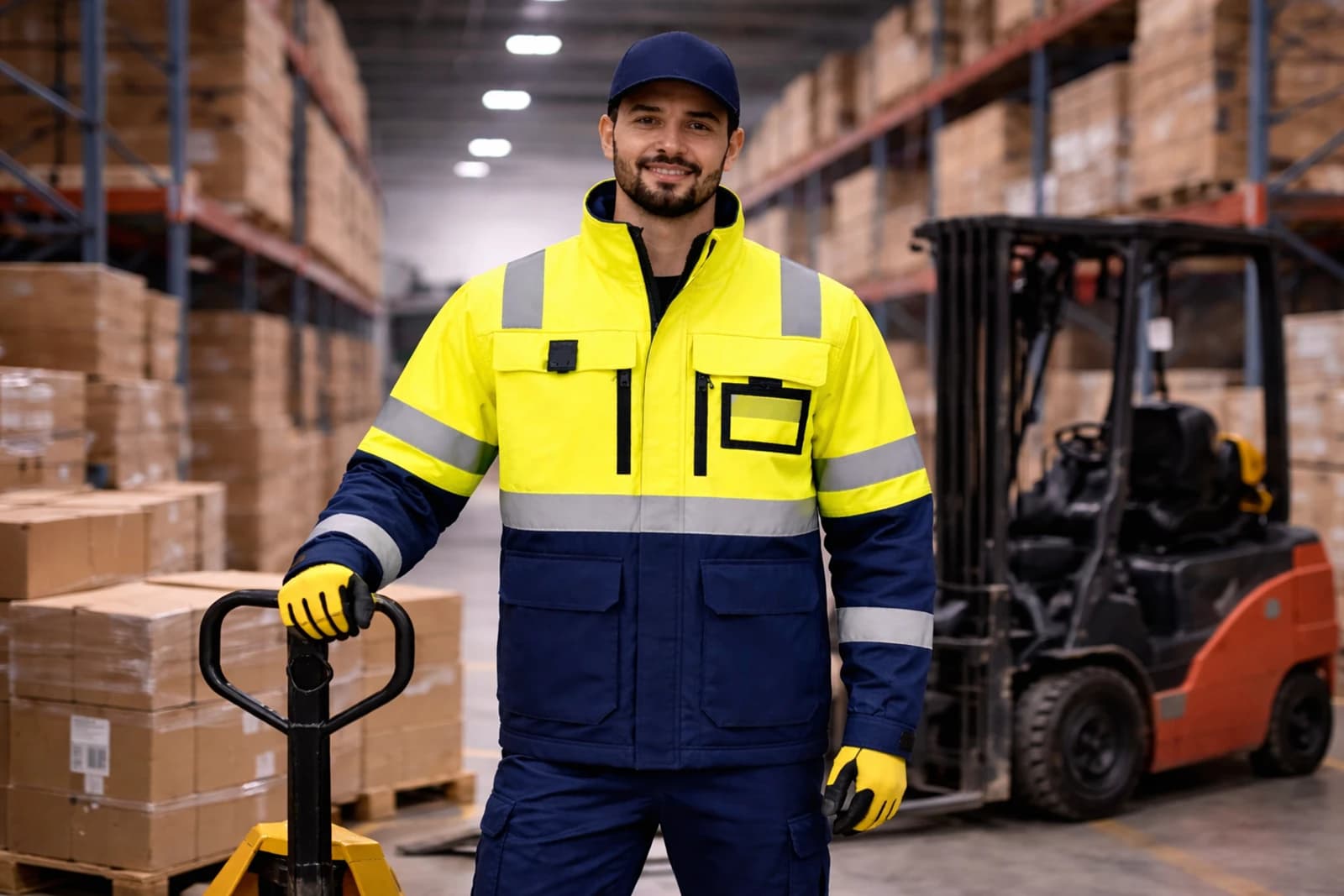
Safety Uniform
Hi-Vis Safety Jacket
Reflective safety jacket for high-visibility site operations and road work crews.
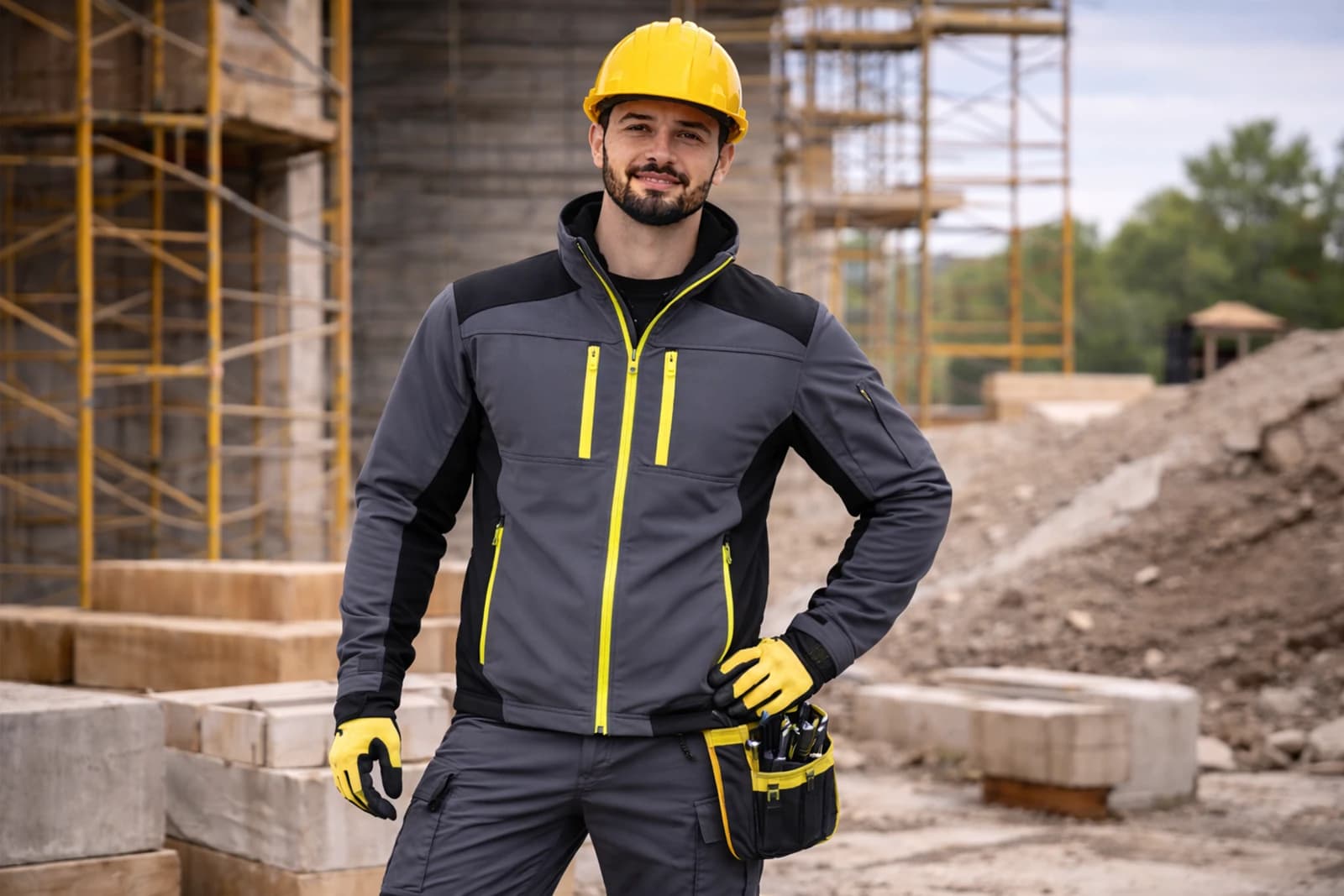
Construction Clothing
Construction Softshell Set
Flexible jacket and trouser set built for crews working across changing weather conditions.