Hi-Vis Safety Jackets for Middle East Oil & Gas & Infrastructure: B2B Sourcing Guide from a Chinese Workwear Manufacturer
Middle East oil & gas and infrastructure megaprojects demand hi-vis safety jackets that survive 50°C heat, sandstorms, and petrochemical exposure. This guide covers what B2B buyers in Saudi Arabia, UAE, Qatar, and Oman should evaluate when sourcing high-performance hi-vis safety jackets from a Chinese workwear manufacturer — from EN ISO 20471 compliance and fabric technology to customisation for corporate identity and desert-adapted design features.

Buyer context
What procurement teams run into
Middle East oil & gas and infrastructure sectors are in a historic expansion phase. Saudi Arabia's NEOM, Red Sea Project, and the Jafurah gas field development alongside Qatar's North Field Expansion and UAE's ADNOC downstream projects are creating massive demand for personal protective equipment — specifically hi-vis safety jackets. For B2B procurement managers, safety officers, and industrial uniform buyers sourcing from Chinese workwear manufacturers, the challenge is getting a hi-vis safety jacket that simultaneously meets international safety standards, performs in the region's most punishing climate, and fits the diverse workforce that dominates Middle East construction and energy sites.\n\nA hi-vis safety jacket in the Middle East is not the same product as one sold in Europe or North America. The thermal environment — summer ambient temperatures of 45–55°C, direct ground surface temperatures exceeding 70°C, and high humidity in coastal zones like Abu Dhabi's Ruwais or Qatar's Ras Laffan — demands breathable, lightweight materials that do not compromise visibility or protection. Sand and dust particulate abrasion, UV radiation levels 2–3 times higher than European averages, and exposure to hydrocarbons, drilling fluids, and chemicals in oilfield environments further complicate the specification. Getting it wrong means heat stress incidents, short replacement cycles, and non-compliance fines.\n\n**1. Compliance to EN ISO 20471 Class 3 for Middle East projects.** The single most important specification for hi-vis safety jackets in Middle East oil & gas and infrastructure is EN ISO 20471 Class 3 certification. This is explicitly required in Saudi Aramco standards (SAES-T-931 and GI-76.102), ADNOC HSE standards, QatarEnergy's PPE specifications, and most international contractor standards on Gulf megaprojects. Class 3 requires minimum 0.80 m² of fluorescent background material and 0.20 m² of retroreflective tape. However, Middle East B2B buyers should request two compliance proofs from the Chinese manufacturer: a valid EU-type examination certificate from a notified body (e.g., SATRA, BSI, SGS, or TÜV SÜD) AND in-country testing or accredited supplier declaration verifying that the specific production batch shipped to the Middle East matches the certified sample. A common pitfall is a manufacturer holding certification for a jacket made with 3M Scotchlite or Orafol retroreflective tape but shipping jackets with lower-grade tape to cut costs. Ask for traceability — each jacket should have a lot number or serial tracking back to the certified production run, particularly for contracts above 5,000 units.\n\n**2. Fabric selection for extreme heat and breathability.** The fatal flaw of most off-the-shelf hi-vis jackets in Middle East conditions is heat buildup. A typical European Class 3 hi-vis jacket uses a 100% polyester 190T taffeta or oxford weave that traps heat and humidity. For the Gulf, the fabric must be engineered for thermal comfort. The preferred specification is a 150–170 gsm microporous breathable polyester fabric with a moisture vapour transmission rate (MVTR) of minimum 6,000 g/m²/24h (ASTM E96 inverse cup method) — this level allows sweat vapour to escape while blocking wind and light rain. For the inner lining, choose a mesh-back or honeycomb structure (not solid taffeta) that creates a 3–5 mm air gap between fabric and skin. Some leading Chinese manufacturers now offer phase-change material (PCM) lining inserts that absorb body heat and release it when the wearer moves to cooler environments like air-conditioned vehicle cabs — these are still premium options but worth considering for high-value oilfield operator roles. The fluorescent fabric must maintain its colour stability after 50 industrial launderings at 75°C per ISO 105 C06; request fade-test reports showing delta-E values of less than 4.0 post-laundering.\n\n**3. Retroreflective tape durability for desert and petrochemical environments.** The retroreflective tape is the most expensive component of a hi-vis jacket and the most failure-prone in Gulf conditions. Standard silver-glass-bead tape (EN 20471 level 1–2) is inadequate for Middle East oil & gas applications. Specify microprismatic tape (e.g., 3M 8920 or Orafol 3200 series) with at least 330 cd/(lux·m²) retroreflection per EN 20471 — microprismatic tape maintains 70–80% of its reflective performance after 25 industrial launderings, compared to 30–40% for glass-bead types. More critically, for petrochemical environments, the tape must be hydrocarbon-resistant: ask for verification of resistance to mineral oil, crude oil, and diesel fuel exposure per ISO 175 or internal test methods. Tape peeling is the number-one field failure in Gulf hi-vis jackets, often caused by adhesive breakdown at 60°C+ surface temperatures on the back of a jacket worn in direct sun. Specify heat-activated adhesive tape with a peel strength of minimum 15 N/cm (EN 1939) and confirm the Chinese manufacturer uses a high-temperature calendering process (not cold-roll lamination) for tape application. Some B2B buyers also specify an additional ultrasonic welded seam on tape edges for jackets intended for offshore or coastal oil & gas operations where salt spray accelerates adhesive degradation.\n\n**4. Desert-adapted design features.** Beyond standards and fabrics, the physical design of a hi-vis safety jacket for Middle East use must account for regional work patterns and environmental conditions. Key features to specify: a stand-up mandarin-style collar with a sweat-absorbent inner band (terry cloth or Coolmax insert) to protect the neck from 70°C surface temperatures on vehicle seats and hard hats; a detachable hood stored in the collar with drawcord stops rated for sand resistance (no exposed metal toggles that heat up in the sun); zippered hand-warmer pockets lined with microfleece — not for warmth, but as a place to keep phones and tablets safe from sand abrasion, with YKK or SBS zippers rated for 20,000+ open-close cycles; a radio-compatible chest pocket with a clear PVC window and a microphone loop on the non-dominant shoulder; and side elastic webbing or shock cord hem adjustment to keep the jacket from ballooning in wind — a common hazard on elevated platforms and crane-adjacent work zones.\n\n**5. Sizing for the Middle East workforce.** The Middle East construction and oil & gas workforce is one of the most diverse in the world — South Asian labour (Indian, Pakistani, Nepali, Bangladeshi workers dominate general construction), Arab engineers and supervisors, Filipino and Indonesian technicians, and local nationals in safety and management roles. A single sizing standard will fail for a 3,000-worker camp. Chinese manufacturers exporting to the Middle East should offer a bespoke sizing programme: a minimum range from 2XS (EUR 44 chest) to 5XL (EUR 70+ chest) with length-adjusted variants. The critical regional adjustment is that the average South Asian and African-origin workforce has a broader chest-to-height ratio than the standard Caucasian pattern on which most Asian factories base their grading. A worker at 170 cm with a 115 cm chest needs a jacket that fits his chest without sleeves reaching his knuckles. Specify a "Middle East fit" block — shorter body length (+2–3 cm shorter than the standard block for each size) with proportionally wider chest and shoulder measurements. For oil & gas sites that also serve women (increasingly common at Saudi Aramco and ADNOC facilities), offer women-specific jacket patterns with a narrower shoulder, graded waist suppression, and shorter arm length — not just scaled-down men's jackets.\n\n**6. Custom branding and corporate identity integration.** Megaproject contractors in the Middle East — Bechtel, KBR, Saipem, Petrofac, Larsen & Toubro, Samsung Engineering, and local giants like Saudi Binladin Group and CCC — use hi-vis jacket programmes as visible safety branding across their project sites. The jacket must support multiple customisation points: chest embroidery (left and right), back-of-neck company logo heat-transfer, upper-arm reflective logo insert, and detachable name tag panels. Embroidery specifications for the Gulf region must account for Arabic script on company logos — Arabic calligraphy requires a minimum stitch density of 12,000 stitches per 100 cm² for clean rendering of diacritical marks. Recommend embroidery thread certified to ISO 105 C06, colourfast to 75°C laundering and UV exposure. For the growing trend of QR-code safety badges on jackets (scanning to display the worker's certifications, training expiry, and medical data), the Chinese manufacturer should provide a sealed vinyl patch pocket sized to standard credit-card dimensions (86 × 54 mm) on the upper sleeve, with a clear PVC window — this is increasingly mandated by Saudi Arabia's Tawteen and Nitaqat workforce compliance programmes on large projects.\n\n**7. Quantity-based specification tiers for B2B procurement.** Not every contract needs the same jacket spec. Chinese workwear manufacturers typically offer tiered pricing and construction levels:\n\n**Economy tier (1,000–5,000 units, ~$18–$28/jacket):** 120 gsm polyester oxford, glass-bead tape (EN 20471 Class 3 minimum), standard YKK zippers, no lining mesh, minimum 25-laundering guarantee. Suitable for general labour and short-term project staff.\n\n**Standard tier (5,000–20,000 units, ~$28–$45/jacket):** 150–170 gsm microporous breathable fabric, microprismatic tape (3M 8920 or equivalent), mesh lining, fleece-lined collar, storm flap, 50-laundering guarantee with colourfast and retroreflective retention. Suitable for site supervisors, skilled operators, and long-term project workforce.\n\n**Premium tier (20,000+ units, ~$45–$70/jacket):** 200+ gsm laminated fabric with waterproof-breathable membrane (PU or ePTFE), full microprismatic taping including segmented side panels, PCM thermal lining for oilfield cold-start mornings, radio pocket with antenna slot, RFID badge pocket integration, 75+ laundering certification, and extended warranty against tape peeling and seam failure. Suitable for offshore, remote oilfield, and senior site personnel.\n\n**8. Logistics, lead times, and compliance documentation.** Middle East megaprojects operate on tight construction schedules with penalties for late deliveries. B2B buyers should secure from the Chinese manufacturer: confirmed lead times (typically 45–60 days for first order with customisation, 25–35 days for repeat orders), sample approval turnaround (7–10 days including fitting samples for size-grading verification), and a dock-to-dock delivery commitment to the nearest Gulf port (Jebel Ali Dubai, King Abdulaziz Port Dammam, Hamad Port Qatar, or Sohar Port Oman) with air freight contingency for urgent top-ups. Most critically, demand a full compliance document package with each shipment: EU-type examination certificate (CE marking), EN ISO 20471 test report from an accredited lab, material safety data sheets (MSDS) for all fabric and components, SDS for retroreflective tape, and a certificate of origin for preferential GCC customs duty treatment under the Greater Arab Free Trade Area (GAFTA).
Sourcing approach
How a factory partner can respond
When sourcing hi-vis safety jackets from a Chinese workwear manufacturer for Middle East oil & gas and infrastructure projects, the winning specification balances four factors: certified EN ISO 20471 Class 3 compliance with auditable traceability, breathable microporous fabric with MVTR above 6,000 g/m²/24h for Gulf heat management, microprismatic retroreflective tape with hydrocarbon resistance for petrochemical environments, and design features adapted to desert conditions — from sweat-absorbent collars to sand-resistant pockets and Middle East-fit sizing blocks. Pair hi-vis safety jackets with construction softshell sets for site supervisors who need a lighter, breathable upper-body option in moderate temperatures, and with industrial coverall pro for workers who require full-body protection in oilfield and hazardous zones. B2B buyers should also consider logistics polo uniforms for office and warehouse staff, creating a consistent safety-brand identity across all project personnel.
Recommended Products
Products that fit this use case
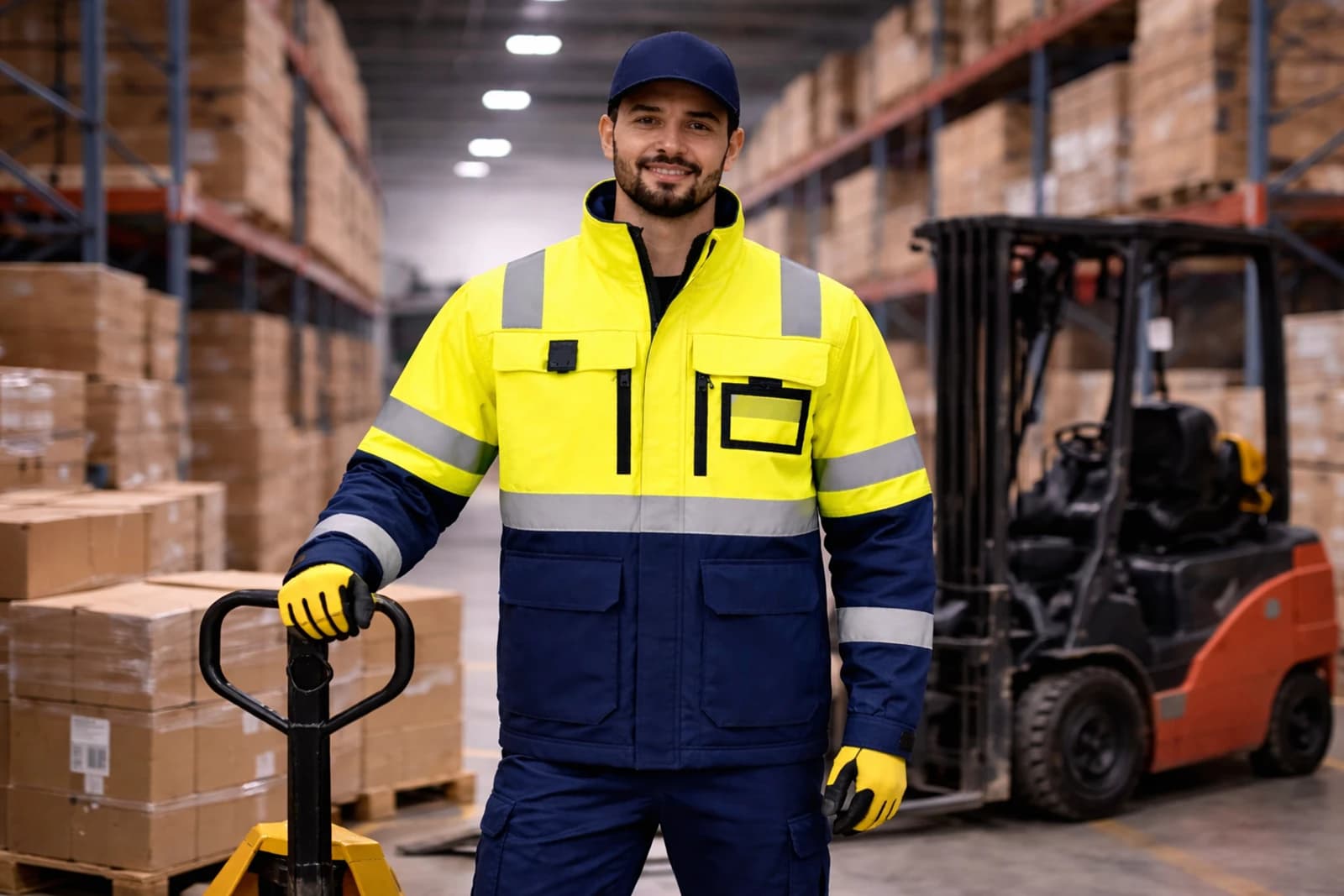
Safety Uniform
Hi-Vis Safety Jacket
Reflective safety jacket for high-visibility site operations and road work crews.
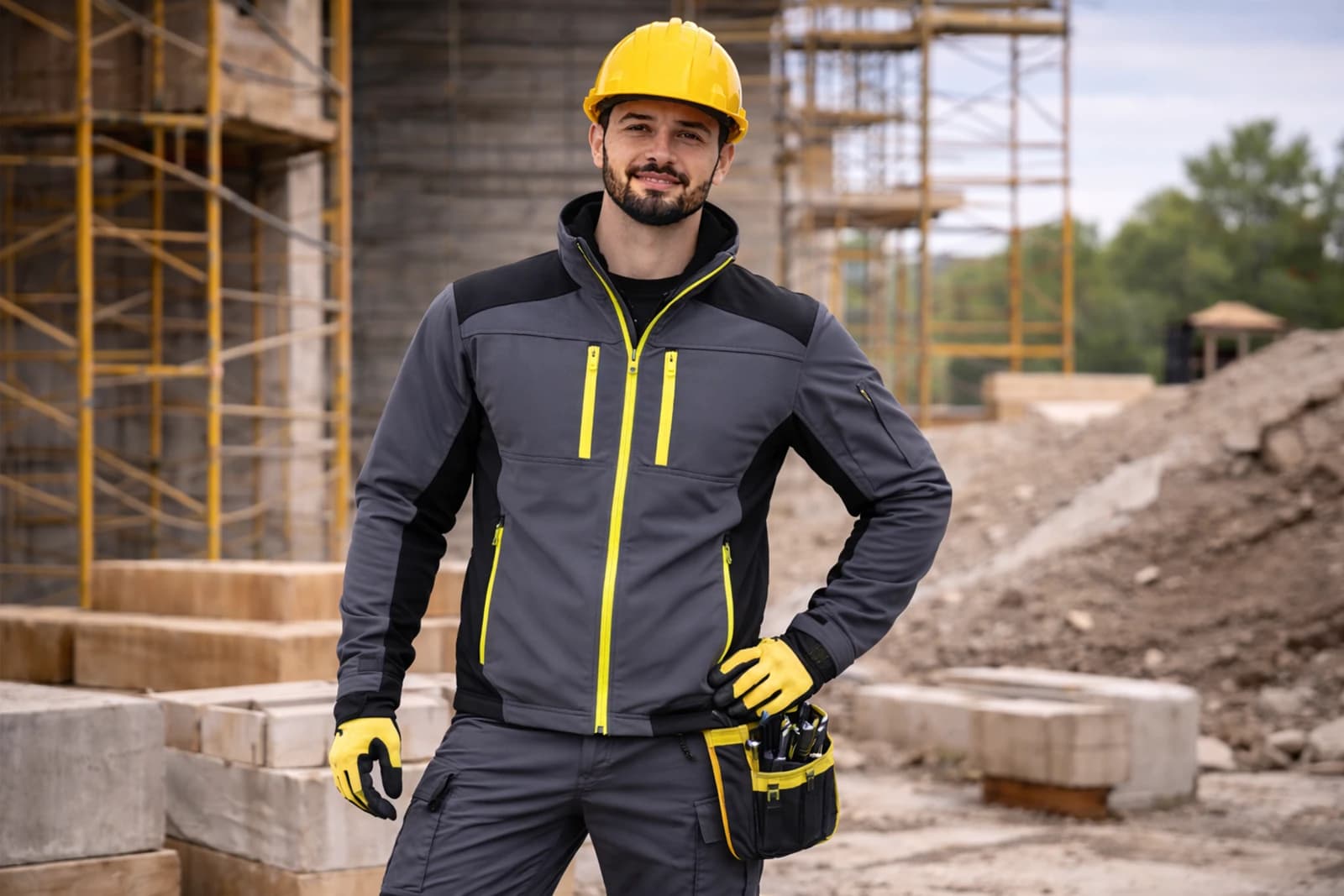
Construction Clothing
Construction Softshell Set
Flexible jacket and trouser set built for crews working across changing weather conditions.
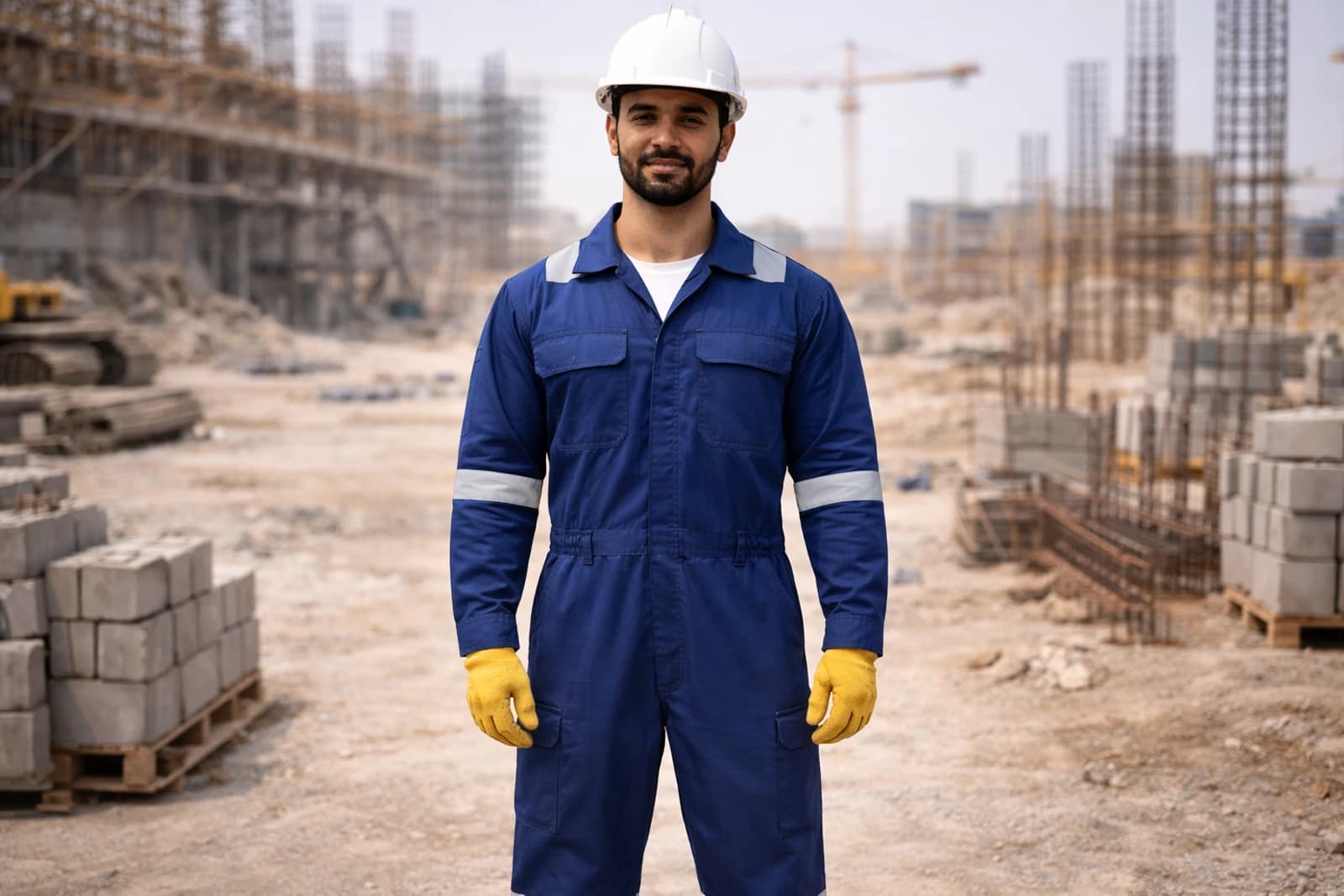
Industrial Workwear
Industrial Coverall Pro
Hard-wearing one-piece coverall for plant, maintenance, and heavy-duty operations.

Logistics Uniform
Logistics Polo Uniform
Breathable uniform polo for warehouse, delivery, and last-mile teams.