Hi-Vis Safety Jackets & Logistics Polo Uniforms: Sourcing Workwear for Middle East Airport Ground Operations
Middle East airports are expanding at unprecedented scale. Dubai World Central (Al Maktoum International) is being expanded to handle 200+ million passengers annually, Hamad International Airport in Qatar is undergoing a major expansion, King Salman International Airport in Riyadh will be one of the world's largest when completed, and airports across the Gulf (Muscat, Bahrain, Kuwait, Amman) are all scaling up. Behind every flight is a ground operations workforce — ramp agents, baggage handlers, aircraft marshals, fuel truck drivers, catering truck operators, de-icing crews, and supervisors — who work in one of the most safety-critical environments on earth. These workers need workwear that balances high-visibility safety, professional appearance, and comfort in extreme Gulf heat. This sourcing guide for Middle East B2B buyers covers hi-vis safety jackets, logistics polo uniforms, fabric specifications for airport environments, compliance (EN ISO 20471), custom branding, and volume procurement from a Chinese workwear manufacturer.
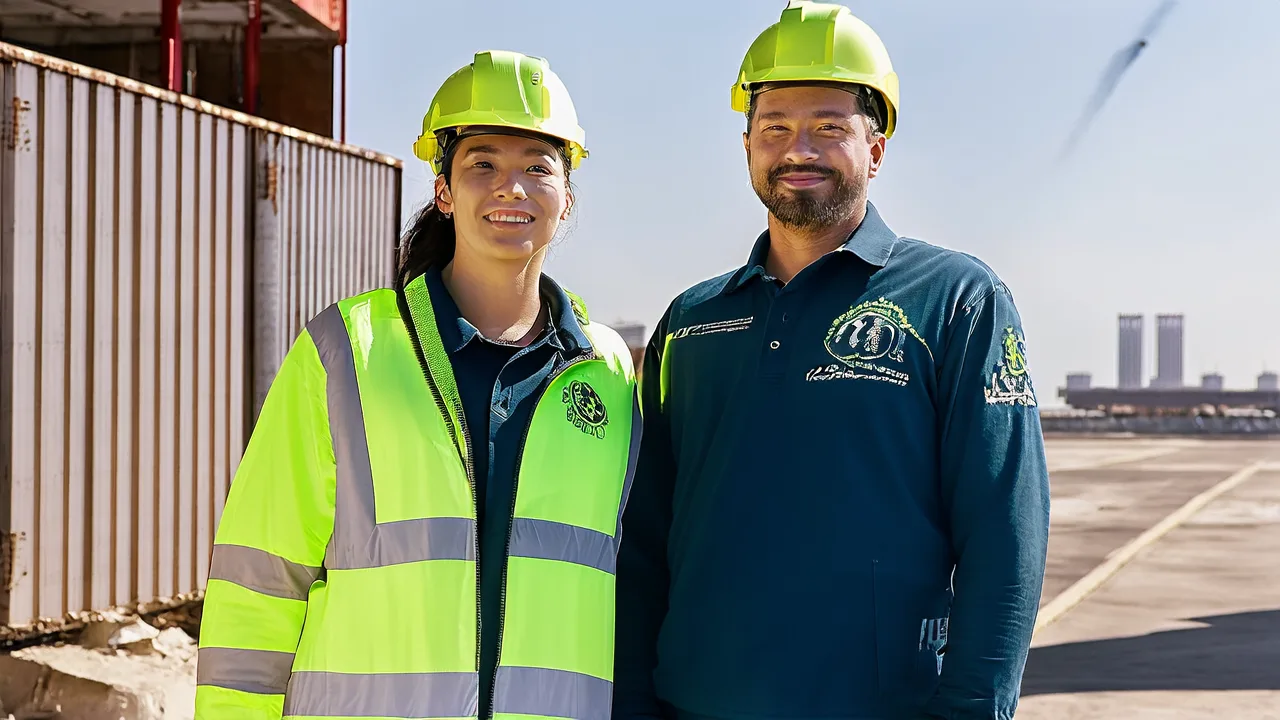
Buyer context
What procurement teams run into
The Middle East's airport infrastructure is entering a phase of unprecedented expansion. Dubai World Central (Al Maktoum International) is being expanded to handle over 200 million passengers annually, making it the world's largest airport by capacity. Hamad International Airport in Qatar is undergoing a major expansion to serve Qatar's growing role as a global aviation hub. King Salman International Airport in Riyadh, when completed, will be one of the world's largest airports, serving Saudi Vision 2030's tourism and business travel goals. Muscat International Airport, Bahrain International Airport, Kuwait International Airport, and Queen Alia International Airport in Amman are all scaling up capacity and route networks. Behind every flight — every arrival, every departure, every turnaround — is a ground operations workforce that works in one of the most safety-critical environments on earth. Ramp agents guide aircraft to gates, baggage handlers load and unload cargo holds, aircraft marshals direct aircraft movements on the apron, fuel truck drivers deliver jet fuel to aircraft, catering truck operators lift food service carts to aircraft doors, de-icing crews spray aircraft wings in winter conditions, and supervisors coordinate the entire operation in real time. These workers operate in an environment where vehicles, aircraft, and people share the same confined space — the apron, the taxiway, the baggage handling area, the cargo terminal. A worker in standard clothing is hard to see, especially at dawn, dusk, under overcast skies, or under sodium lighting at night. High-visibility clothing is not optional — it is a safety requirement enforced by airport authorities, airlines, and ground handling companies. For B2B buyers procuring workwear for airport ground operations, the challenge is specific: **1. The airport apron environment is unlike any other industrial setting** An airport apron combines several hazards in one location: - **Aircraft and vehicle traffic.** Aircraft taxi at low speed but with massive momentum. Tugs, belt loaders, catering trucks, fuel trucks, and baggage tractors move constantly. Workers on foot share these routes — visibility is critical. - **Jet blast and prop wash.** Workers near aircraft engines face high-velocity air streams that can reach 100+ km/h during taxi and pushback. Loose clothing or poorly fitted garments are a safety hazard. - **Fuel and chemical exposure.** Jet fuel (Jet A-1) is present on the apron in large quantities. Workers need garments that resist fuel stains and can be laundered frequently without degradation. - **Noise and communication.** Aircraft engines, ground power units, and vehicle engines create a high-noise environment. Visual recognition (hi-vis clothing) is as important as auditory signals for safety. - **Extreme heat and sun exposure.** Gulf airports are open, unshaded environments. Ramp agents work in direct sun for full shifts, with ambient temperatures of 45–50°C in summer plus radiant heat from tarmac surfaces. - **Shift work across all lighting conditions.** Airport operations run 24/7. Workers transition between daylight, dawn, dusk, night, and artificial lighting — hi-vis clothing must perform in all conditions. **2. Hi-vis safety jackets for ramp agents, baggage handlers, and aircraft marshals** For workers who spend significant time on the apron, near aircraft, or in vehicle zones, the hi-vis safety jacket is the primary safety garment. Key specifications when sourcing from a Chinese manufacturer: **Fabric weight and composition.** Specify lightweight polyester 210–240gsm with mesh lining for Gulf conditions. Heavy hi-vis jackets are unbearable in 45°C summer heat — workers will remove them, defeating the safety purpose. A mesh-lined jacket allows air flow while keeping retroreflective tape visible. **EN ISO 20471 Class 2 or Class 3.** Class 3 offers the highest retroreflective coverage and is the right call for workers who spend significant time near moving aircraft and vehicles — ramp agents, aircraft marshals, and fuel truck drivers. Class 2 suits baggage handlers and cargo terminal staff who work in more confined areas. Many Chinese manufacturers make both, and the price difference at volume is modest. **Fluorescent background and retroreflective tape.** Specify fluorescent yellow-green or orange fabric with retroreflective tape positioned to EN ISO 20471 geometry. The tape must be on the torso, arms, and around the shoulders for full-class coverage. Confirm the tape meets EN ISO 20471 minimum retroreflective intensity (typically 330 cd/lx/m² for Class 3). **Practical details for airport work.** Two-way front zip (workers bend, crouch, and climb constantly), zipped side pockets that close securely so phones and tools don't fall out (foreign object debris on the apron is a serious safety hazard), adjustable cuffs, and a DWR finish with 5,000mm+ hydrostatic head for coastal humidity and brief rain. **Fuel resistance.** Specify fabric and tape that resist jet fuel (Jet A-1) staining and degradation. Airport workers are exposed to fuel spills and splashes regularly — garments must maintain visibility and retroreflective performance after fuel contact and repeated laundering. **3. Logistics polo uniforms for supervisors, coordinators, and customer-facing staff** Airport ground operations employ supervisors, ramp coordinators, operations managers, customer service agents, and airline representatives who spend significant time in terminals, operations control centers, and client-facing areas. These roles need a professional, brandable garment that still performs in Gulf heat. The logistics polo uniform is the right choice. Key specifications: **Fabric.** 180–220gsm pique knit in 65% polyester / 35% cotton. The poly-cotton blend provides easy-care performance, quick drying, and good durability for daily industrial washing. For outdoor-facing supervisors who split time between the apron and the operations office, specify moisture-wicking treatment and UPF 30+ sun protection. **Collar and trim.** A ribbed collar with contrast piping or two-tone detailing looks professional and makes airline or ground handler branding stand out. Tonal buttons and a clean placket lift perceived quality. For Gulf conditions, the collar must hold its shape after repeated washing — cheap collars curl and look sloppy in client meetings. **Branding.** Embroidered chest logos are the standard for airlines and ground handling companies. Embroidery lasts through industrial laundering and harsh sun better than screen print. Specify Pantone colour matching so every batch is consistent. For larger fleets, add woven name tapes and role patches (e.g., "RAMP SUPERVISOR," "OPERATIONS MANAGER," "CUSTOMER SERVICE") — cheap at volume and genuinely professional. **Sizing.** Gulf airport workforces are multinational — Emirati, Saudi, Indian, Pakistani, Filipino, Egyptian, European specialists. Specify a size range from 2XS through 4XL with Middle East / South Asian body proportions. Ask the manufacturer for a full size-run sample before mass production. **4. The hi-vis jacket and polo system for complete airport ground operations uniform** The smartest procurement approach treats hi-vis jackets and polos as a unified uniform system: **Ramp and apron operations:** All ramp agents, baggage handlers, aircraft marshals, and fuel truck drivers in hi-vis jackets over polo uniforms. Supervisors in polos with hi-vis vests or jackets. Operations coordinators in polos with company branding. **Cargo terminal operations:** Baggage handlers and cargo loaders in hi-vis jackets or vests. Cargo terminal supervisors and coordinators in branded polos. Customer-facing cargo service agents in polos with airline branding. **Terminal and customer-facing roles:** Customer service agents, gate agents, and airline representatives in branded polos. Operations managers and supervisors in polos with company branding and role patches. This system means one colour palette, one branding scheme, one manufacturer, and one procurement process covering all ground operations roles — from the apron to the terminal. **5. Compliance and testing for airport workwear** Relevant standards for Middle East airport ground operations: - **EN ISO 20471** — high-visibility clothing. Class 2 or Class 3 depending on role and proximity to aircraft/vehicles. Insist on third-party test reports from accredited labs (SGS, TÜV, Intertek, Bureau Veritas) covering retroreflective performance after washing and fabric colour fastness. - **EN ISO 13688** — general requirements for protective clothing (ergonomics, sizing, ageing, marking). Applies to both hi-vis jackets and polos. - **ISO 105** — colour fastness testing. Gulf sun fades poor dyes rapidly. Specify ISO 105-B02 (xenon arc fade testing) and ISO 105-C06 (colour fastness to industrial laundering). - **OEKO-TEX Standard 100** — restricted substances. Workers in extreme heat sweat heavily; skin contact with harmful chemicals is a real concern. - **Airport-specific requirements.** Many airports (Dubai, Doha, Riyadh) have internal HSE standards that exceed national regulations. Confirm the manufacturer can meet airport-specific requirements for hi-vis performance, fuel resistance, and labelling. **6. Procurement strategy for airport ground operations buyers** Airport ground operations have distinctive procurement patterns: **Volume and frequency.** A mid-size Gulf airport employs 500–2,000 ground operations staff. Order hi-vis jackets in bulk (500–2,000 units) for initial fleet outfitting, then reorder quarterly for replacements (hi-vis jackets typically last 6–12 months in heavy use). Order polos in larger volumes (1,000–3,000 units) with annual reorders. **Consolidate orders.** Order hi-vis jackets and polos in one shipment to reduce freight costs and simplify customs clearance at Dubai, Doha, or Riyadh airports. A Chinese manufacturer with in-house capability for both garment types can produce and ship them together. **Plan for seasonal timing.** Order hi-vis jackets 3–4 months before peak travel seasons (summer Hajj, winter holidays, Eid periods). Avoid ordering for summer delivery during Ramadan production slowdowns. Airport operations peak during these periods — ensure your workforce is fully outfitted before the rush. **Stock buffer.** Order 15–20% buffer stock above annual requirements. Hi-vis jackets wear out quickly on the apron — retroreflective tape degrades, fabric fades, and zippers fail. Reordering small batches of custom-branded garments costs far more per unit than including them in the original production run. **Pilot before full volume.** Order 50–100 hi-vis jackets and 50–100 polos for a trial fitting before committing to the full fleet order. Adjust sizing, fabric weight, or pocket placement based on field feedback from ramp agents and supervisors.
Sourcing approach
How a factory partner can respond
The solution for Middle East airport ground operations is a two-garment workwear system — EN ISO 20471 Class 2/3 hi-vis safety jackets for ramp agents, baggage handlers, aircraft marshals, and fuel truck drivers working near aircraft and vehicles, paired with branded logistics polo uniforms for supervisors, coordinators, and customer-facing ground staff — sourced from a single Chinese workwear manufacturer for consistent branding, consolidated shipping, and volume pricing. **For hi-vis safety jackets (apron and ramp operations):** - Lightweight polyester 210–240gsm with mesh lining for Gulf heat - EN ISO 20471 Class 2 or Class 3 with fluorescent yellow-green or orange fabric - Retroreflective tape on torso, arms, and shoulders (330 cd/lx/m² minimum for Class 3) - Two-way front zip, zipped side pockets, adjustable cuffs, DWR finish (5,000mm+ hydrostatic head) - Fuel-resistant fabric and tape (Jet A-1 resistant) - Third-party test reports from SGS, TÜV, Intertek, or Bureau Veritas **For logistics polo uniforms (supervisors, coordinators, customer-facing staff):** - 180–220gsm pique knit in 65% polyester / 35% cotton with moisture-wicking treatment and UPF 30+ - Ribbed collar with contrast piping; tonal buttons; clean placket - Embroidered chest logos with Pantone colour matching; woven name tapes and role patches - Full size range (2XS–4XL+) with Middle East / South Asian body proportions - ISO 105 colour-fastness certified for Gulf sun and industrial laundering **Procurement strategy:** - Treat hi-vis jackets and polos as a unified uniform system across all ground operations roles - Consolidate both garments into one shipment to reduce freight and simplify customs - Order 3–4 months before peak travel seasons (summer Hajj, winter holidays, Eid) - Stock 15–20% buffer for replacement cycles (hi-vis jackets last 6–12 months in heavy use) - Pilot 50–100 units per garment type before full fleet commitment
Recommended Products
Products that fit this use case
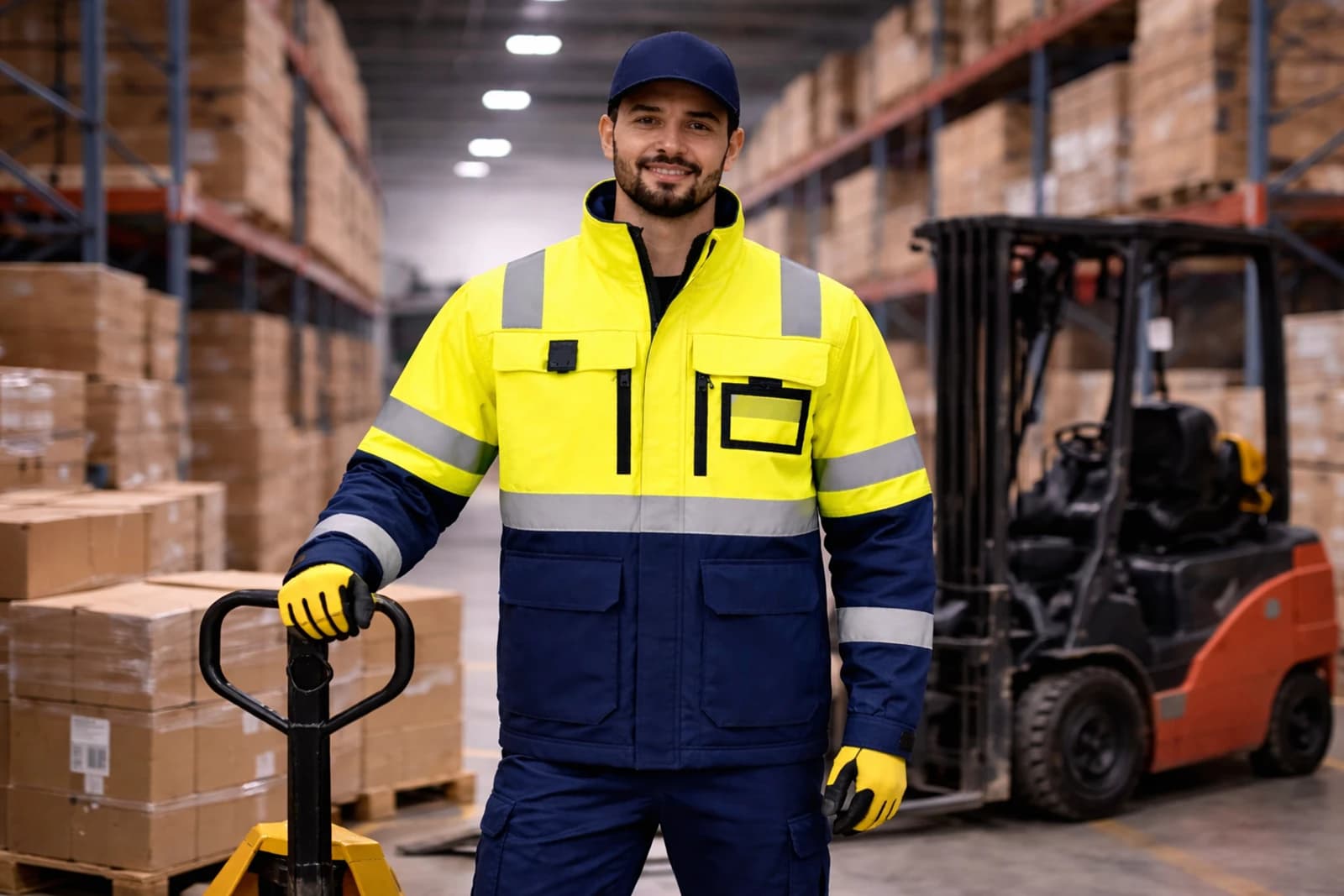
Safety Uniform
Hi-Vis Safety Jacket
Reflective safety jacket for high-visibility site operations and road work crews.

Logistics Uniform
Logistics Polo Uniform
Breathable uniform polo for warehouse, delivery, and last-mile teams.