EN ISO 20471 Hi-Vis Safety Workwear Standards: What Middle East B2B Buyers Must Know When Sourcing from China
Hi-vis safety workwear in the Middle East must comply with EN ISO 20471 for roadworks, oil and gas, logistics, and construction sites. This guide explains what the standard requires for background and reflective materials, Class 1–3 ratings, washing durability, certification verification, and how to specify compliant hi-vis jackets when sourcing from a Chinese workwear manufacturer.

Buyer context
What procurement teams run into
<p>A procurement manager in Riyadh receives a shipment of 500 hi-vis safety jackets for a major highway construction project. The jackets have reflective tape on the front and back and look compliant. But at the project site inspection, the safety officer flags them — the jacket background fabric is only 0.65 m² of fluorescent material when EN ISO 20471 Class 3 requires a minimum of 0.80 m². All 500 jackets are rejected on arrival. The project is delayed by two weeks while replacement jackets are expedited from the manufacturer in China.</p><p>In Dubai, a logistics company orders 1,000 hi-vis vests for their warehouse and yard staff. The vests are Class 2 compliant when new, but after five industrial wash cycles the reflective tape begins peeling at the edges and the fluorescent yellow background has faded noticeably. The safety manager cannot certify the vests as compliant after six months. The company faces a EUR 50,000 fine from the client's HSE team for non-compliant PPE on site.</p><p>EN ISO 20471 is the mandatory standard for high-visibility clothing across the GCC, referenced by Qatar's QCS 2014, Abu Dhabi's ADNOC HSE standards, Saudi Aramco's procurement requirements, and Dubai Municipality safety codes. Understanding what the standard demands — not just that a garment carries a CE mark — is essential for any Middle East B2B buyer sourcing hi-vis workwear from overseas.</p>
Sourcing approach
How a factory partner can respond
<h2>What EN ISO 20471 Requires</h2> <p>EN ISO 20471 specifies requirements for high-visibility clothing that makes the wearer visible in daylight and under vehicle headlights in the dark. It covers three elements:</p> <ul> <li><strong>Background material:</strong> The fluorescent fabric (yellow, orange-red, or red) that provides daytime visibility</li> <li><strong>Retroreflective material:</strong> The reflective tape that provides night-time visibility when illuminated by headlights</li> <li><strong>Combined performance material:</strong> Fabric that combines both fluorescent and retroreflective properties in one material</li> </ul> <h3>Class 1, 2, and 3 — What Each Means</h3> <table> <tr><th>Class</th><th>Minimum Background Material</th><th>Minimum Retroreflective Material</th><th>Typical Applications</th></tr> <tr><td>Class 3</td><td>0.80 m²</td><td>0.20 m²</td><td>Highways, motorways, emergency response, airport tarmac — highest risk environments where vehicle speeds exceed 60 km/h</td></tr> <tr><td>Class 2</td><td>0.50 m²</td><td>0.13 m²</td><td>Road construction zones, warehouse and logistics yards, railway work, oil and gas sites</td></tr> <tr><td>Class 1</td><td>0.14 m²</td><td>0.10 m²</td><td>Low-risk environments away from traffic: parking lots, loading bays with controlled access, indoor warehouse roles with low vehicle speeds</td></tr> </table> <p><strong>For Middle East buyers:</strong> Class 3 is increasingly required by major GCC project owners. Saudi Aramco and ADNOC both specify Class 3 for all personnel working on or near active roadways and heavy equipment zones. Even where the standard technically allows Class 2, many Gulf clients default to Class 3 as a minimum — specify this in your procurement documentation to avoid costly order amendments later.</p> <h2>Garment Design Requirements Under EN ISO 20471</h2> <p>Beyond material area, the standard requires:</p> <ul> <li>Retroreflective tape must be at least 50 mm wide</li> <li>Tape must form closed loops around the torso and both arms (or continuous bands for sleeveless garments)</li> <li>Placement must ensure visibility from a 360° horizontal angle — a jacket zipped up must show tape completely around the body</li> <li>Two horizontal bands around the torso plus two bands around each sleeve is the standard Class 3 configuration</li> <li>The reflective tape on sleeves must remain visible when the arm is raised and the sleeve is not bunched up</li> </ul> <p>One common issue with Chinese-manufactured hi-vis jackets for Middle East buyers: the tape placement on the sleeves. Some manufacturers position the sleeve bands too close to the shoulder — when the wearer raises their arm, the tape moves above the elbow and becomes partially hidden by the jacket body. Request a photo or video of the garment on a person with arms raised at 90° and 180° angles during the pre-production sample approval stage.</p> <h2>Testing and Certification Requirements</h2> <h3>Photometric Performance</h3> <p>Retroreflective material is tested for its coefficient of retroreflection (RA) — how much light is reflected back to the source at different angles. The standard specifies minimum RA values for new material and after washing. A certified EN ISO 20471 garment must be tested by a Notified Body (e.g., BSI, SATRA, INSPEC, or TÜV) and carry a CE certificate referencing the standard.</p> <p><strong>When sourcing from China, request these specific documents:</strong></p> <ul> <li>CE certificate of conformity for the garment model, issued within the last 3 years</li> <li>Test report from an ISO 17025 accredited laboratory showing photometric RA values (new and after designated wash cycles)</li> <li>Declaration of Conformity (DoC) signed by the manufacturer</li> <li>Fabric batch traceability — the garment label should include a model number, lot number, and production date that can be cross-referenced with the test report</li> </ul> <h3>Colour Fastness and Durability</h3> <p>EN ISO 20471 also requires the background fluorescent material to maintain its colour properties after exposure to light, water, and washing. The standard tests for:</p> <ul> <li>Colour fastness to light (ISO 105-B02) — the fluorescent colour must not fade beyond specified limits after 100 hours of artificial sunlight exposure</li> <li>Colour fastness to washing (ISO 105-C06) — the colour must not bleed or fade after 5 domestic or 5 industrial wash cycles</li> <li>Retroreflective material adhesion — the tape must not peel, crack, or delaminate after washing, bending at -20 °C, and exposure to water</li> </ul> <p>For Middle East outdoor applications, request extended lightfastness testing (200 hours instead of the standard 100 hours) in your fabric specification. The GCC receives significantly more intense and longer-duration UV exposure than the European climate for which the standard was originally developed.</p> <h2>Washing and Care: The Hidden Compliance Risk</h2> <p>The single biggest cause of hi-vis garment failure in Middle East use is industrial washing. EN ISO 20471 certification is tested after the manufacturer's specified number of wash cycles — typically 5, 25, or 50 washes. Once a garment exceeds the certified wash cycles, it is no longer compliant and must be replaced.</p> <p>Key points to discuss with your manufacturer:</p> <ul> <li>Confirm the number of certified wash cycles for the specific model you are ordering — some budget hi-vis jackets are only certified for 5 washes</li> <li>Request the actual test report showing RA values after the maximum certified washes — the difference between 5-wash and 25-wash certification can be significant</li> <li>For logistics and construction uniforms that will be commercially laundered at 75 °C, specify that the test report uses ISO 15797 (industrial washing) rather than ISO 6330 (domestic washing)</li> <li>Ask whether the reflective tape is heat-sealed or sewn — heat-sealed tape is more prone to peeling in industrial washing, while sewn-on tape (with heat-sealed edges) performs better over the garment lifecycle</li> <li>Your contract should specify: "Garments must meet EN ISO 20471 requirements after 25 industrial wash cycles per ISO 15797" — this removes ambiguity about which washing conditions apply</li> </ul> <h2>Labels, Marking, and Documentation</h2> <p>EN ISO 20471 compliant garments must carry a label with:</p> <ul> <li>Standard reference: EN ISO 20471</li> <li>Class number: Class 1, 2, or 3</li> <li>Pictogram showing the garment type and standard level</li> <li>Care instructions including maximum wash temperature and maximum certified wash cycles</li> <li>Manufacturer identification and model number</li> <li>Size designation</li> </ul> <p>The label must be permanently attached and legible for the garment's entire certified lifespan. If your order includes a custom branded neck label, ensure the standard-required information is not covered or removed — some manufacturers add a custom brand label that obscures the mandatory compliance label. Specify in your purchase order: "Compliance label must remain fully visible and legible. No other label shall cover or overlap it."</p> <h2>Procurement Checklist for Middle East Buyers</h2> <p>Before placing a bulk order for hi-vis safety jackets from a Chinese manufacturer, verify these points:</p> <ul> <li>☐ The garment EN ISO 20471 test report is from an ISO 17025 accredited laboratory</li> <li>☐ The model number on the test report matches the model number on the garment label</li> <li>☐ The CE certificate is current (not expired) and covers the specific model</li> <li>☐ The background material area meets Class 3 minimum (0.80 m²) if specified</li> <li>☐ Reflective tape width is at least 50 mm</li> <li>☐ Certified wash cycles match your expected garment lifecycle (25+ industrial washes recommended)</li> <li>☐ Lightfastness test covers at least 100 hours (request 200 hours for GCC outdoor use)</li> <li>☐ Pre-production sample is checked for 360° tape visibility and sleeve tape positioning</li> <li>☐ Compliance labels are included and legible — specify no overlap with branded labels</li> <li>☐ Written agreement that the manufacturer accepts liability for non-conforming product</li> </ul> <p>Sidaier's hi-vis safety jackets are CE-certified to EN ISO 20471 Class 3 with certified durability of 25 industrial wash cycles per ISO 15797. We provide the full test report, CE certificate, and fabric batch traceability with every order. For Middle East buyers, we also offer optional extended lightfastness testing (200 hours) and pre-production samples on actual production fabric before bulk manufacturing begins.</p>
Recommended Products
Products that fit this use case

Safety Uniform
Hi-Vis Safety Jacket
Reflective safety jacket for high-visibility site operations and road work crews.
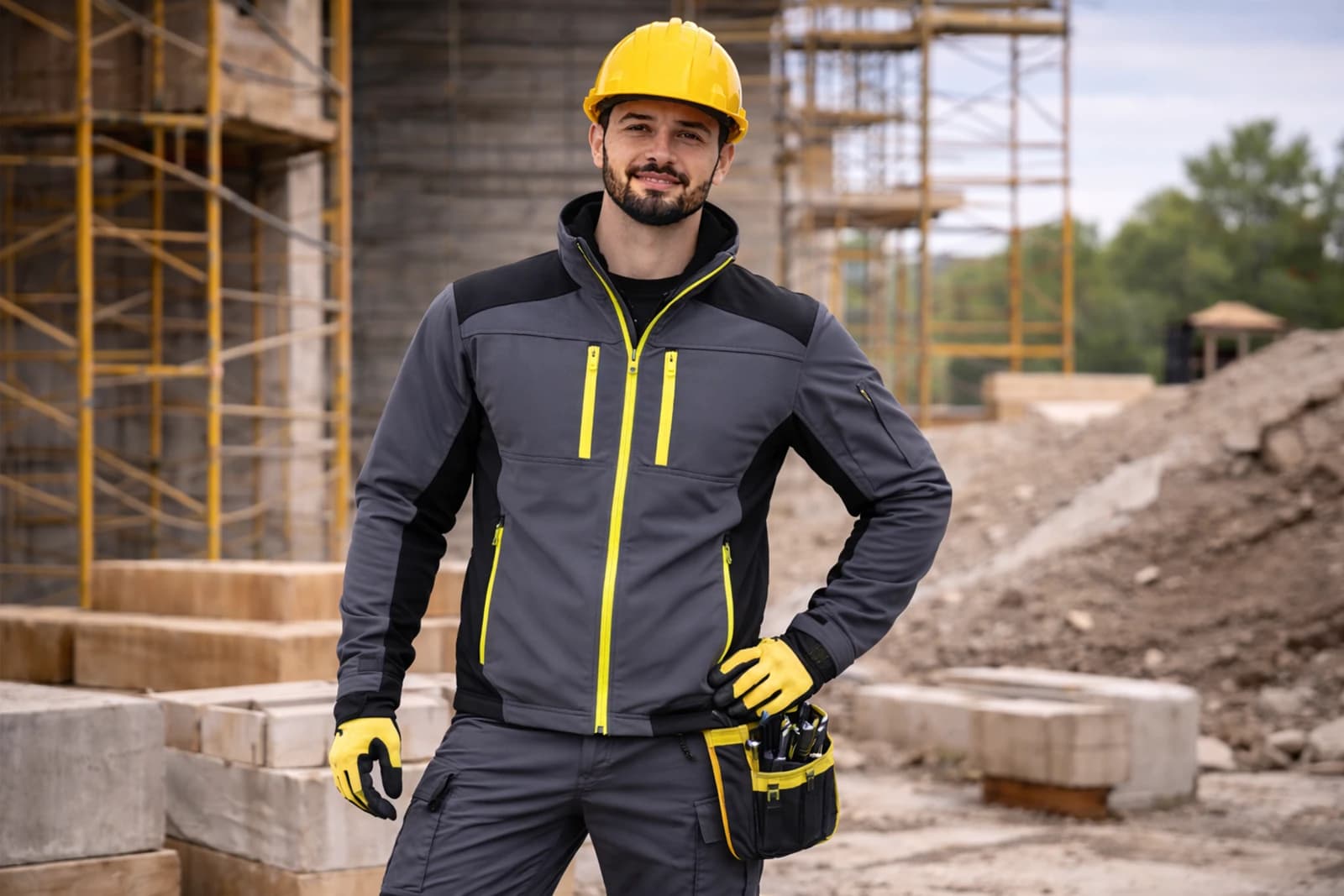
Construction Clothing
Construction Softshell Set
Flexible jacket and trouser set built for crews working across changing weather conditions.