How Many Garments Per Size Should You Order for a 300-Worker Mobilisation?
When mobilising a new workforce — whether a greenfield steel fabrication plant, a new maintenance contract, or a multi-site expansion — buyers must order workwear before all workers are measured. Getting the size-ratio split wrong creates shortages in common sizes and dead stock in extremes. This article covers how to build a size-ratio plan using regional body-size data, staged ordering, and a simple measurement protocol to minimise waste and ensure every worker has a garment that fits from day one.

Buyer context
What procurement teams run into
Every new workforce mobilisation — a greenfield steel fabrication yard, a new facility maintenance contract, a multi-site infrastructure expansion — presents the same workwear sizing problem: the buyer must place a production order weeks before the workforce arrives on site, and the exact body-size distribution of that workforce is unknown. Order too many small sizes and you carry dead stock that cannot be returned; order too few large sizes and workers arrive without garments that fit, creating safety non-compliance, productivity loss, and immediate dissatisfaction. For one-piece garments like industrial coveralls, the problem is sharper than for separates — a coverall that is too short in the body cannot be worn at all, whereas an oversized hi-vis jacket can at least function. **1. Standard size charts do not reflect actual workforce distributions** Most workwear manufacturers supply size charts based on a generic population distribution — typically a bell curve centred on M/L, with falling volumes in S, XL, 2XL, and 3XL. This distribution may reflect a European or East Asian domestic market, but it does not match the body-size profile of a typical Middle East industrial workforce, which draws labour from South Asia (India, Bangladesh, Pakistan, Nepal), East Africa (Ethiopia, Kenya, Uganda), the Arab world (Egypt, Jordan, Sudan), and Southeast Asia (Indonesia, Philippines). Each of these populations has a measurably different body-size distribution: - South Asian workers tend toward shorter stature (160–170 cm median) with narrower chest and waist measurements — sizes S and M dominate, with L and XL less common. - East African workers often have taller, leaner builds (170–180 cm median) — M and L dominate, with S too short and XL too wide. - Arab workers show a wider range, with a higher proportion of XL and 2XL in the population. - Southeast Asian workers cluster in S and M, with a steep drop-off above L. A buyer who orders a standard 10/20/30/25/10/5 split (S/M/L/XL/2XL/3XL) for a workforce that is 60% South Asian will over-order L, XL, and 2XL by a factor of three to five, while still running short on S and M within the first two weeks. **2. The cost of getting the ratio wrong is not symmetrical** Shortages in common sizes (S, M, L for a South Asian-majority workforce) create immediate operational problems: workers cannot be issued garments, supervisors borrow from other sizes creating a tracking mess, and the buyer faces emergency air-freight reorder costs that can double the per-unit price. Excess in uncommon sizes (2XL, 3XL) creates dead stock that sits in the store for months, ties up working capital, and may never be consumed unless the workforce composition changes. The financial asymmetry matters: the cost of a shortage (air freight, worker downtime, safety non-compliance) is typically three to five times the cost of excess stock per unit. But the cost of excess stock is not zero — a 300-worker mobilisation with 15% dead stock in wrong sizes represents 45 garments × unit cost that is effectively written off. **3. One-piece garments amplify sizing errors** Industrial coveralls are a single garment that must fit the worker's chest, waist, hip, inside leg, and body length simultaneously. A worker who is 175 cm tall with a 100 cm chest needs a different coverall size than a worker who is 175 cm tall with a 110 cm chest — but standard coverall size charts map both dimensions to a single size code. The result is that coverall sizing errors are more frequent and more visible than separates sizing errors: a coverall that is too short in the body crotches uncomfortably and restricts movement; a coverall that is too long creates trip hazards and excess fabric that snags on equipment. Hi-vis safety jackets are more forgiving — an oversized jacket still provides visibility compliance and weather protection, and can be adjusted at the hem and cuffs. This means the sizing precision requirement is higher for coveralls than for jackets, and the size-ratio planning effort should focus on the coverall order. **4. Wave mobilisation compounds the uncertainty** Most industrial mobilisations do not bring all 300 workers to site on day one. A typical pattern is: - Week 1–2: survey team, supervisors, and first construction crew (30–50 workers) - Week 3–6: main workforce arrival (150–200 workers) - Week 7–12: specialist trades and commissioning crew (50–80 workers) Each wave may have a different size distribution — the survey team may skew toward smaller sizes (South Asian technicians), while the commissioning crew may skew toward larger sizes (expatriate engineers). A single size-ratio order placed before wave one will be wrong for waves two and three. **5. Re-ordering small batches is expensive** Custom workwear — corporate colours, embroidered logos, site-specific pocket configurations — carries a minimum order quantity (MOQ) of 200–500 pieces per size per colour from most manufacturers. A buyer who discovers after wave one that they need 30 more size-M coveralls cannot simply reorder 30 units; the manufacturer's MOQ means ordering 200 units, creating a new excess-stock problem in the opposite direction. This MOQ constraint makes the initial size-ratio decision critical — there is no cheap correction mechanism. **6. The sizing problem is solvable but requires upfront planning** The common failure is to treat workwear sizing as a clerical task — send the manufacturer a spreadsheet with quantities per size code, based on a generic distribution, and hope for the best. The correct approach treats sizing as a procurement control problem: gather data before ordering, stage the order to reduce uncertainty, and build a tracking system from day one so that each subsequent reorder is based on actual consumption data rather than guesswork.
Sourcing approach
How a factory partner can respond
The solution for a 300-worker mobilisation is a staged ordering strategy built on regional body-size data, a simple measurement protocol for the first wave, and a buffer allocation that concentrates stock in the sizes most likely to be consumed — applied differently to industrial coveralls (where sizing precision is critical) and hi-vis safety jackets (where sizing is more forgiving). **Step 1: Build a size-ratio model from workforce composition data** Before placing any order, determine the nationalities and approximate body-size profile of the incoming workforce. Most mobilisation plans include a workforce composition breakdown by nationality or source country. Use this to construct a size-ratio model: - For a workforce that is 50%+ South Asian: expect 35% S, 35% M, 20% L, 8% XL, 2% 2XL, 0% 3XL. - For a workforce that is 40% South Asian, 30% East African, 20% Arab, 10% other: expect 20% S, 30% M, 25% L, 15% XL, 8% 2XL, 2% 3XL. - For a workforce that is predominantly Arab or North African: expect 10% S, 20% M, 30% L, 25% XL, 10% 2XL, 5% 3XL. These are starting estimates, not exact figures — but they are significantly more accurate than a generic bell curve. Confirm the model against the manufacturer's actual garment measurements (not their size code labels — request the graded measurement spec for each size code and compare it to your workforce body-size data). **Step 2: Stage the order — 60% initial, 40% top-up** Do not place the full 300-unit order before wave one arrives. Instead: - Place an initial order for 60% of total requirement (180 coveralls, 180 hi-vis jackets) using the size-ratio model from Step 1. This order should arrive 2–3 weeks before wave one. - During wave one (weeks 1–2), measure every worker using a simple three-measurement protocol: chest circumference (at fullest point), waist circumference (at natural waistline), and height (barefoot, in cm). Record these against the garment size actually issued. - After wave one is complete (week 3), analyse the actual size distribution from the measurement data. Place the remaining 40% order (120 coveralls, 120 hi-vis jackets) using the actual distribution observed in wave one, adjusted for the expected composition of waves two and three. This staged approach reduces the sizing error by roughly half — the initial 60% order carries some ratio risk, but the 40% top-up is based on measured data and can correct the split. **Step 3: Implement the three-measurement protocol** The measurement protocol must be simple enough for a site supervisor to execute without a tailor's skill: - **Chest:** Measure around the fullest part of the chest, tape horizontal, arms at sides. Record to nearest cm. - **Waist:** Measure around the natural waistline (narrowest point of torso, typically just above the navel). Record to nearest cm. - **Height:** Worker stands barefoot against a wall or flat surface. Measure from floor to crown of head. Record to nearest cm. These three measurements are sufficient to map each worker to the correct coverall size on the manufacturer's graded spec. Cross-reference the measurements against the manufacturer's size chart — not a generic S/M/L chart, but the actual garment measurements for each size code (chest width, waist width, body length, inside leg). If the manufacturer cannot provide a graded measurement spec, request one before ordering — this is a non-negotiable procurement control. **Step 4: Concentrate buffer in core sizes, eliminate extreme sizes** For the initial 60% order, add a 10–15% buffer above the calculated need — but only in the three core sizes (typically S, M, L for a South Asian-majority workforce; M, L, XL for a mixed workforce). Do not add buffer in extreme sizes (S or 3XL) — the probability of consuming these is low, and excess extreme sizes become permanent dead stock. Example: For a 300-worker order with a South Asian-majority distribution, the initial 60% order (180 coveralls) with 12% buffer in core sizes: - S: 35% of 180 = 63 → add 12% = 71 - M: 35% of 180 = 63 → add 12% = 71 - L: 20% of 180 = 36 → add 12% = 40 - XL: 8% of 180 = 14 → no buffer = 14 - 2XL: 2% of 180 = 4 → no buffer = 4 - 3XL: 0% = 0 Total: 200 coveralls (180 calculated + 20 buffer in core sizes). The 10% overall buffer is concentrated where consumption probability is highest. **Step 5: Apply different sizing precision to coveralls and hi-vis jackets** Industrial coveralls require precise sizing — a coverall that does not fit the body length cannot be worn. Order coveralls using the full three-measurement protocol and the manufacturer's graded spec. Do not allow workers to self-select coverall sizes based on S/M/L preference — map each worker to the correct size using their measurements. Hi-vis safety jackets are more forgiving — an oversized jacket still functions, and can be adjusted at the hem and cuffs. For hi-vis jackets, you can accept a one-size tolerance: if a worker measures between M and L, issue L. This reduces the sizing precision requirement and allows you to absorb minor ratio errors without creating unfit garments. Order hi-vis jackets using the same size-ratio model but with a wider tolerance — this means fewer emergency reorders for jackets than for coveralls. **Step 6: Track issuance and replacement from day one** From the first garment issued, record: worker ID, garment type, size issued, date issued. When a replacement is requested (due to damage, wear, or size exchange), record the reason and the new size issued. This data serves two purposes: - It reveals whether the initial size-ratio model was accurate — if replacements cluster in a particular direction (e.g., workers exchanging M for L), the model needs adjustment for the next order. - It builds a consumption history that makes the next mobilisation's sizing decision data-driven rather than estimated. After the first mobilisation, you own the data. The second mobilisation for the same client or similar workforce composition can be ordered with high confidence — the size-ratio split is no longer a guess. **Recommended garments for this approach:** - **Industrial coverall-pro** — the primary one-piece garment for steel fabrication, maintenance, and process-area workers. Sizing precision is critical: use the three-measurement protocol and the manufacturer's graded spec to map each worker to the correct size. Reinforced knees, articulated sleeves, and secure pocket closures make this the correct garment for heavy industrial mobilisations where fit directly affects safety and productivity. - **Hi-vis safety jacket** — the outer visibility garment for yard, crane, and outdoor areas. Sizing is more forgiving: accept a one-size tolerance when a worker measures between sizes. EN ISO 20471 Class 2 or Class 3 compliant retroreflective tape, breathable mesh lining, and adjustable hem make this a functional garment even when slightly oversized.
Recommended Products
Products that fit this use case

Industrial Workwear
Industrial Coverall Pro
Hard-wearing one-piece coverall for plant, maintenance, and heavy-duty operations.
Safety Uniform
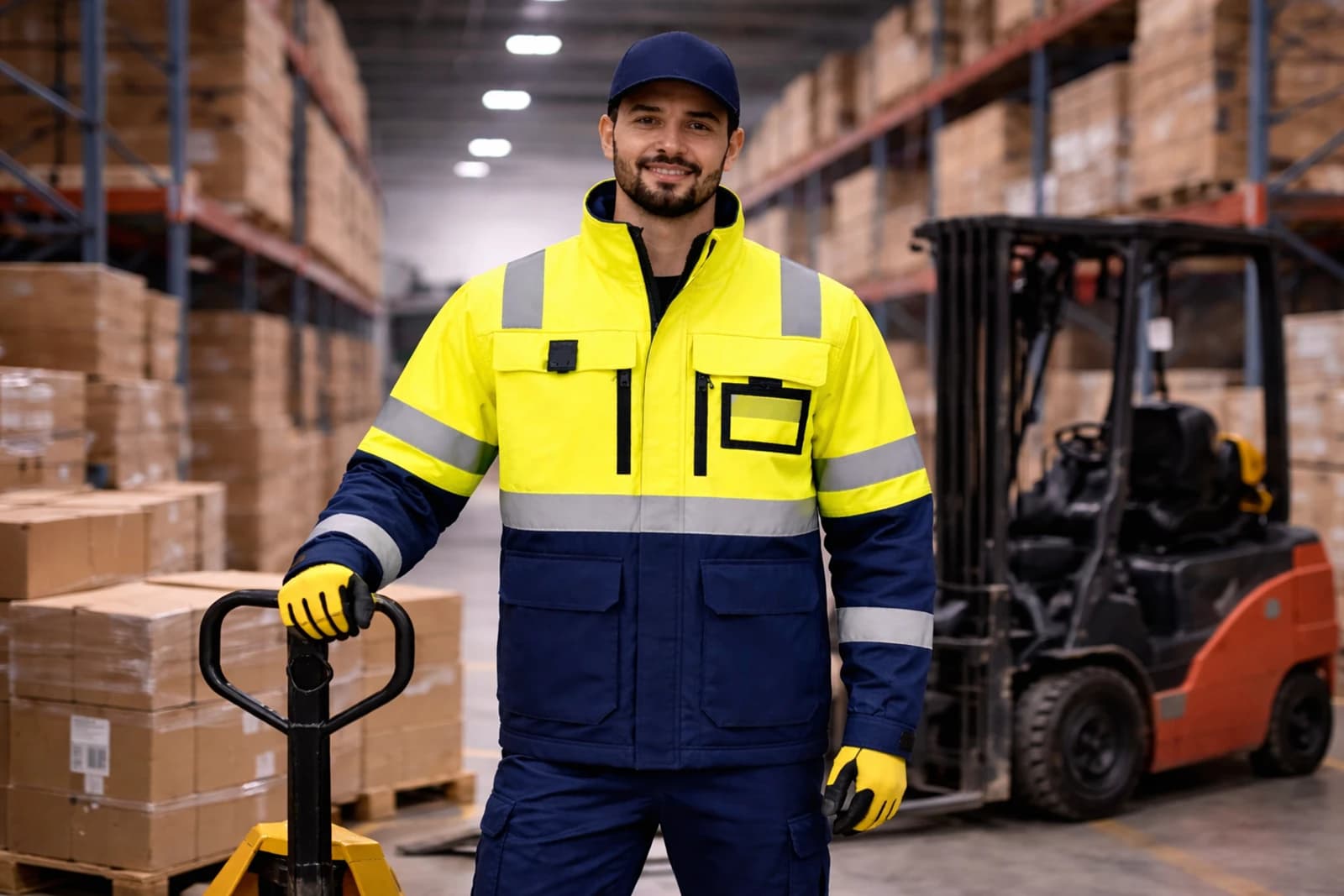
Hi-Vis Safety Jacket
Reflective safety jacket for high-visibility site operations and road work crews.