HVAC Installation & Maintenance Workwear: Sourcing Industrial Coveralls & Polo Uniforms for Middle East Climate Control Infrastructure
The Middle East's HVAC industry is one of the largest per-capita in the world — Saudi Arabia's HVAC market alone exceeds USD 6 billion annually, the UAE spends over 40% of commercial building energy on cooling, and Qatar, Kuwait, Oman, and Bahrain collectively represent a multi-billion-dollar annual HVAC installation and maintenance market. Behind every chilled water plant, every rooftop packaged unit, every VRF system, and every ductwork installation is a workforce of HVAC technicians, pipefitters, duct installers, commissioning engineers, service engineers, and maintenance supervisors who work across some of the most thermally demanding environments on earth — from rooftop plant rooms at 55°C ambient to inside air-handling units at near-freezing coil temperatures. This sourcing guide for Middle East B2B buyers covers industrial coveralls and logistics polo uniforms for HVAC installation and maintenance, fabric specifications for thermal-shock conditions, role-based garment allocation, compliance considerations, and volume procurement from a Chinese workwear manufacturer.
Buyer context
What procurement teams run into
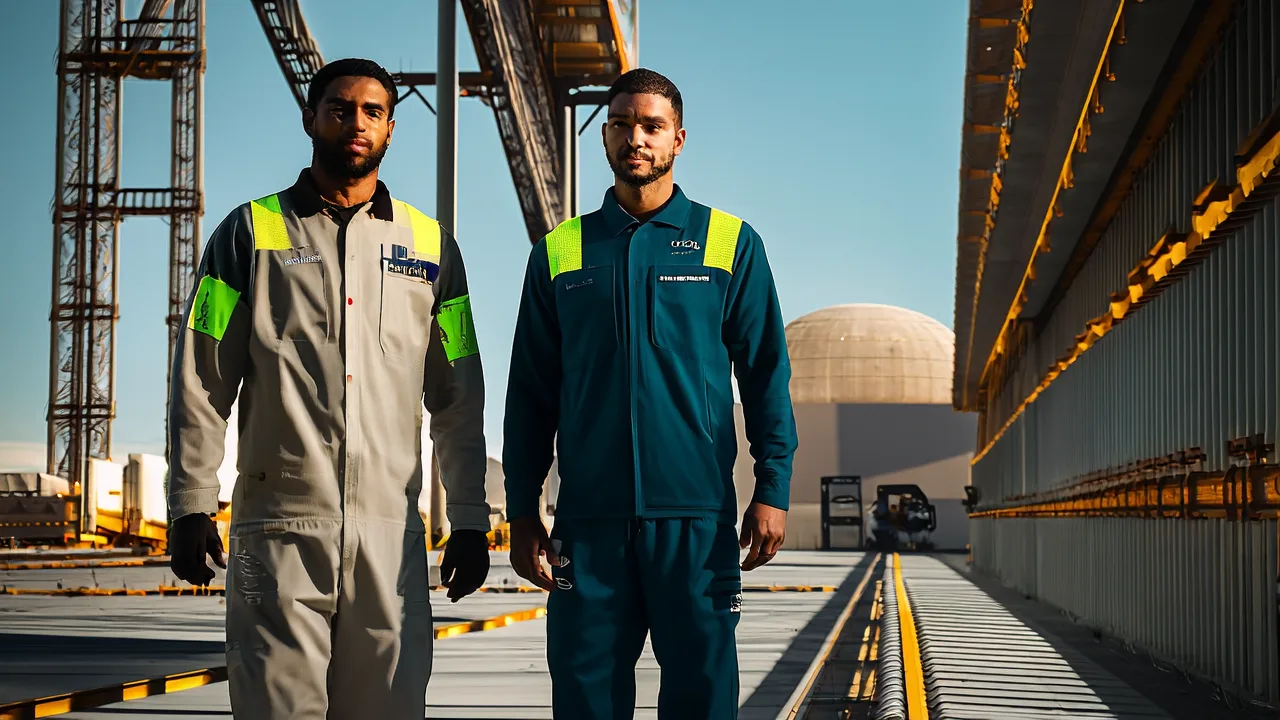
The Middle East is the world's most HVAC-dependent region. Ambient temperatures in Riyadh, Kuwait City, Basra, and the UAE's inland cities regularly exceed 50°C from May to September. Commercial buildings consume 40–70% of their total energy on air conditioning. Every tower block, hospital, school, mall, airport terminal, and industrial facility in the Gulf requires continuous cooling — and the workforce that installs, commissions, and maintains this equipment operates under uniquely punishing conditions. For B2B buyers procuring workwear for HVAC workforces, the challenge is specific because HVAC work combines heavy mechanical installation, precision refrigerant handling, confined-space ductwork, rooftop exposure, and client-facing service — often within the same facility and the same shift. **1. The HVAC installation and maintenance environment combines thermal extremes, confined spaces, and refrigerant hazards** An HVAC technician's working day can span dramatically different conditions: - **Rooftop plant rooms.** Chillers, cooling towers, condensing units, and packaged rooftop units sit fully exposed to direct sun and 50–55°C ambient on rooftops with no shade. Workers face extreme radiant heat, UV exposure, and wind. Refrigerant lines on rooftops can reach 60–70°C surface temperature in direct Gulf sun. - **Mechanical rooms and plant basements.** Central chiller plants, boiler rooms, pump rooms, and AHU rooms are enclosed spaces where temperatures can reach 35–45°C from process heat and equipment radiation. Workers face noise, vibration, and potential refrigerant leak exposure in poorly ventilated plant rooms. - **Inside ductwork and ceiling voids.** Duct installers and commissioning engineers work inside sheet metal ducts, above ceiling grids, and in tight mechanical shafts. Workers face sharp metal edges, fibreglass insulation particles, confined-space posture stress, and dust exposure. - **Occupied tenant spaces.** Service technicians performing maintenance on split units, FCUs, fan coils, and VRF indoor units work inside offices, hotel rooms, hospital wards, and residential apartments. Workers must present a professional, clean appearance in front of clients and building occupants. - **Refrigerant handling areas.** Technicians charging, recovering, or leak-testing R-410A, R-32, and R-134a systems face contact with cold refrigerant (liquid refrigerant at -40°C to -50°C during expansion) and potential skin freeze burns. Garments must resist brief refrigerant contact without absorbing liquid. - **Chilled water pipework.** Workers installing and maintaining chilled water systems (6°C flow, 12°C return) handle heavily insulated copper and steel pipes, often in ceiling voids and shafts. Condensation drips from chilled water pipes are constant — garments must tolerate persistent moisture without degradation. **2. Industrial coveralls for HVAC installation technicians, pipefitters, and ductwork crews** Workers performing new HVAC installation — pulling refrigerant lines, brazing copper pipes, hanging ductwork, setting chillers and AHUs, and running condensate drainage — need full-body protection against the physical demands of mechanical installation. Key specifications when sourcing coveralls for HVAC installation from a Chinese manufacturer: **Fabric weight and composition.** Specify 245–260gsm poly-cotton twill (65% polyester / 35% cotton). The polyester content provides abrasion resistance against sharp duct edges, fibreglass insulation, and copper pipe burrs. The cotton content provides breathability and comfort in hot mechanical rooms and rooftop plant areas. Pure polyester traps too much heat in 40°C+ plant rooms; pure cotton degrades too quickly against metal edges. **Refrigerant splash resistance.** HVAC technicians handling R-410A and R-32 refrigerants face potential contact with expanding cold gas and liquid refrigerant during charging, recovery, and leak-testing. Specify tightly woven twill fabric that resists brief liquid refrigerant penetration — this provides a critical seconds-long barrier against freeze burns. For high-volume refrigerant handling roles, consider coveralls with inherent water-repellent finish (DWR) that causes liquid refrigerant to bead and run off rather than soaking into fabric. **Reinforcement at high-wear zones.** Double-layer knees with internal knee-pad pockets (pipefitters and duct installers kneel on concrete, metal deck, and fibreglass-lined ductwork constantly). Reinforced elbows for overhead pipe-work and duct hanging. Bar-tacked stress points at all pocket corners. Cordura patches at cuffs — HVAC technicians drag cuffs across duct edges, pipe supports, and concrete floors all day. **Pocket configuration for HVAC tools.** Chest pockets sized for refrigerant manifold gauge hoses and thermocouple probes. Thigh cargo pockets for tube cutters, deburring tools, and flare tools. Dedicated pen pockets for leak detector log sheets. Internal chest pocket for phone and refrigerant identification cards. All pockets must have secure closures — tools dropped inside ductwork or ceiling voids become expensive retrieval operations. **Fit for overhead work.** Action back on the jacket for freedom of movement when hanging ductwork, brazing overhead pipe joints, and pulling refrigerant lines through ceiling voids. Articulated knees for kneeling work. Gusseted crotch for climbing ladders and working on top of AHU casings. The coverall must allow full range of motion without riding up or gaping at the waist. **Colour.** Light colourways (khaki, sand, light grey) for rooftop and outdoor installation work to reduce heat absorption. Dark colours (navy, charcoal) for indoor mechanical room work where refrigerant oil stains and pipe dope marks are frequent. Confirm ISO 105-B02 xenon-arc fade testing for rooftop-exposed garments. **Industrial wash durability.** HVAC coveralls accumulate refrigerant oil, pipe dope, flux residue, fibreglass particles, and condensation moisture daily. Specify ISO 15797 compliance with ≤ 3% dimensional change after 50+ wash cycles. Garments must maintain reinforcement integrity and pocket closure function after repeated industrial laundering. **3. Logistics polo uniforms for HVAC service technicians, commissioning engineers, and maintenance supervisors** The majority of HVAC work in the Middle East is maintenance and service — not new installation. Service technicians performing preventive maintenance on split units, FCUs, VRF systems, chillers, and BMS controls work inside occupied buildings where professional appearance matters. Commissioning engineers and maintenance supervisors represent the HVAC contractor to building owners, facility managers, and consultants. Key specifications when sourcing polo uniforms for HVAC service from a Chinese manufacturer: **Fabric.** 180–220gsm pique knit in 65% polyester / 35% cotton with moisture-wicking treatment and UPF 30+ sun protection. HVAC service technicians transition between rooftop plant rooms (extreme heat and UV), mechanical rooms (hot and humid), and occupied tenant spaces (air-conditioned). Garments must wick moisture efficiently across all these environments while maintaining a professional appearance. **Collar and trim.** Ribbed collar with contrast piping in HVAC contractor brand colours; tonal buttons; clean placket. The collar must hold its shape after repeated industrial washing and UV exposure on rooftops. HVAC polo uniforms face 4–8 hours of direct UV daily during rooftop chiller and cooling tower maintenance — collar curl and fade are common failure points. **Branding.** Embroidered chest logos with Pantone colour matching for HVAC contractor branding. Woven name tapes and role patches ("SERVICE TECHNICIAN," "COMMISSIONING ENGINEER," "MAINTENANCE SUPERVISOR," "BMS TECHNICIAN," "REFRIGERATION ENGINEER"). HVAC contractor branding is visible to building owners, facility managers, and tenants — professional appearance directly affects contract renewals and client confidence. **Sizing.** Full size range (2XS–4XL+) with Middle East / South Asian body proportions for the multinational HVAC workforce. Gulf HVAC contractors employ technicians from South Asia, Southeast Asia, the Arab world, and Africa — sizing must accommodate diverse body types. **Colour fastness.** ISO 105 certified for Gulf sun and industrial laundering. HVAC polo uniforms face rooftop UV exposure, refrigerant oil contact, and frequent washing. Colours must not fade to an inconsistent patchwork appearance over a 3–6 month garment life. **Moisture management.** HVAC service technicians transition between rooftop plant rooms (50°C+ ambient), inside AHU rooms (35–40°C with high humidity from condensate), and air-conditioned tenant spaces (22–24°C). Garments must wick moisture efficiently in all these environments to maintain comfort and professional appearance when walking from a hot plant room into a client's office. **Pocket for service tools.** Left chest pocket sized for service tablets, refrigerant ID cards, and thermocouple probes. HVAC service technicians carry diagnostic tools on their person — a secure chest pocket prevents tool loss when working in ceiling voids and tight AHU compartments. **4. The coverall-and-polo system for complete HVAC contractor uniform** The smartest procurement approach treats coveralls and polo uniforms as a unified uniform system across the HVAC contractor's operations: **Installation technicians (new projects):** Industrial coveralls as primary garment for ductwork hanging, pipe brazing, chiller setting, and refrigerant line installation. Coveralls provide full-body protection against sharp metal edges, fibreglass insulation, refrigerant contact, and the physical demands of mechanical installation. **Service technicians (maintenance contracts):** Logistics polo uniform as primary garment for preventive maintenance, filter changes, coil cleaning, refrigerant top-ups, and BMS adjustments inside occupied buildings. Polo provides professional appearance for client-facing work while maintaining comfort across thermal transitions. **Commissioning engineers:** Logistics polo uniform as daily garment for system commissioning, performance testing, and handover documentation. Coveralls available for initial plant room commissioning when systems are first charged with refrigerant and may leak. Polo with company branding for client handover meetings and authority inspections. **Maintenance supervisors:** Logistics polo uniform with distinctive colour (e.g., white or light blue vs. dark colours for field technicians) for instant recognition across multi-building maintenance contracts. Polo for occupied-space work. Coveralls for plant room inspections and heavy maintenance oversight. **Ductwork installation crews:** Industrial coveralls as primary garment for all ductwork fabrication, hanging, and sealing work. Coveralls protect against fibreglass insulation particles, sharp sheet metal edges, and the confined-space demands of working inside ducts and ceiling voids. **Pipefitting and brazing crews:** Industrial coveralls with reinforced elbows and knees for overhead brazing, pipe fitting, and condensate line installation. Coveralls resist flux spatter, refrigerant oil, and the physical demands of working in mechanical shafts. This system means one colour palette, one branding scheme, one manufacturer, and one procurement process covering every role across the HVAC contractor's installation and maintenance operations. **5. Compliance and testing for HVAC workwear** Relevant standards for Middle East HVAC operations: - **EN ISO 13688** — general requirements for protective clothing (ergonomics, sizing, ageing, marking). Applies to both coveralls and polo uniforms. - **EN ISO 20471** — high-visibility clothing. Supplementary hi-vis vests or jackets may be required over coveralls and polos for rooftop work near building edges and for technicians working in plant rooms with vehicle access. - **ISO 105-B02** — colour fastness to light (xenon arc). Critical for Gulf HVAC work where garments face 4–8 hours of direct UV daily on rooftops. - **ISO 15797** — industrial laundering durability. HVAC workwear is washed at 60–75°C in industrial machines. Specify dimensional change ≤ 3% after 50+ wash cycles. - **OEKO-TEX Standard 100** — restricted substances. HVAC technicians in extreme heat sweat heavily; skin contact with harmful chemicals from fabric treatments is a real concern. - **ASHRAE Standard 180** — standard practice for inspection, maintenance, and repair of HVAC systems. While not a garment standard, ASHRAE 180 requires technicians to wear appropriate PPE when working inside air-handling equipment — coveralls meet this requirement for installation and heavy maintenance. - **GCC labour ministry uniform regulations** — Saudi Arabia, UAE, Qatar, Kuwait, Oman, and Bahrain have labour ministry requirements for worker uniforms including minimum fabric weight, breathability standards, and employer obligations for PPE provision. Confirm the manufacturer's garments meet GCC-specific requirements. **6. Procurement strategy for HVAC contractor buyers** HVAC contractors have distinctive procurement patterns: **Volume and frequency.** A mid-size Gulf HVAC contractor employs 200–2,000 technicians across installation projects and maintenance contracts. Order coveralls in bulk (500–3,000 units) for installation crews, then reorder quarterly for replacements. Order polo uniforms in similar volumes for service technicians with semi-annual reorders. **Consolidate orders.** Order coveralls and polo uniforms in one shipment to reduce freight costs and simplify customs clearance at Dammam, Jebel Ali, or Doha ports. A Chinese manufacturer with in-house capability for both garment types can produce and ship them together. **Plan for seasonal timing.** Order coveralls and polos 3–4 months before the peak HVAC installation season (March–May, when new construction mobilises after winter). Order service polo uniforms before summer maintenance peaks (June–September, when every AC unit in the country needs servicing). Avoid ordering for delivery during Ramadan production slowdowns. **Stock buffer.** Order 25–30% buffer stock above annual requirements. HVAC workwear faces accelerated wear from refrigerant oil, fibreglass abrasion, sharp metal edges, and frequent washing. Reordering small batches of custom-branded garments costs far more per unit than including buffer in the original production run. **Pilot before full volume.** Order 50–100 coveralls and 50–100 polo uniforms for a trial fitting before committing to the full contractor order. Adjust sizing, fabric weight, pocket placement, and branding specifications based on field feedback from installation technicians, service engineers, and maintenance supervisors. **Standardise across installation and maintenance divisions.** Whether your contractor focuses on new installation, maintenance contracts, or both, the same coverall-and-polo system works. Standardise on one colour palette and one branding scheme across all divisions — this simplifies procurement, ensures consistent brand representation, and makes your workforce instantly recognisable on multi-contractor construction sites.
Sourcing approach
How a factory partner can respond
The solution for Middle East HVAC installation and maintenance contractors is a two-garment workwear system — industrial coveralls for installation technicians, pipefitters, and ductwork crews performing new HVAC installation, paired with logistics polo uniforms for service technicians, commissioning engineers, and maintenance supervisors performing maintenance and client-facing work — sourced from a single Chinese workwear manufacturer for consistent quality, consolidated shipping, and volume pricing. **For industrial coveralls (installation technicians, pipefitters, ductwork crews):** - 245–260gsm poly-cotton twill (65% polyester / 35% cotton) — abrasion resistant against duct edges and fibreglass insulation, breathable in hot plant rooms - Refrigerant splash resistance — tightly woven twill or DWR finish resists brief liquid refrigerant contact for freeze-burn protection - Double-layer reinforced knees with knee-pad pockets, reinforced elbows, Cordura patches at cuffs - HVAC-specific pocket configuration: chest pockets for manifold gauge hoses and thermocouple probes, thigh cargo for tube cutters and flare tools, internal pocket for phone and refrigerant ID cards - Action back jacket fit with articulated knees and gusseted crotch for overhead brazing, duct hanging, and ladder work - Light colourways for rooftop work, dark colours for mechanical rooms - ISO 15797 industrial wash durability (≤ 3% dimensional change after 50+ cycles), OEKO-TEX Standard 100 **For logistics polo uniforms (service technicians, commissioning engineers, supervisors):** - 180–220gsm pique knit in 65% polyester / 35% cotton with moisture-wicking and UPF 30+ sun protection - Ribbed collar with contrast piping in HVAC contractor brand colours; tonal buttons; clean placket - Embroidered chest logos with Pantone colour matching; woven name tapes and role patches ("SERVICE TECHNICIAN," "COMMISSIONING ENGINEER," "MAINTENANCE SUPERVISOR") - Full size range (2XS–4XL+) with Middle East / South Asian body proportions for multinational workforce - ISO 105 colour-fastness certified for Gulf rooftop sun and industrial laundering - Moisture management for transition between rooftop plant rooms, AHU rooms, and air-conditioned tenant spaces - Left chest pocket for service tablets and refrigerant ID cards **Procurement strategy:** - Treat coveralls and polo uniforms as a unified uniform system across installation and maintenance operations - Consolidate both garments into one shipment to reduce freight and simplify customs - Order coveralls and polos 3–4 months before peak installation season (March–May); order service polos before summer maintenance peaks (June–September) - Stock 25–30% buffer for replacement cycles (HVAC workwear faces accelerated wear from refrigerant oil, fibreglass, and metal edges) - Pilot 50–100 units per garment type before full fleet commitment - Standardise one colour palette and branding scheme across installation and maintenance divisions
Recommended Products
Products that fit this use case

Industrial Workwear
Industrial Coverall Pro
Hard-wearing one-piece coverall for plant, maintenance, and heavy-duty operations.

Logistics Uniform
Logistics Polo Uniform
Breathable uniform polo for warehouse, delivery, and last-mile teams.