Industrial Bakery Workwear Must Control Flour Dust Without Trapping Oven Heat
Industrial bakery workwear must manage airborne flour dust, dissipate radiant heat from tunnel and deck ovens, and meet food safety requirements that prohibit fiber shedding. Standard flour-resistant fabrics use tight, smooth constructions that trap heat against the worker's body and cause heat stress near oven zones. Standard heat-dissipating fabrics use open-weave constructions that capture flour dust in their fiber structure and shed fibers into the production environment. The result: buyers choose between flour-resistant fabric that causes heat exhaustion near ovens and heat-dissipating fabric that fails food safety audits within weeks. This article covers the mechanism that makes flour dust management and heat dissipation conflict, the fabric and design criteria that can deliver both, and the zone-based garment specification that matches fabric properties to the specific thermal and contamination profile of each bakery production area.
Buyer context
What procurement teams run into
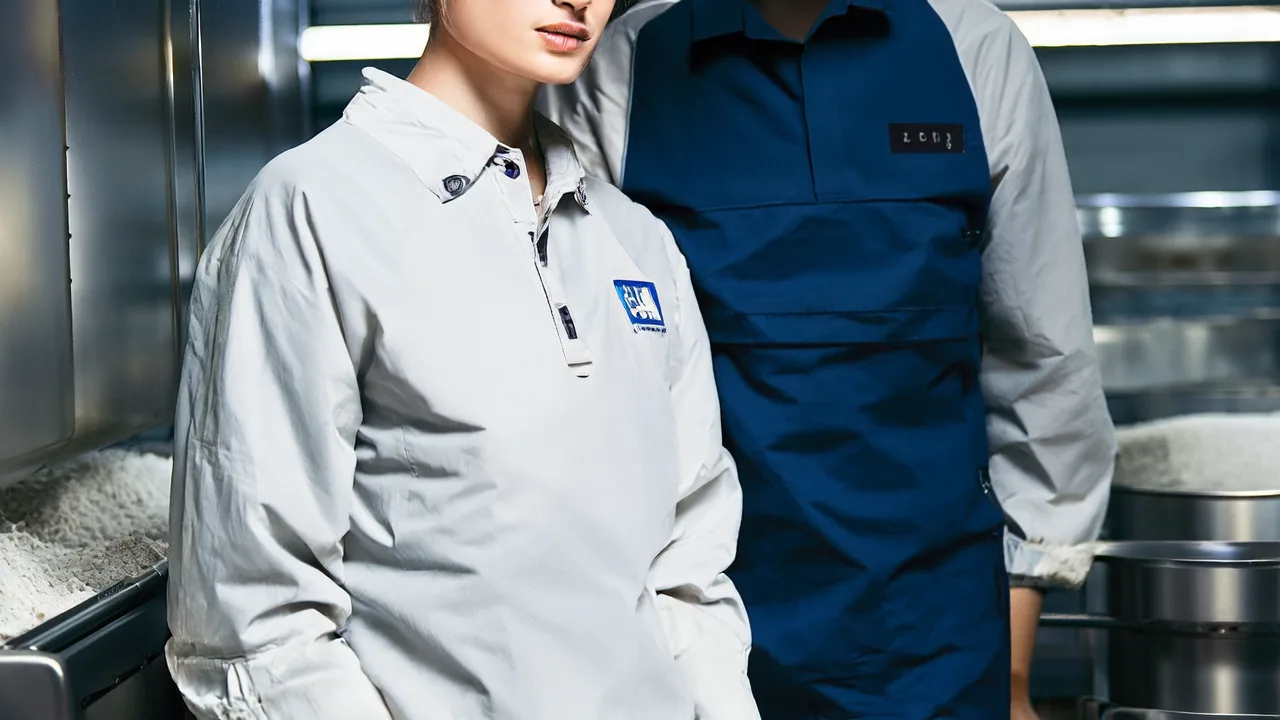
Industrial bakeries produce bread, rolls, pastries, and baked goods at scale through mixing, dividing, proofing, baking, cooling, and packaging operations. Production workers — mixers, divider operators, oven loaders, decorator line staff, cooling-line handlers, and packaging operators — work in environments where flour dust is airborne throughout every shift and radiant heat from tunnel ovens and deck ovens creates localized hot zones with ambient temperatures significantly above the rest of the production floor. The work environment exposes garments to three simultaneous constraints: - **Airborne flour dust:** Mixing, dividing, and shaping operations generate fine flour particles that remain suspended in production area air throughout every shift. Flour dust settles on garment surfaces, accumulates in fabric texture, and creates visible white coating on dark-colored garments within 1–2 hours of wear. Accumulated flour dust creates both appearance problems (workers look unprofessional and unclean) and combustible dust hazard (flour dust accumulated on garments can become an ignition fuel source in areas with potential ignition from oven equipment). - **Radiant heat from ovens:** Tunnel ovens and deck ovens operate at internal temperatures of 200–300°C. The oven exterior and the immediate work zone around oven loading and unloading areas experience radiant heat that raises ambient temperature 8–15°C above the general production area. Workers stationed at oven loading/unloading positions experience sustained radiant heat exposure throughout every shift. Garments must enable heat dissipation to prevent heat stress in these localized hot zones. - **Food safety requirements:** Bakery production areas operate under food safety management systems that require workwear to prevent garment-generated contamination of product. Garments must not shed fibers, must not have external pockets or features that collect contaminants and transfer them to product contact surfaces, and must survive daily washing at temperatures sufficient for biological decontamination. The workwear specification must deliver three protections simultaneously: - **Flour dust management:** fabric surface must resist flour dust accumulation and enable flour dust to be removed by washing — fabric must not trap flour particles in its texture - **Heat dissipation:** fabric must enable heat and moisture vapor to pass through the garment, reducing heat stress for workers near ovens - **Food safety compliance:** fabric must not shed fibers, must survive daily washing at 60°C+, and must not introduce contaminants to the production environment These three requirements conflict in standard fabric constructions. The mechanism: **1. Flour-resistant fabric traps oven heat** Flour-resistant fabrics achieve their performance through tight, smooth fabric constructions — high thread count, low surface texture, and synthetic fiber content that creates a smooth surface on which flour dust does not adhere. The tight, smooth construction prevents flour particles from embedding in the fabric texture — flour dust remains on the surface and can be brushed off or removed by washing. But the same tight, smooth construction that resists flour dust also traps heat: - **Tight weave structure has low air permeability:** Air cannot pass through the fabric easily. Heat generated by the worker's body and radiant heat from ovens cannot dissipate through the fabric. The worker experiences heat buildup under the garment within 30–60 minutes of exposure to oven-zone radiant heat. - **Smooth synthetic fibers have low moisture vapor transmission:** Synthetic fibers that create smooth, flour-resistant surfaces do not absorb or transmit moisture vapor. Sweat vapor generated by the worker's body cannot pass through the fabric and accumulates between the skin and the garment. The worker experiences clamminess and discomfort. - **Tight fabric has higher thermal insulation:** The dense fabric construction creates a thermal barrier between the worker's body and the environment. In oven zones where ambient temperature is elevated by radiant heat, the fabric traps body heat and prevents it from escaping — the worker experiences heat stress, excessive sweating, and fatigue. The result: a fabric that resists flour dust accumulation causes heat stress for workers near ovens. Workers experience heat exhaustion, reduce productivity, and may seek relief by removing garments — creating food safety non-compliance. **2. Heat-dissipating fabric captures flour dust** Heat-dissipating fabrics achieve their performance through open-weave constructions, lightweight fabric weight, and moisture-wicking fiber content. The open, light construction enables air circulation through the fabric — heat and moisture vapor pass through freely, keeping the worker cool and comfortable even in oven-zone radiant heat. But the same open, light construction that enables heat dissipation also captures flour dust: - **Open weave structure has larger gaps between yarns:** Flour particles enter the gaps in the weave and become mechanically trapped within the fabric structure. The flour dust cannot be brushed off — it is embedded within the fabric texture. The garment appears white-coated and unprofessional within 1–2 hours of wear. - **Textured fiber surface traps flour particles:** Natural fibers (cotton) and textured synthetic fibers that enable moisture wicking have surface texture that captures and retains flour particles. The flour dust adheres to the fiber surface and cannot be removed without washing. The garment looks contaminated throughout the shift. - **Light-colored fabrics show flour dust less but trap it more:** Light-colored fabrics that might be chosen to make flour dust less visible actually trap flour dust in their fiber structure — the dust is not visible but is embedded and creates a contamination risk if the garment contacts product contact surfaces. The result: a fabric that dissipates heat effectively captures flour dust and creates appearance problems and potential food safety contamination. Workers look unprofessional, and the garment that is comfortable becomes a food safety liability. **3. The procurement mistake: specifying one fabric property and accepting the tradeoff on the other** The most common procurement error is to specify workwear for one requirement and accept the tradeoff on the other: - **Specify flour-resistant fabric and accept heat stress:** Workers near ovens experience heat exhaustion, reduce productivity, and may remove garments to seek relief — creating food safety non-compliance. The bakery faces productivity loss in oven zones and potential food safety violations from workers removing garments. - **Specify heat-dissipating fabric and accept flour dust accumulation:** Workers throughout the production area experience flour dust accumulation on garments within hours. Garments look unprofessional and unclean. Food safety auditors identify flour-dust-laden garments as potential contamination sources. The bakery faces food safety audit findings and worker complaints about appearance. The buyer who chooses flour resistance without heat dissipation faces heat stress and productivity loss in oven zones. The buyer who chooses heat dissipation without flour resistance faces appearance problems and food safety contamination risk throughout the production area. **4. The secondary driver: one garment specified for all bakery zones** Many bakeries specify one workwear garment for all production workers — the same fabric, the same design — regardless of the worker's specific zone and its thermal and contamination profile. But bakery production areas have distinct zones with different combinations of flour dust exposure and radiant heat: - **Mixing and dividing areas:** High flour dust exposure, moderate ambient temperature (no direct oven radiant heat). The primary garment requirement is flour dust management. - **Oven loading and unloading areas:** Moderate flour dust exposure (lower than mixing areas because dough has been shaped and flour dust generation is reduced), high radiant heat exposure. The primary garment requirement is heat dissipation with secondary flour dust management. - **Cooling and packaging areas:** Low flour dust exposure (product has completed baking, flour dust generation is minimal), moderate ambient temperature. The primary garment requirement is food safety compliance and appearance. - **Decorator and finishing areas:** Low flour dust exposure, moderate ambient temperature. The primary garment requirement is appearance and food safety compliance (garments must look clean and professional). The buyer who specifies one garment for all zones must choose a compromise fabric that delivers moderate flour resistance and moderate heat dissipation — but the compromise fabric does not fully meet the primary requirement of any zone. Oven-zone workers still experience heat stress. Mixing-zone workers still experience flour dust accumulation. The compromise satisfies no zone fully. **5. The cost of getting it wrong** The buyer who specifies only flour resistance without heat dissipation faces: - Heat stress for oven-zone workers — workers experience heat exhaustion, reduced productivity, and may remove garments to seek relief - Food safety non-compliance — workers removing garments in production areas creates contamination risk - Worker complaints and high garment rejection — oven-zone workers reject the garments and seek alternatives that do not meet food safety requirements The buyer who specifies only heat dissipation without flour resistance faces: - Flour dust accumulation throughout the production area — garments look unprofessional and unclean within hours - Food safety audit findings — flour-dust-laden garments identified as potential contamination sources - Worker complaints about appearance — workers feel unprofessional and uncomfortable in flour-coated garments - Increased washing frequency — garments must be washed mid-shift to remove flour dust accumulation, increasing laundering costs
Sourcing approach
How a factory partner can respond
The solution for industrial bakery workwear is to specify zone-based garment requirements — matching fabric properties to the specific thermal and contamination profile of each bakery production area — and to specify fabric constructions that deliver both flour dust management and heat dissipation for workers in zones where both requirements apply. **Step 1: Map bakery production zones by thermal and contamination profile** Before specifying workwear, map the bakery's production areas by their flour dust exposure level and radiant heat exposure level: - **High flour dust / moderate heat:** Mixing, dividing, shaping areas. Primary requirement: flour dust management. Secondary requirement: general comfort. - **Moderate flour dust / high heat:** Oven loading and unloading areas. Primary requirement: heat dissipation. Secondary requirement: flour dust management. - **Low flour dust / moderate heat:** Cooling, packaging, decorator, finishing areas. Primary requirement: appearance and food safety compliance. Secondary requirement: general comfort. The zone mapping identifies which workers need flour-resistant fabric, which workers need heat-dissipating fabric, and which workers need both properties. **Step 2: Specify fabric constructions that deliver both flour dust management and heat dissipation** For oven-zone workers who need both flour dust management and heat dissipation, work with the supplier to identify fabric constructions that deliver both properties. The fabric construction criteria: - **Moderate weave density:** Tight enough to prevent flour particles from embedding in the fabric texture, but open enough to enable air permeability and heat dissipation. Avoid extremely tight weaves (which trap heat) and extremely open weaves (which capture flour dust). - **Smooth fiber surface with moisture-wicking capability:** Specify synthetic fibers (polyester or polyester blend) with a smooth surface finish that resists flour dust adhesion, combined with a moisture-wicking treatment or construction that enables sweat vapor to pass through the fabric. The smooth surface prevents flour dust from embedding; the moisture-wicking capability enables heat dissipation. - **Moderate fabric weight:** Light enough to enable heat dissipation but heavy enough to resist flour dust penetration. A balanced weight (150–200 gsm) that achieves both properties. Avoid extremely heavy fabrics (which trap heat) and extremely light fabrics (which capture flour dust). - **Anti-static treatment:** Flour dust is attracted to static-charged fabric surfaces. Specify fabric with anti-static treatment or anti-static fiber content that reduces static charge and prevents flour dust from being attracted to and adhering to the garment surface. - **Light color or flour-dust-masking color:** Specify fabric in a color that does not show flour dust immediately — light grey, light blue, or other colors that make flour dust less visible between washing cycles. Avoid dark colors (navy, black) that show flour dust immediately and create an unprofessional appearance within hours. The supplier should provide fabric construction data — weight, weave density, fiber composition, air permeability, surface smoothness, and any treatments — and confirm that the construction achieves both flour dust management and heat dissipation. **Step 3: Specify zone-specific garment types** Based on the zone mapping, specify different garment types for different zones: - **Oven-zone workers (high heat, moderate flour dust):** Specify a garment with heat-dissipating fabric construction — moderate weave density, smooth fiber surface with moisture wicking, moderate weight, anti-static treatment. The garment must enable heat dissipation for workers exposed to radiant heat throughout every shift. Require the supplier to provide air permeability testing data and moisture vapor transmission testing data for the fabric. - **Mixing-zone workers (high flour dust, moderate heat):** Specify a garment with flour-resistant fabric construction — tight weave density, smooth fiber surface, anti-static treatment, light color. The garment must resist flour dust accumulation for workers exposed to airborne flour throughout every shift. Require the supplier to provide fabric surface smoothness data and anti-static testing data. - **Cooling and packaging workers (low flour dust, moderate heat):** Specify a garment with appearance-focused fabric construction — smooth surface, light color, food safety compliant. The garment must look clean and professional throughout the shift and meet food safety requirements for fiber shedding and contamination prevention. **Step 4: Specify design features that reduce flour dust accumulation** In addition to fabric properties, specify design features that reduce flour dust accumulation and contamination risk: - **Minimal external seams and pockets:** External seams and pockets create ledges where flour dust accumulates. Specify garments with minimal external seams, concealed pockets, and smooth exterior surfaces that do not trap flour dust. - **Sealed or covered seams:** Internal seams that are sealed or covered prevent flour dust from entering the garment interior through needle holes. Specify garments with sealed or covered seams in areas that contact product or product contact surfaces. - **Smooth closures:** Specify smooth closures (concealed zippers, covered snaps) that do not create ledges where flour dust accumulates. Avoid exposed buttons or rough-textured closures that trap flour dust. - **Elastic or fitted cuffs:** Specify elastic or fitted cuffs that prevent flour dust from entering the garment through the wrist opening. Loose cuffs allow flour dust to enter the garment and accumulate on the worker's skin and personal clothing. **Step 5: Evaluate samples under bakery-environment conditions** When the supplier submits samples, evaluate both flour dust management and heat dissipation under conditions that replicate the bakery environment: - **Flour dust evaluation:** Expose the fabric sample to airborne flour dust in a controlled environment (flour dust chamber or production area simulation) for a defined period — confirm that flour dust does not embed in the fabric texture and can be removed by brushing or shaking. Confirm that the fabric surface does not show visible flour accumulation after 2–4 hours of exposure. - **Heat dissipation evaluation:** Measure the fabric's air permeability and moisture vapor transmission rate — confirm that the fabric enables heat and moisture vapor to pass through. If possible, have workers wear the garment in oven-zone conditions and confirm that they do not experience excessive heat buildup or sweating. - **Food safety evaluation:** Test the fabric for fiber shedding — confirm that the fabric does not shed fibers that could contaminate product. Test the fabric's wash durability — confirm that the fabric survives daily washing at 60°C+ without degradation of flour resistance, heat dissipation, or color fastness. - **Wash test:** Subject samples to repeated wash cycles at 60°C+ (minimum 25 wash cycles) — confirm that the fabric maintains flour resistance, heat dissipation, anti-static properties, and color fastness after washing. If the sample passes flour dust evaluation but fails heat dissipation (fabric traps heat), request a second sample with enhanced heat dissipation — more open weave, lighter weight, or moisture-wicking treatment. If the sample passes heat dissipation but fails flour dust evaluation (fabric captures flour dust), request a second sample with enhanced flour resistance — tighter weave, smoother surface, or anti-static treatment. **Step 6: Implement zone-based replacement and washing protocols** Bakery workwear replacement and washing should be managed by zone: - **Oven-zone garments:** Replace garments when heat dissipation properties degrade (fabric air permeability decreases after repeated washing, moisture-wicking treatment degrades) or when flour dust accumulation becomes visible despite anti-static treatment. Track replacement by zone and by garment type. - **Mixing-zone garments:** Replace garments when flour resistance degrades (fabric surface becomes textured after repeated washing, anti-static treatment degrades) or when fabric integrity is compromised. Track replacement by zone and by garment type. - **Washing protocol:** Specify washing temperature and cycle appropriate for food safety decontamination (minimum 60°C) — confirm that the washing protocol does not degrade flour resistance or heat dissipation properties. If garments require more frequent washing in high-flour zones, confirm that the fabric survives the increased washing frequency without degradation. **Recommended garments for industrial bakery workwear:** - **Industrial coverall-pro** — specify the coverall for oven-zone workers (oven loaders, oven unloaders) who face radiant heat exposure throughout every shift and need heat dissipation with secondary flour dust management. Specify the coverall with heat-dissipating fabric construction: moderate weave density, smooth fiber surface with moisture wicking, anti-static treatment, and moderate weight that enables air permeability while resisting flour dust embedding. Request the supplier to provide air permeability and moisture vapor transmission testing data before approving bulk production. - **Logistics polo uniform** — specify the polo uniform for cooling-line, packaging, and warehouse staff in bakery operations who work in low-flour-dust areas and need appearance-focused, food safety compliant garments. Specify the polo with smooth surface fabric, light color, and food safety compliant construction that does not shed fibers. Request the supplier to provide fiber shedding testing data and wash durability testing data before approving bulk production.
Recommended Products
Products that fit this use case

Industrial Workwear
Industrial Coverall Pro
Hard-wearing one-piece coverall for plant, maintenance, and heavy-duty operations.

Logistics Uniform
Logistics Polo Uniform
Breathable uniform polo for warehouse, delivery, and last-mile teams.