Industrial Coveralls & Construction Softshell Sets for Middle East: A B2B Buyer's Guide for Sourcing from China
From Saudi Arabia's NEOM gigaproject to Dubai's Expo City district cooling plants and Qatar's North Field LNG expansion, Middle East industrial sites demand coveralls and softshell sets that survive 50°C heat, abrasive sand, chemical exposure, and industrial laundering while meeting EN 343, EN ISO 20471, and NFPA 70E standards. For B2B buyers sourcing from a Chinese workwear manufacturer, this guide breaks down fabric choices (T/C twill vs. inherent FR vs. flame-retardant treated cotton), breathability vs. protection tradeoffs, softshell layering for 15-45°C temperature swings, coverall pocket configurations for utility workers, zipper and seam durability specs, and bulk procurement considerations for workforces of 500-20,000+.

Buyer context
What procurement teams run into
The Middle East industrial sector is undergoing an unprecedented construction and energy expansion. Saudi Arabia's NEOM (requiring 30,000+ workers across The Line, Oxagon, and Trojena), Dubai's $8.7 billion sewage treatment expansion at Warsan, QatarEnergy's North Field LNG expansion (increasing LNG capacity by 64% from 77 to 126 million tonnes per annum), and Abu Dhabi's $4.6 billion ICAD III industrial city are collectively driving demand for over 500,000 industrial coveralls and 300,000 construction softshell jacket/pant sets annually across the GCC.\n\nEach industrial worker requires 4-6 sets of coveralls per year (replaced every 2-4 months due to soiling, chemical contamination, and wear) and 2-3 softshell sets per year for layering in temperature-controlled environments. For Middle East B2B procurement officers, safety managers, and uniform suppliers sourcing from Chinese workwear manufacturers, the key technical decisions span six critical areas:\n\n**1. Coverall fabric selection for GCC industrial environments**\n\nThe most common mistake Middle East buyers make is ordering standard 245-260 gsm cotton drill coveralls designed for temperate climates. In the GCC, these fabrics:\n- Cause heat stress above 40°C (workers in full cotton coveralls face 3-4°C higher core temperatures vs. breathable T/C blends)\n- Shrink 5-8% after first industrial wash (vs. 2-3% for pre-shrunk T/C fabrics)\n- Fade rapidly under UV 9+ (cotton retains 60% less color after 50 hours of direct sun vs. polyester blend)\n\nThe recommended GCC coverall fabric hierarchy:\n\n- **Best all-rounder: 65/35 polyester-cotton (T/C) twill, 240-260 gsm** — This is the most popular choice for GCC oil & gas, construction, and utility workers. It offers 2-3x better UV fade resistance than pure cotton, 3-4x less shrinkage, and superior moisture management (providing 25-30% faster drying time). Key spec: EN 1149-5 antistatic treatment for explosive environments (required in oil & gas zones).\n- **Best for heat mitigation: 80/20 cotton-polyester ripstop, 220-240 gsm** — Lighter weight with ripstop reinforcement to prevent tear propagation. Used in Qatar's Ras Laffan and Saudi Aramco's non-FR zones. The open ripstop weave allows 15-20% more air exchange while maintaining tear strength of 60+ N (ISO 13937-2).\n- **Flame-resistant options:** Two paths — (a) IFR (Inherently Flame Retardant) modacrylic/cotton blends meeting ASTM F1506 or EN 11612, required at ADNOC, Saudi Aramco, and QatarEnergy refineries; (b) FR-treated cotton with Proban® or Pyrovatex® CP chemistry, cost-effective (30-40% less than IFR) but with a key caveat: FR treatment wash life is typically 50-100 washes vs. IFR's lifetime protection. For GCC: if temperatures exceed 200°C flash fire risk, **always** specify IFR over FR-treated cotton.\n\n**Warning on Chinese coverall sourcing:** Many Chinese factories label 80/20 CVC (chief value cotton) twill as \"cotton-polyester\" — CVC has significantly lower abrasion resistance (10-15 Martindale cycles vs. 25-35 for true T/C 65/35). For heavy industrial environments like steel fabrication, cement plants, or waste management, specify DIN EN 530 abrasion at Grade 3 minimum and tear strength at 40+ N warp/30+ N weft per ISO 4674-1.\n\n**2. Seam and zipper durability in GCC conditions**\n\nCoverall failure in Middle East industrial sites most frequently occurs at three points:\n- **Crotch seam failure** — Occurs after 15-20 wears on standard single-needle stitched coveralls when workers crouch, kneel, and climb. Specify: double-needle locked seams (DIN 2576 Type 301) on all major stress points, with 4+ stitches per cm. Crotch gussets (flattened triangle inserts) reduce failure by 60-80%.\n- **Zipper corrosion from salt-laden atmosphere** — GCC coastal industrial zones (Jebel Ali, Ras Laffan, Jubail) have airborne salt concentrations 5-10x higher than inland sites. Standard brass or nickel zippers corrode within 8-12 weeks. Specify: YKK® stainless steel zippers or brass zippers with anti-corrosion coating (salt spray test per ISO 9227: minimum 72 hours).\n- **Knee pad pocket abrasion** — Workers kneeling on concrete/steel surfaces abrade through standard single-layer pockets in 4-6 weeks. Specify: reinforced knee pad zones with two-layer 600+ denier Oxford fabric, accessible from the top with hook-and-loop closure.\n\n**3. Softshell fabric performance for construction temperature swings**\n\nConstruction softshell sets in the GCC face a unique challenge: they're worn for morning (15-20°C) and evening (20-25°C) shifts in winter, and for air-conditioned control rooms (18-20°C) year-round. They must NOT be rated for extreme cold, but MUST handle:\n- Wind penetration (coastal construction zones have 25-40 km/h winds)\n- Light rain/dust storms (6-8 dust events per year in Dubai, 20+ in Riyadh)\n- Abrasion from concrete, rebar, and scaffolding\n\nRecommended GCC softshell specification:\n\n- **Fabric weight:** 280-320 gsm laminated softshell (3-layer structure: outer woven polyester, middle breathable membrane, inner microfleece). At 280 gsm, the fabric breathes at 500-800 g/m²/24h (MVTR, EN ISO 2528) — critical for preventing sweat buildup during active construction work.\n- **Wind resistance:** Minimum 200 L/m²/s at 200 Pa (EN ISO 9237). A well-constructed 3-layer softshell should achieve 300-400 L/m²/s — enough to block Gulf coastal winds while preventing heat buildup.\n- **Water repellency:** DWR (Durable Water Repellent) coating, C6 or C0 (PFC-free) chemistry. For GCC softshells, 80/10 (80° contact angle after 10 washes) is sufficient — workers won't face sustained rain but need protection from dust storms and morning condensation.\n- **Fabric stretch:** 15-20% 2-way stretch for mobility when climbing scaffolding, operating crawler cranes, or working on inclined structures. 4-way stretch is premium but adds 25-30% to cost and is unnecessary for most construction roles.\n\n**4. Pocket configuration for utility/construction workers**\n\nUnlike logistics polo uniforms (which need minimal pockets), industrial coveralls and construction softshells require functional pocket layouts:\n\nCoverall pocket requirements by sector:\n- **Oil & gas: 6-8 pockets** — 2 chest (one with pen partition), 2 hip, 1 thigh cargo (with flap and Velcro closure for small tools), 1 rule pocket (right leg), 1 sleeve pocket (for earplugs/gloves). All pockets must be rivet-reinforced at stress corners.\n- **Construction: 8-10 pockets** — Above plus: 1 hammer loop (left side), 1 phone pocket (left sleeve, 15 cm deep with transparent touch-screen window), 2 knee pad pockets (drop-in style with foam padding inserts). Specify bar-tack reinforcement (DIN 27388) at all pocket stress points.\n- **Waste/utilities: 8+ pockets** — Include: 2 waterproof zippered inner pockets (for phones/wallet in wet environments), key ring D-ring (right waist), glove holder loop.\n\nSoftshell jacket pocket requirements:\n- Minimum: 4 external (2 handwarmer, 1 chest zip, 1 sleeve pocket) and 2 internal (1 phone/tablet, 1 mesh for documents)\n- Closure: YKK® VISLON® zippers (molded plastic — won't rust, won't jam with sand). Avoid metal zippers on softshells — they can conduct cold and damage LCD screens.\n\n**5. Certification requirements per GCC country**\n\nMiddle East B2B buyers must ensure coveralls and softshells meet country-specific and end-client requirements:\n\n| Certification | Region | Requirement |\n|---------------|--------|-------------|\n| EN ISO 20471 | GCC-wide | Required if hi-vis tape is present on softshell jacket or coverall. Class 2 minimum for highway/construction zones, Class 3 for rail/emergency response. |\n| EN 343 + EN 342 | UAE/Saudi | Required for softshells — EN 343 Class 3 for water resistance (200 mm water column minimum), EN 342 Class 1 for cold protection (0.077 m²·K/W insulation minimum). |\n| NFPA 70E | Saudi Aramco / ADNOC | Required for arc-flash rated coveralls in power utility zones. HRC 2 minimum (8 cal/cm²). |\n| EN 1149-5 | GCC oil & gas | Antistatic standard for Zone 1/2 explosive environments. Surface resistance ≤ 5 × 10⁷ Ω and charge decay ≤ 2 seconds. |\n| SASO / ESMA | Saudi Arabia / UAE | Mandatory local compliance certification for imported PPE. SASO requires factory audit by Saudi Standards, Metrology and Quality Organization (SASO) and shipment inspection via SABER system. |\n| QatarEnergy (formerly QP) | Qatar | Separate QP-approved supplier list for North Field/RLOC projects. Requires material test certificates (MTCs) from ISO 17025-accredited labs. |\n\n**Critical note:** Chinese manufacturers will typically provide EN/ISO certifications but may not have GCC-specific certificates. Always check: (a) Does the CE certificate include Notified Body number on the EU Declaration of Conformity? (b) Is the EN 20471 certificate issued by an EU Notified Body (e.g., BTTG, SATRA) or an in-house test? In-house tests are not accepted by NEOM or Aramco procurement systems.\n\n**6. Bulk procurement strategy for Middle East buyers**\n\nWhen sourcing industrial coveralls and construction softshell sets from Chinese manufacturers for GCC workforces of 500-20,000+:\n\n- **Minimum order quantities (MOQ):** Most quality Chinese workwear manufacturers require 500-1,000 pieces per style per color for coveralls, and 300-500 pieces for softshell sets. Orders below MOQ are produced on short-run lines with 15-25% higher unit cost.\n- **Size distribution by region:** GCC male workers require a different size curve than Chinese or European markets. The typical breakout for Middle East orders: 45% L, 25% XL, 15% M, 10% 2XL, 5% 3XL. Chinese manufacturers default to East Asian sizing (30% M, 35% L, 20% XL) — specify your distribution in the product spec sheet.\n- **Sample lead time:** 10-15 days for initial proto samples (size check, fabric check, certificate package). Then 7-10 days for PP (pre-production) samples. Total sampling: 20-25 days. Production: 30-45 days for coveralls, 25-35 days for softshell sets. Full order cycle: 60-75 days from PO to FOB Chinese port.\n- **Packing for GCC shipping:** Individual polybag with desiccant (silica gel sachets, 2-3 g per bag) to prevent mold during Red Sea/Gulf transit (60-75% humidity, 35-40°C container temperature). Master cartons: double-wall corrugated, 10-15 kg max, strapped with plastic banding. Label in English AND Arabic for UAE/Saudi customs clearance.\n- **Payment terms standard:** 30% TT deposit, 70% against copy of B/L (bill of lading). LC at sight for government tenders (Saudi Vision 2030 projects, QatarEnergy, ADNOC).
Sourcing approach
How a factory partner can respond
A Chinese workwear manufacturer with Middle East export experience can deliver industrial coveralls that meet GCC industrial standards (EN 1149-5 antistatic, EN ISO 20471 hi-vis, or NFPA 70E arc flash) and construction softshell sets that balance breathability, wind resistance, and professional appearance for 15-45°C temperature swings. Key considerations include specifying 65/35 T/C twill or inherent FR fabrics for coveralls, 280-320 gsm 3-layer laminated softshell with DWR coating, reinforced stress points (double-needle seams, YKK stainless steel zippers, rivet-reinforced pockets), and ensuring EN certification from an EU Notified Body. The right partner provides size curves matched to GCC demographics, sample lead times of 20-25 days, and production cycles of 35-45 days — critical for fleet uniform rollouts across Saudi NEOM, QatarEnergy North Field, or UAE construction megaprojects.
Recommended Products
Products that fit this use case
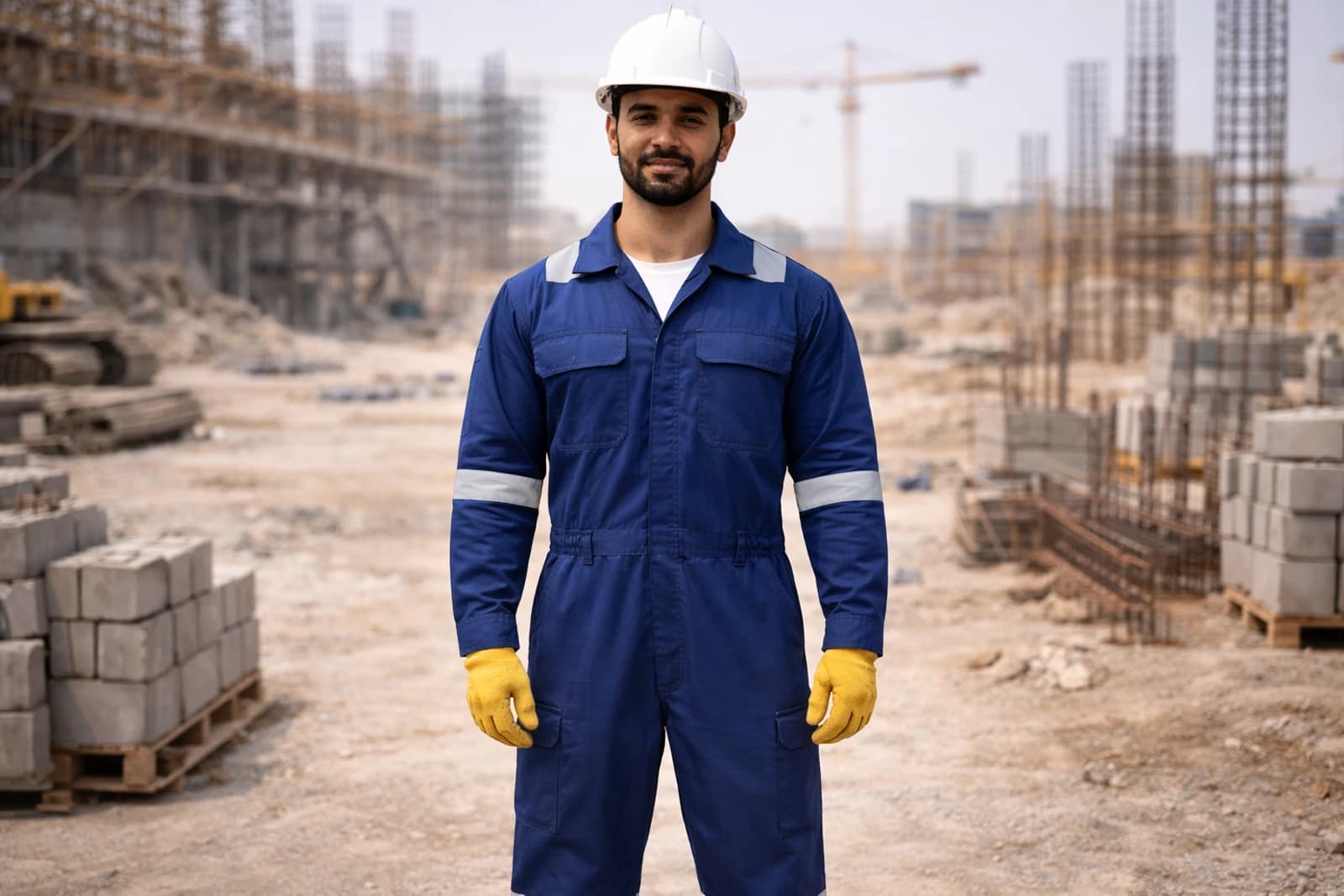
Industrial Workwear
Industrial Coverall Pro
Hard-wearing one-piece coverall for plant, maintenance, and heavy-duty operations.
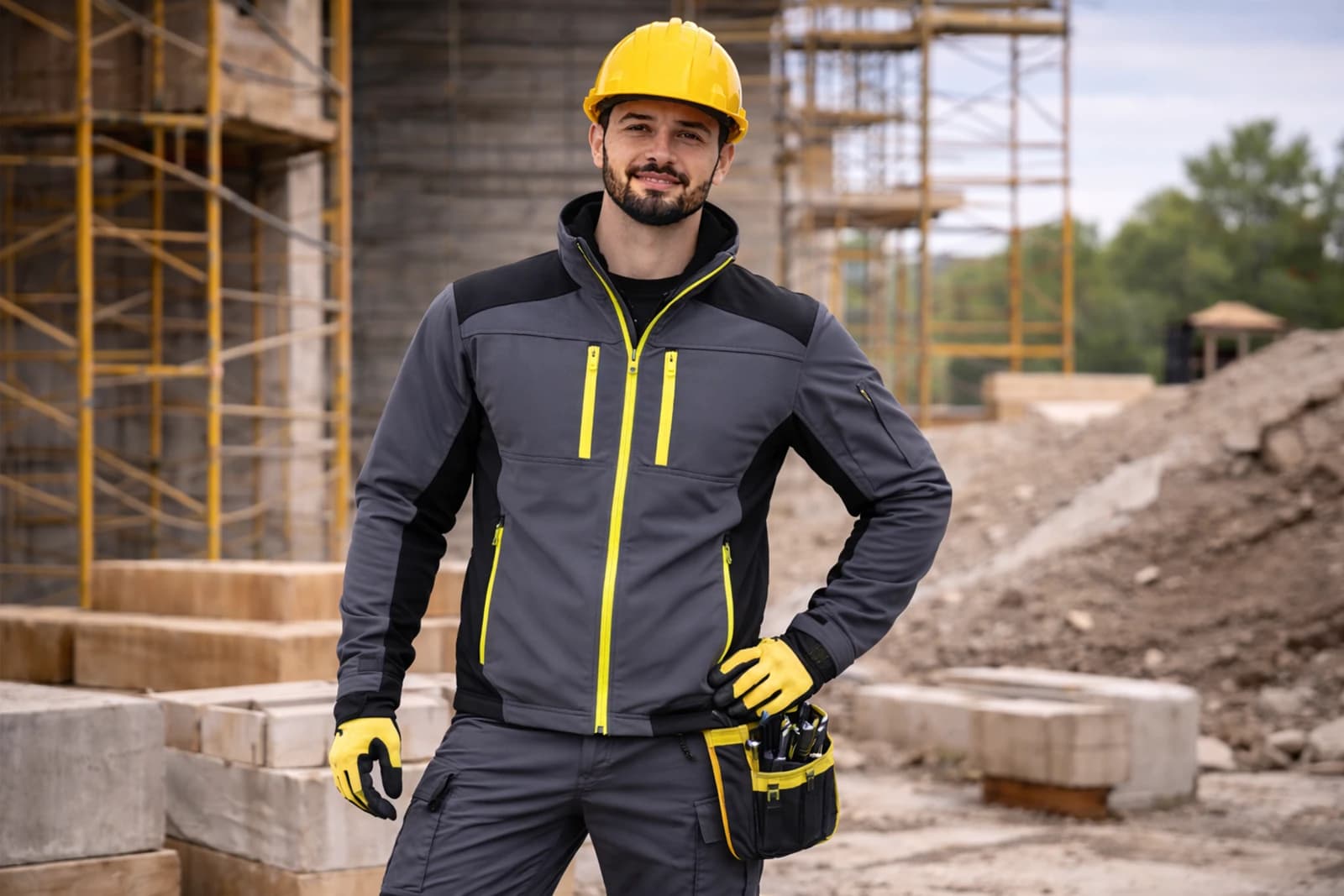
Construction Clothing
Construction Softshell Set
Flexible jacket and trouser set built for crews working across changing weather conditions.