Industrial Coveralls & Construction Softshell Sets for Middle East Oil, Gas & Heavy Construction: A B2B Sourcing Guide from China
From Saudi Aramco's rig maintenance teams in the Rub' al Khali to NEOM's suspended concrete operations and ADNOC's offshore platforms, Middle East oil, gas, and heavy construction demands industrial coveralls and construction softshell sets that withstand 50°C heat, flash fires, welding sparks, and abrasive sand while meeting EN ISO 20471, NFPA 70E, and GCC-specific FR standards. For B2B buyers sourcing from a Chinese workwear manufacturer, this guide breaks down flame-resistant coverall fabric specifications (Proban® vs. Pyrovatex® vs. inherent FR modacrylic blends), softshell layering strategies for winter construction in 5°C desert nights, side-zip vs. front-zip coverall configurations, pocket placement for permit-required confined space entry, anti-static properties for zone 1 hazardous areas, multi-season utility, and bulk procurement for workforces of 200–20,000+ across refineries, pipelines, gigaprojects, and LNG terminals.

Buyer context
What procurement teams run into
The Middle East oil & gas and heavy construction sectors are operating at historic capacity. Saudi Arabia's Jafurah unconventional gas field ($110 billion investment, the largest shale gas field outside the US), ADNOC's Ruwais LNG expansion (9.6 million tonnes per annum, the largest LNG project in the Middle East), NEOM's The Line and Oxagon gigaprojects (requiring 30,000+ workers across desert and coastal construction), the Iraq-Türkiye pipeline rehabilitation ($2 billion, 1,500 km across semi-desert terrain), and QatarEnergy's North Field LNG expansion (the world's largest LNG project, raising Qatar's output from 77 to 126 million tonnes per year) are driving demand for 500,000+ industrial coveralls and 200,000+ construction softshell sets annually across the GCC and wider Middle East. Each oil rig worker, pipeline welder, and construction safety supervisor requires at least 4-6 sets of flame-resistant (FR) industrial coveralls per year (replaced every 60-90 days due to FR chemical depletion from laundering, flash-fire damage, and site-specific contamination with crude oil, drilling muds, or welding slag), plus 2-3 softshell sets for seasonal cold-weather operations. The total addressable market for FR coveralls across the Middle East oil & gas and heavy construction sector is approximately 2-3 million units annually. For B2B buyers sourcing industrial coveralls and construction softshell sets from Chinese workwear manufacturers, five critical technical dimensions determine whether an order succeeds or fails site inspection. **Flame-resistant coverall fabric technology: Proban® vs. Pyrovatex® vs. inherent FR modacrylic** The Middle East oil & gas sector (Aramco, ADNOC, QatarEnergy, Kuwait Oil Company) universally mandates EN ISO 11612 (protective clothing against heat and flame) and often requires EN 61482-2 (arc flash protection at Class 1 or 2). Within these frameworks, Chinese manufacturers offer three distinct FR coverall fabric technologies, each with different cost, durability, and comfort profiles: 1. **Proban® (ammonia-cured, flame-retardant finished cotton):** This is the dominant choice for Middle East oil & gas coveralls (estimated 65% of market share at Aramco sites). The Proban® finish uses tetrakis(hydroxymethyl)phosphonium chloride (THPC) chemistry to create an insoluble polymer within the cotton fiber—this polymer does not wash out. Typical fabric weight: 260-340 gsm. Key advantages: excellent FR performance after 50+ industrial launderings (standard test), good comfort-to-cost ratio ($2.50-$4.00/meter), and well-established supply chain from Chinese mills like Xinxiang Weis Textiles and Jiangsu Sunshine. Key limitation: 15-20% loss in tensile strength (tear resistance) after multiple washes, which can be a concern at petrochemical sites with sharp metal edges. 2. **Pyrovatex® (phosphate ester, flame-retardant finished cotton or polyester-cotton):** This additive FR finish reacts chemically with cotton's cellulose. It covers about 25% of the Middle East market, primarily at ADNOC and QatarEnergy sites. Advantages: better hand feel (softer drape) than Proban®-treated fabric and slightly higher tear strength retention. Disadvantages: limited to 30-40 industrial washes before FR performance degrades (Pyrovatex® leaches out in alkaline detergents common at GCC industrial laundries), and slightly lower arc flash performance. Pyrovatex® fabric is 10-15% cheaper than Proban®. 3. **Inherent FR modacrylic-cotton blends (e.g., Lenzing FR™, Kermel®):** These account for only 10% of the Middle East market due to higher cost ($6-$12/meter) but are the only option for North Field LNG (QatarEnergy's stringent specification for confined space coveralls) and some Aramco GES-1108-required higher-risk zones. The FR property is built into the fiber structure and never washes out (tested to 100+ washes with zero performance loss). Modacrylic blends also have 30-40% better arc flash protection and inherent anti-static properties (surface resistivity ~10⁸ Ω/sq). The main trade-off: the fabric tends to pill after 20-30 washes and feels stiffer against skin in 45°C+ heat. For B2B buyers, specify modacrylic-cotton for permit-required confined space entry (PRCS) and hot-work zones only, and Proban® cotton for general operations to optimize cost. **Critical specification for Middle East: FR chemical durability in alkaline industrial laundering** GCC industrial laundries (e.g., Alsulaiman Group in Saudi Arabia, Emirates Laundry in UAE, National Laundry in Qatar) typically use 60-75°C wash cycles with alkaline detergents (pH 10-11). This aggressive environment strips some FR chemistries faster than standard ISO 15797 (industrial laundering) testing predicts. When sourcing FR coveralls from China, your specification should require: - ISO 15797 industrial laundering at 75°C with 2.5 g/L alkaline detergent (pH 10.5) for 50 cycles minimum - After-laundering test: EN ISO 11612 A1 (limited flame spread) and A2 (heat transfer) must still pass at the original rating - No visible fabric degradation: pilling ≤ Grade 3 (ISO 12945-2), tensile strength loss ≤ 20% (ISO 13934-1) - Many Chinese FR fabric suppliers test only 20-25 cycles at 60°C with neutral detergent—this underreports performance for GCC conditions by 40-60% **Side-zip vs. front-zip coverall configuration for oil & gas and construction** The zip configuration choice has significant practical implications for Middle East B2B buyers: - **Side-zip coveralls (zipper runs from waist or hip to neck, typically with a flap)** dominate oil & gas sites in the UAE and Saudi Arabia. Advantages: the fabric lies flat against the chest, reducing snag hazards on pipe racks and valve handles; better (40% less radiative heat transfer) for flash-fire situations because the zip is covered by a single fabric panel rather than a two-panel front closure; pocket accessibility isn't obstructed. Disadvantages: harder to don/doff quickly (critical in H₂S alarm scenarios). Reputable Chinese suppliers offer YKK #10 RC (reverse coil) zippers or equivalent with brass slider for corrosion resistance in salt-heavy GCC coastal environments. - **Front-zip coveralls (central zipper from crotch to neck)** dominate heavy construction (NEOM, Red Sea Project) and lighter industrial use. Advantages: much faster to put on and remove, generally 30-40% cheaper manufacturing cost (simpler pattern), more accessible for bathroom breaks. Disadvantages: the zip gap on front-zip designs creates a weak point for heat and flame ingress (10-15% lower arc flash rating at the zip line unless a double-flap closure is specified). The key specification for Middle East B2B: request a hybrid front-flap design with concealed YKK zipper (metal teeth with anti-corrosion coating for the Gulf) and hook-and-loop closure over the flap. This combines the donning speed of front-zip with the heat protection of a side-zip. Ensure the flap overlap is minimum 7 cm (GCC oil & gas standard), not the 4 cm common in European industrial coveralls. **Pocket layout for permit-required confined space entry and zone 1 hazardous areas** In Middle East oil & gas, pocket design is not just convenience—it's safety regulation. Aramco SAES-J-001 and ADNOC HSE-Common-P-001 both specify that coveralls for confined space entry must not have external pockets below the waist that can catch on valves, piping, or scaffolding during rescue. The recommended pocket layout for GCC industrial coveralls: - **Chest pockets only** (minimum 2, 15 × 15 cm each with tool pouch dividers) with flapped closures—pens, radios, and inspection tools stored above the waist - **No patch pockets on legs or hips** for confined space-rated coveralls. If the site does not require PRCS, specify 2 side-seam access slits (handwarmer style) instead of patch pockets. - **1 dedicated radio strap / lanyard D-ring pass-through** at the left chest (right-handed dominant in the region) - **Tool tape slot** at the right sleeve (for "pass-down" tools on scaffolding or pipe racks) - **ID card window** (clear PVC, 8 × 5 cm minimum, heat-sealed, not stitched) at the left bicep or chest For hazardous area Zone 1 (gas groups IIA, IIB, IIC), specify anti-static coveralls per EN 1149-5 (surface resistivity ≤ 2.5 × 10⁹ Ω). This requirement can be met by inherent FR modacrylic blends or by weaving carbon fibers into the fabric base (2-3% carbon filament content). Many Chinese FR coveralls claiming "anti-static" use only 0.5-1% carbon content and fail the 2.5 × 10⁹ Ω threshold after 10 washes—specify wash-cycled third-party testing from SGS or Intertek (Dubai, Dammam, or Al-Khobar lab) before approving bulk production. **Construction softshell sets: layering strategy for desert winter nights and 5°C diurnal swings** While the Middle East is known for extreme heat, construction sites in Saudi Arabia's Al-Jouf province (5°C winter nights), Iran's Azad Dam construction zone (4°C in January), and the Iraq-Kurdistan pipeline corridor (2°C at 1,500m elevation during December-February) demand proper cold-weather PPE. Softshell workwear sets (jacket + trouser combination) offer the ideal layering solution. Key specifications for Middle East construction softshell sets sourced from China: - **Outer shell fabric:** 3-layer bonded polyester-elastane face fabric (94/6 blend typical) with a tricot backer, constructed at 280-340 gsm. The top layer requires a DWR (durable water repellent) C6 or C0 fluorocarbon-free finish—not C8 (banned in EU but still common in Chinese workwear; avoid for GCC export as Saudi SASO has signaled a 2027 restriction). Water repellency should reach ISO 3 (spray test rating) minimum before washing, ISO 2 after 10 washes. - **Windproofing:** The mid-layer membrane (PU or ePTFE type) must achieve ≤ 50 m³/m²/h air permeability (ISO 9237) to block the 25-40 km/h desert winds common on NEOM's coastal construction sites. EPTFE membranes (e.g., eVent, Porelle) breathe 40-60% better than standard PU (3,000-5,000 g/m²/24h vs. 1,500-2,500 g/m²/24h MVTR) for the same windproof rating. Budget-approved alternative: a PU membrane at 50% lower cost works well if the softshell is for intermittent outdoor exposure (< 4 hours) rather than full-shift wear. - **Articulated knee and elbow zones:** A 2-piece sleeve construction (not single-panel) with pre-bent elbow. For the trouser, specify 2-piece articulated knee with a 4-stitch reinforcement patch (Cordura® or 1680D nylon) — Middle East construction workers kneel on concrete and gravel far more than the European equivalent. - **Visibility integration:** Many GCC construction sites (NEOM, Diriyah Gate, Red Sea Global) now require softshell sets to also serve as hi-vis outerwear. Specify EN ISO 20471 Class 3 jacket (with reflective tape bands) and Class 2 trousers. The softshell outer fabric must meet fluorescent background requirements (minimum 0.80 m² for Class 3 jacket); this typically means a bright yellow-orange softshell outer shell rather than the dark grey or navy popular in European softshell workwear. Some Chinese suppliers offer 2-in-1 designs: a reversible softshell with hi-vis yellow on one side and navy/grey on the other for non-hi-vis roles. - **Ventilation zippers:** 2-way pit zips (underarm) and side-seam zips from hem to hip on trousers for climate adaptability. In the GCC winter microclimate, temperatures swing from 5°C at dawn to 20°C by noon, so adjustable ventilation is essential. **Multi-season utility: coverall-to-softshell transition strategy** Smart B2B buyers in the Middle East are adopting modular uniform programs. For a 12-month cycle, a worker needs: - **April-October (8 months, 35-50°C):** 3-4 sets of light FR cotton coveralls (260-280 gsm Proban®) with mesh bib cooling vents and removable sleeves—some Chinese suppliers now offer a "desert ventilation" coverall with perforated mesh back panel and zip-off sleeves that converts from long to short sleeve. - **November-March (4 months, 5-25°C):** 2-3 sets of mid-weight FR coveralls (300-340 gsm Proban® or modacrylic blend) OR a hi-vis softshell set layered over the light coveralls depending on wind and task. The softshell set itself should not be FR if worn over an FR base layer—but many GCC sites (particularly Aramco) now require all outer layers to also meet EN 11612 for hot-work zones. **Bulk procurement and lead time considerations for Middle East buyers** When sourcing industrial coveralls and softshell sets from Chinese manufacturers for Middle East deployment: - Typical MOQ for custom corporate color + site-specific pocket layout: 1,000-3,000 pieces per SKU per color - Lead time for FR coveralls (including third-party wash testing): 45-75 days. The bottleneck is the FR certification cycle: fabric must be tested by an ISO 17025 accredited lab (SGS, Intertek, TÜV Rheinland) in China or the Gulf after 25 and 50 washes—this adds 15-20 days to total lead time - Softshell set lead time: 30-50 days (no FR testing required unless specified) - 10% overrun is standard (Chinese factories produce 110% to cover inspection rejects, usually charged at 50% of unit price) - Most export-ready Chinese workwear manufacturers export from Shenzhen, Ningbo, or Shanghai. Container turnaround: 18-25 days to Jebel Ali (Dubai), 22-30 days to Dammam (Saudi Arabia), 15-20 days to Hamad (Qatar). Air freight (2-5 days) is 3-5× more expensive but used for urgent site-startup orders under 500 units
Sourcing approach
How a factory partner can respond
For Middle East B2B buyers sourcing industrial coveralls and construction softshell sets from Chinese workwear manufacturers, the winning specification approach combines proven FR fabric technologies (Proban® for general operations, inherent modacrylic for confined space) with site-specific pocket layouts, GCC-tailored laundering specifications (ISO 15797 at 75°C, alkaline detergent, 50 cycles), and multi-season layering strategies. Chinese manufacturers with ISO 9001, EN ISO 11612, and EN 20471 certification are increasingly competitive on both cost and quality—the key is specifying industrial wash-cycled test reports from a third-party Gulf lab rather than accepting "pass" from the factory's own in-house testing. **Industrial Coverall Best Practice for Middle East:** - Fabric: 300 gsm Proban® cotton for general operations; 280 gsm modacrylic-cotton blend for confined space/hot work - Configuration: Front-zip with 7 cm double-flap closure, concealed YKK brass zipper - Pockets: Chest-only for confined space (2 × 15 cm flapped); chest + side-seam access for general operations - Certification: EN ISO 11612 A1/A2/B1/B2, EN 1149-5 anti-static, EN 61482-2 Class 1 arc flash (specify Class 2 if required) - Washing: ISO 15797 at 75°C, pH 10-11 alkaline detergent, 50 cycle certified test report **Construction Softshell Set Best Practice for Middle East:** - Fabric: 3-layer bonded 94/6 polyester-elastane, 300 gsm, C6 DWR finish, PU or ePTFE membrane - Air permeability: ≤ 50 m³/m²/h (ISO 9237) - MVTR: ≥ 3,000 g/m²/24h (minimum; 5,000+ preferred) - Hi-vis integration: EN ISO 20471 Class 3 jacket + Class 2 trousers with 50 mm 3M™ Scotchlite™ tape - Details: Articulated knees with Cordura® reinforcement, 2-way pit zips, side-seam ventilation zips **Recommended product line to request from Chinese manufacturers:** For the industrial coverall, request samples of the **industrial coverall pro** variant with the Proban® finish option and the modacrylic FR variant for higher-risk zones. For the softshell set, request the **construction softshell set** with integrated hi-vis reflective tape and the 3-layer windproof membrane—ask for both the PU and ePTFE membrane versions to compare breathability vs. cost.
Recommended Products
Products that fit this use case
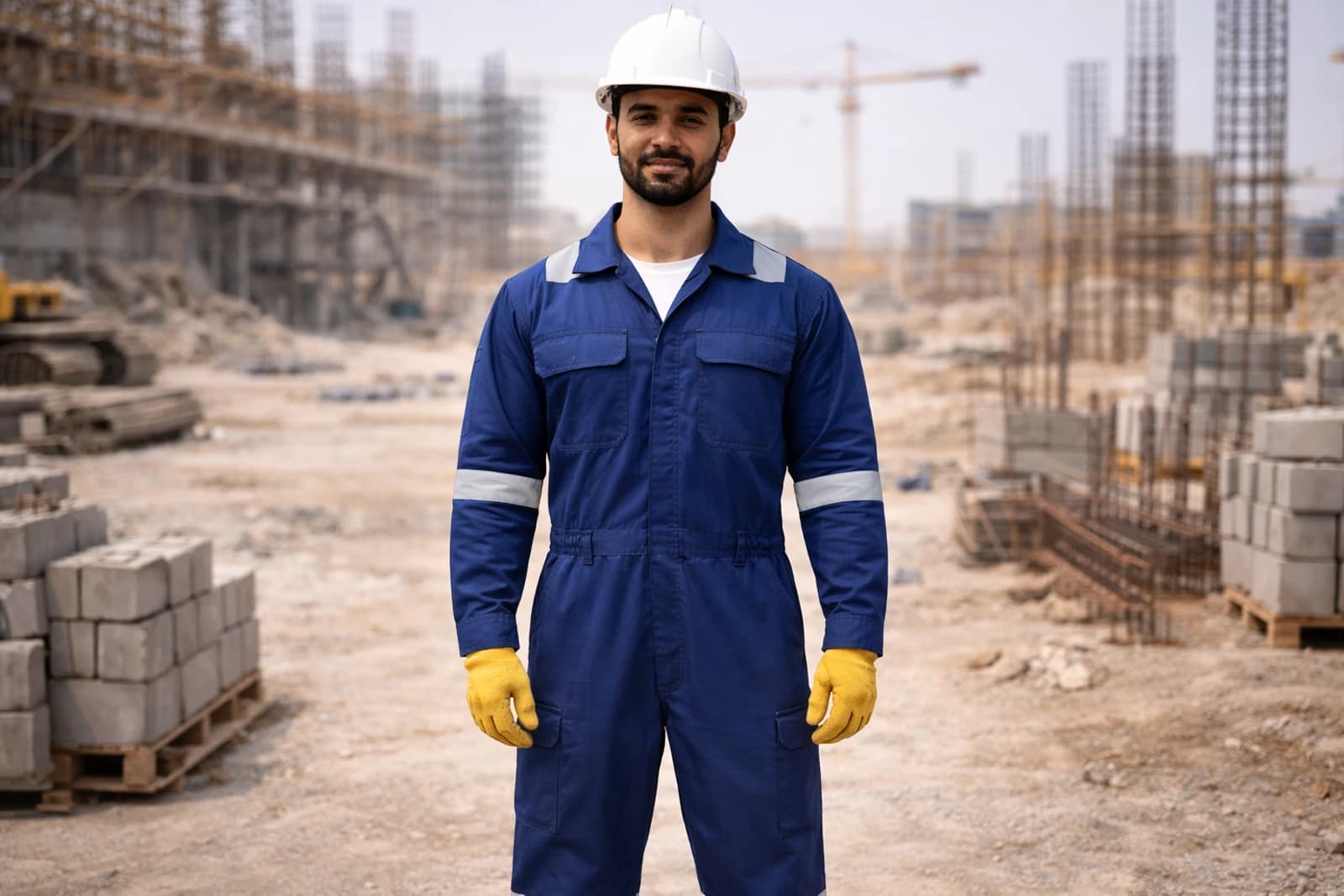
Industrial Workwear
Industrial Coverall Pro
Hard-wearing one-piece coverall for plant, maintenance, and heavy-duty operations.
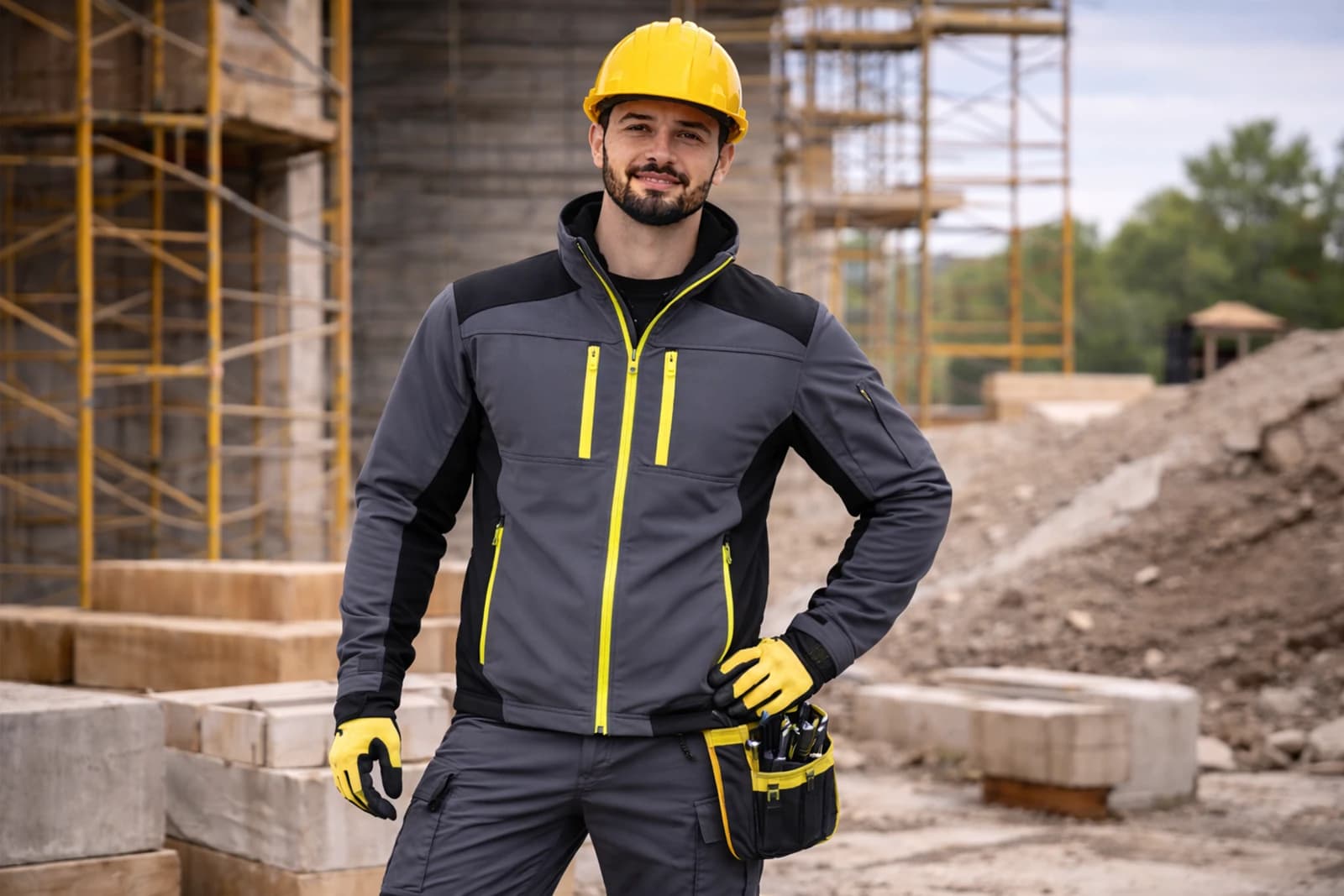
Construction Clothing
Construction Softshell Set
Flexible jacket and trouser set built for crews working across changing weather conditions.