Industrial Coveralls for Middle East Maintenance & Construction Teams: A B2B Buyer's Guide to Fabric, Fit, and Flame Resistance
For Middle East B2B buyers sourcing industrial coveralls for maintenance, construction, and oil-field crews, choosing the right fabric, fit, and protective features is critical. This guide covers flame resistance standards (EN ISO 11612, NFPA 2112), fabric weight for Gulf heat, sizing for diverse body types, and customization options from a Chinese workwear manufacturer — with a comparison of the Industrial Coverall Pro and the Construction Softshell Set for different work environments.

Buyer context
What procurement teams run into
A procurement manager at a facilities maintenance contractor in Dubai is tasked with sourcing 600 coveralls for a new five-year contract across three project types: an oil refinery turnaround (high-risk, requiring flame-resistant garments), a commercial building maintenance crew (general-purpose, moderate wear-and-tear), and a road construction team (outdoor, temperature swings, need for layering). The initial instinct is to order one standard cotton coverall for everyone — but this approach fails on multiple fronts. For Middle East B2B buyers sourcing from a Chinese workwear manufacturer, industrial coveralls are not a commodity buy. Getting them wrong means: - **Heat stress and low compliance** — a 300 GSM 100% cotton coverall worn at 45 °C Gulf summer temperatures is unbearable. Workers roll up sleeves, unzip the front, or simply leave the coverall in the locker. If it's not worn, it's not protecting. - **Wrong fabric for the risk** — standard polyester-cotton blends that aren't FR-treated can melt onto skin in a flash fire or arc flash. But specifying full NFPA 2112-certified flame-resistant coveralls for a general maintenance team that never works near ignition sources wastes 40–60% on garment cost. - **Poor fit across diverse body types** — Middle East workforces include workers from South Asia, Southeast Asia, and the Levant, with different average heights and builds. A one-size approach means some workers swim in fabric that gets caught in machinery, while others can't fully bend or squat. - **No flex or movement for active work** — traditional coveralls with no gussets, no stretch panels, and no articulated knees restrict mechanics, pipe fitters, and welders. The result: discomfort, reduced productivity, and premature garment failure at stress points. - **Inconsistent branding and visibility** — if the coverall doesn't include reflective tape or company logo placement from the factory, buyers end up paying separately for aftermarket embroidery and tape application, which often fails faster than factory-applied options. The core problem: most buyers treat "coveralls" as a single category, when in fact the fabric weight, closure type, pocket configuration, FR treatment, and fit system should all match the specific work environment and risk assessment.
Sourcing approach
How a factory partner can respond
The solution is a risk-based coverall specification strategy: match the garment type, fabric weight, and protective features to the specific work zone, rather than issuing a single coverall for all roles. For Middle East buyers sourcing from a Chinese manufacturer, both the Industrial Coverall Pro (industrial-coverall-pro) and the Construction Softshell Set (construction-softshell-set) can cover most maintenance, construction, and oil-field roles — when specified correctly. **When to choose the Industrial Coverall Pro:** The Industrial Coverall Pro is the right choice when workers need full-body protection in moderate to high-risk environments: - **Fabric options** — available in 245 GSM poly-cotton twill for general use, or 320 GSM flame-resistant treated cotton for oil & gas and welding zones. The FR variant meets EN ISO 11612 (heat and flame) and IEC 61482-2 (arc flash), covering most Middle East refinery and petrochemical requirements. - **Fit and mobility features** — articulated knees, a gusseted crotch, and a bi-swing back allow full range of motion for bending, climbing, and reaching. Side elastic waist inserts provide a trim fit without restricting movement — important for workers who spend 10-hour shifts on their feet. - **Pocket configuration** — two chest pockets with flaps, two side hip pockets, one rule pocket on the right leg, and two back pockets. A radio loop on the chest and a D-ring tab at the waist accommodate common accessories. For maintenance technicians who carry tools, this reduces the need for a separate tool belt. - **Closure system** — a two-way heavy-duty nylon zipper with a snap storm flap prevents snagging on equipment. The zipper should be non-metallic in hot climates to avoid heat conduction against bare skin. - **Ventilation options** — for Gulf summer use, specify the mesh-back panel option that replaces the solid back yoke with ventilated mesh, reducing heat buildup by an estimated 15–20% while maintaining the garment's protective integrity. - **Visibility add-ons** — the Pro model accepts factory-applied EN ISO 20471 reflective tape on the torso (Class 2) and sleeves (adds Class 3), making it suitable for road construction and airport apron work without requiring a separate hi-vis vest. **Key specifications for the Industrial Coverall Pro in Middle East conditions:** - **Fabric weight** — for general maintenance (indoor/outdoor mixed): 245 GSM poly-cotton (65/35) twill. For FR applications (oil & gas, welding): 320 GSM FR cotton or FR poly-cotton blend. - **Color** — navy blue or dark grey for general maintenance (hides dirt and oil stains well); khaki or orange for construction/road crews where visibility is a secondary concern; white for refinery turnaround (reflects heat, shows contamination). - **Sizing system** — specify the extended size range (S–5XL) to accommodate diverse body types. Request a size run sample (one each of S, M, L, XL, 2XL, 3XL) to validate fit across your workforce before placing the bulk order. - **Zipper** — two-way non-metallic zipper with auto-lock slider and snap storm flap. The two-way feature allows workers to unzip from the bottom when sitting or bending, a detail that significantly improves comfort in field conditions. **When to choose the Construction Softshell Set:** The Construction Softshell Set (a separates system: softshell jacket + work pants) is the right choice when: - **Layering is required** — workers who move between indoor air-conditioned spaces and outdoor heat benefit from a zip-on/zip-off jacket over work pants, rather than a one-piece coverall that must be fully removed to adjust temperature. - **Primarily general construction or light maintenance** — in environments where full-body protection is not mandatory (no FR requirement, no heavy chemical exposure), the separates system offers better comfort, easier bathroom breaks, and more flexibility for supervisors and inspectors. - **Mobile work requiring upper-body dexterity** — mechanics and technicians who frequently remove their upper-layer (e.g., when working in tight engine compartments) find separates much more practical than coveralls. - **Mismatched sizing is common** — if your workforce has a high proportion of workers with different jacket vs. pants sizes (e.g., broad shoulders with shorter inseam), separates allow each worker to wear the correct jacket size and pant size independently. **Key specifications for Middle East construction use:** - **Jacket** — lightweight 180 GSM softshell fabric with breathable membrane, not insulated. Full front zip, high collar, adjustable cuffs. Add reflective tape on torso and sleeves for secondary hi-vis compliance. - **Pants** — 240 GSM poly-cotton work pants with articulated knees, multiple pockets, and a gusseted crotch. The pants should have knee pad pockets (with included foam pads) for workers who kneel frequently. - **Visibility** — both jacket and pants can accept factory-applied reflective tape, though this is optional for general construction where hi-vis is not mandated by contract. **For both options, add these customizations from your Chinese manufacturer:** - **Logo embroidery or heat transfer** — factory-applied chest logo (left chest, 10 cm width) with silicone heat transfer for long-lasting adhesion. Avoid direct embroidery through reflective tape — it compromises the retro-reflective performance. - **Name embroidery** — right chest (optional), for workforces where individual identification is required. Request contrasting thread color (white on navy, yellow on khaki) for legibility. - **Pocket customizations** — add a dedicated phone pocket on the left sleeve or thigh for crews who need mobile devices on-site. Add a pen pocket on the left chest flap for supervisors and inspectors.
Recommended Products
Products that fit this use case
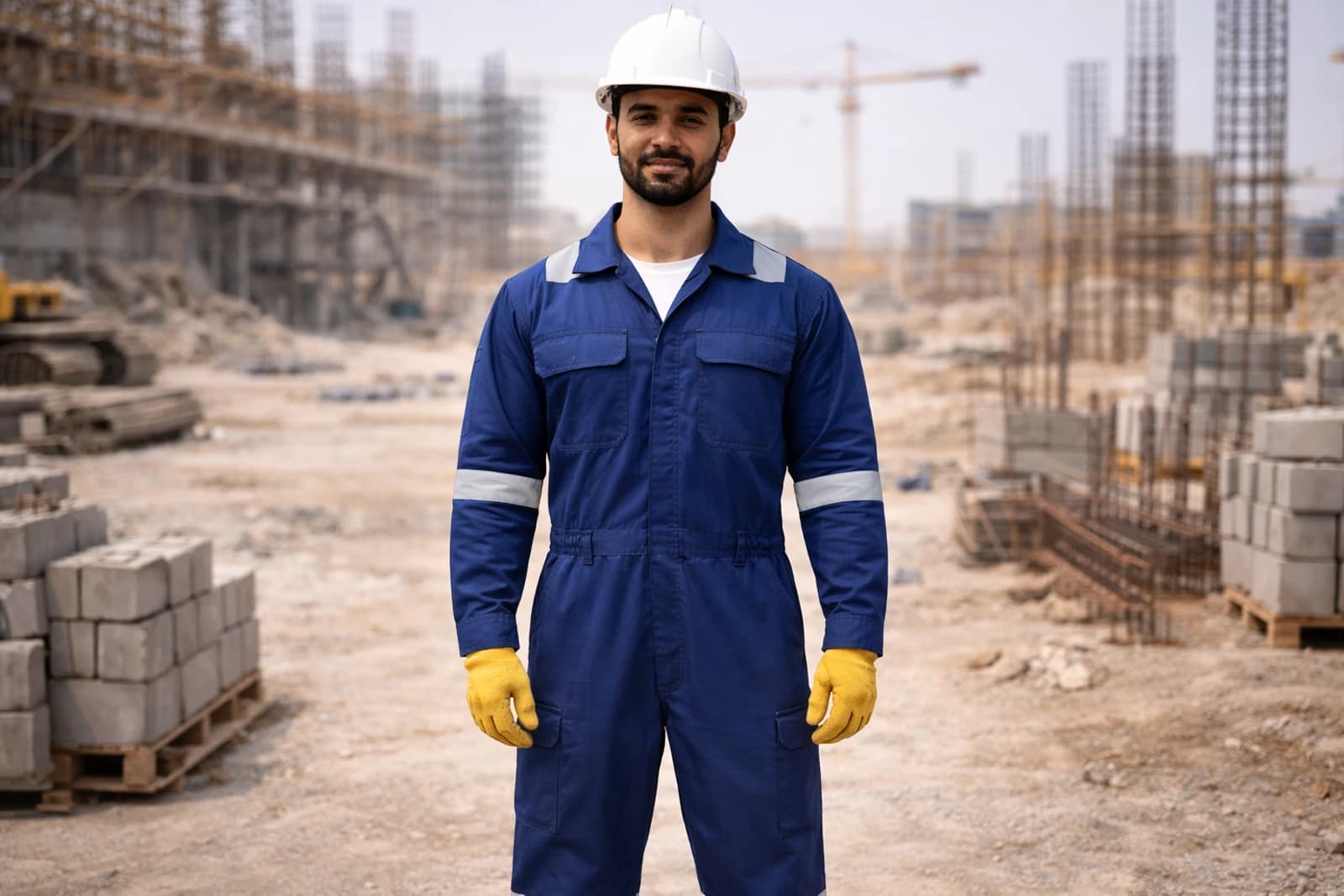
Industrial Workwear
Industrial Coverall Pro
Hard-wearing one-piece coverall for plant, maintenance, and heavy-duty operations.
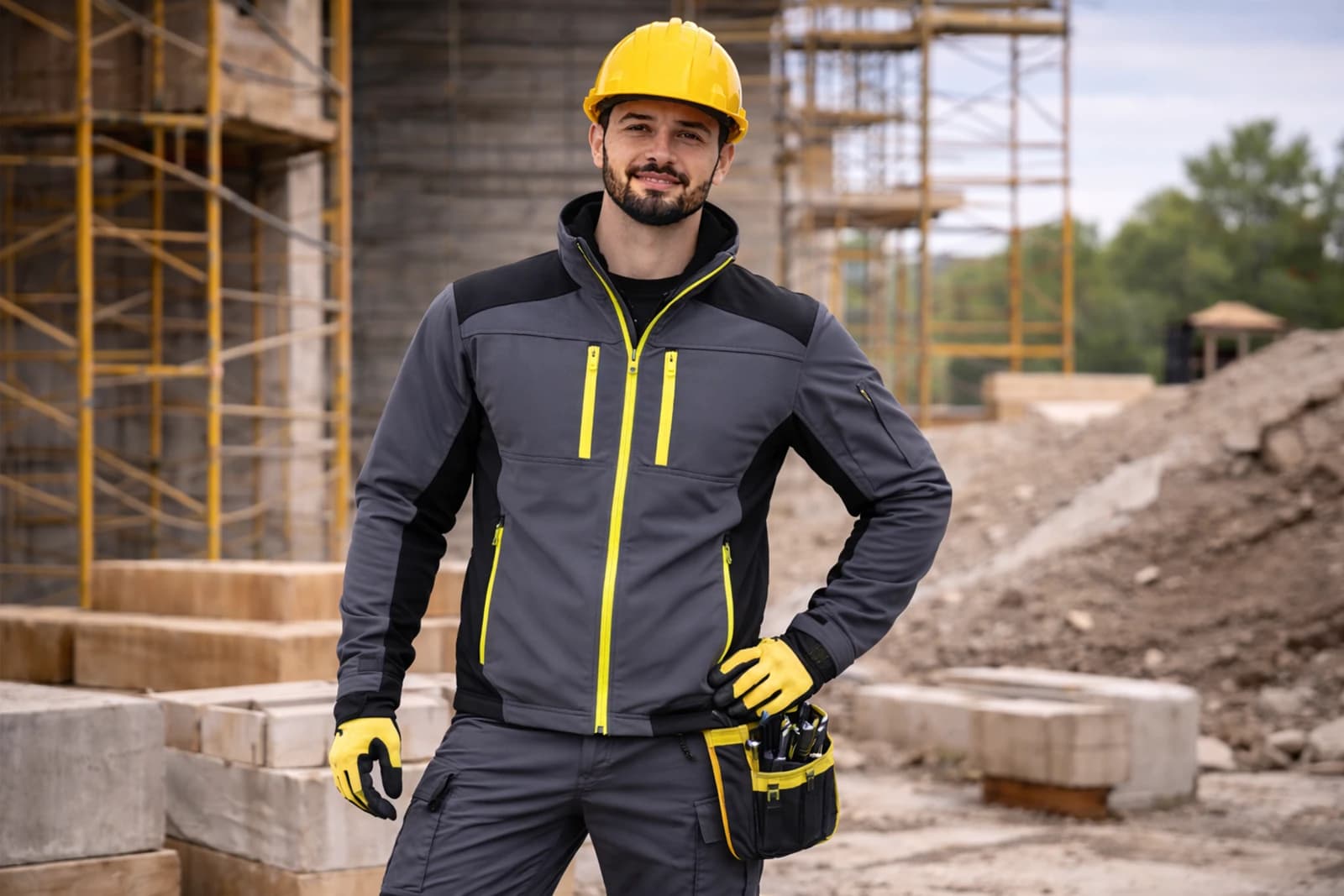
Construction Clothing
Construction Softshell Set
Flexible jacket and trouser set built for crews working across changing weather conditions.