Industrial Coverall & Hi-Vis Safety Jacket for Middle East Oil & Gas: B2B Sourcing from China
The Middle East oil, gas, and petrochemical sectors require high-performance industrial coveralls and hi-vis safety jackets for refinery, rig, and infrastructure workers. This guide helps B2B procurement managers in the GCC source flame-resistant coveralls and high-visibility jackets from a Chinese workwear manufacturer, covering the key standards (EN ISO 11612, EN ISO 20471, NFPA 2112), fabric specifications for extreme heat and sandstorm conditions, customisation for corporate branding, and volume procurement strategies for 500–10,000+ worker rollouts.

Buyer context
What procurement teams run into
The Middle East is home to some of the world's largest oil and gas operations — Saudi Aramco's Ghawar field (the world's largest oil field), ADNOC's offshore and onshore UAE operations, QatarEnergy's North Field expansion, and Kuwait Oil Company's facilities. These operations employ hundreds of thousands of workers in environments where industrial coveralls and hi-vis safety jackets are mandatory PPE, not optional uniforms. For B2B buyers sourcing from a Chinese workwear manufacturer, several critical challenges arise: **Flame resistance standards confusion:** The Middle East oil and gas sector commonly requires compliance with multiple international standards — EN ISO 11612 (protective clothing against heat and flame) for European-influenced specifications, NFPA 2112 for US-influenced operators, and increasingly GOST or SASO certifications for local regulatory approval. A single coverall design must often satisfy two or three of these standards simultaneously, which limits fabric sourcing options and increases cost. Chinese manufacturers vary widely in their certification readiness — some hold only domestic GB standards, which may not satisfy GCC procurement requirements. **Heat stress in FR coveralls:** Flame-resistant (FR) fabrics are inherently heavier and less breathable than standard workwear. In Middle East summer conditions where ambient temperatures reach 50°C (122°F) and humidity in coastal refineries (Ras Tanura, Ruwais) exceeds 80%, workers wearing standard 100% cotton FR coveralls (typically 300–350 gsm) can experience dangerous heat stress within 30–45 minutes of light activity. The challenge is finding FR materials that pass flame resistance tests while offering enough breathability for 8-hour shifts in extreme heat. **Hi-vis jacket durability in sand and UV:** The Middle East's persistent fine sand and dust particles act as abrasives on hi-vis fabric surfaces and retroreflective tape. Standard hi-vis jackets that perform well in European or North American conditions may show significant degradation within 2–3 months of Gulf refinery or rig use — the retroreflective tape loses its reflectivity due to micro-abrasion from sand particles embedded in the fabric, and the fluorescent background colour fades rapidly under intense UV exposure (the GCC receives 3,500+ sunshine hours annually, compared to ~1,600 in London). **Layering compatibility for rig and refinery workers:** Oil and gas workers move between climate-controlled control rooms (18–22°C), outdoor desert heat (45–50°C), and, for offshore rig workers, salt-spray environments with cooling breeze. A hi-vis jacket worn over an industrial coverall must not restrict movement (climbing ladders, operating valves, emergency evacuation), must not create a heat trap, and must allow for rapid doffing in emergency scenarios. Many standard jacket-coverall combinations fail on mobility — particularly in the shoulders and arms when both garments are worn together. **Sizing for mixed workforces in GCC oil and gas:** The oil and gas workforce in the GCC is one of the most ethnically diverse in the world — workers from the Philippines, India, Pakistan, Bangladesh, Egypt, Sudan, Yemen, and Europe all work side by side. A coverall that fits a 165 cm Bangladeshi worker comfortably may be too short in the rise and torso for a 188 cm Egyptian or European worker. Critical fit points — shoulder width, torso length, crotch-to-hem inseam, and sleeve length — must accommodate this range without creating safety hazards (cuffs riding up, crotch binding, shoulder restriction). **Branding and identification for multinational operators:** Oil and gas companies require extensive identification on workwear — company logo, worker name, department/unit identifier, blood type, and sometimes certification badges. Placement of these on FR coveralls must consider safety (no metal fasteners near logo areas that could spark), durability (embroidery through FR fabric must not compromise flame resistance), and maintainability (replacement of ID patches without damaging the garment).
Sourcing approach
How a factory partner can respond
**1. FR Industrial Coverall Specifications for Middle East Oil & Gas** **Fabric selection for heat and flame protection with breathability:** The optimal fabric for GCC oil and gas coveralls is a **FR treated cotton / modacrylic / nylon blend**, typically 270–310 gsm: - **Modacrylic (55–60%):** Provides inherent flame resistance — the fibre self-extinguishes when the flame source is removed. Modacrylic also has a soft, cotton-like hand feel that improves worker comfort compared to 100% treated cotton. - **Cotton (38–40%):** Provides breathability, moisture absorption, and static dissipation. The cotton content also improves comfort in high-humidity refinery environments. - **Nylon (2–5%):** Adds abrasion resistance and tensile strength for the harsh physical conditions of rig and refinery work. For extreme-heat periods (June–September in the GCC), a **lighter-weight 245–260 gsm FR fabric** (60% modacrylic / 39% cotton / 1% antistatic fibre) is available. This reduces heat stress by approximately 15–20% compared to standard 300 gsm fabrics while still meeting EN ISO 11612 (A1, A2, B1, C1) requirements. Specify this for summer-only procurement cycles. **Key standards compliance checklist:** Your Chinese manufacturer should provide test reports for: - **EN ISO 11612 (A1, A2, B1, C1, F1):** The European standard for heat and flame protection. A1 covers limited flame spread; A2 covers convective heat; B1 covers radiant heat; C1 covers molten metal splash; F1 covers contact heat. - **EN 1149-5:** Antistatic protection — essential for petrochemical environments where static discharge can ignite flammable vapours. - **NFPA 2112 (optional):** Required for US-influenced operators or if the garments will be used at facilities with US safety protocols. - **SASO (Saudi Standards):** Required for Saudi Aramco and Saudi projects — verify that the fabric and garment meet SASO's specific heat and flame performance thresholds. **Design features for Middle East oil and gas use:** - **Concealed snap front closure** (no exposed metal zippers — spark risk in gas environments) - **Two-way front zipper under snap placket** for ventilation and bathroom convenience without full doffing - **Elastic waist inserts** (side panels) for improved fit across diverse body types — critical for the multinational GCC workforce - **Cargo pockets with snap closure and drain holes** — essential for carrying tools while allowing sand and water to drain - **Knee pad pockets** for workers who kneel during pipeline inspection and maintenance - **Pen/radio pocket on left sleeve** for communication devices - **Reflective piping on sleeves and legs** for low-light visibility (consistent with company safety colour coding) **2. Hi-Vis Safety Jacket Specifications for Middle East Oil & Gas** **Fabric and material selection:** - **Shell fabric:** 100% polyester oxford weave, 150–200 gsm with PU (polyurethane) coating. The PU coating provides water resistance for unexpected desert rain and wind protection for exposed rig positions, while the oxford weave structure resists sand particle penetration and abrasion. - **Fluorescent background:** ISO 20471 Class 3 (minimum 0.80 m² of fluorescent material) — the standard for high-risk environments. Fluorescent yellow-green is preferred in the Gulf over orange-red as it provides better contrast against the desert sand background. For offshore rigs, fluorescent orange-red is sometimes preferred for maritime visibility. - **Retroreflective tape:** Specify microprismatic tape (not glass bead) — microprismatic tape offers 2–3x the reflectivity of glass bead and is more resistant to sand abrasion. Width: minimum 50 mm per band. Configuration: two 50 mm horizontal bands around the torso, plus 50 mm bands on each sleeve. **UV and sand resistance specifications:** - **UV resistance:** Specify the fabric must retain minimum 80% of original fluorescent colour strength after 100 hours of accelerated UV exposure per ISO 105-B02. Standard hi-vis fabrics may fade to 50–60% colour retention in GCC conditions within 3 months — this specification ensures the jacket remains compliant for at least 6–8 months of daily use. - **Tape abrasion resistance:** Retroreflective tape should pass EN ISO 20471 Annex B abrasion test (minimum 5,000 cycles with less than 20% reflectivity loss). Standard glass-bead tape typically fails after 2,000–3,000 cycles in sand-abrasive conditions. **Design features for oil and gas environments:** - **Detachable sleeves:** A hi-vis vest that converts to a full jacket — useful for the variable temperatures workers experience between control rooms and outdoor areas - **Radio/communication pocket:** Left chest with loop antenna slot and clear window for radio display - **Two-way front zip under storm flap:** For wearing over a coverall without heat retention - **Mesh lining:** For breathability — critical when worn over an FR coverall in 45°C+ conditions - **ID card window on right chest:** With scratch-resistant transparent PVC - **D-ring access:** For workers who need to attach safety harness or fall protection equipment **3. Combination Wear Strategy: Coverall + Hi-Vis Jacket** The most practical approach for oil and gas workers in the GCC is: - **Primary layer:** FR industrial coverall (worn as the base working garment, always on) - **Over layer:** Hi-vis safety jacket (worn when outside, in low-light conditions, or for specific tasks requiring enhanced visibility) This combination allows workers to: - Remove the jacket during peak heat (11:00–15:00) while maintaining FR protection - Add the jacket during cooler morning/evening shifts and night work - Comply with hi-vis requirements for specific zones (loading areas, helipads, night operations) without requiring a separate hi-vis coverall - Doff the jacket quickly in emergency scenarios **4. Sizing for the GCC Multinational Workforce** Work with your Chinese manufacturer on a **customised size grading** for Middle East oil and gas workforces: | Size | Chest (cm) | Torso Length (cm) | Sleeve Length (cm) | Inseam (cm) | Suitable for | |------|--------|--------|--------|--------|------| | S | 94–100 | 72 | 58 | 74 | Smaller South Asian builds | | M | 100–106 | 74 | 60 | 76 | Average South Asian builds | | L | 106–114 | 76 | 62 | 78 | Larger South Asian / average Arab builds | | XL | 114–122 | 78 | 64 | 80 | Larger Arab / European builds | | 2XL | 122–130 | 80 | 66 | 82 | +90 kg European / Arab builds | | 3XL | 130–140 | 82 | 68 | 84 | Large builds | **Key customisation for the GCC:** Increase torso length by 3–5 cm compared to standard Asian sizing at each grade — Arab and European body types typically have longer torsos relative to chest circumference compared to South Asian populations. **5. Branding and Identification** For oil and gas operators, customisation is extensive: - **Left chest:** Company logo (embroidered on a patch and sewn to the coverall — NOT embroidered through the FR fabric, which could create needle holes that compromise FR integrity) - **Right chest:** Worker name (embroidered patch, sewn with FR thread) - **Shoulder (optional):** Company or department identifier - **Back (optional):** Company name for large-format brand presence - **Inner branding label:** Care instructions in English and Arabic, size, date of manufacture, and applicable standards certifications **Thread specification note:** All stitching on FR coveralls must use FR thread (Nomex or similar). Non-FR thread melts and creates burn channels in a flash fire, which can compromise the entire garment's protective performance. Verify your Chinese manufacturer sources certified FR thread for all FR garments. **6. Volume Procurement and Bulk Ordering** For 500–10,000+ worker rollouts: - **Sample approval:** Order 5–10 samples per size for fit testing across your workforce demographics before confirming bulk production - **Pre-production samples (PPS):** Request 1–2 finished garments per size for the buyer's QA team to inspect prior to bulk production - **In-line inspection:** Include third-party inspection (e.g., SGS, Bureau Veritas) during production — at cutting stage and sewing stage - **Factory audit:** Verify the Chinese manufacturer holds valid certifications for FR garment production, including EN ISO 11612 and EN 1149-5, before placing the order - **Lead time:** Standard 60–75 days for FR fabric weaving + garment production; schedule orders 90 days ahead for first-time collaborations - **Minimum order quantity (MOQ):** Typically 300–500 pieces per style per colour for customised FR garments from established Chinese workwear manufacturers
Recommended Products
Products that fit this use case
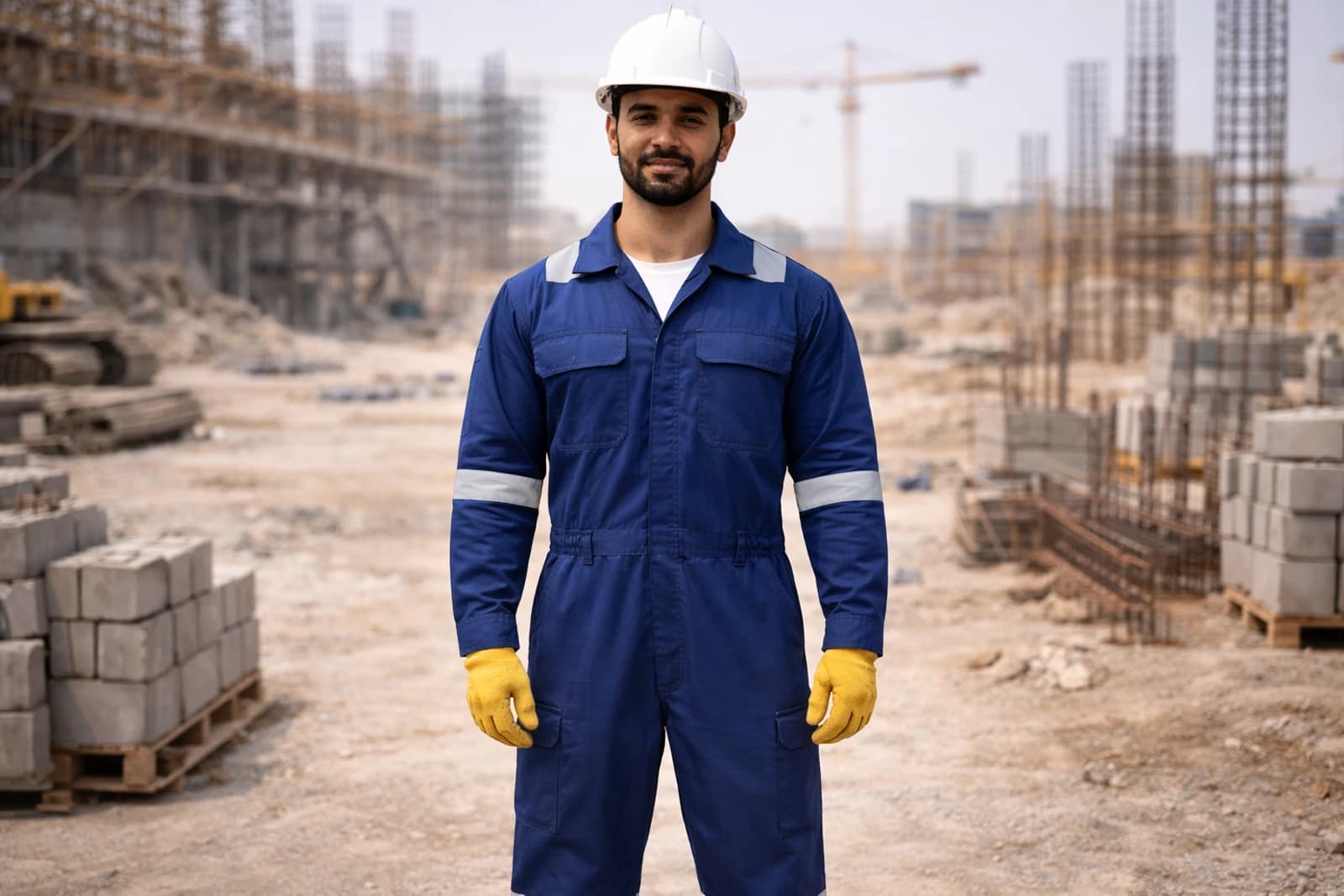
Industrial Workwear
Industrial Coverall Pro
Hard-wearing one-piece coverall for plant, maintenance, and heavy-duty operations.
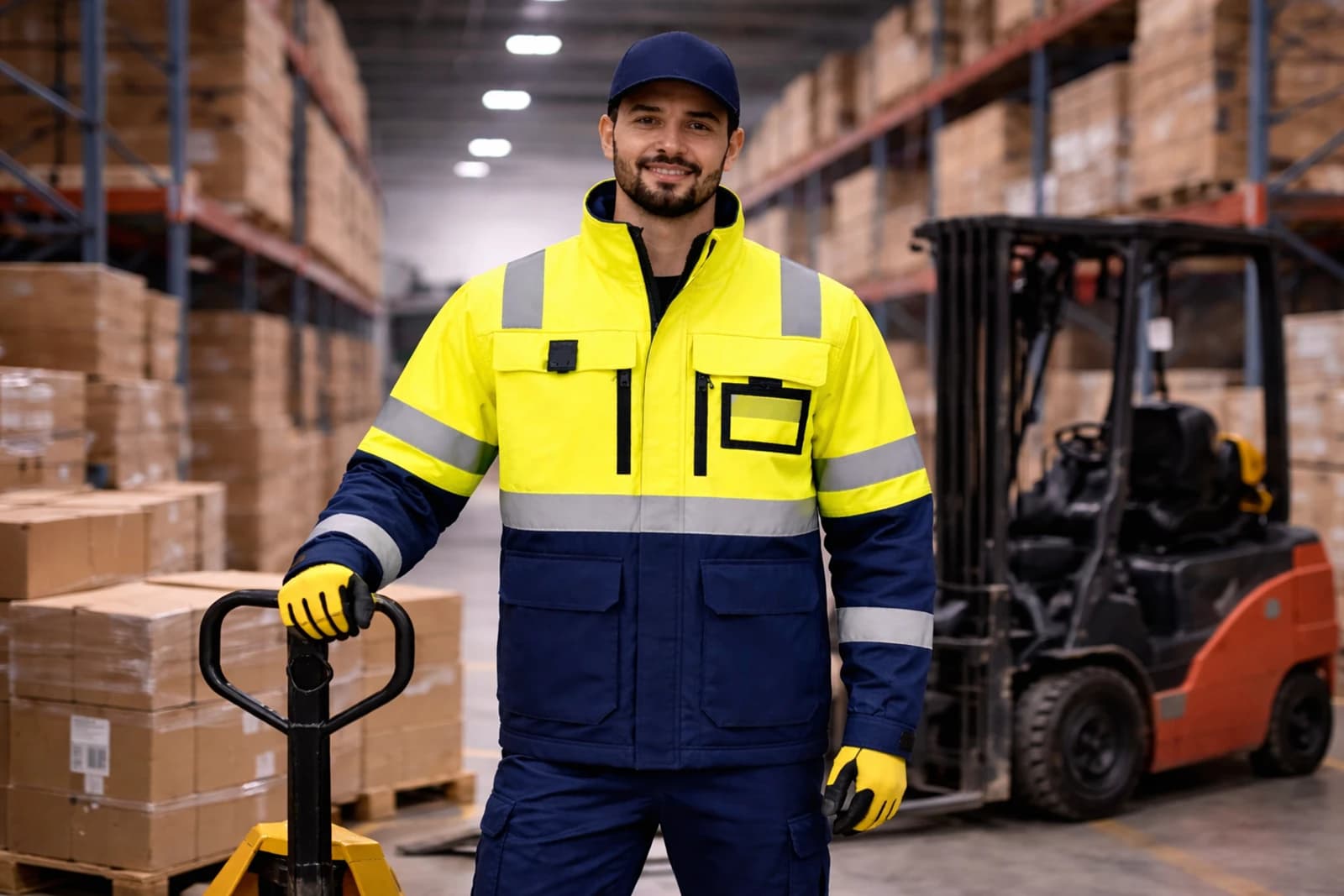
Safety Uniform
Hi-Vis Safety Jacket
Reflective safety jacket for high-visibility site operations and road work crews.