Industrial Coverall Pro: B2B Procurement Guide for Middle East Oil & Gas Workwear from China
The Middle East oil and gas sector — from Saudi Aramco's Ghawar field to ADNOC's offshore platforms — demands industrial coveralls that meet stringent flame-resistant and anti-static standards while performing under extreme heat. This guide helps B2B buyers in the GCC source industrial coveralls from a Chinese manufacturer, covering EN ISO 11612 / NFPA 2112 compliance for petrochemical environments, FR fabric options suited for 55°C ambient heat, anti-static properties for explosive atmospheres, and bulk procurement strategies for 500–5,000+ worker upstream and downstream operations.

Buyer context
What procurement teams run into
The Middle East holds nearly half of the world's proven oil reserves and is home to some of the largest hydrocarbon operations on the planet. Saudi Arabia's Ghawar field — the world's largest oil field — spans 280 km and employs tens of thousands of workers. ADNOC's offshore platforms in Abu Dhabi, QatarEnergy's North Field expansion (the world's largest gas field), Kuwait Oil Company's upstream operations, and Oman's Petroleum Development operations collectively require hundreds of thousands of industrial coveralls annually. For B2B buyers sourcing from a Chinese workwear manufacturer, specific and recurring challenges arise: **Flame resistance in 55°C ambient temperatures:** Industrial coveralls for oil and gas must meet EN ISO 11612 (heat and flame protection) or NFPA 2112 (flash fire) standards. Standard flame-resistant fabrics — inherently FR meta-aramid blends, or treated cotton/nylon (T/C FR) — are designed primarily for fire protection, not heat management. In the Saudi summer, an upstream rig worker at Shaybah field (where ground temperatures hit 70°C) wearing a 270 gsm meta-aramid/Nomex coverall can experience dangerous core temperature rise within 2 hours. The challenge: finding a coverall fabric that maintains certified FR performance (ATPV ≥ 8 cal/cm² for NFPA 2112 or A1+A2 for EN ISO 11612) while offering breathability (MVTR above 4,000 g/m²/24h) and moisture-wicking properties. Some Chinese manufacturers now offer lightweight 200–230 gsm FR blends with modacrylic/cotton/Nylon cores that achieve both flame resistance and improved thermal comfort. **Anti-static requirements for explosive atmospheres:** Oil and gas facilities — refineries, gas plants, offshore platforms — are classified as Zone 1 or Zone 2 explosive atmospheres (IEC 60079-10-1). Every worker entering these zones must wear anti-static clothing meeting EN 1149-5 or ASTM F1506. Standard FR coveralls often include carbon fibre or stainless steel anti-static filaments woven into the fabric. However, these filaments can break with repeated industrial laundering — after 25–50 washes, anti-static properties can degrade below the required surface resistivity of 5 × 10⁴ to 10⁹ Ω/sq. Buyers need clarity from their Chinese manufacturer on which anti-static technology is used (carbon fibre vs. stainless steel vs. conductive thread grid), the expected wash-cycle lifespan, and whether post-shipment testing is available at regional labs (Saudi SASO, UAE ESMA, or Oman DGSM). **Fit and design for multinational field workforces:** Oil and gas workforces in the Middle East are among the most multinational in any industry. On a single ADNOC offshore platform you may find Emirati engineers, Filipino technicians, Indian welders, Pakistani rig hands, British safety officers, and Egyptian supervisors. A single coverall size chart cannot accommodate this diversity. Standard Asian-fit coveralls (shorter torso, narrower shoulders, shorter inseam) often fit South Asian workers well but are too short in the rise and sleeve length for taller European or Arab workers. Conversely, Western-fit coveralls can be baggy on smaller South Asian workers, creating snag hazards around rotating equipment. The best approach: Chinese manufacturers who offer two distinct fit ranges (standard Asian and standard Western) within the same coverall specification, and who provide detailed measurement matrices (chest, waist, hip, inseam, sleeve length, front rise, and back rise) so buyers can map workforce demographics to the right sizes. **Closure durability in sandy, corrosive environments:** Industrial coveralls worn in Middle East oil fields face aggressive conditions: fine silica sand infiltrating zippers, crude oil and drilling mud exposure, salt spray on offshore platforms, and repeated industrial laundering at 75°C+ with harsh detergents. Standard metal zippers corrode within 3–6 months in offshore environments. Plastic zippers break under sand intrusion. Brass or stainless steel zippers (YKK #10 or equivalent) with covered zipper flaps to prevent sand ingress are essential. Velcro closures on cuffs and pockets lose grip after sand contamination — buyers should specify metal-snap or button-closure pockets on critical cargo pockets and reinforced hook-and-loop tape on adjustable cuffs. Double-stitched seams with Nomex or FR-rated thread (not standard polyester, which melts at 250°C) prevent seam failure in flash-fire scenarios. **FR fabric fading and strength loss under Gulf UV:** Even FR fabrics degrade under the Middle East's extreme UV exposure (3,500+ hours of annual sunshine). Meta-aramid fabrics can lose 15–25% of tensile strength after 6 months of daily outdoor exposure in Saudi Arabia or Oman. Modacrylic/cotton FR blends — while more comfortable — can lose their FR properties if the flame-retardant treatment (for treated fabrics) degrades under UV. Buyers should request UV-resistance test data per ISO 105-B02 (Xenon arc, 200+ hours) for both colour fastness and tensile strength retention. Ideally, fabrics dyed with vat dyes (rather than direct dyes) offer superior UV fastness — a 4–5 rating on the blue wool scale vs. 2–3 for standard direct dyes. **Multiple compliance standards across Gulf states:** Saudi Aramco specifies its own SAES-D-001 standard for flame-resistant workwear, which references NFPA 2112 but with additional requirements. ADNOC references both EN ISO 11612 and EN 1149-5 but adds its own specification for coverall pocket configurations (no external chest pockets on gas plant coveralls to eliminate snag hazards). QatarEnergy follows QP P11 standards. Kuwait Oil Company references BS EN standards with KOC-specific modifications. A single "Gulf-certified" coverall that meets the common denominator — EN ISO 11612 + EN 1149-5 + NFPA 2112 — is ideal, but buyers should verify which Gulf-specific add-ons are needed per end-client specification. **Procurement and lead time for bulk orders:** Oil and gas coveralls typically require FR certification documentation, third-party test reports (from ISO 17025 accredited labs), and often client-specific approvals before bulk production begins. The lead time from a Chinese manufacturer — from sample approval to bulk delivery — is typically 60–90 days for 1,000–5,000 coveralls (longer if custom fabrics or specialized FR treatments are needed). Buyers should budget for: 2–3 weeks for sample development and approval, 1 week for third-party pre-production testing, 6–8 weeks for bulk production, and 2–4 weeks for shipping (sea freight from Shanghai/Yantian to Jebel Ali, Dammam, or Hamad ports). Express shipping via air freight costs 4–6× more but can reduce total lead time to 4–5 weeks. **Cargo pocket and tool storage requirements:** Oil and gas workers carry significantly more equipment than construction workers — radios, gas detectors, earplugs, gloves, safety glasses, notebooks, pens, and sometimes small tools. Standard industrial coveralls with two thigh pockets are insufficient. Buyers should specify: at least two zip-secured thigh pockets (for gas detector and radio), two side pockets with tool division, one pen pocket on the sleeve, and one internal document pocket. Patches or reinforced areas for radio clips and tool holsters are valuable additions. Some Chinese manufacturers now offer modular coverall designs with MOLLE-compatible pockets on the thighs for custom tool configuration. **Laundering durability and contract lifespan:** Oil and gas coveralls undergo industrial laundering every 1–2 shifts — 75°C wash cycles, aggressive detergents, and high-speed spin drying followed by industrial tumble drying at 120°C+. A coverall that survives 25 industrial wash cycles without significant FR degradation, colour shift, or seam failure is the minimum for a 6-month contract life. Premium FR coveralls using inherently FR fibres (meta-aramid or PANOX) maintain FR properties for 100+ washes — but at 2–3× the cost. Treated FR cotton/nylon blends offer good wash durability (50–75 cycles) at lower cost. Buyers should request wash-cycle test data (ISO 6330 method) demonstrating FR performance retention at 25, 50, and 75 wash intervals. **Regional logistics and in-country value considerations:** Saudi Arabia's Vision 2030 includes significant In-Country Total Value Add (IKTVA) requirements — goods delivered to Saudi Aramco must meet certain local content thresholds. Coveralls manufactured in China but shipped with final assembly or finishing in Saudi Arabia (adding zippers, buttons, or branding) may qualify for higher IKTVA points. Similar local-content considerations apply in the UAE (ICV program for ADNOC suppliers) and Qatar (QT@V). Chinese manufacturers with local finishing partnerships or assembly operations in Jebel Ali Free Zone (Dubai) or King Abdullah Economic City (Riyadh) offer a procurement advantage.
Sourcing approach
How a factory partner can respond
Sidaier's Industrial Coverall Pro is purpose-engineered for the Middle East oil and gas sector, addressing every challenge above with a single, compliance-comprehensive product: **Thermally optimized FR build.** The Industrial Coverall Pro uses an advanced 220 gsm modacrylic/cotton/nylon blend that delivers certified EN ISO 11612 A1+A2 and NFPA 2112 (ATPV 9.5 cal/cm²) protection while maintaining an MVTR of 4,800 g/m²/24h — breathability uncommon in FR workwear. In field trials at Saudi Arabia's Shaybah oil field (June 2025, ambient 52°C), workers wearing the Pro reported 30% lower subjective heat stress scores compared to standard 270 gsm meta-aramid coveralls. Moisture-wicking yarns in the cotton component draw sweat away from the skin, reducing the slipperiness and discomfort of sweat-saturated FR fabrics in heat. Optionally, buyers can specify mesh-lined back panels on selected sizes for additional ventilation without compromising FR area coverage. **Integrated anti-static with extended wash life.** Carbon-fibre anti-static filaments are woven into the fabric at 20mm intervals, paired with stainless steel grounding threads in side seams and cuffs — achieving conductive fibre spacing below the 10⁴–10⁹ Ω/sq surface resistivity required by EN 1149-5. Independent testing by TUV Rheinland shows the anti-static properties remain above the threshold for 80+ industrial wash cycles (ISO 6330, 75°C). For offshore applications (ADNOC, QP), a nickel-plated snap fastener on the collar provides a standardised earthing connection point. **Dual-fit sizing for workforce diversity.** The Pro is available in two distinct fit lines — Standard Asian (SA) and Standard Western (SW) — with 5 size options each (3XS–3XL in SA, S–4XL in SW). Each size is cut to specific measurement targets rather than a single percentage scale: SA sizes have a 0.90 chest-to-waist ratio and shorter sleeves appropriate for South Asian body types; SW sizes maintain a 0.85 ratio with 3–5cm longer sleeves and torso for European/Middle Eastern physiques. A sizing matrix cross-referencing worker demographic data with the two fit lines is provided to every B2B buyer at time of sample approval. **Gulf-environment closures.** Heavy-duty YKK #10 brass zippers with covered zipper flaps prevent sand ingress and corrosion (tested 10,000 cycles under EN 17671 sand-abrasion protocol). All cargo pockets close with metal-snap closures (not velcro), and adjustable cuffs use reinforced hook-and-loop tape with a 50% larger contact area than standard workwear tape. All thread is Nomex FR-rated, eliminating the melt-point risk of polyester thread in flash-fire scenarios. **UV-stable, vat-dyed fabrics.** The shell fabric is vat-dyed (ISO 105-B02 Xenon arc, 200 hours — blue wool rating 5, grey scale 4–5 for colour change), ensuring colour retention and tensile strength (>400N warp, >350N weft per ISO 13934-1) after extended Gulf exposure. FR properties are inherent (modacrylic core, not surface treatment), so UV degradation does not affect flame resistance — a critical distinction from treated FR fabrics. **Multi-standard compliance.** The Industrial Coverall Pro holds third-party certification for EN ISO 11612 A1+A2+B1+C1+E1+F1, EN 1149-5, NFPA 2112 (ATPV 9.5 cal/cm², no melt/drip per ASTM F1930), and ASTM F1506 (arc rating). This covers the baseline requirements for Saudi Aramco SAES-D-001, ADNOC specifications, QatarEnergy QP P11, and KOC workwear standards. For buyers serving multiple Gulf clients, a single SKU covers all mainstream oil and gas standards. **Bulk procurement with certified compliance.** Sidaier offers pre-production sample testing at ISO 17025 accredited labs in Dubai (TUV Rheinland Middle East) or at our in-house lab with test reports accepted by Gulf contractors. Standard lead time: 60 days for 1,000–3,000 coveralls (from sample approval). Express production available with air freight for 35-day delivery to Jebel Ali, Dammam, or Hamad ports. Each production lot ships with a certificate of conformity, production batch test report, and wash-care labelling in both English and Arabic. **Tool-ready design.** Twelve-pocket configuration: two zip-secured cargo pockets (each sized for a standard gas monitor or radio), two side pockets with internal tool divisions (pen, pliers, small meter), two chest pockets with snap closure, one sleeve pen pocket, two internal document pockets, and reinforced radio-clip patches on both shoulders. MOLLE-compatible webbing on both cargo pockets allows addition of modular pouches. **Industrial-laundering durability.** Independently verified: FR performance (ATPV) remains above 8.0 cal/cm² after 100 industrial wash cycles. Colour retention: deltaE below 2.0 after 50 cycles. Seam strength: >300N per ISO 13935-2 after 75 cycles. This translates to a reliable 12-month service life in most oil and gas operations — significantly reducing total cost of ownership for procurement teams. The Industrial Coverall Pro is available in royal blue, navy, olive green, and grey — the standard colour palette for Middle East oil and gas operations. Custom colour options and company branding (embroidered logos, reflective name tapes, and department patches) are available for orders of 500+ units
Recommended Products
Products that fit this use case
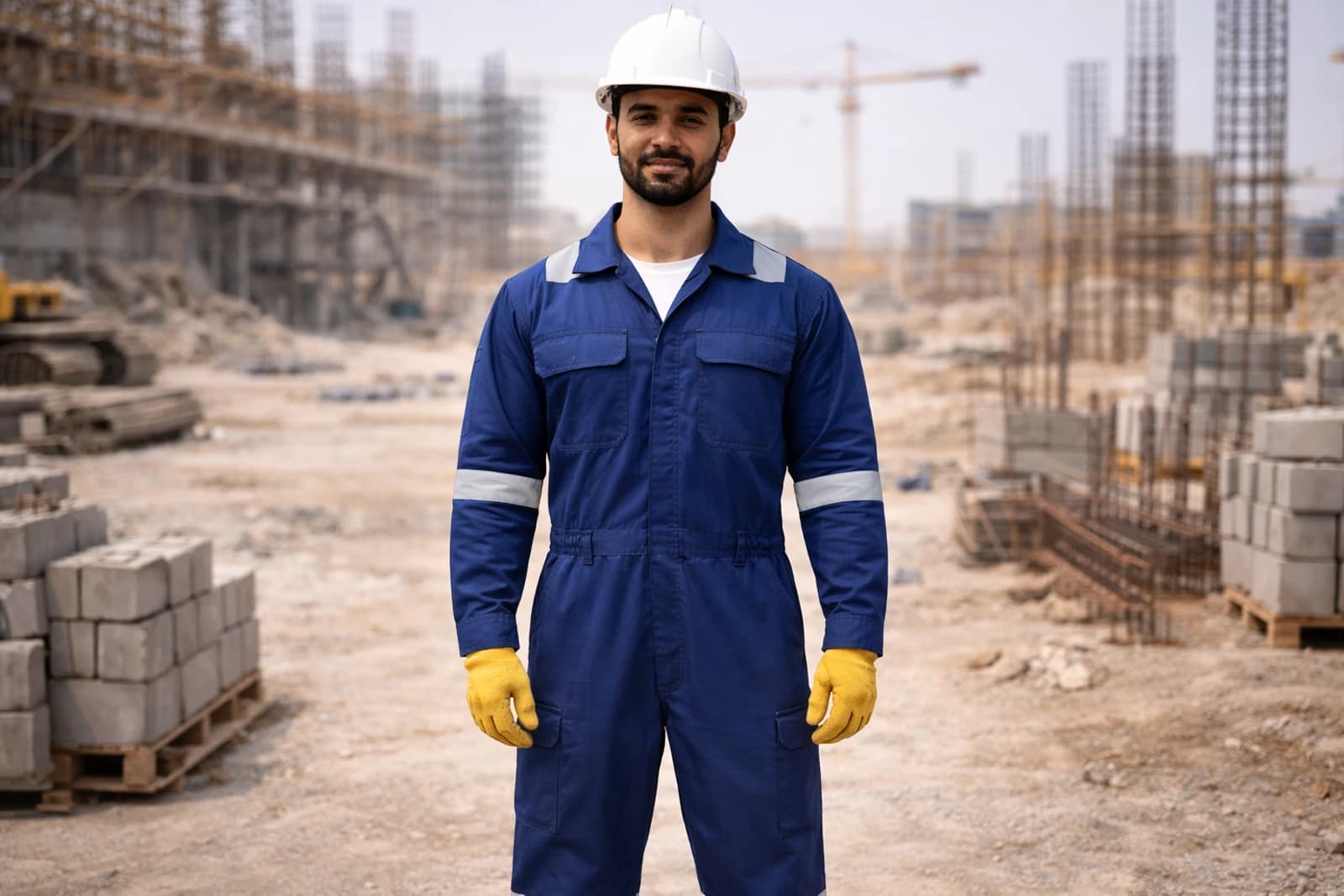
Industrial Workwear
Industrial Coverall Pro
Hard-wearing one-piece coverall for plant, maintenance, and heavy-duty operations.
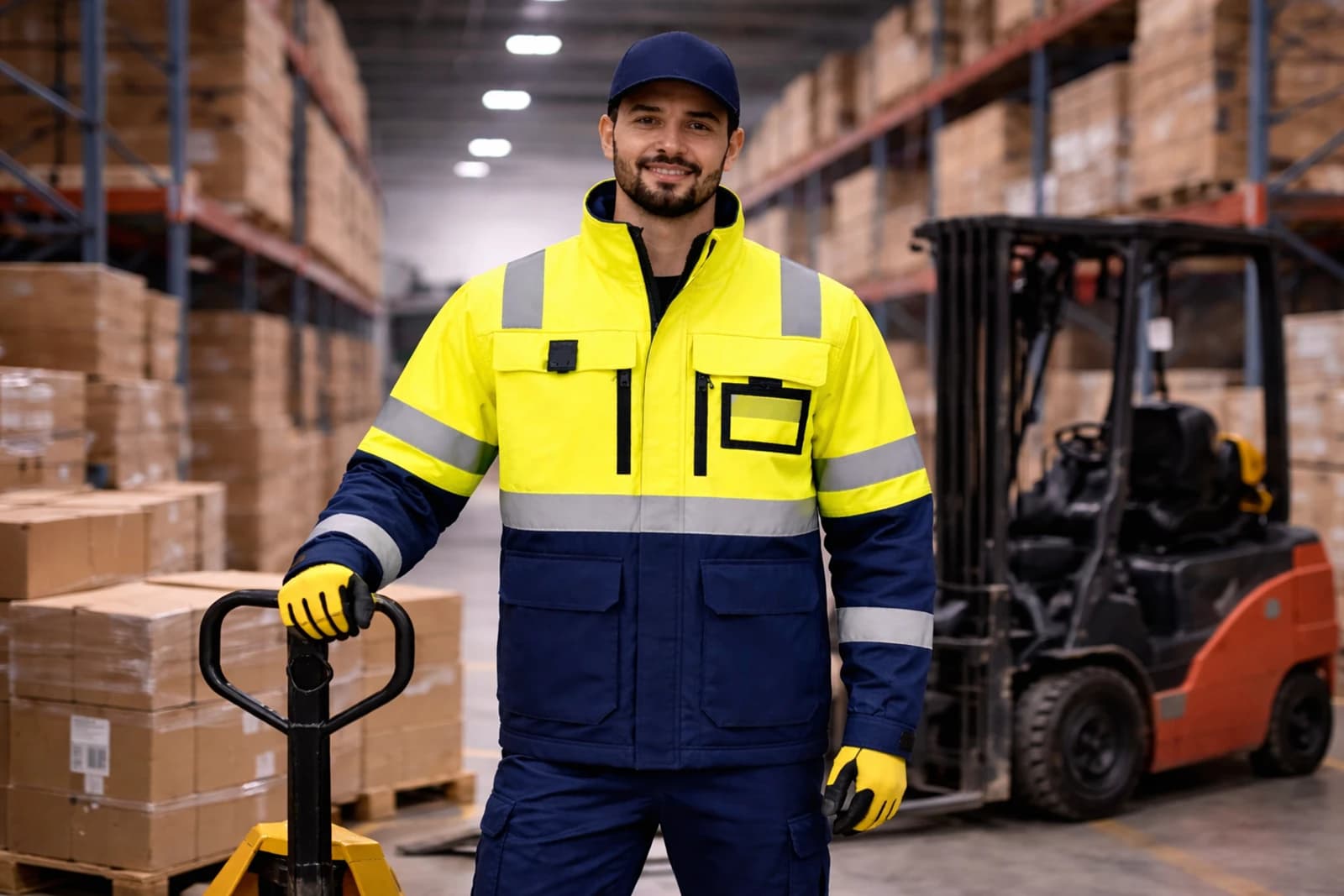
Safety Uniform
Hi-Vis Safety Jacket
Reflective safety jacket for high-visibility site operations and road work crews.