Industrial Coverall Pro — B2B Sourcing Guide for Middle East Oil, Gas & Heavy Industry from a Chinese Manufacturer
Middle East industrial sectors — oil & gas, petrochemical, heavy manufacturing, and power generation — demand coveralls that perform in extreme heat, flash-fire environments, and high-visibility zones. This guide covers what procurement managers, HSE directors, and workforce outfitting buyers across Saudi Arabia, UAE, Qatar, Kuwait, and Oman should know when sourcing industrial coveralls from a Chinese workwear manufacturer: flame-resistant fabric choices, ventilation design for 50°C conditions, reflective tape integration, and achieving the right balance of durability and worker comfort for 12-hour shifts.

Buyer context
What procurement teams run into
The Middle East industrial workforce spans oil and gas extraction, petrochemical processing, power and desalination plants, heavy manufacturing, mining, and cement production. Saudi Arabia's industrial sector — anchored by Saudi Aramco, SABIC, Ma'aden, and a growing network of industrial cities — employs over 1.5 million workers in roles that require full-body protective clothing. The UAE's industrial strategy Operation 300bn, Qatar's petrochemical expansion, and Kuwait's KNPC refinery megaprojects all drive massive demand for industrial coveralls that can withstand the region's unique combination of hazards. For B2B buyers sourcing at scale, the challenge is finding industrial coveralls that address the following Middle East-specific requirements: **1. Extreme heat and humidity — the daily reality of Gulf industrial work** Unlike temperate-climate industries where coveralls are mostly worn in cooler conditions, Gulf industrial workers wear coveralls year-round in ambient temperatures that reach 50°C in summer with 80–95% relative humidity in coastal facilities. An industrial coverall that is designed for European or North American conditions will cause dangerous heat stress within hours. Key thermal considerations: - Fabric breathability (measured as MVTR — moisture vapour transmission rate) becomes a life-safety factor, not just a comfort feature. At 50°C with high humidity, workers can accumulate 1–2 litres of sweat per shift inside a non-breathable coverall - Dark-coloured coveralls absorb infrared radiation and can raise internal garment temperature by 5–8°C above ambient — a critical issue when ambient is already 50°C - Multi-layer fabric systems (common in FR coveralls) trap heat. The fabric weight must be balanced between protection and thermal load **2. Flame-resistant (FR) requirements specific to Middle East oil & gas** Middle East NOCs (National Oil Companies) — Saudi Aramco, ADNOC, QatarEnergy, KOC, PDO — each have their own workplace clothing standards that go beyond international norms: - **Saudi Aramco:** Requires SATIP (Saudi Aramco Technical Instruction Procedure) compliant FR coveralls. The SATIP-07 series specifies minimum arc rating, flame spread resistance per ASTM D6413, and specific colour requirements (royal blue for most operations). Additionally, Aramco mandates anti-static properties per EN 1149-5 to prevent ignition in hydrocarbon environments - **ADNOC:** Follows a similar framework referencing NFPA 2112 and EN ISO 11612 with specific requirements for fabric weights, colourfastness after industrial laundering, and reflective tape placement for site access control - **QatarEnergy:** Emphasises compliance with QP-SPEC-280 series, requiring HRC 2 (arc rating of 8 cal/cm²) as a minimum for non-utility work with specific additional requirements for offshore platforms - **KOC and PDO:** Increasingly adopt a hybrid of international standards (NFPA 2112 / EN ISO 11612) with local amendments for desert environment performance The complexity for B2B buyers: a single bulk order may supply workers across multiple NOC sites, meaning the coverall must simultaneously meet 3–4 different client standards. **3. High-visibility requirements in industrial zones** Industrial sites in the Middle East involve frequent interaction between workers and mobile equipment — forklifts, cranes, heavy-haul trucks, cherry pickers, and light vehicles. EN ISO 20471 Class 3 (360° visibility) is commonly required, but the specific tape configuration varies: - Saudi Aramco sites typically require 2" (50 mm) reflective tape: horizontal chest band, two shoulder-to-waist vertical stripes on front and back, and leg bands on both lower legs - Some sites specify 75 mm tape for offshore platforms or night operations - The reflective tape must maintain performance after 25–50 industrial laundering cycles in 75°C water with aggressive detergents — a major failure point for low-quality coveralls - Colour coding for role identification (operators in blue, contractors in orange, safety officers in red, visitors in yellow) adds complexity to any bulk procurement **4. Industrial laundering durability** Middle East industrial laundries operate at high temperatures (75–85°C) with strong caustic detergents and mechanical agitation. Coveralls must survive: - 50–100 industrial wash cycles without significant shrinkage (>3% shrinkage typically results in rejection) - Retention of reflective tape reflectivity (minimum 330 cd/(lux·m²) after 25 washes for EN ISO 20471 compliance) - No delamination of multi-layer FR fabrics - Zipper, button, and Velcro closure durability — these are the first failure points in field use - Colour retention: faded coveralls on site raise compliance questions and require premature replacement **5. Worker adoption — the make-or-break factor** A technically perfect coverall that workers dislike wearing will have poor compliance rates. Middle East industrial workers come from diverse backgrounds (South Asia, Southeast Asia, Egypt, Jordan, Philippines, local nationals) with different body types and heat tolerances. A coverall design must accommodate: - 12-hour shifts with minimal comfort breaks - Prayer requirements — garment must allow easy kneeling and prostration without binding or exposing equipment belts/harnesses - Integration with safety harnesses, respiratory protection, and hearing protection
Sourcing approach
How a factory partner can respond
**1. Fabric selection: the foundation of a Middle East-suitable industrial coverall** The right fabric system for Middle East industrial coveralls must balance thermal comfort, FR performance, and durability. For non-FR applications (general industry, logistics, power plant operation outside hazardous zones), a treated cotton-polyester blend or inherently FR-modacrylic blend is the starting point: **Non-FR coveralls (general industrial use):** - **Twill fabric:** 65% polyester / 35% cotton at 245–265 gsm. The polyester content provides durability and wrinkle resistance; the cotton provides breathability and static-dissipative properties when treated with an anti-static finish - **Mechanical stretch:** A 2–3% mechanical stretch in the twill direction (warp) allows for better range of motion without adding elastane (which can compromise FR properties) - **Colour:** Light colours (light blue, light grey, beige, sand) reflect solar radiation and reduce heat buildup — mid- to light-blue is the most common specification for Middle East industrial coveralls as it balances professional appearance with thermal performance **FR coveralls (oil & gas, petrochemical):** - **Inherent FR fabrics:** 88% modacrylic / 12% para-aramid (Nomex-equivalent) blends at 230–280 gsm. Inherently FR fabrics (where the FR property is in the fibre itself, not a chemical treatment) are strongly preferred by Middle East NOCs because they: - Maintain FR properties for the garment's entire life — no wash-out of chemical treatments - Pass SATIP and ADNOC requirements for FR performance tests (vertical flame test per ASTM D6413 — afterflame < 2 seconds, char length < 100 mm, no melting or dripping) - Offer lower thermal conductivity than treated cotton — critical for flash-fire events - Weigh 20–30% less than treated cotton FR fabrics at equivalent protection levels, directly reducing heat stress - **FR treated cotton:** 88% cotton / 12% nylon or 100% FR-treated cotton at 300–350 gsm — more affordable but heavier, less breathable, and FR properties degrade with washing (typically rated for 50–70 industrial launderings) - **Anti-static:** Carbon-filament conductive fibres (carbon-loaded nylon or polyester) woven into the fabric at 12–20 mm intervals, per EN 1149-5 requirements. This is non-negotiable for hydrocarbon environments **Fabric performance targets to demand from your manufacturer:** | Property | Test Method | Target Value | Why It Matters | |---|---|---|---| | Fabric weight | ISO 3801 | 230–280 gsm (FR) / 245–265 gsm (non-FR) | Heavier = more heat stress, lighter = less protection | | Tensile strength (warp/weft) | ISO 13934-1 | ≥ 1,200 N | Survives snags, tears, industrial laundering | | Tear strength (warp/weft) | ISO 4674 (tongue tear) | ≥ 60 N | Zipper pull failures, caught on equipment | | Dimensional stability (shrinkage) | ISO 6330 (5 washes at 75°C) | ≤ 3% in both directions | Ensures consistent sizing after laundering | | Air permeability | ISO 9237 | ≥ 150 l/m²/s | Breathability — critical for 50°C work | | MVTR | ASTM E96 (desiccant method) | ≥ 5,000 g/m²/24h | Sweat vapour escape — heat stress mitigation | **2. Design for Middle East industrial conditions — ventilation, mobility, and usability** The design of an industrial coverall for Middle East buyers must prioritise ventilation and mobility above nearly every other consideration: **Ventilation features:** - **Mesh-lined back vent:** A 30–40 cm horizontal opening across the upper back, with a moisture-wicking mesh backing, allows trapped heat to escape when the worker bends or leans forward — one of the most effective passive cooling features - **Underarm gussets with mesh panels:** Circular knit mesh inserts in the underarm area (where body heat concentrates) provide 15–20% heat reduction in the torso zone - **Side seam zippers:** Full-length side zippers (typically from waist to hem at both sides) allow the wearer to open the coverall for ventilation without removing it — a popular feature in Gulf summer conditions. These should be covered by a storm flap to maintain FR integrity - **Waist drawcord adjustability:** A simple internal drawcord at the waist allows workers to loosen the coverall for airflow when sitting, bending, or during meal/prayer breaks **Mobility features:** - **Articulated knees:** Darted or pleated knee construction provides 30° more knee flexion compared to straight-leg designs — essential for kneeling during pipe fitting, valve operation, and inspection work - **Diamond gusset crotch:** A diamond-shaped fabric insert at the crotch reduces stress on the seam and provides freedom of movement for squatting, climbing ladders, and prayer prostration - **Action back:** A pleated or gusseted back panel — either a full bi-swing back or accordion pleat — provides 5–8 cm of reach extension for overhead work without pulling the waistband up - **Two-way zip front:** A heavy-duty two-way brass or nickel zipper (size #8 or #10) allows the top to be opened for ventilation or seated comfort without fully unzipping **Usability features requested by Middle East site managers:** - **Chest and thigh pockets with drain holes:** Pen pockets, mobile phone pocket (left chest, internal drop-in), document pocket (right chest with flap and Velcro), and two cargo pockets on thighs. All closed pockets require drain holes to prevent water accumulation in the case of washdown or rain - **Tool/glove loops:** D-rings at the waist (left and right) for tool lanyards and a glove/pad storage loop at the back waist - **Knee pad pockets:** External knee pad pockets with top-loading entry and foam knee pad inserts — knee injuries are among the most common lost-time incidents in Middle East industry - **ID badge holder:** A clear PVC window on the left chest for site access badges, common in Saudi Aramco and ADNOC site protocols - **Mic clip loop:** A small fabric loop at the left shoulder for two-way radio microphone clips — essential for control room coordination **3. Visibility and site compliance — reflective tape and colour specification** **Reflective tape placement for Middle East NOC compliance:** A fully compliant industrial coverall for Middle East oil and gas sites should have: - Two 50 mm horizontal bands around the body: one at chest level (approximately 15 cm below the shoulder) and one at waist level - Two 50 mm vertical stripes on the front, from shoulder over the chest band to the waist band - Two 50 mm vertical stripes on the back, from shoulder to waist - Two 50 mm horizontal bands on each lower leg (one above the knee and one above the ankle), or continuous vertical stripes down the outside of each leg - The reflective tape must be silver (retroreflective) on fluorescent yellow-green or fluorescent orange-red contrast panels for maximum daytime and nighttime visibility **Colour classification systems for Middle East sites:** Buyers should confirm the colour-coding system with their client before ordering bulk coveralls. The most common Middle East industrial site colour systems — each corresponding to a specific fabric colour and reflective tape colour — include: - **Royal blue (Saudi Aramco standard):** Accepted across most Aramco-controlled sites and emulated by other operators. Paired with silver reflective tape on fluorescent yellow-green panels - **Navy blue:** Common in QatarEnergy and ADNOC sites for operator/maintenance roles - **Orange:** Typically denotes fire watch, safety patrol, or HSE personnel - **Light grey / beige:** Often used for inspectors and supervisors in non-hazardous zones - **Lime green:** Emergency response, rescue teams, or paramedical personnel - **Khaki / sand:** Civil engineers and site management (reducing heat absorption while maintaining a professional appearance) **4. Sizing for the Middle East workforce — a critical sourcing consideration** Middle East industrial workforces are multinational, with workers from India, Pakistan, Bangladesh, Sri Lanka, Nepal, Philippines, Egypt, and Jordan alongside local Arab nationals. Body proportions vary significantly: - **Height range:** 158 cm (5'2") to 190 cm (6'3") across the workforce - **Chest range:** 88 cm (34.6") to 130 cm (51.2") - **Waist range:** 70 cm (27.6") to 120 cm (47.2") - **Inseam:** 72 cm (28.3") to 90 cm (35.4") **Sizing approach:** A minimum of 6 sizes (S through 4XL or 3XL Long) is required. The top 2–3 sizes (3XL and 4XL) will typically account for 35–45% of a bulk order — contrary to Western sizing distributions where XL/XS sizes are more prominent **Custom sizing patterns for the Middle East workforce differ from Asian or Western norms in two important ways:** 1. **Shorter torso, longer legs** compared to European populations of the same height — a standard European pattern will have too-long body length and too-short sleeves 2. **Broader shoulders relative to chest** — many workers from the subcontinent have proportionately broader shoulders for their chest size, requiring adjustment in the shoulder-to-chest ratio of the pattern A Chinese manufacturer with experience in Middle East export patterns can provide a pattern block specifically developed for the Arab-Pakistani-Indian workforce body type, which is the correct solution for B2B buyers sourcing at scale. **5. Procurement and compliance best practices for bulk ordering** **Minimum standards documentation to request from your manufacturer:** 1. Testing certificate per the applicable coverall standard (EN ISO 11612 for heat/flame, EN ISO 11611 for welding, or NFPA 2112 for flash fire) 2. EN 1149-5 anti-static test report showing surface resistivity < 5 × 10⁹ Ω 3. EN ISO 20471 certificate for high-visibility components (reflective tape + background material) 4. SGS, Intertek, or Bureau Veritas third-party test report for dimensional stability (shrinkage after 5 industrial washes at 75°C) 5. SATIP (if Saudi Aramco approved) or ADNOC specification compliance letter 6. Sample colour card with 5-colour minimum options for buyer approval 7. Marking/labelling compliance — all coveralls must have permanent care labels in English, Arabic, and the language of the primary workforce (typically Hindi, Urdu, Tagalog, or Bengali depending on the site) **Bulk order pricing considerations:** | Quantity | Typical Lead Time | Per-Unit Price Range (FR) | Per-Unit Price Range (non-FR) | |---|---|---|---| | 500–1,000 pcs | 30–45 days | $22–35 | $12–18 | | 1,001–5,000 pcs | 45–60 days | $18–28 | $9–14 | | 5,001–10,000 pcs | 60–75 days | $15–22 | $7–10 | | 10,000+ pcs | 75–90 days | $12–18 | $5–8 | *Note: FR fabric surcharge (modacrylic/aramid vs. treated cotton vs. non-FR) is the primary driver of price differential between coverall tiers. Prices quoted FOB Shanghai/Ningbo port.* **Sample ordering process:** Order 3–5 samples in the top 3 sizes (L, XL, 2XL) at least 6–8 weeks before the bulk order deadline. Conduct a wearer trial with 10–20 workers over 7–14 days, collecting feedback on fit, heat retention, mobility, and comfort. This upfront investment in samples is the single highest-impact action a buyer can take to ensure bulk order satisfaction. **6. Summary checklist for Middle East B2B buyers sourcing industrial coveralls from China** ✅ Confirm the end-client site requirements (Aramco, ADNOC, QatarEnergy, etc.) — each has specific colour, FR level, and reflective tape standards ✅ Request the FR certificate to confirm compliance with EN ISO 11612 or NFPA 2112 ✅ Verify the fabric weight — target 230–280 gsm for FR, 245–265 gsm for non-FR ✅ Check the shrinkage test — must be ≤ 3% after 5 industrial washes at 75°C ✅ Review the sizing chart — ensure size range covers S through at least 4XL ✅ Look for ventilation features: mesh back vent, side zippers, underarm gussets ✅ Confirm reflective tape configuration — two 50 mm horizontal bands + two vertical stripes is the most common Middle East NOC specification ✅ Request 3–5 samples in top sizes for a 7–14 day wearer trial ✅ Set a 60–90 day lead time for bulk orders with 30% deposit, 70% against inspection By focusing on these specifications and working with an experienced Chinese workwear manufacturer that understands Middle East NOC standards, B2B buyers can significantly reduce rejection rates, improve worker compliance, and achieve better cost-per-wear economics over a 12–24 month contract period.
Recommended Products
Products that fit this use case
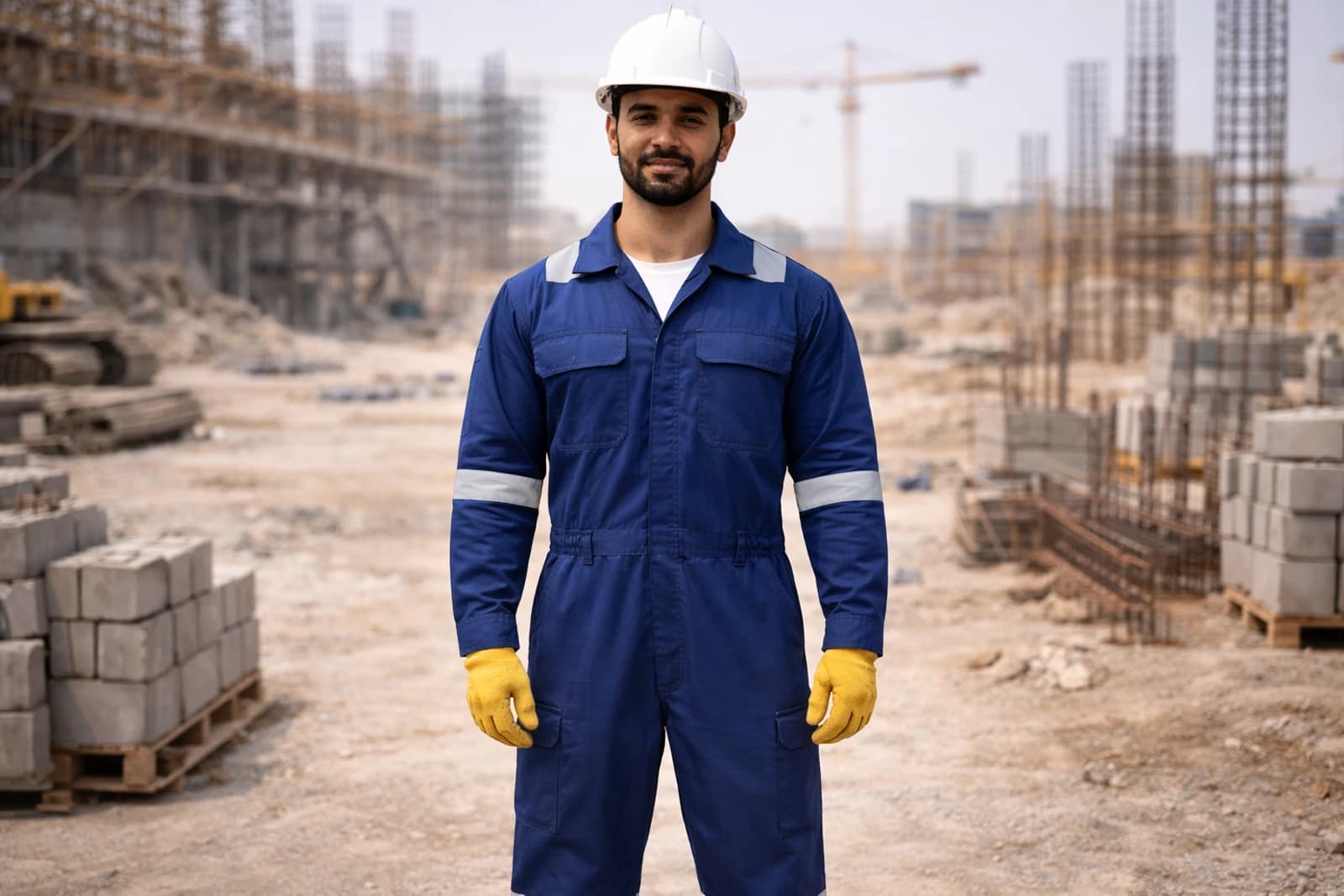
Industrial Workwear
Industrial Coverall Pro
Hard-wearing one-piece coverall for plant, maintenance, and heavy-duty operations.
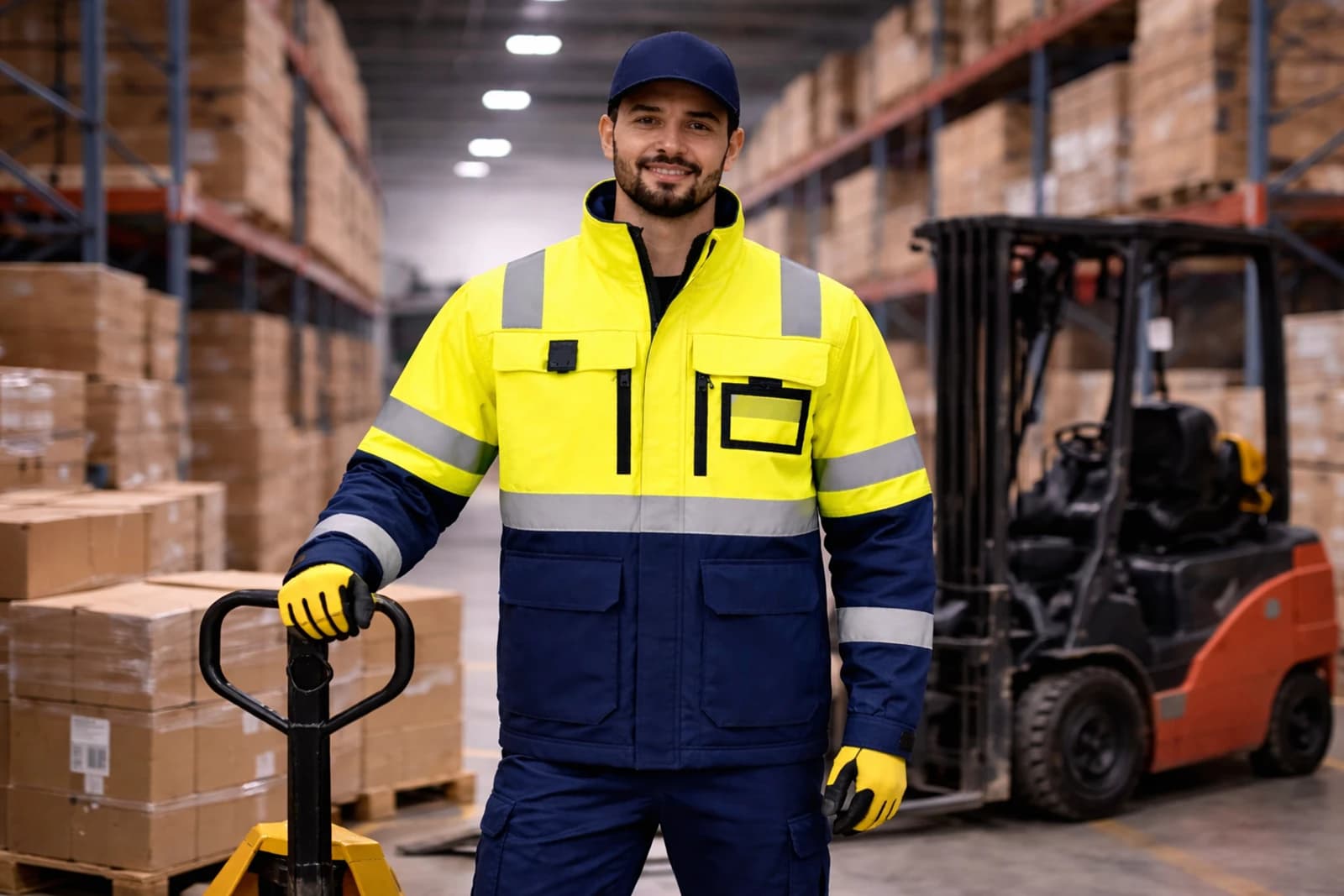
Safety Uniform
Hi-Vis Safety Jacket
Reflective safety jacket for high-visibility site operations and road work crews.