Industrial Coverall Pro & Hi-Vis Safety Jacket for Middle East Oil & Gas: B2B Sourcing Guide from China
The Middle East oil, gas, and petrochemical sector — spanning Saudi Aramco, ADNOC, QatarEnergy, Kuwait Petroleum, and Oman's PDO — demands industrial workwear that meets rigorous international safety standards while performing in extreme desert and offshore conditions. This guide helps B2B buyers source Industrial Coverall Pro and Hi-Vis Safety Jacket combinations from a Chinese workwear manufacturer, covering fabric technology for flame resistance and arc flash protection, heat stress management in 50°C environments, and bulk procurement strategy for 500–5,000+ worker deployments.

Buyer context
What procurement teams run into
The Middle East holds nearly half of the world's proven oil reserves and approximately 40% of its natural gas reserves. The GCC petrochemical industry alone is valued at over $100 billion annually, with Saudi Arabia's industrial sector employing over 1.5 million workers across oil fields, refineries, petrochemical plants, and support infrastructure. From the Ghawar field (the world's largest onshore oil field) to ADNOC's offshore Zakum field and QatarEnergy's North Field expansion, industrial workers operate in some of the most demanding conditions on earth. For B2B procurement managers responsible for outfitting 500–5,000+ workers across these operations, the combination of industrial coveralls and hi-vis safety jackets presents a unique set of challenges: **Extreme heat combined with FR/ARC protection requirements:** In Saudi Arabia's Eastern Province, Kuwait's Burgan field, and Iraq's Basra region, summer daytime temperatures routinely exceed 50°C (122°F) in direct sunlight. When a worker must wear a flame-resistant (FR) industrial coverall plus a hi-vis safety jacket simultaneously, thermal insulation compounds — a standard 7 oz (240 gsm) FR coverall with a 200 gsm hi-vis jacket creates a total thermal burden that can drive core body temperature dangerously high within 30–45 minutes of physical exertion. The result is reduced productivity, increased heat stress incidents, and in severe cases, heat stroke — a leading cause of injury in Gulf industrial operations. **Stringent safety standards with multiple certifications:** Middle East NOCs (National Oil Companies) typically require compliance with multiple international and local standards simultaneously: NFPA 2112 (flash fire), NFPA 70E (arc flash, typically CAT 2 or CAT 4), EN ISO 11612 (heat and flame), EN 1149-5 (antistatic), and EN ISO 20471 (hi-vis). Additionally, Saudi Aramco has its own SAES-D-010 standards, ADNOC requires ADNOC-approved PPE specifications, and QatarEnergy mandates compliance with QE-OP-001. A single garment combination must satisfy all these certifications — sourcing from a manufacturer without verified, documented third-party testing for each standard creates serious liability. **Durability in abrasive industrial environments:** Oil field workers handle heavy equipment, climb derricks and structural steel, kneel on grit-covered surfaces, and work with chemicals, drilling muds, and hydrocarbons. A coverall that tears at the knee after 3 months or a hi-vis jacket whose reflective tape delaminates after 15 industrial launderings creates recurring replacement costs and potential safety gaps between replacement cycles. For a 2,000-worker deployment, each additional replacement cycle per year at $40–60 per coverall adds $80,000–120,000 to annual PPE spend. **Comfort and fit across diverse body types:** Middle Eastern industrial workforces are increasingly diverse — Saudi Arabia's workforce includes workers from India, Pakistan, Bangladesh, Philippines, Egypt, and Sudan, while the UAE workforce spans over 200 nationalities. A one-size-fits-most approach to coverall sizing leads to poor fit: coveralls that are too long create trip hazards; too short restrict movement; too loose create snag risks around rotating equipment; too tight reduce mobility and ventilation. Proper sizing across a multi-national workforce requires careful anthropometric data and graded sizing. **Hi-vis colour retention under extreme UV exposure:** In Gulf sunlight (UV Index consistently 8–12 for 8+ months of the year), hi-vis fluorescent yellow and orange fabrics can lose 40–60% of their luminance within 3–4 months of daily outdoor exposure. This degradation may cause the garment to fall below EN ISO 20471 minimum luminance requirements before the end of its intended service life — a significant safety and compliance risk that is often overlooked.
Sourcing approach
How a factory partner can respond
**1. Fabric technology for FR performance with heat management**\n\nThe most critical specification for Middle East industrial workwear is achieving certified flame resistance without creating a thermal hazard of its own.\n\n**For the Industrial Coverall Pro:**\n\n- **80/20 cotton-nylon FR blend (7–9 oz / 240–305 gsm):** This is the industry standard for Middle East oil and gas. The cotton content provides natural comfort, breathability, and char formation (the protective carbonised layer when exposed to flame), while the nylon adds abrasion resistance — critical for workers climbing ladders, kneeling, and sliding across equipment. A 7.5 oz (255 gsm) twill weave offers the best balance of protection, durability, and thermal comfort for most GCC applications.\n\n- **Modacrylic/cotton blends for arc flash protection:** For operations requiring CAT 2 or CAT 4 arc flash protection (common in refinery electrical maintenance), a modacrylic/cotton blend (typically 55/45 or 60/40) provides inherent flame resistance that doesn't wash out, combined with superior arc thermal performance (ATPV of 8–12 cal/cm² for CAT 2 and 30–40+ cal/cm² for CAT 4). These fabrics are significantly lighter (6–7 oz / 200–240 gsm) than heavy cotton FR, offering better heat stress management.\n\n- **Moisture-wicking FR base layers as a system solution:** For extreme heat environments (e.g., Kuwait Oil Company's summer operations), pair the FR coverall with a lightweight FR moisture-wicking t-shirt (4 oz / 135 gsm modacrylic/rayon blend). This creates a two-layer system that pulls sweat away from the skin, reducing heat stress by 15–25% compared to a coverall worn against bare skin.\n\n**For the Hi-Vis Safety Jacket:**\n\n- **FR-rated hi-vis shell fabric (6–8 oz / 200–270 gsm):** The jacket must meet EN ISO 20471 Class 3 (minimum 0.80 m² of fluorescent material and 0.20 m² of retroreflective material). For FR applications, use an inherently flame-resistant hi-vis fabric — either modacrylic/cotton blend with fluorescent dyeing or an FR-treated polyester-cotton blend. Avoid standard non-FR hi-vis polyester jackets, which melt and drip when exposed to flame or arc flash.\n\n- **Segment silver reflective tape rated for industrial laundering:** The retroreflective tape should meet EN ISO 20471 and be rated for minimum 25 industrial washes at 75°C with no more than 20% loss of reflective performance. Wide segment tape (50 mm or 2 inches) is preferred over glass-bead tape for durability in oilfield environments.\n\n- **Removable/reversible design for temperature flexibility:** A hi-vis jacket with full-front zipper, removable sleeves (converting to a hi-vis vest), or zip-out quilted liner allows workers to adjust thermal protection through their shift. In the early morning desert chill (5–15°C at 5 AM in winter) versus midday 50°C heat, this flexibility is essential.\n\n**Specification questions for your Chinese manufacturer:**\n\n1. Request third-party test reports for NFPA 2112 (flash fire), NFPA 70E (arc flash category), EN ISO 11612 (heat & flame), and EN 1149-5 (antistatic) — ask for reports dated within the last 24 months.\n2. Ask for heat stress / thermal manikin testing (ASTM F1930 or equivalent) showing predicted burn injury at your specific fabric weight and layering combination.\n3. Ask for retroreflective tape ageing tests — the tape should maintain minimum 80% of initial reflective performance after 25 industrial washes at 75°C.\n4. Ask for UV resistance testing (ISO 105-B02 / AATCC 16.3) — the fluorescent fabric should retain minimum luminance factor of 0.50 after 100 hours of xenon-arc exposure.\n\n**2. Design features for oil field functionality**\n\nA well-designed industrial coverall and hi-vis jacket combination for Middle East oil and gas should include:\n\n- **Coverall:** Two-way front zipper with storm flap (keeps out dust and sparks), elastic waist inserts (improves fit and ventilation), reinforced knees with knee-pad pockets, tool pockets with flap closures (prevents tools falling into machinery), radio/phone pocket on chest, pen slot on sleeve, and brass zippers (non-sparking in gas environments).\n- **Hi-vis jacket:** Full-length two-way zipper with snap storm flap, stand-up collar (for neck protection from sun and sparks), adjustable hook-and-loop cuffs (snag-free), multiple utility pockets with drainage holes (for wet environments), and an ID/badge holder on the left chest.\n- **Colour coding:** Standard GCC colour codes are navy blue or royal blue for general operations, dark green for safety/hygiene officers, grey for supervisors, white for engineers/management — though each NOC has its own colour scheme. Confirm colour specifications with your manufacturer and request shade band approval before bulk production.\n\n**3. Bulk procurement strategy**\n\nFor 500–5,000+ worker deployments:\n\n- **Pilot order (50–100 sets):** Start with a pilot batch covering key size ratios and one or two fabric options. Allow 4–6 weeks for wearer trials across different job roles (drilling, maintenance, logistics).\n- **Bulk order sizing:** Request size ratio analysis based on workforce anthropometry. GCC workforce sizing typically requires 15–20% more size 2XL–4XL compared to Western sizing ratios, reflecting the diverse South Asian, East Asian, and Middle Eastern body types in the labour force.\n- **First-article inspection (FAI):** Before bulk production, request FAI of each size and colour combination with photographic documentation.\n- **Third-party inspection:** Engage SGS, Bureau Veritas, or Intertek for factory audit and a mid-production inspection + final random inspection (AQL 2.5, Level II).\n- **Shipment consolidation:** Combine coveralls and hi-vis jackets in the same container to reduce freight cost by 15–25%. A 40-foot HQ container holds approximately 8,000–10,000 coveralls or 12,000–15,000 hi-vis jackets on hangers.\n\n**4. Compliance documentation checklist**\n\nEnsure your manufacturer provides:\n\n- Declaration of Conformity (DoC) for each garment type\n- Third-party test reports for all applicable standards\n- Factory production certificate (ISO 9001:2015 minimum)\n- Country of origin certificate\n- CE certificate for EU-recognised standards (if exporting to ADNOC or QatarEnergy)\n- SASO / QS / GSO certification for local GCC market compliance
Recommended Products
Products that fit this use case

Industrial Workwear
Industrial Coverall Pro
Hard-wearing one-piece coverall for plant, maintenance, and heavy-duty operations.
Safety Uniform
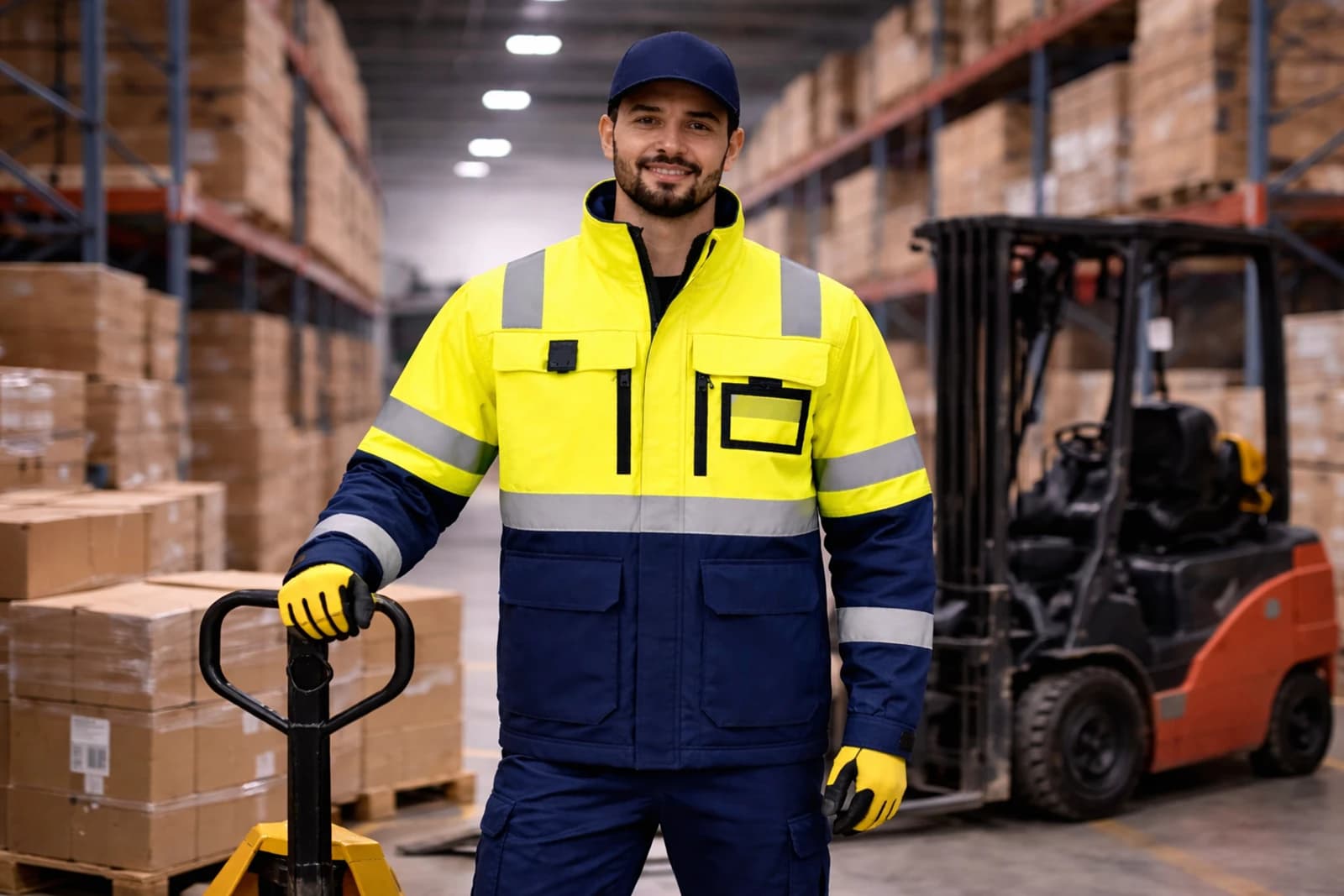
Hi-Vis Safety Jacket
Reflective safety jacket for high-visibility site operations and road work crews.