Industrial Coverall Pro: Sourcing Flame-Resistant & Hi-Vis Coveralls for Middle East Oil & Gas, Petrochemical & Heavy Industry
Middle East oil & gas operators — from Saudi Aramco and ADNOC to QatarEnergy and Kuwait Oil Company — require industrial coveralls that meet international safety standards, withstand extreme heat, and hold up to industrial laundering over multiple years. This guide covers what B2B procurement managers should evaluate when sourcing industrial coveralls from a Chinese workwear manufacturer: fabric fire resistance and arc-rating compliance, hi-vis retroreflective tape certification to EN ISO 20471, heat-stress considerations for desert refinery environments, reinforced stitching and seam construction for field durability, pocket configuration for carrying inspection tools and handheld devices, and custom branding with embroidered or heat-sealed company logos. Includes recommended product pairings for a complete industrial safety uniform programme.

Buyer context
What procurement teams run into
Middle East oil, gas, and petrochemical operators — including Saudi Aramco, ADNOC, QatarEnergy, Kuwait Oil Company, Oman's PDO, and Bahrain's Bapco — manage some of the world's most demanding industrial work environments. Their workforce of field technicians, rig operators, refinery maintenance crews, pipeline inspectors, and safety officers requires industrial coveralls that do far more than cover the body. These coveralls are the last line of defence between the worker and catastrophic injury in environments where flash fires, arc flashes, chemical splashes, and heavy mechanical equipment are daily realities. For B2B buyers in the Gulf region sourcing from a Chinese workwear manufacturer, understanding the specific performance requirements is critical to avoiding costly specification mismatches.\n\n**1. Flame resistance and arc rating — the non-negotiable starting point.** In oil and gas operations, the primary hazard is thermal exposure from flash fires (typically 3–5 seconds of flame exposure at 800–1000°C) and electric arc flashes common in petrochemical processing plants. The industrial coverall must be certified to one of the recognised international flame-resistant (FR) standards: NFPA 2112 (US standard for flash fire), EN ISO 11612 (European standard for heat and flame protective clothing), or IEC 61482-2 (for arc flash protection). The Arc Thermal Performance Value (ATPV) or Energy Breakopen Threshold (EBT) — reported in cal/cm² — is the key metric. For typical Middle East oil and gas field operations, an ATPV of 8–12 cal/cm² is the minimum entry point, while refinery electrical workers may need 25–40 cal/cm². When sourcing from China, the buyer should request third-party test reports from an accredited laboratory (e.g., SGS, Intertek, or Bureau Veritas) verifying the fabric's FR properties, not just the manufacturer's in-house test data. Common FR fabric substrates used by Chinese manufacturers include: inherently FR modacrylic/cotton/nylon blends (e.g., 50% modacrylic / 25% cotton / 24% nylon / 1% antistatic fibre, typically 245–280 gsm) for superior durability and breathability; treated 100% cotton FR fabrics (Proban or Pyrovatex CP finishes, 300–340 gsm) for budget-conscious bids; and aramid-blend fabrics (Nomex/Kevlar blends, 200–240 gsm) for premium protection in upstream exploration and drilling environments. The buyer must confirm that the FR treatment is durable through at least 100 industrial launderings, and that the fabric retains its char length and after-flame time (typically ≤ 150 mm and ≤ 2 seconds respectively for EN ISO 11612 compliance) after repeated washing.\n\n**2. Hi-vis retroreflective tape — performance in Gulf light conditions.** Most Middle East oil and gas sites mandate hi-vis coveralls with retroreflective tape compliant to EN ISO 20471 Class 3 — the highest visibility rating. The tape must be 50 mm minimum width, arranged in a chest horizontal band and leg bands, with a minimum retroreflective coefficient (RA) of 330 cd/lx/m² for the silver tape and a fluorescent background of at least 0.5 m² in yellow-orange or red-orange. The critical failure mode in Gulf environments is UV degradation: under 8–10 hours of daily solar exposure, non-UV-stabilised retroreflective tape can lose 50–70% of its reflectivity within 6 months, rendering a Class 3 garment effectively Class 1 or lower. B2B buyers should specify retroreflective tape with UV-stabilised microprismatic construction (not glass-bead tape, which degrades faster under UV) and request a UV-resistance test report per ISO 20471 Section 7.2 (minimum 50 hours of Xenon-arc exposure with ≤ 20% loss in RA value). An additional consideration: the fluorescent background fabric colour must remain vivid after industrial laundering. Specify minimum wash-fastness — typically ISO 105 C06 at 60°C for 30 cycles — and request washed samples for visual approval.\n\n**3. Heat-stress management in desert refinery environments.** A petrochemical refinery worker in Jubail Industrial City (Saudi Arabia) or Ruwais (Abu Dhabi) may be wearing a multi-layer FR hi-vis coverall in ambient temperatures of 45–50°C with high humidity near cooling towers and coastal processing units. The metabolic heat load from heavy physical work combined with the inherent thermal resistance of FR fabrics can push core body temperature into the danger zone within 60–90 minutes. The procurement response is to select inherently FR fabric blends with lower thermal resistance (clo value) — typically modacrylic/cotton/nylon blends in the 245–260 gsm range, which offer a 20–30% lower thermal resistance compared to heavier treated cotton FR fabrics (300+ gsm). Vented back panels (mesh inserts covered by a flap), underarm mesh gussets, and zip-off sleeves (for coverall-to-trouser conversion) are design features that improve heat management without compromising FR protection. The buyer should ask the manufacturer for clo value data per ASTM F2737 (Standard Test Method for Measuring the Thermal Insulation of Clothing Using a Heated Manikin) and compare values across fabric options before selecting the base material.\n\n**4. Reinforced stitching and seam durability.** An industrial coverall in oil and gas field service is a high-stress garment. The knees take the load when a technician kneels on steel grating to inspect a flange. The elbows bear weight when a pipeline inspector climbs up a vertical ladder rung. The crotch seam endures years of squatting and bending while working on valve assemblies at ground level. Standard single-needle lockstitch seams on budget coveralls fail in 3–6 months under these conditions, with seam slippage starting at the stress points and then propagating across the entire seam. The specification fix: double-needle or triple-needle felled seams on the crotch, inseam, and underarm; bar-tack reinforcement at all pocket corners and stress points (crotch intersection, belt loop attachments, knee pad pocket ends); and high-tenacity bonded polyester thread (e.g., Coats Epic or Anefil 120/3) instead of standard spun polyester. For the knee area specifically, a reinforced knee pad pocket with two-entry access (top-load + side-load) for inserting 8–10 mm closed-cell foam knee pads is a practical upgrade that significantly extends the uniform's usable life in field operations. Request seam strength test data per ASTM D1683 (Standard Test Method for Failure in Sewn Seams of Woven Fabrics) with a minimum breaking force of 300 N for the main seams.\n\n**5. Pocket and tool-carrying configuration.** Oil and gas field technicians carry a specific inventory of handheld tools: a multi-meter for electrical diagnostics, a tablet or rugged phone for digital inspection checklists, a torch/flashlight, a pair of gloves, a notepad or clipboard, and personal items (ID badge, wallet, phone). The typical standard industrial coverall pocket layout — two side pockets and one chest pocket — is insufficient for this range of equipment. A B2B buyer should specify: a left-sleeve smartphone pocket with a clear TPU window for touchscreen use (eliminating the need to pull out the device repeatedly); a right-chest zippered pocket for secure storage of tools and valuables; cargo pockets on both thighs (bellows type with a flap closure, deep enough to hold a 200 mm multi-meter); a dedicated radio/DMR pocket on the left chest with a D-ring or mic tab; a ruler pocket on the right leg (essential for inspection and maintenance roles); and a loop ID badge holder on the right chest. These pocket specifications should be reflected in the technical drawing approved before production starts.\n\n**6. Custom branding and identification.** Middle East oil and gas operators typically require the company name, employee name, job title, and department printed or embroidered on the coverall, often in both English and Arabic. The preferred method for hi-vis FR coveralls is heat-sealed or ultrasonic-bonded label transfers (which do not penetrate the FR fabric and compromise barrier integrity), rather than sewn-on patches which create needle holes that weaken the FR fabric at the stitching line and void the FR certification at those locations. The buyer should specify: placement of the company logo on the back in large block letters (minimum 100 mm height, EN ISO 20471 compliant placement); name and title on the right chest; department identification on the left sleeve; and FR warning labels on the inside collar and inside placket. The branding elements must themselves be FR-rated (using FR thread for any stitching and FR-substrate transfers), and the combined surface area of all branding must not reduce the fluorescent background area below the minimum 0.5 m² required for Class 3 hi-vis certification.
Sourcing approach
How a factory partner can respond
When sourcing industrial coveralls for Middle East oil, gas, and petrochemical operations from a Chinese workwear manufacturer, the procurement strategy must start with a clear specification sheet that covers four pillars: **safety certification**, **fabric performance**, **garment design**, and **branding compliance**.\n\n**Safety certification pillar.** Specify exactly which of the accepted standards (NFPA 2112, EN ISO 11612, IEC 61482-2) the coverall must meet, and request third-party test reports from SGS, Intertek, or Bureau Veritas. For arc flash protection, specify the required ATPV/EBT rating in cal/cm². The certification must explicitly cover the full garment — not just the fabric — so verify that the manufacturer holds a valid CE certificate (EU) or UL listing (US) for the complete finished coverall.\n\n**Fabric performance pillar.** Choose inherently FR fabric blends (modacrylic/cotton/nylon) for the best balance of durability, breathability, and protection, specifying 245–280 gsm weight. Request clo value data (ASTM F2737) to compare heat-stress risk between fabric options. Specify UV-stabilised microprismatic retroreflective tape with minimum RA 330 cd/lx/m² and 50-hour Xenon-arc UV resistance test results. Request anti-static fibre integration (1–2% carbon fibre content) for all petrochemical environments where flammable gas or dust is present.\n\n**Garment design pillar.** Require double-needle fretted seams on all main seams, bar-tack reinforcement at stress points, knee pad pockets with two-entry access, vented back panels, and the pocket layout specified in the problem section. Include size range from S to 6XL with proportional grading, and request a pre-production sample in the median size for fit approval.\n\n**Branding compliance pillar.** Specify heat-sealed or ultrasonic-bonded branding for all logos and identification elements on the FR hi-vis coverall. Provide Pantone colour codes for all brand colours. Request a branded pre-production sample to verify placement and colour accuracy before mass production starts.\n\nBy following this structured specification approach, B2B buyers can secure industrial coveralls that pass safety audits, survive 12–18 months of field use, and maintain professional appearance — ultimately reducing uniform programme costs and improving worker safety outcomes.
Recommended Products
Products that fit this use case

Industrial Workwear
Industrial Coverall Pro
Hard-wearing one-piece coverall for plant, maintenance, and heavy-duty operations.
Safety Uniform
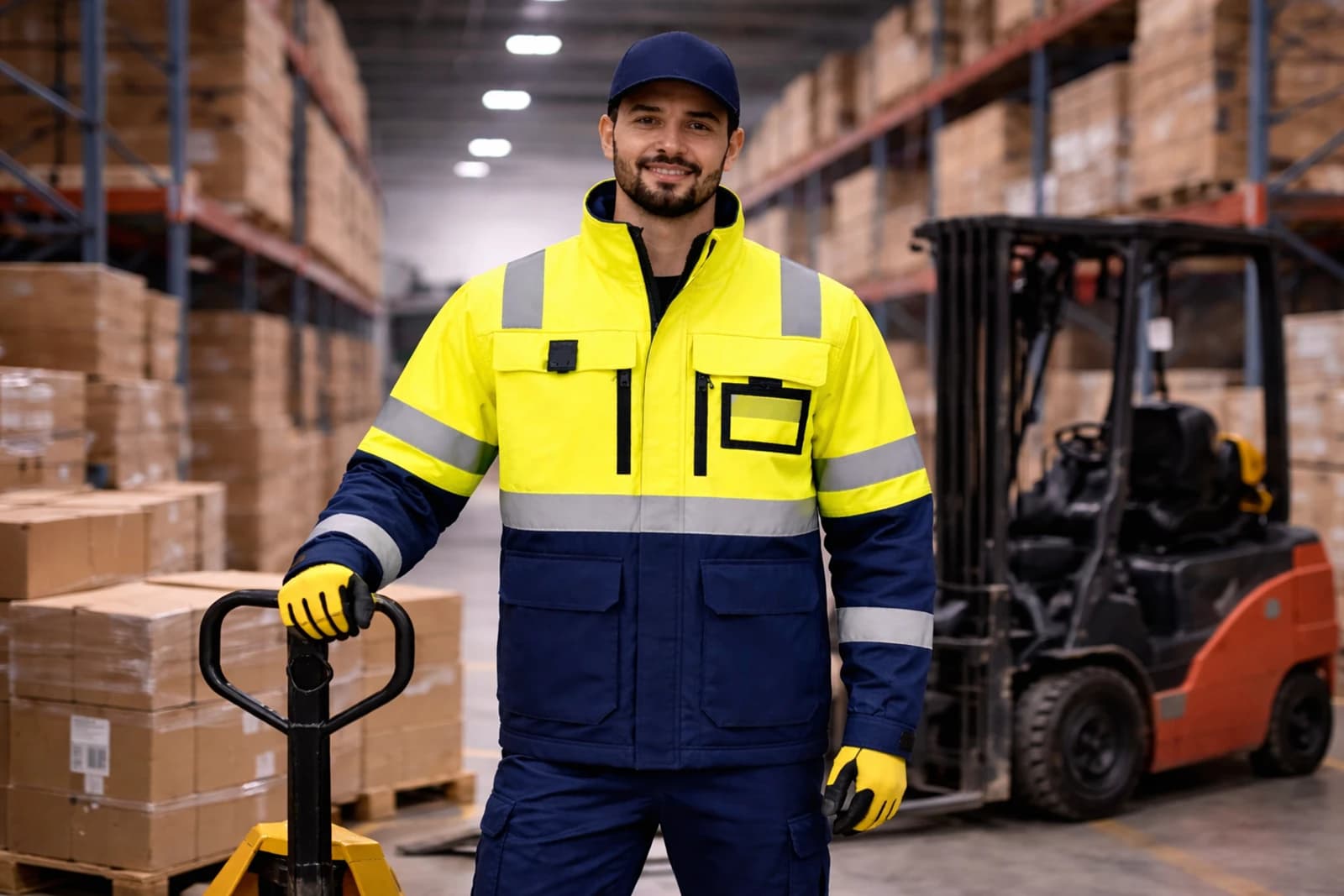
Hi-Vis Safety Jacket
Reflective safety jacket for high-visibility site operations and road work crews.