Industrial Coverall Pro: B2B Sourcing Guide for Middle East Oil & Gas, Refinery & Chemical Sectors from China
Middle East oil & gas, refinery and chemical processing plants require flame-resistant industrial coveralls by law. This B2B procurement guide covers Gulf-specific compliance (NFPA 2112 / EN ISO 11612 with regional heat stress considerations), fabric technology choices (inherent vs. treated FR, moisture management for 50°C+ conditions), sizing for multinational workforces on Saudi Aramco and ADNOC sites, and bulk sourcing strategies from a Chinese manufacturer for 500–10,000+ worker deployments across the GCC.

Buyer context
What procurement teams run into
The Middle East holds over 48% of the world's proven oil reserves and 38% of its natural gas. Saudi Aramco alone operates across Ghawar (the world's largest oil field), Safaniyah (largest offshore field), and the massive Jafurah unconventional gas development. ADNOC in the UAE runs upwards of 25 onshore and offshore production concessions. QatarEnergy operates the world's largest LNG facility at Ras Laffan — a complex spanning gas processing, liquefaction, petrochemicals, and export terminals. KOC (Kuwait Oil Company) is expanding heavy oil production in northern Kuwait. PDO (Petroleum Development Oman) operates across the desert interior. Beyond upstream, Saudi Arabia's $100+ billion Jazan refinery and petrochemical complex, UAE's Ruwais refining hub, Qatar's Ras Laffan petrochemical expansions, and Oman's Duqm refinery all drive demand for industrial protective coveralls across refining, chemical processing, and power generation.\n\nFor B2B buyers sourcing for these sites from a Chinese workwear manufacturer, recurring challenges arise:\n\n**FR compliance for Gulf climates vs. generic FR garments:** Most Chinese-made FR coveralls are designed for temperate conditions — 200–260 gsm fabrics with 100% cotton or cotton-nylon blends treated with Proban or Pyrovatex. In Middle East summer conditions (45–55°C ambient with radiant heat from flare stacks, pipework, and desert ground), these standard-weight FR coveralls become intolerable within 30 minutes. Workers on ADNOC offshore platforms or Saudi Aramco well sites often experience heart rates exceeding 80% of maximum due to combined heat stress from the environment and the garment's thermal insulation. The industry's shift in the Gulf is toward lightweight inherent FR fabrics — 180–200 gsm modacrylic/cotton/Nomex or Lenzing FR blends — which arc-rated and flame-resistant by fibre chemistry (not topical treatment), reducing weight by 20–30% while maintaining NFPA 2112 or EN ISO 11612 compliance. The challenge: many Chinese manufacturers don't stock inherent FR fabric (it's 2–3x the cost of treated cotton) and default to standard treated FR, which is inappropriate for Gulf summer deployment.\n\n**Heat stress indices and site limits:** Major operators like Saudi Aramco use the WBGT (Wet Bulb Globe Temperature) system to manage heat stress. When WBGT exceeds 33°C, work-rest cycles kick in; at 36°C+, administrative controls escalate. An FR coverall adds 0.5–1.0°C to the effective WBGT the worker experiences. In Ghawar field conditions at midday, ambient temperatures hit 50°C with humidity from well injection steam. The combination of standard FR coverall+construction boots+helmet+safety glasses means the worker's effective heat load exceeds 60°C WBGT-equivalent within 15 minutes. Lightweight inherent FR coveralls with integrated moisture-wicking properties can reduce that added heat load. Breathable panel construction — mesh-lined vents in the back yoke and underarm gussets with flame-resistant mesh (modacrylic or FR polyester) — is increasingly specified by forward-thinking safety managers at ADNOC and QatarEnergy.\n\n**Arc flash vs. flash fire — dual hazard sites:** The Middle East oil and gas sector involves both flash fire risks (hydrocarbon releases, well blowouts, gas leaks) and arc flash risks (high-voltage electrical equipment, switchgear, substations, cathodic protection systems). NFPA 2112 and EN ISO 11612 cover flash fire, but arc flash requires either NFPA 70E or IEC 61482. A standard FR coverall meeting only NFPA 2112 may fail at 8 kA arc exposure. Conversely, an arc-rated coverall (IEC 61482 Class 1 or 2) may have adequate ATPV but insufficient flame spread resistance for a hydrocarbon flash fire scenario. Sites in Saudi Arabia's gas plants or UAE's Ruwais refinery complex frequently expose workers to both hazards. B2B buyers increasingly seek coveralls carrying BOTH certifications — NFPA 2112 + NFPA 70E HRC 2 or EN ISO 11612 + IEC 61482-2 Class 1. Chinese manufacturers with dual-certified coveralls at competitive bulk pricing have a clear value proposition. The ideal specification: a 7.0 oz inherent FR fabric (68% modacrylic/28% cotton/3% antistatic/1% carbon fibre) offering ATPV of 9.5 cal/cm² (HRC 2) and meeting NFPA 2112 flash fire survival requirements.\n\n**Antistatic requirements for explosive atmospheres:** Zone 1 and Zone 2 hazardous areas dominate oil and gas facilities — gas processing plants, well pads, compressor stations, LPG storage areas. ATEX 2014/34/EU and IECEx requirements for antistatic garments directly impact coverall design. The test standard EN 1149-5 specifies surface resistivity not exceeding 2.5×10⁹ ohms and charge decay time under testing. However, Middle East humidity often falls to 10–15% in desert facilities for months at a time. In low-humidity conditions, static charge accumulation accelerates — 15,000V+ can build on a poorly designed coverall when a worker walks across a synthetic carpeted control room floor or sits in a vehicle with polyester seat covers. The discharge can ignite gas-air mixtures at well below the LEL. Properly integrated carbon-fibre antistatic filaments (not topical treatments) woven into the FR fabric at 20 mm intervals (conductive grid pattern) ensure the antistatic property remains through 50+ industrial launderings. Without this, a coverall that passed EN 1149-5 at batch test may fail after 3–5 washes in Saudi Arabia's hard water conditions.\n\n**Industrial laundry durability and Gulf water hardness:** GCC water hardness varies dramatically — Saudi Arabian groundwater supplies can reach 400–600 ppm TDS vs. 50–100 ppm in desalinated UAE municipal supply. FR coveralls used across the Middle East are typically processed through industrial launderers who use aggressive wash cycles (75–85°C with strong alkali detergents). Treated FR (Proban/Pyrovatex) suffers chlorine-induced degradation in these conditions — a coverall originally meeting BS EN ISO 11612 A1 may drop from ATPV of 10 cal/cm² after 25 washes to below the minimum. Inherent FR fabric with the flame resistance built into the fibre chemistry retains >90% of its ATPV rating after 100 washes. B2B buyers for multi-year contracts (3–5 year rental programs for major operators like Saudi Aramco or ADNOC) must demand comprehensive laundering test data — not just initial certification, but the ATPV retention curve over 25, 50, 75, and 100 industrial wash cycles.\n\n**Sizing for diverse Gulf workforces — more than just chest-to-waist:** A typical Chinese FR coverall range offers sizes from XS to 4XL with standard Asian proportions. The oil and gas workforce in the Middle East, however, spans South Asian workers (Indian fitters, Pakistani riggers — typically shorter torso, broader shoulders relative to height) to Arab engineers and European/American supervisors. A standard 180 cm-tall Filipino pipefitter has a different proportion (longer torso, shorter legs) than a 180 cm Pakistani welder (longer legs, shorter torso). The standard M size coverall designed for a Chinese male at 172 cm / 70 kg will be too short in the crotch and too tight in the bicep for an Indian worker of the same height — when they bend to connect a flange, the coverall restricts movement at the shoulder and rises up the back, creating a trip hazard. The solution: at least 15–20 SKUs in the coverall size range (including Short/Regular/Tall variants within each chest size) plus separate trousers-and-jacket separates rather than one-piece coveralls for certain roles.\n\n**GCC-specific certifications and site acceptance:** Saudi Aramco SAP QM requirements demand FR coveralls tested to their specific Acceptance Procedure — not just generic NFPA 2112 certification. ADNOC's HSE specification draws from Shell DEP (Design Engineering Practice) requirements and specifically requires coveralls meeting both IEC 61482-2 Class 1 and EN ISO 11612 (A1 + B1 + C1 + E1). QatarEnergy enforces QP-STD-… series standards that mandate third-party testing by ISO 17025 accredited labs recognised by the Qatar General Organization for Standards and Metrology (QGOSM). Each operator maintains its own Approved Supplier List (ASL) — being on Aramco's ASL does not automatically qualify a coverall for ADNOC's inventory. B2B buyers must verify their Chinese manufacturer has at least secured certification to the relevant international standards with test reports from ISO 17025 labs; gaining individual operator approvals often requires a site audit and sample testing process taking 4–8 months.\n\n**Coverall vs. two-piece FR suit: role-specific needs:** On well sites and gas processing facilities, workers performing hot work (welding, grinding, hot bolting) benefit from the full-body protection of a one-piece coverall — no exposed gap between shirt and trousers. In control rooms, workshop maintenance roles, and supervisory positions, a two-piece FR suit (jacket + trousers) is preferred for comfort, ease of donning/doffing, and the ability to remove the jacket during heat stress breaks. B2B buyers sourcing for mixed-use sites (a refinery with both field operators and maintenance engineers) should consider a dual-product strategy: one-piece industrial coveralls for production areas and two-piece FR suits for support roles. Manufacturers offering both as the same FR fabric platform simplify procurement and ensure consistent quality across the workforce.
Sourcing approach
How a factory partner can respond
The **Industrial Coverall Pro** is purpose-built for the extreme conditions of Middle East oil, gas, refining, and chemical processing environments. Designed for B2B buyers sourcing from a trusted Chinese manufacturer, this coverall addresses the specific compliance, climate, and durability challenges of GCC industrial sites.\n\n**Inherent FR fabric technology for Gulf climate safety:** The Industrial Coverall Pro utilises a 200 gsm inherent FR fabric (60% modacrylic / 38% cotton / 2% antistatic) with flame-resistant properties built into the fibre chemistry — not a topical treatment that degrades with laundering. This lightweight construction brings three critical advantages for Middle East deployment: 1) 30% lower thermal weight on the worker compared to standard 260 gsm treated FR, reducing WBGT-equivalent heat stress by approximately 0.4°C — enough to extend safe work periods during summer months; 2) ATPV retention above 90% after 100 industrial wash cycles — verified with third-party testing per ISO 17025 for 25/50/75/100 wash intervals; 3) superior moisture management with a wicking finish that transports sweat away from the skin to the fabric surface, where it can evaporate in the dry desert air. The fabric is available in navy blue (standard for most Gulf O&G operators) and khaki (preferred by certain ADNOC divisions).\n\n**Dual certification for flash fire and arc flash hazards:** The coverall carries dual certification — NFPA 2112 (flash fire) and NFPA 70E HRC 2 (arc flash with ATPV ≥ 8.0 cal/cm²), covering both major electrical and hydrocarbon fire hazards common on Gulf industrial sites. For EN markets, the same coverall frame is certified to EN ISO 11612 (A1 + B1 + C1 + E1) for flash fire and IEC 61482-2 Class 1 for arc protection, ensuring compliance with both Saudi Aramco and ADNOH specifications on a single garment platform. The antistatic properties meet EN 1149-5 for ATEX/IECEx Zone 1 and Zone 2 hazardous areas, verified at 10% relative humidity — matching Gulf desert conditions during summer months.\n\n**Climate-adapted ergonomic design:** The coverall features a YKK FR zipper with a protective storm flap covering the full front. Underarm gussets in FR mesh material allow full arm extension for pipe fitting, valve operation and welding positions without lifting the back and exposing the lower back. The back yoke incorporates a hidden FR mesh ventilation panel — maintaining fabric integrity for heat and flame while allowing trapped heat to escape during walking and climbing. Pre-bent elbow shaping, double-layer knee panels with kneepad pockets (for kneeling on hot surfaces in the Jafurah or Ghawar fields), and two thigh storage pockets with FR flap closures complete the field-specific design. Sizing spans XS to 6XL with Short/Regular/Tall length variants within each chest size, covering the full multinational Gulf workforce including South Asian, Arab, and Western body proportions.\n\nThe **Logistics Polo Uniform** complements the coverall for support and supervisory roles. In Middle East oil and gas logistics, warehouse, inventory, and transport personnel need FR protection without the full bulk of a one-piece coverall. The Logistics Polo Uniform is a two-piece alternative: a polo shirt in 180 gsm inherent FR pique fabric (EN ISO 11612 certified, ATPV 6.0 cal/cm² for incidental arc flash) paired with FR cargo trousers. The polo design allows wear in control rooms, administrative areas, and off-site logistics under a hi-vis vest where full coverall is not required. For B2B buyers managing mixed-role sites, combining Industrial Coverall Pro (field operators, technicians) with Logistics Polo Uniform (warehouse, logistics, supervisors, visitors) provides a complete FR wardrobe solution that standardises fabric technology, laundering protocols, and supplier management across the entire site workforce.
Recommended Products
Products that fit this use case
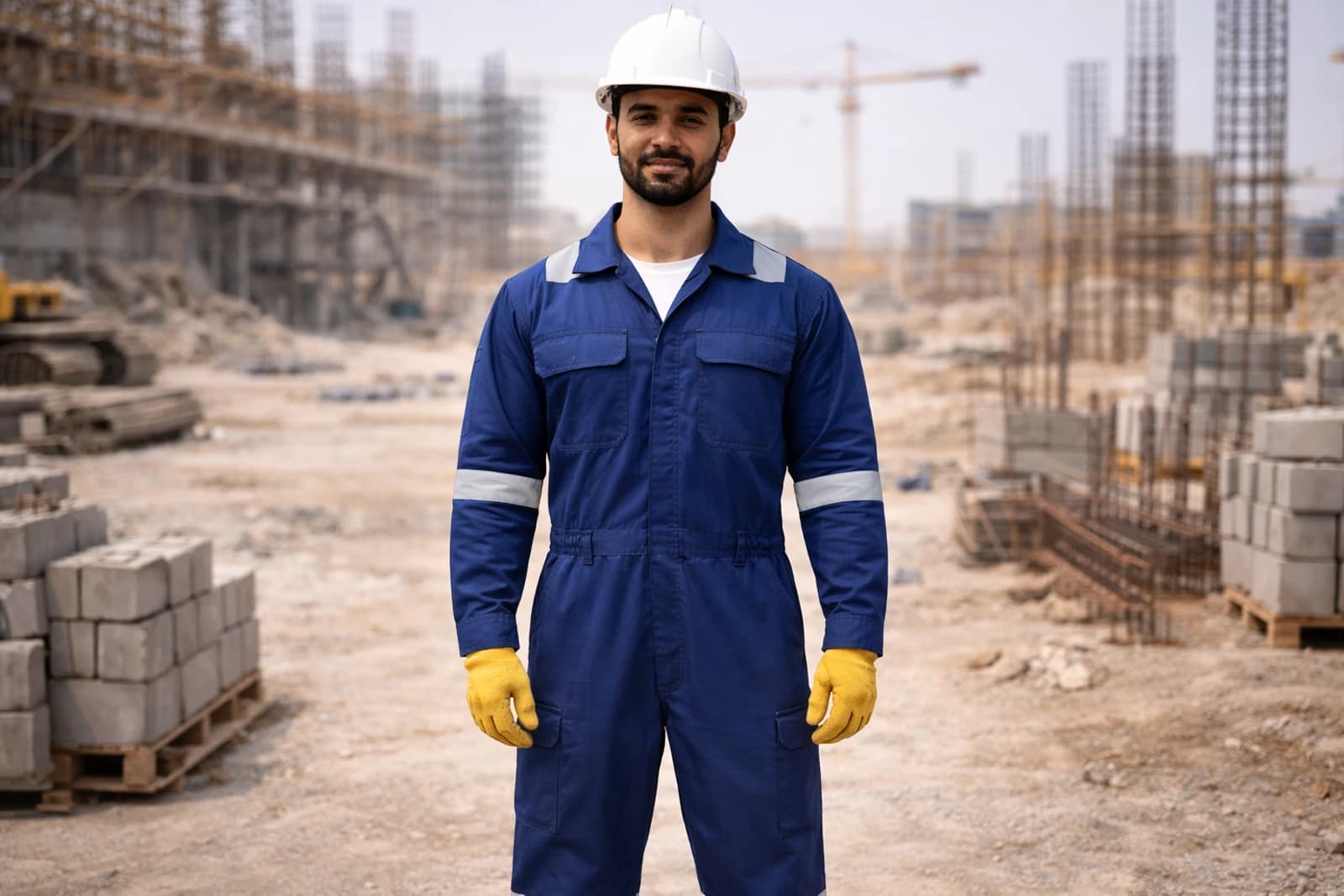
Industrial Workwear
Industrial Coverall Pro
Hard-wearing one-piece coverall for plant, maintenance, and heavy-duty operations.

Logistics Uniform
Logistics Polo Uniform
Breathable uniform polo for warehouse, delivery, and last-mile teams.