Industrial Coverall Pro for Middle East Oil & Gas: A B2B Procurement Guide for Sourcing from a Chinese Manufacturer
From ADNOC's offshore platforms in Abu Dhabi to Saudi Aramco's Ghawar field and QatarEnergy's LNG expansion at Ras Laffan, oil and gas operations across the Middle East demand FR-rated, antistatic, and inherently durable coveralls that perform in extreme heat, flash-fire zones, and hydrocarbon-rich environments. This guide shows Middle East B2B procurement managers how to source the Industrial Coverall Pro — a Chinese-manufactured, multi-certified flame-resistant workwear solution — for upstream, midstream, and downstream workforce safety.

Buyer context
What procurement teams run into
A procurement manager at a Saudi Arabian oilfield services company responsible for 800+ workers across three gas processing plants and two drilling rigs in the Eastern Province is sourcing FR coveralls for the 2026–2027 contract cycle. The current supplier — a European FR workwear brand — provides a 320 g/m² flame-resistant cotton/nylon blended coverall at $85–$110 per piece, with 10–12 week lead times and minimum order quantities of 1,500 pieces per SKU. The contractor faces four critical issues: (1) the coverall's FR treatment (topical flame-retardant finish) degrades rapidly in the Gulf's high-heat, high-humidity conditions — after 15–20 industrial launderings (85°C wash, pH 11–12 detergents), the FR performance drops below NFPA 2112 or ISO 11612 standards, forcing premature replacement at 50–60% of the rated service life; (2) the European-designed fits (standard German/Nordic body proportions) perform poorly across the multinational oilfield workforce — Saudi, Omani, and Egyptian technicians have longer torsos and broader shoulders, while Filipino and Indian subcontractors need shorter, more athletic fits — resulting in a 28% first-order exchange rate and complaints about restricted arm lift range during overhead pipework; (3) the standard coverall lacks pocket configurations tailored to upstream oilfield workflows — no dedicated radio holster, no flame-resistant pen/notepad pocket, and no knee pad provision for pipeline inspection crawling — forcing workers to wear separate FR tool vests that increase heat stress in 45–55°C ambient conditions; and (4) the stitched-on reflective tape (on hi-vis FR coverall variants) delaminates after 10–15 industrial washes due to aggressive mechanical agitation and chemical breakdown, compromising nighttime visibility compliance per EN ISO 20471 and increasing rework costs.\n\nFor Middle East B2B procurement teams purchasing industrial FR coverall pro suits from a Chinese workwear manufacturer, the following specific considerations apply:\n\n**Inherent FR vs. treated FR — the Gulf operations difference** — In Middle East oil and gas environments, inherent FR fabrics (modacrylic, aramid or FR-rayon blends) are increasingly preferred over topical FR-treated cotton/nylon blends. The reason: the Gulf's combination of extreme heat (ambient temperatures of 45–55°C on open rigs), high humidity (80–95% in coastal and offshore installations), and aggressive industrial laundering (85°C wash, pH 11–12 detergents, high-G spin) degrades topical FR finishes 3–4x faster than in temperate climates. Leading Chinese manufacturers now produce inherent FR coveralls using a proprietary 88% modacrylic / 12% para-aramid or 70% FR-modacrylic / 28% cotton / 2% antistatic-fiber blend that maintains its FR and ATPV (Arc Thermal Performance Value) ratings for 75+ industrial launderings — verified by ISO 15797 (industrial washing) and ASTM F1959/F1959M (ATPV) test reports. B2B buyers should request: (a) inherent FR certification (no topical chemicals) per ISO 11612 A1/A2/B1/C1/F1 and NFPA 2112 with a published ATPV of at least 8.0 cal/cm² (CAT 2 minimum), (b) antistatic fiber integration meeting EN 1149-5 or ASTM F1506 with surface resistance below 2.5×10⁹ Ω, and (c) launderability test reports showing FR performance retention at 25, 50, 75, and 100 industrial wash cycles. The cost differential is approximately 15–25% more per piece for inherent FR vs. treated FR, but the service life extension (75+ washes vs. 20–30 washes in Gulf conditions) delivers a 35–50% lower total cost of ownership over a 12-month contract cycle.\n\n**Sizing across multinational oilfield workforces** — A typical offshore platform or drilling rig in the Gulf region employs personnel from 10–18 nationalities. Chinese FR coverall manufacturers have developed a Gulf-specific sizing matrix that accounts for three dominant body geometry clusters: (1) Arab Gulf cluster (Saudi, Omani, Emirati, Qatari, Kuwaiti) — longer torsos (3–5 cm above ISO standard), broader shoulders (2–4 cm wider at chest for same waist measurement), and larger neck circumferences; (2) South Asian cluster (Indian, Pakistani, Bangladeshi, Sri Lankan) — shorter stature, more athletic build, narrower shoulders but broader hips relative to waist; and (3) Southeast Asian cluster (Filipino, Indonesian, Vietnamese) — shortest average height, leanest build, requiring significantly adjusted inseams and sleeve lengths. The best suppliers offer a made-to-measure onboarding process: the importing distributor or oil company procurement team submits body measurement data for their actual workforce (captured via mobile tablet-based measurement sessions or digital sizing kiosks deployed at base camps), and the manufacturer generates pattern-adjusted production blocks for each size grade. This process reduces first-order size-related return/exchange rates from 25–35% (common with off-the-shelf FR coveralls from European suppliers) to under 5%, and also reduces on-site safety compliance issues from ill-fitting garments that ride up during overhead work, exposing skin to flash-fire hazards.\n\n**Pocket and tool integration for upstream workflows** — Oilfield workers in the Gulf carry a distinct loadout that differs from downstream petrochemical operators or general industrial workers. An upstream drilling, wellhead, or pipeline inspection worker typically requires: a two-way intrinsically safe (IS) radio (ATEX or IECEx Zone 1/2 certified) with belt loop or shoulder strap attachment, a smartphone or PDA for digital rounds logging, an inspection notepad and oilfield-grade marker pen, safety glasses and earplugs within arm's reach, a multi-tool or pocket knife, and gloves that are frequently removed and re-donned. The ideal FR coverall for Middle East oilfield operations features: a left-chest IS-radio pocket with transparent window (for LED/display visibility) and a D-ring or webbing loop attachment point rated to 5 kN break strength, a right-chest document pocket with clear ID-window sleeve and pen division, two front inset pockets with drainage grommets (for hydrocarbon liquid egress and quick-drying), a left-sleeve zip pocket for access card or electronic key fob, two rear patch pockets with Velcro-flap closure, and knee pad pockets (EN 14404 compliant) with top-drop access and removable closed-cell foam inserts. For downstream and midstream operations (refineries, pipeline pumping stations, gas processing plants), additional features include: a two-way separating front zipper with storm flap and hidden snap closure (prevents gas ingress behind the zipper tape), a high-visibility trim configuration that meets EN ISO 20471 Class 3 with 360° reflective bands, and an integrated belt-loop system that accommodates both standard tool belts and fall-protection harnesses without the belt loops interfering with the harness D-ring.\n\n**Heat stress mitigation — fabric breathability and moisture management** — Heat stress is the single largest occupational safety risk in Gulf oil and gas operations. Ambient temperatures of 45–55°C combined with radiant heat from equipment surfaces (60–80°C) and the metabolic heat generated by the wearer (200–400 W during active work) can push core body temperature above 38.5°C within 20–30 minutes in a standard FR coverall. Chinese manufacturers have developed lightweight FR fabric constructions specifically for Gulf conditions: 210–245 g/m² (vs. the 280–350 g/m² standard in North Sea or North American FR workwear) using a blend of 70–75% inherently FR modacrylic/FR-rayon with 25–30% high-tenacity FR-treated cotton, achieving a moisture vapor transmission rate (MVTR) of 8,000–12,000 g/m²/24h per ASTM E96 while maintaining required ATPV of 8–12 cal/cm² (CAT 2). Key design features for heat stress reduction include: (1) underarm gussets with mesh venting (250–300 mm zippered openings) that create a chimney effect, pulling hot air out and drawing cooler air in through the neck opening; (2) a two-way front zipper that allows the wearer to unzip from the bottom 15–20 cm for ventilation during non-hazardous tasks while still meeting minimum FR coverage requirements; (3) back cape venting — a pleated back panel that creates an air gap between fabric and skin, reducing direct contact heat transfer by 30–40%; and (4) moisture-wicking internal pocket bags and collar lining made from 100% inherently FR modacrylic mesh that actively moves perspiration away from the skin. B2B buyers should request thermal manikin testing (ISO 15831 or ASTM F1291) showing total thermal insulation (Iₜ) values below 0.8 clo for Gulf summer operations and evaporative resistance (Rₑₜ) below 30 m²·Pa/W, ensuring the coverall does not trap dangerous levels of metabolic heat during high-activity tasks.\n\n**Local certification pathway — SASO, ESMA, and NFPA compliance** — Middle East oil and gas operators (Saudi Aramco, ADNOC, QatarEnergy, Kuwait Oil Company, OQ) each maintain their own approved supplier lists and specific FR workwear specifications. A Chinese manufacturer targeting this market must demonstrate compliance with three certification tiers: (1) International standards — NFPA 2112 (flash fire), NFPA 70E (arc flash, for electrical environments), ASTM F1506 (FR and arc-rated), ISO 11612 (heat and flame), ISO 11611 (welding), and EN 1149-5 (antistatic) — all tested by an ISO 17025-accredited third-party lab; (2) Gulf regional standards — SASO (Saudi Standards, Metrology and Quality Organization) registration for shipment to KSA, ESMA (Emirates Standardization and Metrology Authority) certification for UAE imports, and GCC Conformity Marking for cross-GCC distribution; and (3) end-user specific approvals — Saudi Aramco's Inspection and Testing Authorization (ITA), ADNOC's approved supplier registration through the GMS (Group Materials Standard) system, and QatarEnergy's SAG (Supplier Approval Group) listing. B2B procurement managers should request batch traceability for all FR coveralls — meaning every coverall carries a serialized label with QR code linking to the specific fabric batch, FR test certificate number, date of production, and wash-care parameters — enabling full chain-of-custody compliance during client audits by the end-user operator.\n\n**Minimum order quantities and regional warehousing** — Chinese manufacturers of FR coveralls for oil and gas typically set MOQs of 500–1,000 pieces per SKU for direct export orders, with lead times of 5–8 weeks from sampling sign-off to FOB Qingdao or Shanghai. The most established China-based exporters to the Gulf market maintain regional distribution hubs in Jebel Ali (Dubai) and Dammam (Saudi Arabia's Eastern Province), stocking 3,000–5,000 units of the most common sizes (Middle East sizing grades 3–6 representing 70–80% of oilfield workforce demand) for 2–4 week delivery within the Gulf region. These regional hubs also manage direct-to-site delivery, used garment collection for industrial laundering cycle tracking, and spot-fill capability for emergency orders (50–200 pieces within 5–7 business days). B2B buyers should negotiate a 12-month volume-commitment agreement with quarterly release orders rather than individual blanket purchase orders to secure lower per-unit pricing and priority production slot allocation during the peak Gulf procurement season (September–November, ahead of the November–March cooler drilling and maintenance window).
Sourcing approach
How a factory partner can respond
The Industrial Coverall Pro from a Chinese manufacturer is purpose-built for Middle East oil and gas operations — inherently FR (modacrylic/aramid blend), antistatic, and designed for extreme heat conditions with lightweight 210–245 g/m² breathable fabric construction. It offers multi-national sizing (made-to-measure onboarding for Arab Gulf, South Asian, and Southeast Asian body geometries), oilfield-specific pocket integration (intrinsically safe radio pocket, document pocket with ID sleeve, knee pad provision), ISO 11612/NFPA 2112/ASTM F1506/EN 1149-5 multi-certification with industrial laundry durability through 75+ cycles, and regional warehousing in Jebel Ali/Dammam for 2–4 week Gulf delivery. An 18-month total cost of ownership that is 35–50% lower than European FR coverall alternatives when factoring in its extended service life and sub‑5% size-related return rate.
Recommended Products
Products that fit this use case

Industrial Workwear
Industrial Coverall Pro
Hard-wearing one-piece coverall for plant, maintenance, and heavy-duty operations.
Safety Uniform
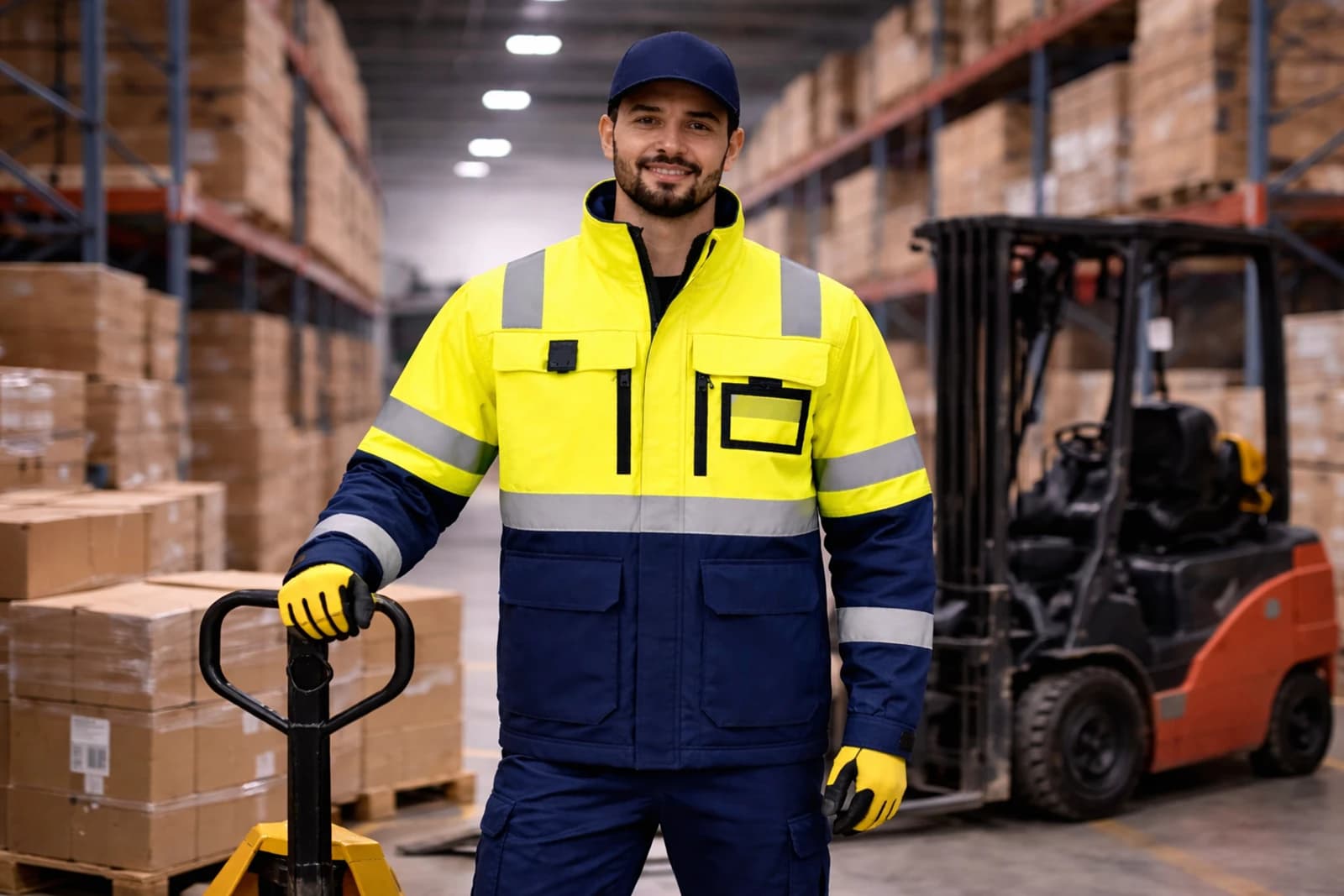
Hi-Vis Safety Jacket
Reflective safety jacket for high-visibility site operations and road work crews.