Why Middle East Warehouse Managers Are Switching to Industrial Coveralls Over Two-Piece Uniforms
Middle East logistics and industrial managers are increasingly choosing one-piece industrial coveralls over traditional two-piece uniforms for warehouse, maintenance, and plant operations. This guide for B2B buyers explains the practical advantages — from better safety compliance and fewer snag hazards to simplified sizing, reduced inventory SKUs, and lower replacement costs — and how to source durable industrial coveralls from a Chinese manufacturer that meet Gulf region standards.

Buyer context
What procurement teams run into
A warehouse operations manager at a major logistics hub in Dubai manages 150 workers across a 50,000 sqm distribution center handling FMCG goods, electronics, and heavy machinery parts. Currently, workers wear two-piece cotton-polyester work sets — a shirt and trousers — sourced from three different suppliers. The problems are mounting: shirt tails come untucked during pallet stacking, exposing bare skin near conveyor belts; trouser waistbands slip below the midriff when bending to shrink-wrap pallets; and loose shirt sleeves get caught on racking edges. In the past six months alone, there have been four near-miss incidents involving garments snagging on equipment. For Middle East B2B buyers sourcing from a Chinese workwear manufacturer, the two-piece uniform approach creates hidden costs that compound across a large workforce: - **Sizing complexity** — you need separate shirt and trouser sizes for each worker, doubling size-matching effort. A worker who wears size XL shirt but M trousers requires a mixed-size order, which most standard two-piece programs don't accommodate. - **Inventory bloat** — if you maintain 10 shirt sizes × 10 trouser sizes, that's up to 100 size combinations to stock as spares. In practice, warehouses end up overstocking the most common combinations and running out of less common ones. - **Compliance gaps** — loose shirt fabric between belt and waistband creates a rolling hazard near machinery. Even tucked-in shirts can work loose during a full shift of bending, reaching, and climbing. - **Laundry inconsistency** — shirt and trouser fabrics from different lots fade at different rates, so after 20 wash cycles the top and bottom no longer match, forcing full set replacement even if one piece is still serviceable. The core problem: two-piece workwear was originally designed for office-adjacent roles, not for active warehouse and industrial environments where workers are in constant motion, exposed to snag hazards, and require full-body protection that stays put regardless of movement.
Sourcing approach
How a factory partner can respond
The solution is transitioning your workforce to industrial coveralls — one-piece garments that wrap the entire torso and legs in a single, continuous safety envelope. For Middle East logistics and industrial buyers sourcing from a Chinese manufacturer like Sidaier, the Industrial Coverall Pro (industrial-coverall-pro) is purpose-built for these environments. Here is how to make the switch and what to specify. **Why coveralls outperform two-piece uniforms in warehouse and industrial settings:** 1. **Zero skin exposure** — the one-piece design eliminates the shirt-tail gap at the waist. When a worker bends to lift a pallet, the coverall stays sealed. This is critical for HSE compliance in facilities with moving machinery, conveyor belts, or automated guided vehicles (AGVs). 2. **No snag points** — modern industrial coveralls are designed with minimal loose fabric. Side pockets are flush with the seam, sleeve cuffs are elasticated or buttoned, and there are no shirt flaps or trailing tails to catch on racking, forklift controls, or pallet corners. 3. **Simplified sizing = fewer SKUs** — a single coverall size chart replaces two separate size matrices. One size range (S–5XL) covers all workers. For a workforce of 150, you need perhaps 7–8 coverall sizes in stock vs. 12–15 two-piece combinations. This directly reduces your spare-inventory holding cost. 4. **Consistent fading and replacement** — since the coverall is a single garment from a single dye lot, the color stays uniform across the entire garment throughout its life. When a coverall needs replacement, you replace one item, not two. This cuts replacement inventory by roughly 40% compared to two-piece systems. 5. **Better pocket layout** — the Industrial Coverall Pro offers 8+ integrated pockets: two chest pockets with media ports, two side slash pockets, two cargo pockets on the thighs, a rule pocket on the right leg, and a back pocket. For warehouse workers who carry scanners, gloves, box cutters, and notepads, this means everything is on the body — no lost tools, no fumbling. **Specifications for Middle East warehouse and industrial applications:** - **Fabric** — specify 245–280 GSM cotton-polyester twill (65% polyester / 35% cotton) with a Teflon or PU coating for light oil and water repellency. This weight breathes adequately in air-conditioned warehouses (typically 22–26 °C) while providing abrasion resistance for 12+ months of daily wear. For non-air-conditioned facilities in the Gulf summer, consider a lighter 200 GSM cotton-rich blend with underarm ventilation grommets. - **Fit** — modern European-style semi-fitted cut rather than the baggy US-style coverall. A semi-fitted cut has enough room for layering a thin t-shirt underneath but eliminates excess fabric that creates snag hazards. Request a two-way front zipper (heavy-duty metal or nylon coil) so workers can unzip from the bottom to sit or crouch comfortably without undoing the entire garment. - **Closures** — specify hook-and-loop (Velcro) adjustable cuffs and ankle closures. This allows workers to seal the coverall over safety boots and gloves, preventing debris ingress and ensuring no loose hem catches on equipment. The front zip should have a double-layer storm flap with concealed snap buttons for additional closure security. - **Safety features** — include reflective tape on the torso and arms (EN ISO 20471 Class 1 as a minimum, Class 2 preferred) even if your facility doesn't require hi-vis for indoor work. This future-proofs the uniform for outdoor tasks like yard loading or nighttime goods receipt. Knee pad pockets with top-loading access (for insert-style knee pads) should be standard — warehouse workers spend hours on their knees shrink-wrapping pallets or accessing low shelves. - **Color and branding** — for Gulf region buyers, navy blue, charcoal grey, and royal blue are the most popular coverall colors because they conceal dirt from dust and cardboard residue. Logo placement should be left chest (embroidered or heat-sealed, 8 cm wide) and upper back center (reflective transfer or screen-print logo, 20 cm wide) for rear visibility in warehouse aisles. **Procurement checklist when sourcing industrial coveralls from China:** - **Request a pre-production sample in the most common size** (typically L or XL for Middle East male workers). Test the full range of motion: squat, reach overhead, crawl, and sit in a forklift seat. The crotch should not restrict seated posture, and the armholes should not bind when reaching forward. - **Specify 50+ wash test data** — ask the manufacturer for shrinkage data after 50 industrial wash cycles (60 °C / 140 °F). Cotton-polyester blends should not shrink more than 3% in length or width. If shrinkage exceeds this, order one size up across the board to compensate. - **Ask for thread and zipper specs** — the most common coverall failure point is seam splitting at the crotch and underarm (high-stress areas). Insist on Nylon bonded thread (not polyester core-spun) in these zones, and request bar-tack reinforcement at all pocket corners and zip ends. - **Consider a dedicated color per department** — use navy for warehouse, charcoal for maintenance, and royal blue for supervisors. When coveralls are department-color coded, you visually identify unauthorized personnel in restricted zones and simplify shift management. Order a single fabric from a single dye lot to avoid color variation between batches.
Recommended Products
Products that fit this use case
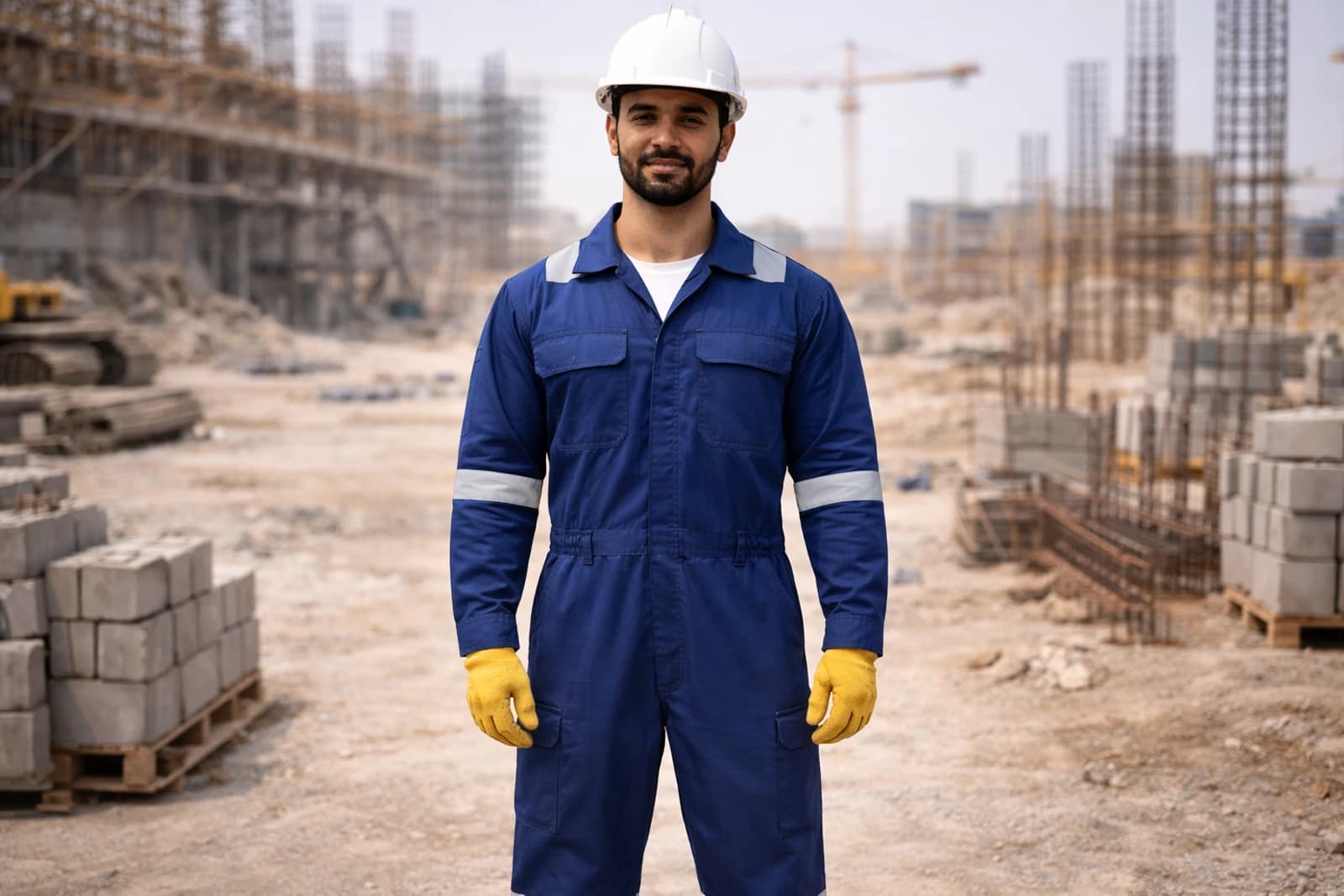
Industrial Workwear
Industrial Coverall Pro
Hard-wearing one-piece coverall for plant, maintenance, and heavy-duty operations.

Logistics Uniform
Logistics Polo Uniform
Breathable uniform polo for warehouse, delivery, and last-mile teams.