Industrial Coverall Pro for Oil & Gas: B2B Sourcing Guide for Middle East Buyers
From ADNOC onshore rig crews, Saudi Aramco maintenance teams, and QatarEnergy LNG plant operators to Kuwait Oil Company field inspectors and Oman refinery turnaround crews — the Industrial Coverall Pro is the standard-bearer for hydrocarbon sector workwear. This guide helps Middle East B2B buyers source flame-resistant, anti-static, high-durability coveralls from a Chinese workwear manufacturer, covering fabric specifications for Gulf refinery environments, ergonomic design for confined-space work, custom branding for fleet compliance, and bulk procurement strategies for NOCs and EPC contractors.

Buyer context
What procurement teams run into
The Middle East oil and gas sector accounts for nearly 30% of global hydrocarbon production, with national oil companies (NOCs) like Saudi Aramco, ADNOC, QatarEnergy, KOC, and PDO operating some of the world's largest onshore and offshore facilities. For B2B buyers sourcing the Industrial Coverall Pro from a Chinese workwear manufacturer, several distinct challenges emerge: **Extreme heat meets flash-fire risk:** Gulf refinery and rig environments combine ambient temperatures reaching 55°C with the ever-present risk of hydrocarbon flash fires. Standard FR coveralls (typically 100% cotton or cotton/nylon blends at 250–300 gsm) that meet NFPA 2112 or EN ISO 11612 are widely available — but workers in 50°C+ conditions wearing heavy FR cotton often suffer heat stress, reducing productivity by 20–35% during summer months. The challenge: finding a fabric that maintains arc rating and flame resistance while significantly reducing heat strain. **Hydrocarbon soiling and laundering durability:** Oil rig and refinery coveralls become saturated with crude, diesel, hydraulic fluid, and drilling mud within hours. Frequent industrial laundering — sometimes daily at 85°C with aggressive detergents — rapidly degrades standard FR finishes. ATPV (Arc Thermal Performance Value) ratings can drop 30–40% after 25 industrial wash cycles if the FR treatment is not inherently fibre-bound, putting workers at risk and buyers at compliance liability. **Pilling and abrasion in high-friction zones:** Coveralls on oil and gas sites endure constant abrasion — crawling under pipe racks, climbing tank stairs, kneeling on grating, brushing against flanges and valves. Standard 250 gsm FR cotton/polyester blends pill severely at knees, elbows, and seat panels within 4–6 weeks, presenting an unprofessional appearance for NOC-branded fleets and creating weak points that compromise protective integrity. **Static discharge in explosive atmospheres:** Zone 0, Zone 1, and Zone 2 classified areas (ATEX/IECEx) require garments with surface resistance below 1×10⁹ ohms and charge decay below 0.1 seconds. Many mid-range FR coveralls claim anti-static properties but fail after repeated laundering as carbon-fibre or stainless-steel anti-static filaments break, producing non-compliant gaps in conductive pathways. **Fit and mobility for confined-space entry:** Oil and gas workers frequently enter tanks, vessels, and pipe chases where restricted mobility directly impacts safety. Standard coveralls with insufficient gusseting or stretch restrict ladder climbing, valve turning, and emergency egress. For Middle East workforces, additional sizing challenges arise — Gulf anthropometrics differ from Western sizing charts, with shorter torsos and broader shoulders requiring dedicated pattern grading. **Certification documentation and traceability:** NOCs require full certification packages: ISO 11612 (heat and flame), ISO 1149-5 (anti-static), IEC 61482-2 (arc flash), and often EN 13034 (chemical splash) — plus batch-level test reports and fabric mill certificates. Chinese manufacturers without on-site ISO 17025-accredited testing or NOC pre-qualification struggle to meet documentation requirements, delaying procurement cycles by 3–6 months.
Sourcing approach
How a factory partner can respond
A properly specified Industrial Coverall Pro from an experienced Chinese workwear manufacturer addresses each of these oil and gas challenges directly: **Inherent FR bi-component fabric for heat-stress reduction:** The optimal fabric for Gulf oil and gas is an inherent FR bi-component blend — typically 88% modacrylic / 12% para-aramid or 60% FR viscose / 40% meta-aramid at 220–260 gsm. This construction delivers thermal protective performance (TPP) above 40 cal/cm² per ASTM F2700 while weighing 20–30% less than equivalent cotton FR fabrics. The open-weave structure (plain or twill with 120–150 threads per inch) enables moisture vapour transmission above 8,000 g/m²/24h (ASTM E96), significantly reducing heat stress. Chinese suppliers sourcing from certified mills (Kermel, Lenzing FR, or domestic equivalents meeting Oeko-Tex Standard 100 Class II) can deliver consistent TPP values within ±5% across production batches of 10,000+ units. **Fibre-bound FR for 100+ industrial washes:** Specify inherent FR fibres rather than FR topical finishes. Inherent FR (modacrylic, para-aramid, FR viscose) maintains flame resistance permanently — no wash-cycle degradation. Request ISO 15797 test results (industrial laundering at 85°C with alkali detergent) demonstrating: - Surface change rating ≤ 3.5 after 50 washes (ISO 6330) - Dimensional change within ±3% after 50 washes (ISO 5077) - TPP and arc rating degradation under 10% after 100 washes - Colour fastness at ΔE ≤ 4.0 after 50 washes (ISO 105 C06) **Double-layer reinforcement with anti-pill finish:** Specify 500D nylon reinforcement patches double-stitched at knees, elbows, and seat — bartacked at all stress corners. The main fabric should carry an anti-pill rating of 4–5 (ASTM D4970 / ISO 12945-2, 2,000 cycles, 415g pressure). For the most demanding clients, add Kevlar or Dyneema thread at critical seams (crotch gusset, underarm, inseam) and flame-resistant Nomex hook-and-loop at wrist and ankle closures instead of standard nylon fasteners that melt in flash-fire scenarios. Request Martindale abrasion testing (ASTM D3884): minimum 35,000 cycles before breakthrough for reinforced zones, 25,000 for main fabric. **Built-in conductive grid with wash-durable grounding:** The anti-static system uses a 12.5 mm × 12.5 mm grid of 80/20 stainless-steel/polyester core-spun conductive yarns woven into the fabric structure at 5% coverage minimum (per ISO 1149-5). Unlike carbon-coated surface treatments, this grid survives industrial laundering — retain 90%+ conductivity after 100 washes. Request surface resistance testing per EN 1149-1: below 2.5×10⁵ ohms (target 1×10⁶ maximum). For Zone 0 compliance, add a built-in grounding snap at the chest that mates to a hard-hat grounding tether and conductive boot straps — offering full body bonding (worker → coverall → helmet → boots → earth) with resistance below 10⁶ ohms. **Ergonomic pattern grading for Gulf body types and confined access:** Dedicated pattern grading for Middle East workforces: shorter torso (1–3 cm shorter than Western X-short sizing), broader shoulder-to-waist ratio (2–4 cm wider at shoulders for same waist), and longer sleeves relative to height. Include these mobility features: - 3 cm crotch gusset for deep squatting during valve operation - Articulated elbows with 20° pre-bend for pipe climbing ergonomics - Full-length side zip (YKK #10 flame-resistant brass) for doffing over boots in confined spaces - Bi-swing back pleat for 30° forward-reach extension - Internal knee-pad pocket with adjustable height positioning (7 positions, 2 cm increments) - 270° reflective tape configuration (3M Scotchlite 8910 or equivalent, EN ISO 20471 Class 3) ensuring 360° visibility through full rotation **Pre-qualification-grade certification documentation:** Work with Chinese manufacturers who maintain active certifications from: - ISO 9001 / ISO 14001 / ISO 45001 (management systems) - CNAS (China National Accreditation Service) in-house or partner testing lab meeting ISO 17025 - Pre-qualification submissions ready for Saudi Aramco, ADNOC, QatarEnergy, KOC supplier portals - Digital batch traceability: QR code on each coverall links to fabric mill cert, in-production QC photos, and batch-level ISO test reports Request the full certification package upfront: fabric mill certificate, garment test report per EN ISO 11612 / IEC 61482-2 / EN 1149-5, laundering durability report (50-cycle), and dimensional stability report. Chinese manufacturers with export experience to Saudi Arabia, UAE, and Iraq typically deliver this documentation package within 7–10 business days. For oil and gas buyers in the Gulf, the Industrial Coverall Pro represents the highest ROI decision — the differential between a basic FR coverall (replaced every 3–4 months) and a premium inherent FR coverall (18–24 month service life) is typically recovered within the first replacement cycle while eliminating heat-stress complaints and improving site safety audit scores.
Recommended Products
Products that fit this use case
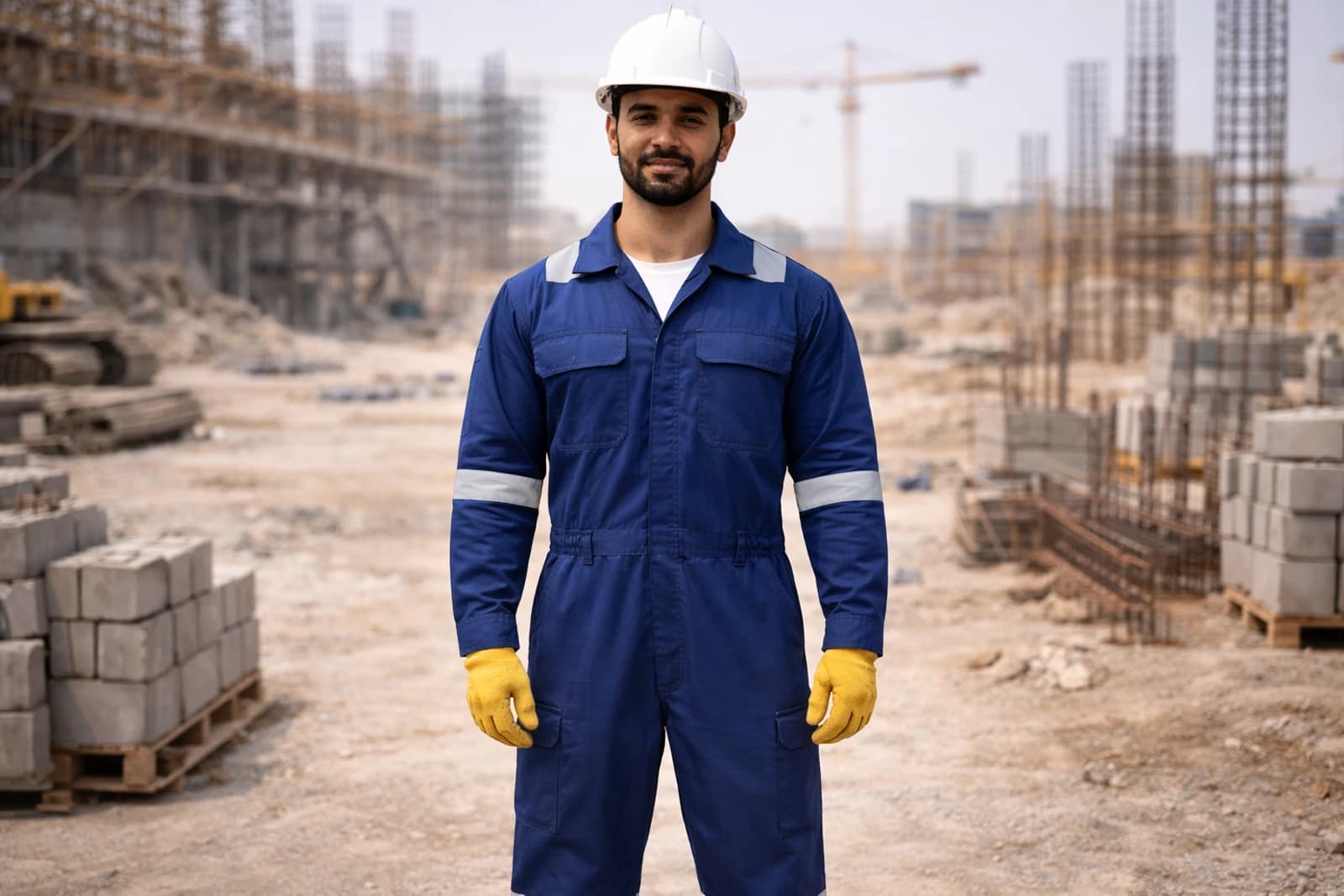
Industrial Workwear
Industrial Coverall Pro
Hard-wearing one-piece coverall for plant, maintenance, and heavy-duty operations.

Logistics Uniform
Logistics Polo Uniform
Breathable uniform polo for warehouse, delivery, and last-mile teams.