Industrial Coverall Pro for Onshore & Offshore Oil & Gas: B2B Sourcing Guide for Middle East Buyers
Middle East onshore and offshore oil & gas operations demand industrial coveralls that resist flash fire, chemical splash, and extreme heat while keeping workers comfortable in 50°C conditions. This guide covers what B2B buyers in Saudi Arabia, UAE, Qatar, Kuwait, and Oman should know when sourcing industrial coverall pro garments from a Chinese workwear manufacturer — from flame retardant certifications and fabric technology to regional sizing and customisation for corporate identity.

Buyer context
What procurement teams run into
Middle East oil and gas operations are expanding at an unprecedented pace. Saudi Aramco's Jafurah unconventional gas development, the Marjan and Zuluf field expansions, ADNOC's $150 billion five-year downstream investment plan, and QatarEnergy's North Field LNG expansion are driving massive demand for industrial-grade coveralls. For B2B procurement managers, HSE directors, and industrial uniform buyers sourcing from Chinese workwear manufacturers, the critical challenge is sourcing an industrial coverall that simultaneously meets international flame retardant and chemical protection standards, survives the punishing Gulf climate, fits a highly diverse multinational workforce, and delivers the right cost-per-wear economics for contracts ranging from 500 to 50,000 units. An industrial coverall for Middle East oil and gas is fundamentally different from one designed for temperate European or North American conditions. The combination of extreme ambient heat (45–55°C summer highs), humidity in coastal and offshore zones reaching 90%+, direct UV radiation levels 2–3 times higher than European averages, and the specific hazard profile of Gulf oil and gas operations — hydrogen sulphide (H₂S) exposure risk, hydrocarbon splash, flash fire potential from wellhead operations, and mechanical abrasion from sand and crude residues — creates a specification challenge that off-the-shelf products from Western markets often fail to address. The financial stakes are significant. In Saudi Arabia, a non-compliant coverall on a Saudi Aramco project can trigger contract penalties of up to $100,000 per incident under SAEP-2832 HSE non-compliance clauses. In Qatar, QatarEnergy's mandatory PPE registration system requires documented certification traceability from the manufacturer. Buyers who source the wrong product face not only safety violations but also short replacement cycles — a coverall that fails after 10 industrial launderings instead of the required 50 drives unit lifetime costs up by 400%. **1. Flame retardant certification — the non-negotiable foundation.** Every industrial coverall destined for Middle East oil and gas must carry EN ISO 11612 (heat and flame) certification, and for most upstream and downstream operations, EN ISO 11611 (welding and allied processes) is also mandatory. For hydrocarbon environments in particular, buyers should specify the A1 and A2 limited flame spread requirements as a minimum (A1: no flame spread, no flaming debris; A2: after-flame time under 2 seconds per ISO 15025). The gold standard for Gulf oil and gas is EN ISO 11612 with additional B (convective heat), C (radiant heat), and E (molten iron splash) performance levels — though E is typically more relevant for foundries and smelters than oil and gas production. The critical question for B2B buyers is whether the Chinese manufacturer offers inherently flame retardant (IFR) fabrics versus treated FR fabrics. IFR fabrics — such as those made from modacrylic/cotton (Proban or Pyrovatex-treated) or aramid blends — maintain their FR properties for the garment's entire lifetime regardless of washing. Treated FR fabrics can degrade after 25–50 washes depending on the chemistry and wash protocol. For Middle East oil and gas where industrial laundering at 75°C with aggressive detergents is standard, IFR fabrics are strongly recommended. The three most common IFR fabric systems offered by top Chinese workwear manufacturers for Middle East contracts are: (a) 300–320 gsm Proban-treated cotton-rich FR canvas (good comfort, moderate durability), (b) 280–300 gsm modacrylic/cotton blend with permanent FR properties (best comfort-to-protection ratio for Gulf conditions), and (c) 250–280 gsm aramid blend with anti-static fibre integration (maximum protection for high-risk wellhead and H₂S exposure zones). Request from the manufacturer: the full EU-type examination certificate (CE 0333 or equivalent), the specific fabric test reports for limited flame spread and heat transfer per EN ISO 11612, and crucially, the industrial laundering durability test report showing that after 50 wash cycles at 75°C, the FR properties remain within 90% of the original values. Coveralls for Saudi Aramco contracts additionally require compliance with SAES-J-910 and 33-SAMSS-028, which mandate specific labelling and lot traceability requirements. **2. Fabric weight and thermal comfort for 50°C+ environments.** The most common complaint about industrial FR coveralls in the Middle East is heat stress. A 350 gsm cotton drill FR coverall that performs well in a North Sea winter can cause dangerous core temperature rise within 45 minutes of direct sun exposure in the Saudi Eastern Province summer. For Gulf conditions, the optimal fabric weight is 280–300 gsm for upstream and midstream operations, with a minimum air permeability of 100 l/m²/s (ISO 9237) to allow convective heat exchange. Leading Chinese manufacturers now offer engineered fabric structures that address the thermal challenge: (a) taped vent openings in the back yoke and underarm gussets with flap covers that prevent liquid ingress while allowing air circulation; (b) mesh drop-lining in the upper back and shoulders — a 3D spacer fabric that creates a 5 mm air gap between the coverall and the wearer's clothing; (c) moisture-wicking inner surface finish with an MVTR of minimum 5,000 g/m²/24h (ASTM E96) to manage sweat evaporation. For buyers sourcing coveralls for offshore operations or gas processing plants where the heat hazard is more moderate, a 250–270 gsm modacrylic/cotton blend is comfortable enough to allow full-shift wear without fatigue. Another critical but often-overlooked factor is colour: for Gulf oil and gas, the traditional navy blue or dark grey coveralls absorb significantly more solar radiation than lighter alternatives. Some Middle East buyers now specify a two-tone design — light grey (high solar reflectivity) on the torso, arms, and back with dark navy or royal blue on the lower legs and collar. This maintains a professional, high-visibility appearance while reducing surface temperature by 8–12°C compared to an all-dark garment in direct sun. Request radiant heat reflectance (solar reflectance index) data from the manufacturer for your chosen colour combination. **3. Chemical splash and hydrocarbon resistance for Gulf-specific hazards.** Middle East oil and gas coveralls must resist a specific set of chemical hazards: crude oil, diesel, drilling mud additives (including caustic soda and barite), hydrogen sulphide (H₂S) permeation, and — for downstream refinery operations — aromatic hydrocarbons and sulphur compounds. While most FR coveralls are not certified as full chemical protective suits, the fabric should provide splash resistance and limited permeation protection. Specify fabric with a minimum repellency rating of class 3 per EN ISO 6530 (protection against liquid chemicals — penetration and repellency) for crude oil and diesel fuel. This requires a fluorocarbon finish or a hydrophobic fibre surface treatment that causes liquids to bead and roll off rather than soak through. The fabric should also demonstrate an oleophobic rating of minimum 5 (AATCC 118) for hydrocarbon resistance. For H₂S environments — common in Gulf sour gas operations — anti-static properties are essential: the coverall must meet EN 1149-5 (electrostatic properties) with a surface resistivity of less than 5 × 10¹⁰ ohms per square, as static discharge can ignite H₂S gas. Request verified test reports from an ISO 17025 accredited laboratory for each of these parameters. Some Chinese manufacturers also offer integrated carbon-fibre or stainless-steel conductive threads in the fabric (not just surface anti-static treatment) to ensure permanent anti-static performance through the garment's lifetime. **4. Sizing for the multinational Middle East oil and gas workforce.** The Gulf oil and gas workforce is among the most diverse anywhere: South Asian general labourers (Indian, Pakistani, Nepali, Bangladeshi), Filipino and Indonesian technicians, Arab engineers and safety officers, Western expatriate specialists, and local nationals. A single sizing range fails for a workforce spanning 155 cm to 195 cm height with chest circumferences from 88 cm to 140 cm. B2B buyers should specify a sizing programme from 2XS (44 chest, 160 cm height) to 5XL (68 chest, 195 cm height), with short, regular, and long length variants at each size. The critical Middle East-specific adjustments are: (a) shorter sleeve lengths relative to chest size for the South Asian demographic — a worker with a 100 cm chest may need a sleeve length 3–5 cm shorter than a European-worker standard; (b) adjustable waist tabs (elastic or Velcro) rather than fixed waist lines to accommodate varying body shapes; (c) knee pad pockets with adjustable height positions — South Asian workers spend significantly more time in kneeling or crouching positions during pipeline and rig floor maintenance. Some Chinese manufacturers now offer fractional sizing (e.g., M+ and L+ with adjusted proportions) as a mid-cost alternative to fully bespoke sizing. For contracts of 5,000+ units, many will create a custom grading rule set based on the buyer's historical anthropometric data or a sample fitting session at the manufacturer's facility. This custom fitting service — typically included for large-volume deals — reduces field returns from 12–15% with stock sizing to under 3%. **5. Durability features that extend replacement cycles in Gulf conditions.** The economic case for sourcing industrial coveralls from a Chinese manufacturer often hinges on cost-per-wear rather than unit price. A $25 coverall that lasts 25 industrial launderings costs $1.00 per wear. A $40 coverall that lasts 75 industrial launderings costs $0.53 per wear — 47% lower lifetime cost. Key durability features to specify include: (a) triple-stitched main seams with a minimum 0.6 cm seam allowance — not the 0.3 cm allowance common on low-cost garments — with either double-needle chain stitch or lockstitch construction; (b) bar-tack reinforcement at all stress points — crotch, underarm, knee pad pocket corners, and belt loops — with a minimum of 12–16 bar tacks per coverall; (c) YKK or SBS heavy-duty zippers with a minimum rating of 4 gauge (not 3-gauge fashion zippers) and a tape-locked zip that prevents the slider from separating from the tape on the pull side; (d) concealed press stud closure over the zipper to prevent the zip tab from contacting hot surfaces or equipment; (e) reinforced knee patches — dual-layer fabric with a 500 denier Cordura or similar abrasion-resistant outer layer, stitched and boxed at the edges — not just a single layer with an internal knee pad pocket; (f) Sand-collecting pocket closures — use flap-and-Velcro instead of open pockets to prevent sand and grit from accumulating at the leg, chest, and thigh pocket openings. For offshore contracts, all metal components (zippers, studs, buttons) should be specified as nickel-free non-corrosive alloy or brass — standard zinc-alloy press studs pit and corrode within 6 months in a Gulf offshore environment with salt spray and 80%+ humidity. **6. Customisation and branding for corporate identity and workforce management.** Middle East oil and gas operators — Saudi Aramco, ADNOC, QatarEnergy, KOC, PDO — require extensive garment customisation as part of their contractor management programmes. This typically includes: (a) woven labels with the operator's logo and the contractor's company name — positioned on the left chest, left sleeve, and back between the shoulder blades; (b) reflective tape colour-coded by role — typically silver for general workers, yellow-green for supervisors, and red for emergency response personnel, applied per the operator's specific SSOW (safe system of work) colour-coding; (c) snap-on or Velcro detachable panels for role identification — medic patches, H₂S awareness tabs, or confined-space entry badges; (d) RFID tag insertion pockets sewn into the neck label or side seam for digital workforce tracking and garment assign-and-return tracking systems. Chinese workwear manufacturers competitive in the Middle East market typically offer digital sublimation printing for logos and text that matches woven label quality at lower unit cost for large orders. For embroidery, specify minimum 7,000 stitches per logo for adequate definition at 10 metres distance in oilfield lighting conditions. **7. Logistics and compliance documentation for Middle East customs clearance.** A common hidden cost for Middle East B2B buyers is customs delays and re-inspection fees due to incomplete compliance documentation. When sourcing industrial coveralls from a Chinese manufacturer, request the following shipping documentation package: (a) Certificate of Conformity (CoC) from an accredited testing body for the specific product model being shipped; (b) Manufacturer's Declaration of Conformity (DoC) signed by an authorised representative with the notified body number and EC-type examination certificate reference; (c) HS Code classification (typically 62113290 for men's cotton industrial wear or 62113900 for synthetic blend workwear) with the correct duty rate and GCC/GSO marks where applicable; (d) Batch-specific test reports matching the bill of lading production runs; (e) For Saudi Arabia-bound shipments, Saber/SASAB certification registration documents; (f) For UAE and Qatar, Electronic Import Declaration and product registration with the Emirates Authority for Standardisation and Metrology (ESMA) or Qatar General Organisation for Standardisation (QS). Most experienced Chinese workwear manufacturers with a Middle East export focus will include customs documentation preparation in their DDP (Delivered Duty Paid) or CIP (Carriage and Insurance Paid To) pricing. Buyers are advised to request documentation samples in the RFP stage, not after the order is placed.
Sourcing approach
How a factory partner can respond
For Middle East B2B buyers sourcing industrial FR coveralls from a Chinese workwear manufacturer, the solution starts with specifying EN ISO 11612-compliant inherently flame retardant fabrics (modacrylic/cotton blends at 280–300 gsm) with verified certification traceability, and then layering in Gulf-specific requirements: thermal comfort features (mesh venting, moisture-wicking finishes, light-coloured torso panels), hydrocarbon repellency per EN ISO 6530 Class 3, anti-static properties per EN 1149-5, and tailored sizing programmes covering 2XS to 5XL with length variants optimised for the region's multinational workforce. The recommended product to evaluate is the **Industrial Coverall Pro** — a heavy-duty FR/chemical-resistant coverall built to EN ISO 11612, 1149-5, and 6530 standards, available in 280 gsm modacrylic/cotton IFR fabric with taped venting, reinforced knees, YKK heavy-duty zippers, and full customisation for operator branding, role-colour coding, and RFID integration. Pair it with the **Hi-Vis Safety Jacket** (also from the same manufacturer) for workers who need layered protection combining FR coveralls with hi-vis reflective visibility on wellpad and rig floor operations.
Recommended Products
Products that fit this use case
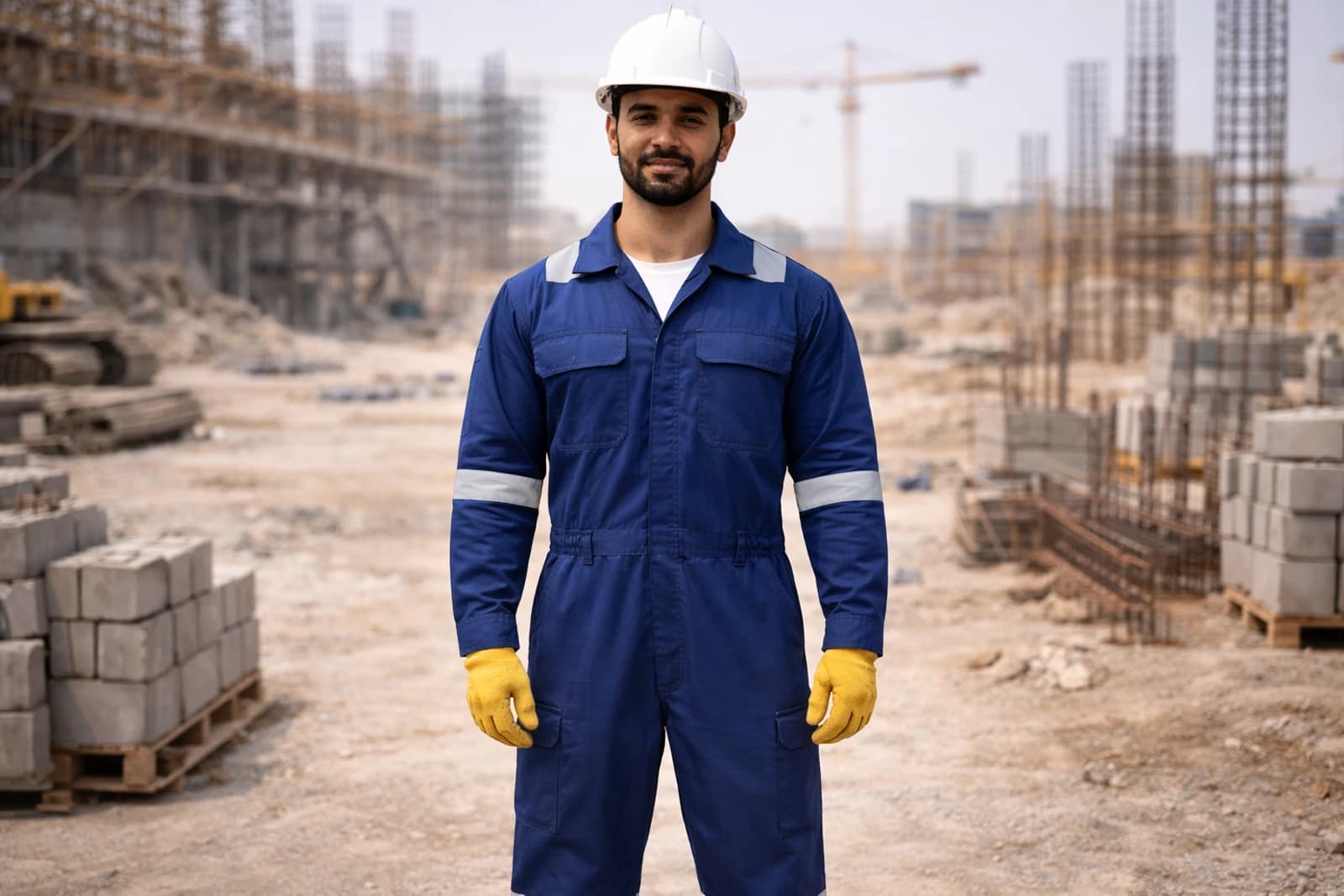
Industrial Workwear
Industrial Coverall Pro
Hard-wearing one-piece coverall for plant, maintenance, and heavy-duty operations.
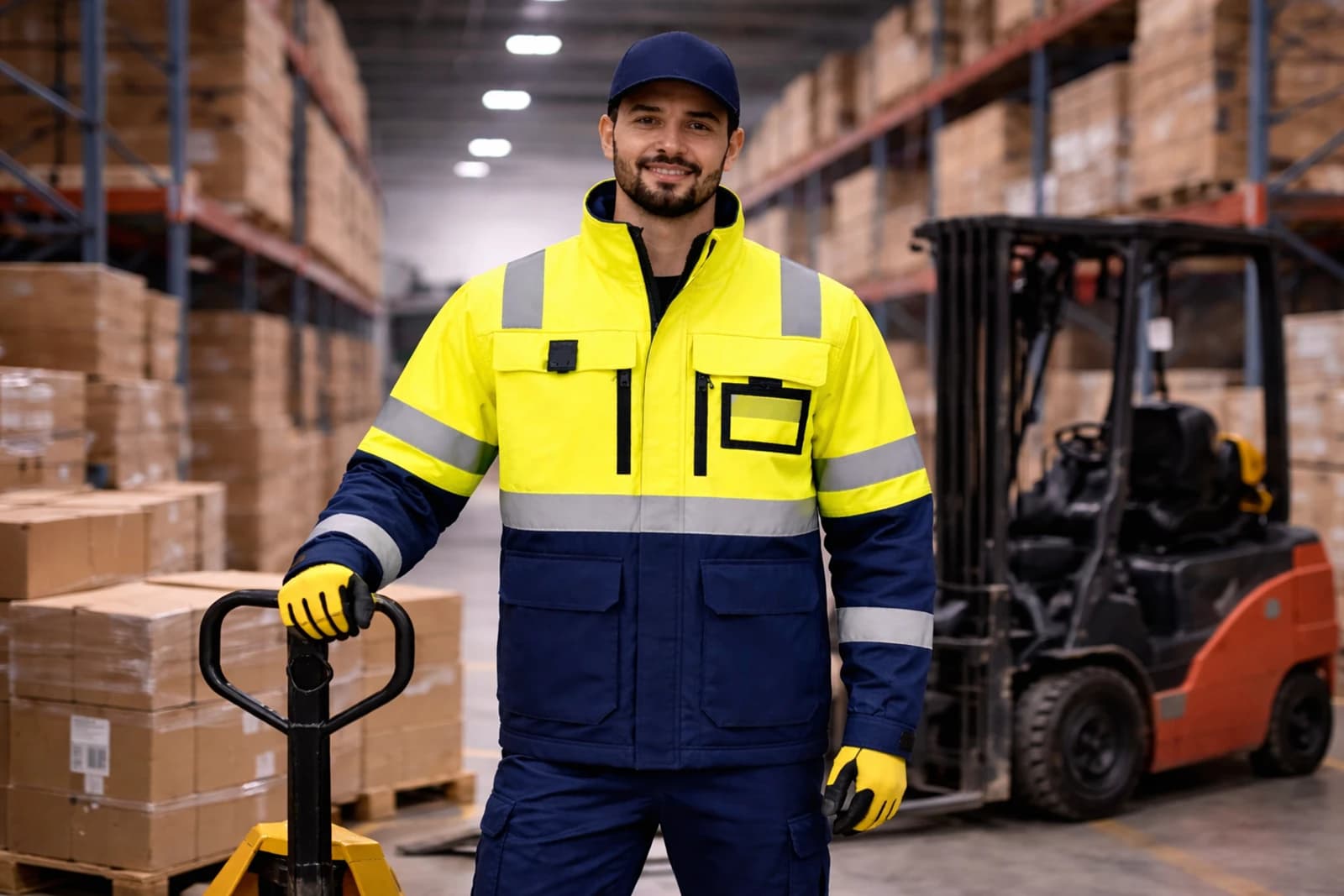
Safety Uniform
Hi-Vis Safety Jacket
Reflective safety jacket for high-visibility site operations and road work crews.