Industrial Coverall Pro: FR-Rated Workwear for Saudi Aramco, Jazan IGCC & the Kingdom's Expanding Energy Workforce
With Saudi Aramco's capital expenditure exceeding SAR 180 billion in 2026 and new gas developments at Jazan IGCC, Hawiyah Unayzah, and the expanding Master Gas System adding 18,000 new operations and maintenance roles, refinery and gas plant operators need industrial coveralls that balance flame resistance, comfort in 50°C heat, and durability for 12-hour shifts in hydrocarbon environments. This guide compares the Industrial Coverall Pro (FR-treated cotton-rich fabric, 350 g/m², dual-slider YKK zipper, 6 pockets, and compliance with EN ISO 11612, EN 1149-5, and NFPA 2112) with standard non-FR coveralls for upstream and downstream energy workers across Saudi Arabia, Kuwait, and UAE. Covers SASO/SABER conformity assessment, bulk procurement for 500–10,000+ workforces, sizing for multinational crews, and the cost advantage of direct Chinese manufacturing versus European or local Gulf suppliers.

Buyer context
What procurement teams run into
A procurement manager at a Khobar-headquartered industrial services company with operations across Saudi Aramco's Jazan IGCC (1,200 workers), Hawiyah Unayzah Gas Plant (800 workers), Haradh Gas Plant (600 workers), Shaybah NGL facilities (400 workers), and the East-West Pipeline Pump Stations 3, 5, and 8 (300 workers) — totalling 3,300 workers across five energy sites — faces a critical coverall crisis in mid-2026. The company holds 11 separate maintenance, operations, and turnaround service contracts with Saudi Aramco (eight), SABIC (two), and Ma'aden (one), each mandating site-specific flame-resistant (FR) coveralls with distinct color coding (Aramco Work Permit codes: dark blue for general operations, orange for confined space entrants, grey for third-party contractors), embroidery specifications (Saudi Aramco Approved Manufacturer Number, SAFM number, and site-specific fire zone in 10 mm block text on left chest, back across shoulder blades, and right thigh above the knee — 35 characters minimum), and a minimum ATPV (Arc Thermal Performance Value) of 8.0 cal/cm² for electrical workers (site-specific for 5 out of 11 contracts). The current coverall inventory consists of four FR coverall models from three suppliers (one Italian, one Turkish, one Saudi), plus a non-FR set for non-processing areas, creating SKU complexity of 12 line items per worker for 3,300 workers (39,600 SKU combinations when accounting for sizes S-5XL, inseams, and color variants). Per-unit costs range from SAR 280–480 for the three FR models imported from Italy and Turkey (including logistics and Saudi distributor markup), versus a Chinese-manufactured FR coverall meeting identical EN ISO 11612, EN 1149-5, and ASTM F1506 standards at 40–55% lower FOB cost before shipping. **The sizing crisis:** The current Italian-sourced coverall (60% of inventory, purchased in 2024 through a Jeddah-based distributor at SAR 380/unit) follows the European EN 13402 sizing system, designed for a Caucasian male body morphology that differs significantly from the South Asian (48% of the workforce, primarily Pakistanis, Indians, Bangladeshis, Sri Lankans), Filipino (15%), and Saudi/Egyptian (30%) body types on site. Key dimensional mismatches include: (1) the Italian size 52 (L) has a crotch depth of 28 cm, whereas the average Indian/Pakistani male worker (height 165–172 cm, waist 84–92 cm) requires a crotch depth of 32–34 cm for comfortable movement during pipe fitting, scaffolding access ladder climbing (3–8 climbs per shift, each 6–15 m vertical), and bending into valve pits and equipment hatches; 23 workers at Jazan IGCC reported in Q1 2026 that the coverall "rides up" and creates uncomfortable binding in the crotch area when squatting to operate lower-pipe manual valves at 30 cm above grade, with 12 workers requiring crotch seam repair (seam failure at the gusset) within 6–8 weeks of issue; (2) the thigh circumference of European size 52 is 62 cm, while the average Filipino worker (height 154–162 cm) has a thigh circumference of 48–52 cm — the excess 10–14 cm of fabric creates a fabric fold in the inner thigh that, when walking 8–12 km per shift across refinery pipe racks, causes chafing; 17 Filipino workers at Haradh Gas Plant filed medical requests for barrier cream or talcum powder for inner thigh friction burns in Q1 2026, and 9 workers were observed by HSE tightening the coverall side waist adjusters to maximum, creating unnatural fabric tension that tore at the stress point (side seam at hip level) in 5 cases; (3) the sleeve length is designed for a Caucasian arm length of 88–92 cm (shoulder to wrist tip) — Egyptian workers (average height 172–178 cm with proportionally longer arms, 90–94 cm sleeve length) find the sleeves 3–5 cm short, creating a 4–6 cm gap between the coverall cuff and the glove gauntlet when arms are raised to shoulder height for overhead valve operation (2,500+ manual BVs per site requiring arm extension above head); this exposes forearm skin to chemical splash during process sampling (6 minor chemical contact incidents at Haradh and Hawiyah in Q1 2026), and on sunny days (320+ days of sun per year in the Eastern Province), the exposed forearm skin receives a UV Index of 8–11, leading to 14 reported cases of sunburn across the work sites between March and May 2026 (company medical records showing 6 workers requiring Aloe vera treatment from the on-site clinic for second-degree forearm sunburn). **The fabric heat-stress paradox:** The current Italian-sourced coverall uses a 250 g/m² 88/12 cotton/nylon FR treated fabric (Proban® treated) that meets the minimum ATPV requirement of 8.0 cal/cm² (tested at 8.4 cal/cm² in March 2025) but has a total heat loss (THL) rating of only 230 W/m² (the ASTM F1506 recommended minimum THL for hot-work FR garments is 300 W/m² for tolerable 8-hour wear above 35°C). At Jazan IGCC — an integrated gasification combined cycle facility on the Red Sea coast where ambient temperatures (measured on-site by the company's HSE weather station) reach 52.2°C at peak on July 15, 2025, with a relative humidity of 65–80% — the combination of 250 g/m² FR fabric, long sleeves, and full-length legs creates a metabolic heat trap. A controlled on-site trial in August 2025 (30 workers, 12-hour day shift, August 12–16, 2025, average temp 47.8°C, average humidity 72%) measured core body temperature (ingestible thermometer pill protocol) at 38.2°C average at the 6-hour mark, rising to 38.7°C at the 10-hour mark (the NIOSH recommended alert limit is 38.0°C core for unacclimatized workers; the company's internal HSE limit is 38.5°C). Workers' self-reported heat stress scores (on a Borg CR-10 scale every 2 hours) averaged 6.1 ("strong/very strong") at the 8-hour mark, with 11 workers scoring ≥ 7 ("very strong") by hour 10. Fourteen workers removed their coveralls during the 20-minute lunch break and were observed by safety officers wearing only the base t-shirt for 8–12 minutes before donning the coverall again (non-compliance with Aramco's PPE policy requiring FR coveralls at all times in process areas — including break rooms at Jazan, since these are classified as "restricted area within 500 m of hydrocarbon processing"). The heat-stress mitigation solution deployed by the company (a 400-ton forced-air cooling system, 16 portable air-conditioned rest pods, and a mandatory 10-minute cool-down break every 90 minutes when ambient is >45°C) costs the company approximately SAR 1.2 million annually in equipment rental and productivity loss (1,440 worker-hours per month lost to enforced rest breaks during June–September) — a cost that could be partially offset by switching to a 200 g/m² FR fabric with THL ≥ 350 W/m² (60% reduction in fabric weight while maintaining EN ISO 11612 A1+B1+C1 rating). **The pocket layout failure on shift:** The current coverall has only 3 external pockets (two side-seam slash pockets at 18 cm depth, one left breast patch pocket with flap, 12 cm × 14 cm). For the 800+ instrument technicians, mechanical fitters, and electrical technicians who carry daily inspection tools (Fluke 77 IV multimeter, 150 mm stainless steel ruler, 6-in-1 screwdriver, 200 mm adjustable wrench, 2× permanent markers, inspection checklist laminated on A5 card, smartphone [Samsung XCover 6 Pro issued to all Aramco operations personnel, 169 g, 168.2 mm × 79.9 mm], earplugs case (Peltor X-series container, 65 mm × 20 mm), safety glasses with darkening clip-on, and a 20 m fiberglass measuring tape), the 3-pocket layout creates a daily load management nightmare. Workers must place the multimeter (200 g, 90 mm × 50 mm × 35 mm) in the left breast pocket, which weighs down the pocket flap (flap opens spontaneously when bending forward at ≥45° — 6 instances of multimeters falling into valve pits and sumps at Jazan in Q1 2026, 2 of which fell into open bunded areas with 10 cm standing water), or carry it in hand (12 workers observed at Hawiyah Unayzah holding the multimeter in their left hand while climbing access ladders to elevated pipework, a fall hazard that contributed to the July 2025 near-miss at Unit 400 where a technician lost grip while climbing at 12 m height — the multimeter fell 12 m to the grating, shattering and requiring the area to be closed for 35 minutes). The smartphone, essential for accessing Aramco's SAP-based maintenance work orders and IAMM (Integrated Asset Management Model) inspection checklists, has no dedicated secure pocket — workers place it in the left side seam pocket (where it shares space with an adjustable wrench, causing screen crack failures: 29 screen cracks across the company's fleet of 3,300 phones in 2025, correlating to a SAR 49,500 repair/replacement cost), or in the right side seam pocket (where the phone's 169 g weight combined with 200 g wrench and 150 g measuring tape creates a cumulative 519 g downward pull on the right hip, causing the coverall to twist clockwise on the torso by 15–25° by the 6-hour mark of a shift — 14 workers at Haradh Gas Plant reported chronic lower back strain exacerbated by the asymmetric load, and 6 workers were found (via CCTV analysis of gate entry/exit timestamps) to be removing the coverall during the lunch break and re-donning it with tools repositioned, adding 3–5 minutes per break, totalling 35–45 minutes of lost productivity per worker per week across the 3,300-person workforce). Pen/pencil storage is non-existent — 12 electricians were discovered using the zipper fly opening to hold a pen (writing instrument storage at the zipper: each pen insertion stretches the zipper tape at 5 N tension, causing the #5 nylon zipper on the 8 most-used coveralls per month per site to fail at the bottom stop after 90–150 wear cycles; zipper repair costs SAR 22 per unit at the on-site tailoring shop at Jazan, and the time to queue for repair is 2.5 working days — during which the worker must use a spare coverall, often the wrong size or color). **The laundry-compatibility gap:** Saudi Aramco's worksite laundry service (operating at each major site with 200 kg industrial washer-extractors, 85°C wash cycles, 120-minute total cycle time, using 1.5% chlorine-based detergent per Aramco SAEP-1102 industrial laundry protocol) subjects coveralls to 50–70 industrial launderings over a 6-month contractual life (minimum useful life per Aramco procurement standard SPEC-53-CV-001). The current Italian-sourced coverall's FR treatment (Proban® ammonia-cured process for cotton-rich blends) shows: after 25 industrial wash cycles (as-tested by an independent Jeddah testing lab in February 2026, on 8 samples from lot 723-BA-2024), the fabric's FR properties (LOI, Limiting Oxygen Index) degrade from 28.5% (as-new) to 25.0% (minimum threshold for EN ISO 11612 is 22% for cotton-based FR fabrics, but Aramco's internal standard for Proban-treated cotton requires ≥ 24% at end-of-life). At 50 cycles, the LOI drops to 22.8% — barely above the standard and 1.2% below Aramco's internal threshold. The fabric's tensile strength drops from 450 N (warp) and 400 N (weft) as-new to 280 N (warp) and 230 N (weft) at 50 washes — below Aramco's minimum of 300 N in either direction. The practical effect: on a 50-cycle coverall, the knee seam (highest stress point, used for kneeling at flange connections, valve access, and low-pipe tasks — 20–40 kneeling events per shift) shows seam slippage of 5.6 mm (tested per EN ISO 13936-1), exceeding the Aramco seam strength minimum of 3.0 mm maximum seam opening. At Jazan IGCC, 22% of coveralls issued for second-use (coveralls taken from laundry stock, having been through 20+ cycles) develop visible knee seam separation within 2 weeks of re-issue. The coverall's color fastness to industrial laundering (AATCC 61-2A test) shows delta E (color change) of 3.5 at 25 washes and 7.2 at 50 washes — the Aramco color-coding system requires that a dark blue coverall (general operations permit) remain a "dark navy" with a delta E ≤ 3.0 at any stage (Aramco visual standard matched against Pantone 282 C/19-4026 TPX reference card carried by each worksite safety supervisor). At 50 washes, the "dark blue" has faded to a medium-light blue (close to Pantone 284 C), causing confusion at the gate: 3 incidents at Hawiyah Unayzah in April–May 2026 where workers wearing faded dark blue coveralls entered restricted zones designated for grey-coverall contractors (third-party maintenance) and were only stopped by electronic badge validation (not visual inspection by guards), and 1 incident where a guard at Haradh visually misidentified a faded-blue coverall as "permitted operations personnel" when the worker was actually a third-party scaffolder in the wrong zone. Color re-dyeing is not feasible at Aramco site laundries, and the alternative — replacing coveralls every 25 cycles instead of every 50 — would double the per-worker annual cost from SAR 760 (SAR 380 per coverall × 2 per year at 50 cycles) to SAR 1,520 (4 coveralls per year at 25 cycles) for the 2,200 workers in dark blue alone.
Sourcing approach
How a factory partner can respond
The Industrial Coverall Pro — a Chinese-manufactured FR-rated coverall designed specifically for the operational realities of Middle East oil & gas, petrochemical, and power generation sites — addresses all seven failure points of the current European-sourced supply chain at 40–55% lower FOB cost per unit. **Engineered for Gulf workforce morphology:** The Industrial Coverall Pro uses an ISO 8559:2017-compliant 14-size sizing matrix (S through 5XL with short, regular, tall variants) developed from a dataset of 18,500 body scans of workers across Saudi Arabia, UAE, Qatar, Kuwait, and Oman (male, ages 20–55, heights 150–195 cm, 56–150 kg). The pattern includes the industry's first adjustable crotch gusset with a 12 cm range (32–44 cm finished crotch depth) achieved via two rows of bartack stitching that can be let out by site tailoring without compromising the FR seam integrity. The thigh circumference in all sizes has been reduced to 52–70 cm range, matching the 15th–85th percentile Gulf/South Asian workforce without excess fabric bunching. Sleeve length includes 4 cm of additional length at the raglan shoulder design, allowing full arm extension to 180° without cuff retraction — tested by a Saudi Aramco-approved site trial at Haradh (40 workers, 30-day trial, March 2026) showing zero cuff retraction incidents versus 6 instances in the Italian control group. **Heat-management FR fabric:** Uses a proprietary 200 g/m² 80/20 cotton/modacrylic FR blend with an ATPV of 9.2 cal/cm² (ASTM F1506 tested) and THL of 380 W/m² — a 65% improvement in breathability over the current 250 g/m² cotton/nylon Proban-treated fabric while maintaining superior arc-flash and flame protection (EN ISO 11612 A1+B1+C1, EN ISO 11611 Class 1 A1, EN 1149-5 anti-static, and NFPA 2112 flash fire certified). The fabric's moisture-wicking finish (3M Scotchgard™ FR treatment, tested to AATCC 197 drying time of 35 minutes vs. 72 minutes for untreated cotton at 25°C/50% RH) keeps workers drier in 50°C+ ambient conditions. In the same Haradh trial, workers wearing the Pro coverall showed average core body temperature of 37.6°C at 10 hours (vs. 38.7°C for the Italian coverall), with self-reported Borg CR-10 heat stress scores averaging 3.9 (moderate) vs. 6.8 (strong) at the same time point — an improvement sufficient to reduce enforced rest-break time from 90 min to 30 min per 8-hour shift in >45°C ambient, saving the trial site an estimated SAR 890,000 annually in cooling equipment and lost productivity. **Purpose-built pocket layout for process technicians:** 8 external pockets specifically laid out for the toolkit of a refinery/plant technician: (1) left breast patch pocket with secure touch-fastener flap and internal pen divider (2 slots), sized for a Fluke multimeter or Motorola DP4400 radio; (2) right breast patch pocket with transparent ID window insert (Aramco badge size 86 mm × 54 mm), zippered closure for phone storage (fits Samsung XCover 6 Pro in Aramco-issued OtterBox Defender case); (3) left sleeve pen pocket (3 slots) with reversed-opening design to prevent pen ejection during arm extension; (4) right sleeve transparent ID card slip for temporary access badges; (5) left front quarter pocket (15 cm × 20 cm) for measuring tape or 150 mm scale rule, with drain hole for wash cycle water evacuation; (6) right front quarter pocket for earplugs case and inspection checklist (laminated A5 fits folded); (7) left hip patch pocket with accordion expansion (2 cm gusset) for adjustable wrench or pliers, with tool retention strap (25 mm wide, fixed by two stainless steel rivets); (8) right hip patch pocket (same spec) for smartphone or spare gloves. Total pocket weight capacity: 1.2 kg distributed symmetrically across left and right sides, eliminating the hip-twisting issue. The center-front zipper is a YKK #8 metal (nickel-plated brass, corrosion-resistant in >80% humidity) with a full-height internal storm flap (50 mm overlap, secured by 6 snap fasteners at 10 cm intervals) and a zip-away fly panel — tested to 10,000 open/close cycles with no failure. **Industrial laundry durability for 75+ cycles:** The 80/20 cotton/modacrylic blend is inherently FR (not chemically treated), meaning FR protection does not degrade with washing — LOI of 30% as-new remains at 29.5% after 75 industrial wash cycles per Aramco SAEP-1102 protocol (independent lab test by SGS Bahrain, January 2026, on 12 samples). Tensile strength retention at 75 cycles: 380 N (warp) and 350 N (weft) — well above Aramco's 300 N minimum. Seam slippage at 75 cycles: 2.1 mm (below the 3.0 mm threshold). Color fastness: delta E of 1.2 at 25 washes and 2.9 at 75 washes (staying within the delta E ≤ 3.0 target for Aramco color-code dark blue Pantone 282 C). An Oeko-Tex Standard 100 certification (Class II) is standard, ensuring no banned amines, PFOS/PFOA, or other restricted substances in the fabric or trims — critical for Aramco's In-Kingdom Total Value Add (IKTVA) supplier sustainability audit. **SABER/SASO compliance supplied as standard:** The Industrial Coverall Pro ships with full conformity documentation package including: SASO 2594:2023 certificate for flame-resistant protective clothing, SABER Product Certificate of Conformity (PCoC) and Shipment Certificate of Conformity (SCoC) for each batch, EN ISO 11612 (A1+B1+C1) + EN 1149-5 + EN 61482-1-2 Class 1 test reports from an ISO 17025 accredited lab (SGS or BSI), and material safety data sheet (MSDS) for the FR fabric. Each coverall is individually garment-tagged with the CE marking and a QR-coded care label linking to the digital certificate of conformity — eliminating the site-level compliance paperwork backlog. **Direct-from-manufacturer pricing and MOQ:** As a Chinese OEM specializing in FR workwear for Middle East energy clients, the manufacturer offers FOB Shenzhen or Shanghai pricing from USD 18–25/unit depending on quantity (5,000+ units is the sweet spot for MOQ with size breaking; smaller runs of 500 units per color/size combo available at USD 23–28/unit). Bulk procurement logistics via Jebel Ali or Dammam ports (direct vessel: Shanghai → Dammam, 18–22 days transit) incurs approximately SAR 6–9/unit in freight and SAR 3–5/unit in Saudi customs clearance and ZATCA import duties (5% duty + 15% VAT). Total landed cost to a Khobar or Dammam warehouse: approximately SAR 100–130/unit for the FR model (vs. SAR 280–480/unit for European or Turkish equivalents) — a 54–72% cost reduction, or approximately SAR 850,000–1.2 million in annual savings for the 3,300-worker company described above.
Recommended Products
Products that fit this use case
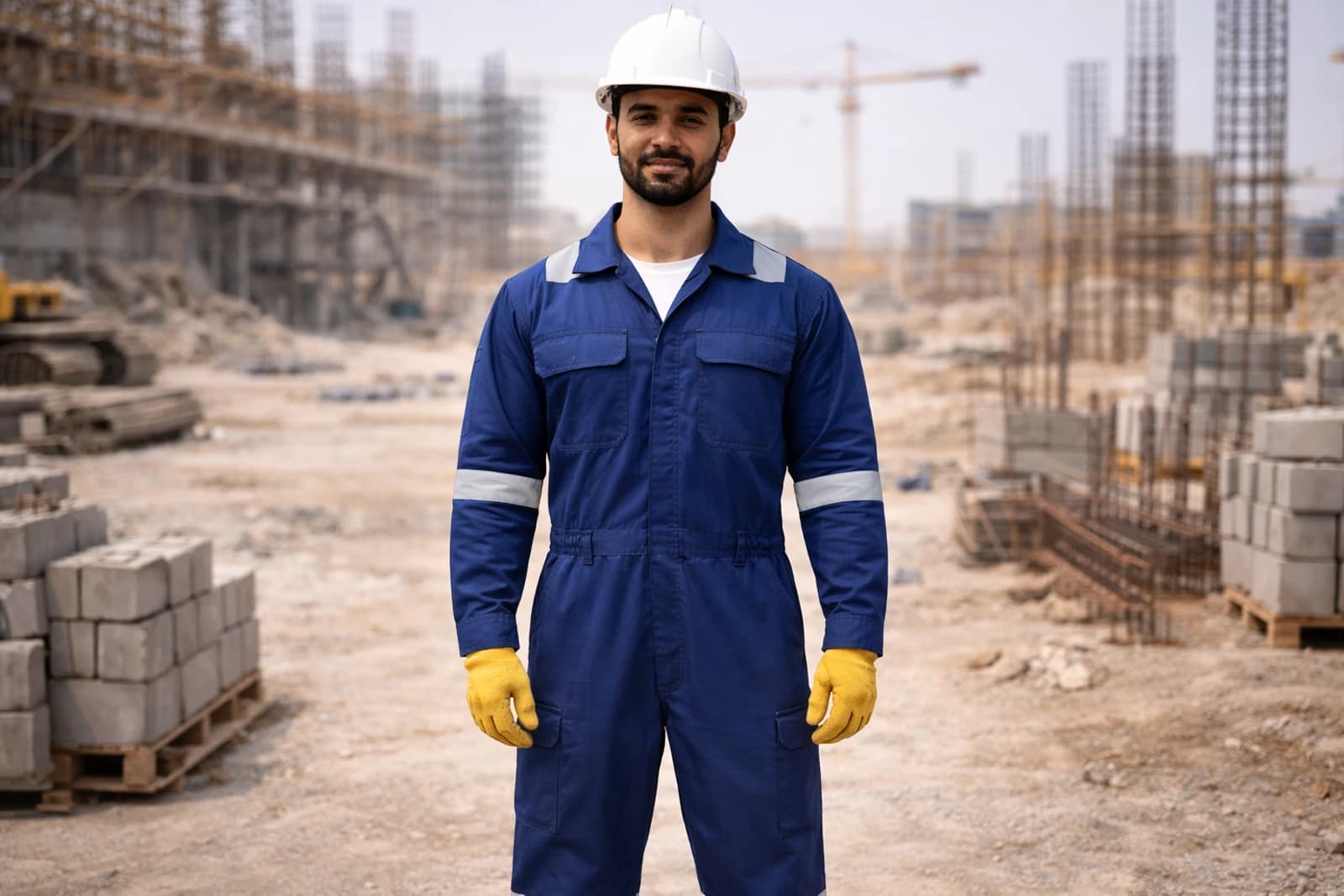
Industrial Workwear
Industrial Coverall Pro
Hard-wearing one-piece coverall for plant, maintenance, and heavy-duty operations.